JEE Main 2021 — Organic Chemistry
Chemistry Organic Chemistry questions from JEE Main 2021.
Other Years
237 Organic Chemistry Questions from 2021
A reaction of benzonitrile with one equivalent ${\mathrm{CH}}_{3}\mathrm{MgBr}$ followed by hydrolysis produces a yellow liquid "P". The compound "P" will give positive ________
The major product of the following reaction is : 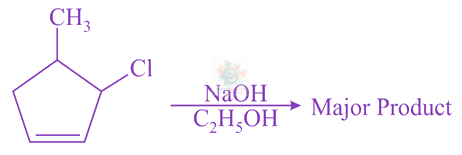
Which of the following compounds will show optical isomerism?
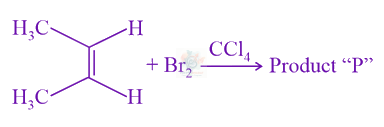 Consider the above chemical reaction. The total number of stereoisomers possible for Product "P" is _________
An organic compound '$A$' ${C}_{4}{H}_{8}$on treatment with ${\mathrm{KMnO}}_{4}/{H}^{+}$ yields compound '$B$' ${C}_{3}{H}_{6}O$. Compound '$A$' also yields compound '$B$' an ozonolysis. Compound '$A$' is :
The total number of negative charge in the tetrapeptide, Gly-Glu-Asp-Tyr, at $\mathrm{pH}12.5$ will be_______ (Integer answer)
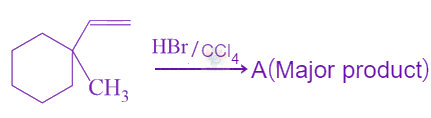
Match List$-I$ with List$-\mathrm{II}:$ <table class="pyq-table"><tbody><tr><td></td><td>List$-I$ (Chemicals)</td><td></td><td>List$-\mathrm{II}$ (Use / Preparation / Constituent)</td></tr><tr><td>(a)</td><td>Alcoholic potassium hydroxide</td><td>(i)</td><td>Electrodes in batteries</td></tr><tr><td>(b)</td><td>$\mathrm{Pd}/{\mathrm{BaSO}}_{4}$</td><td>(ii)</td><td>Obtained by addition reaction</td></tr><tr><td>(c)</td><td>$\mathrm{BHC}$ (Benzene hexachloride)</td><td>(iii)</td><td>Used for $\beta -$elimination reaction</td></tr><tr><td>(d)</td><td>Polyacetylene</td><td>(iv)</td><td>Lindlar's catalyst</td></tr></tbody></table>Choose the most appropriate match
Consider the following chemical reaction. $\mathrm{CH}\equiv \mathrm{CH}\frac{1)\mathrm{Red}\mathrm{hot}\mathrm{Fe}\mathrm{tube},873K}{2)\mathrm{CO},\mathrm{HCl},{\mathrm{AlCl}}_{3}}>\mathrm{Product}$ The number of ${\mathrm{sp}}^{2}$ hybridized carbon atom(s) present in the product is
Assertion A : Enol form of acetone $[{\mathrm{CH}}_{3}{\mathrm{COCH}}_{3}]$ exists in $<0.1%$ quantity. However, the enol form of acetyl acetone $[{\mathrm{CH}}_{3}{\mathrm{COCH}}_{2}{\mathrm{OCCH}}_{3}]$ exists in approximately $15%$quantity. Reason R : enol form of acetyl acetone is stabilized by intramolecular hydrogen bonding, which is not possible in enol form of acetone. Choose the correct statement:
The major products formed in the following reaction sequence $A$ and $B$ are: 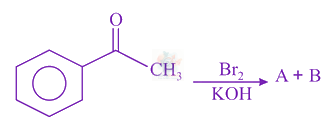
In Carius method, halogen containing organic compound is heated with fuming nitric acid in the presence of:
The number of acyclic structural isomers (including geometrical isomers) for pentene are
What is the major product "P" of the following reaction ? 
Which one of the following gives the most stable Diazonium salt ?
The structure of product $C,$ formed by the following sequence of reactions is : ${\mathrm{CH}}_{3}\mathrm{COOH}+{\mathrm{SOCl}}_{2}\longrightarrow A\rightarrow _{{\mathrm{AlCl}}_{3}}^{\mathrm{Benzene}}\longrightarrow B\rightarrow _{-\mathrm{OH}}^{\mathrm{KCN}}\longrightarrow C$
Out of the following, which type of interaction is responsible for the stabilisation of $\alpha -$helix structure of proteins?
In the following molecules, 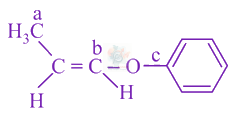 Hybridisation of carbon $a,b$ and $c$ respectively are :
Which one of the following compounds contains $\beta -{C}_{1}-{C}_{4}$ glycosidic linkage ?
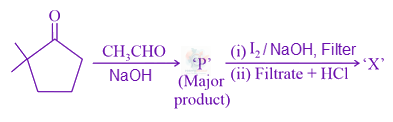
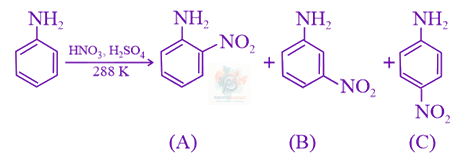 Consider the given reaction, percentage yield of :
The total number of reagents from those given below, that can convert nitrobenzene into aniline is __________ . (Integer answer) I. $\mathrm{Sn}-\mathrm{HCl}$ II. $\mathrm{Sn}-{\mathrm{NH}}_{4}\mathrm{OH}$ III. $\mathrm{Fe}-\mathrm{HCl}$ IV. $\mathrm{Zn}-\mathrm{HCl}$ V. ${H}_{2}-\mathrm{Pd}$ VI. ${H}_{2}-$ Raney Nickel
Identify the incorrect statement from the following.
Given below are two statements: Statement $I$: A mixture of chloroform and aniline can be separated by simple distillation. Statement $\mathrm{II}$: When separating aniline from a mixture of aniline and water by steam distillation aniline boils below its boiling point. In the light of the above statements, choose the most appropriate answer from the options given below:
The structure of the starting compound $P$ used in the reaction given below is: 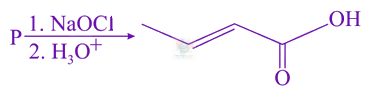
The total number of amines among the following which can be synthesized by Gabriel synthesis is ________.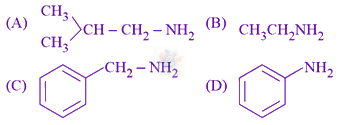
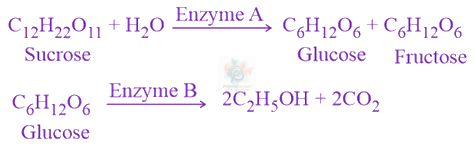 In the above reactions, the enzyme $A$ and enzyme B respectively are :-
The stereoisomers that are formed by electrophilic addition of bromine to $\mathrm{trans}-\mathrm{but}-2-\mathrm{ene}$ is/are :
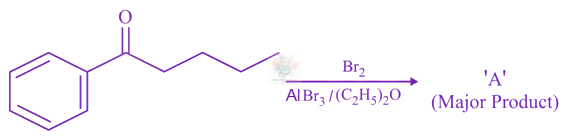 Consider the given reaction, the Product $A$ is:
Which of the following is not a correct statement for primary aliphatic amines?
The transformation occurring in Duma's method is given below ${C}_{2}{H}_{7}N+(2x+\frac{y}{2})\mathrm{CuO}\rightarrow {\mathrm{xCO}}_{2}+\frac{y}{2}{H}_{2}O+\frac{z}{2}{N}_{2}+(2x+\frac{y}{2})\mathrm{Cu}$ The value of $y$ is (Integer answer)
Which one of the following compounds is not aromatic?
When $10\mathrm{mL}$ of an aqueous solution of ${\mathrm{KMnO}}_{4}$ was titrated in acidic medium, equal volume of $0.1M$ of an aqueous solution of ferrous sulphate was required for complete discharge of colour. The strength of ${\mathrm{KMnO}}_{4}$ in grams per litre is _______$\times {10}^{-2}.$ (Nearest integer) [Atomic mass of $K=39,\mathrm{Mn}=55,O=16$]
Which of the following compounds does not exhibit resonance ?
Which of the following molecules does not show stereo isomerism ?
The correct pair(s) of the ambident nucleophiles is (are): (A) $\mathrm{AgCN}/\mathrm{KCN}$ (B) $\mathrm{RCOOAg}/\mathrm{RCOOK}$ (C) ${\mathrm{AgNO}}_{2}/{\mathrm{KNO}}_{2}$ (D) $\mathrm{AgI}/\mathrm{KI}$
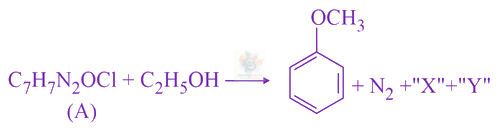 In the above reaction, the structural formula of (A), "X" and "Y" respectively are :
Among the following, the aromatic compounds are : 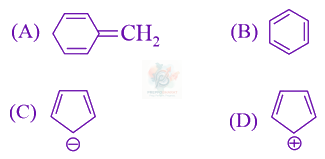 Choose the correct answer from the following options :
Identify $A$ in the given chemical reaction. 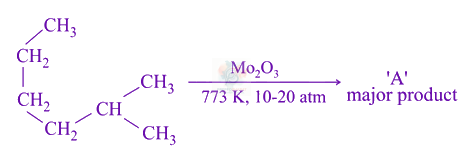
Compound(s) which will liberate carbon dioxide with sodium bicarbonate solution is/are : 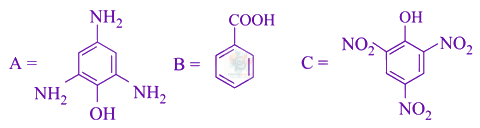
The correct structures of A and B formed in the following reactions are : 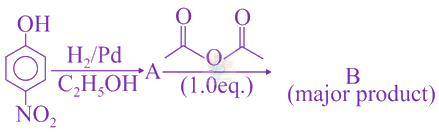
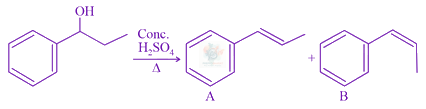 consider the above reaction, and choose the correct statement:
 Major product P of above reaction, is:
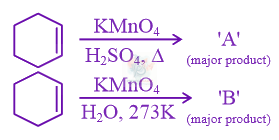 For above chemical reactions, identify the correct statement from the following:
When $0.15g$ of an organic compound was analyzed using Carius method for estimation of bromine, $0.2397g$ of $\mathrm{AgBr}$ was obtained. The percentage of bromine in the organic compound is _________.(Nearest integer) [Atomic mass : Silver $=108,$ Bromine $=80$]
Which one of the following compounds is non-aromatic?
Choose the correct statement regarding the formation of carbocations A and B given :- 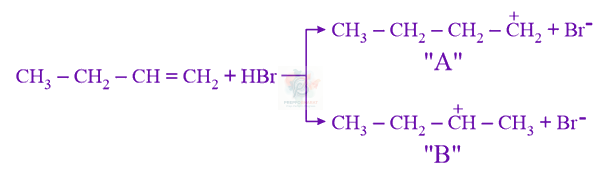
$0.8g$ of an organic compound was analysed by Kjeldahl's method for the estimation of nitrogen. If the percentage of nitrogen in the compound was found to be $42%$, then....... $\mathrm{mL}$ of $1M$ ${H}_{2}{\mathrm{SO}}_{4}$ would have been neutralized by the ammonia evolved during the analysis.
The correct order of the following compounds showing increasing tendency towards nucleophilic substitution reaction is: 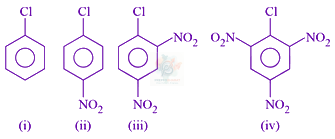
Which among the following pairs of Vitamins is stored in our body relatively for longer duration?
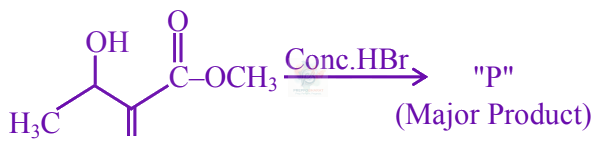 Consider the above reaction, the major product $P$ formed is :-
 Consider the given reaction, Identify ${X'}^{'}$ and ${Y'}^{'}$ :
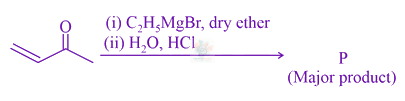 Consider the above reaction, the major product '$P$' is:
A reaction of 0.1 mole of Benzylamine with bromomethane gave $23g$ of Benzyl trimethyl ammonium bromide. The number of moles of bromomethane consumed in this reaction are $n\times {10}^{-1},$ when $n=$_____ (Round off to the Nearest Integer). $(\text{Given : Atomic masses}:C:12.0u,H:1.0u,N:14.0u,\mathrm{Br}:80.0u)$
Hydrolysis of sucrose gives:
The correct order of acid character of the following compounds is :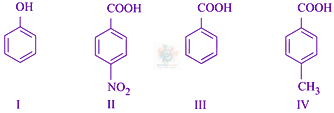
Mesityl oxide is a common name of:
For the given reaction:  What is $A$?
Main Products formed during a reaction of $1$-methoxy naphthalene with hydroiodic acid are:
Carbylamine test is used to detect the presence of primary amino group in an organic compound. Which of the following compound is formed when this test is performed with aniline?
Identify $A$ in the following reaction. 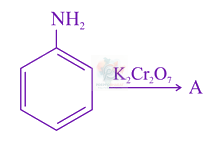
Staggered and eclipsed conformers of ethane are:
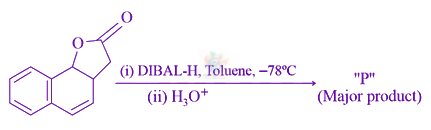 The product "$P$" in the above reaction is :
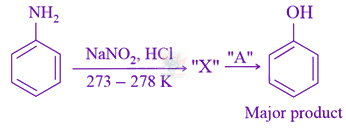 In the above chemical reaction, intermediate "$X$" and reagent/condition "$A$" are :
Primary, secondary and tertiary amines can be separated using:
In the following reaction, the reason why meta-nitro product also formed is: 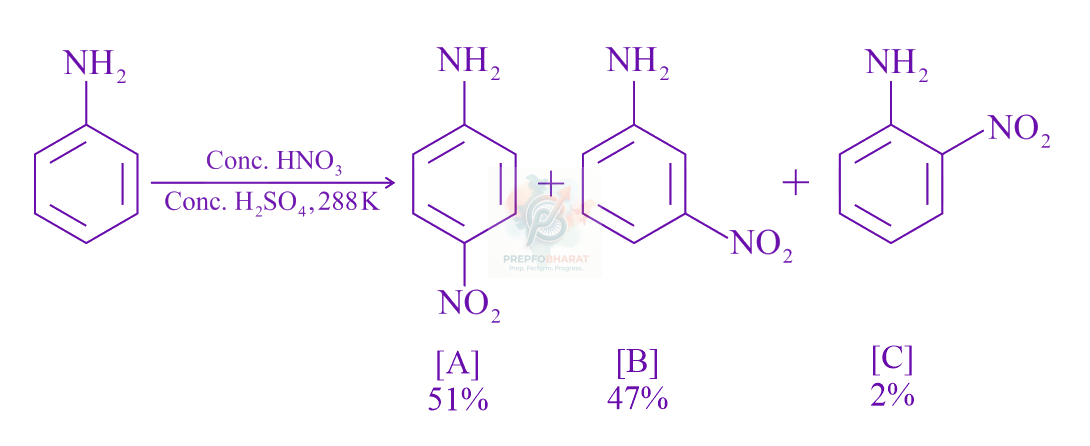
The correct structure of Ruhemann's Purple, the compound formed in the reaction of Ninhydrin with proteins is:
A non-reducing sugar $A$ hydrolyses to give two reducing mono saccharides. Sugar $A$ is
The major products $A$ and $B$ in the following set of reactions are: 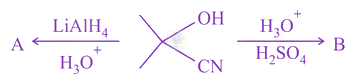
In the given reaction $3-$Bromo$-2,2-$dimethyl butane $\overset{{C}_{2}{H}_{5}\mathrm{OH}}{\longrightarrow }\underset{\text{(Major Product)}}{'A'}$ Product $A$ is:
Which one of the following pairs of isomers is an example of metamerism?
In the following sequence of reactions, the final product $D$ is: 
Identify $A$ in the given chemical reaction. 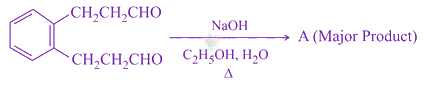
In Tollen's test for aldehyde, the overall number of electron(s) transferred to the Tollen's reagent formula ${[\mathrm{Ag}{({\mathrm{NH}}_{3})}_{2}]}^{+}$ per aldehyde group to form silver mirror is ___.(Round off to the Nearest integer)
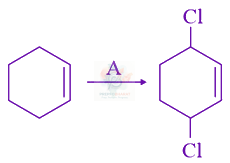 Identify the reagent(s) '$A$' and condition(s) for the reaction :
Which one of the following reactions does not occur ?
Benzene reacts with chlorine in the presence of FeCl₃ to give:
What is the final product (major) '$A$' in the given reaction? 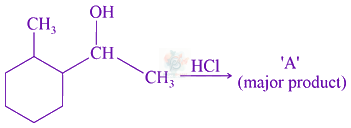 Major product among the following is?
Which of the following compound gives pink colour on reaction with phthalic anhydride in conc. ${H}_{2}{\mathrm{SO}}_{4}$ followed by treatment with $\mathrm{NaOH}$?
Given below are two statements: Statement-I: Retardation factor $({R}_{f})$ can be measured in meter/centimetre. Statement-II: ${R}_{f}$ value of a compound remains constant in all solvents. Choose the most appropriate answer from the options given below:
Which one of the following tests used for the identification of functional groups in organic compounds does not use copper reagent?
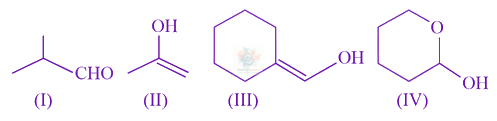 Which among the above compound/s does/do not form Silver mirror when treated with Tollen's reagent?
Match List - I with List - II.<table class="pyq-table"><tbody><tr><td colspan="2" rowspan="1">List-I (Salt)</td><td colspan="2" rowspan="1">List-II (Flame colour wavelength)</td></tr><tr><td>(a)</td><td><img src="https://prepforbharat.s3.ap-south-1.amazonaws.com/exam/615f0e999476412f48314daf/Chemistry/images/Amines/648b5a6a417cc3fb48d67218/question_1__q_648b5a6a417cc3fb48d67218__cdn-question-pool.getmarks.app__0217e565-ca29-4400-90db-6846af03ed46-image__778a74b7a7_final_ppt_sync.png" alt="JEE Main 2021 Chemistry, Amines — question figure 1"></td><td>(i)</td><td>${\mathrm{Br}}_{2}/\mathrm{NaOH}$</td></tr><tr><td>(b)</td><td><img src="https://prepforbharat.s3.ap-south-1.amazonaws.com/exam/615f0e999476412f48314daf/Chemistry/images/Amines/648b5a6a417cc3fb48d67218/question_2__q_648b5a6a417cc3fb48d67218__cdn-question-pool.getmarks.app__08d4de91-2a2f-4c10-8e2b-200519a02c8b-image__ec4150aca5_final_ppt_sync.png" alt="JEE Main 2021 Chemistry, Amines — question figure 2"></td><td>(ii)</td><td>${H}_{2}/\mathrm{Pd}-{\mathrm{BaSO}}_{4}$</td></tr><tr><td>(c)</td><td><img src="https://prepforbharat.s3.ap-south-1.amazonaws.com/exam/615f0e999476412f48314daf/Chemistry/images/Amines/648b5a6a417cc3fb48d67218/question_3__q_648b5a6a417cc3fb48d67218__cdn-question-pool.getmarks.app__10dcf030-7b0a-4369-bcd3-ee2434bc9ebb-image__01f6a5e148_final_ppt_sync.png" alt="JEE Main 2021 Chemistry, Amines — question figure 3"></td><td>(iii)</td><td>$\mathrm{Zn}(\mathrm{Hg})/\mathrm{Conc}.\mathrm{HCl}$</td></tr><tr><td>(d)</td><td><img src="https://prepforbharat.s3.ap-south-1.amazonaws.com/exam/615f0e999476412f48314daf/Chemistry/images/Amines/648b5a6a417cc3fb48d67218/question_4__q_648b5a6a417cc3fb48d67218__cdn-question-pool.getmarks.app__fa1d2e93-87f7-4d63-915a-fd4ebb2a7ff9-image__1a5db1416e_final_ppt_sync.png" alt="JEE Main 2021 Chemistry, Amines — question figure 4"></td><td>(iv)</td><td>${\mathrm{Cl}}_{2}/\mathrm{Red}P,{H}_{2}O$</td></tr></tbody></table>Choose the correct answer from the options given below:
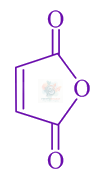 Maleic anhydride Maleic anhydride can be prepared by :
Given below are two statements : one is labelled as Assertion (A) and the other is labelled as Reason (R). Assertion (A) : Sucrose is a disaccharide and a non-reducing sugar. Reason (R): Sucrose involves glycosidic linkage between ${C}_{1}$ of $\beta$-glucose and ${C}_{2}$ of $\alpha$-fructose. Choose the most appropriate answer from the options given below :
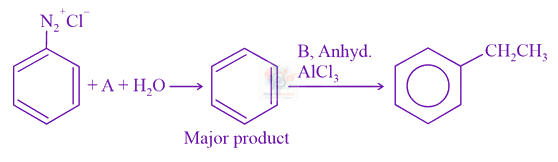 In the chemical reactions given above $A$ and $B$ respectively are :
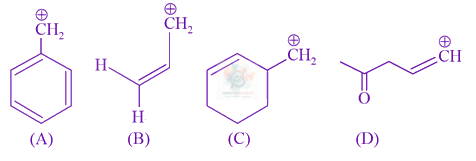 Among the given species the Resonance stabilised carbocations are:
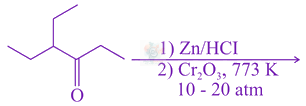 Considering the above reaction, the major product among the following is:
Match List - I with List - II :<table class="pyq-table"><tbody><tr><td></td><td>List - I (Metal ion)</td><td></td><td>List - II (Group in Qualitative analysis)</td></tr><tr><td>(a)</td><td>${\mathrm{Mn}}^{2+}$</td><td>(i)</td><td>Group - III</td></tr><tr><td>(b)</td><td>${\mathrm{As}}^{3+}$</td><td>(ii)</td><td>Group - IIA</td></tr><tr><td>(c)</td><td>${\mathrm{Cu}}^{2+}$</td><td>(iii)</td><td>Group - IV</td></tr><tr><td>(d)</td><td>${\mathrm{Al}}^{3+}$</td><td>(iv)</td><td>Group - IIB</td></tr></tbody></table>Choose the most appropriate answer from the options given below :
The dihedral angle in staggered form of Newmann's projection of$1,1,1$-Trichloro ethane is $\ldots \ldots \ldots$degree. (Round off to the nearest integer) (Round off to the nearest integer)
Which of the following is correct structure of $\alpha$-anomer of maltose?
Given below are two statements : one is labelled as Assertion (A) and the other is labelled as Reason (R). Assertion (A) : Synthesis of ethyl phenyl ether may be achieved by Williamson synthesis. Reason (R): Reaction of bromobenzene with sodium ethoxide yields ethyl phenyl ether. In the light of the above statements, choose the most appropriate answer from the options given below.
Which purification technique is used for high boiling organic liquid compound (decomposes near its boiling point) ?
Given below are two statements : one is labelled as Assertion (A) and the other is labelled as Reason (R). Assertion (A) : Aluminium is extracted from bauxite by the electrolysis of molten mixture of ${\mathrm{Al}}_{2}{O}_{3}$ with cryolite. Reason (R) : The oxidation state of $\mathrm{Al}$ in cryolite is $+3.$ In the light of the above statements, choose the most appropriate answer from the options given below :
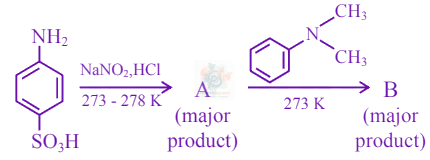 Consider the above reaction, compound B is:
For the following sequence of reactions, the correct products are : 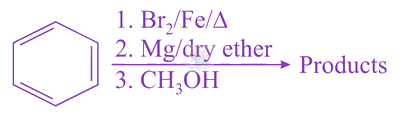
What is the major product formed by $\mathrm{HI}$ on reaction with 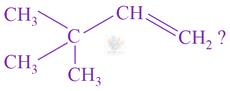
Given below are two statements, one is labelled as Assertion (A) and other is labelled as Reason (R). Assertion (R) : Gabriel phthalimide synthesis cannot be used to prepare aromatic primary amines. Reason : Aryl halides do not undergo nucleophilic substitution reaction. In the light of the above statements, choose the correct answer from the options given below:
The major product of the following reaction, if it occurs by ${S}_{N}2$ mechanism is : 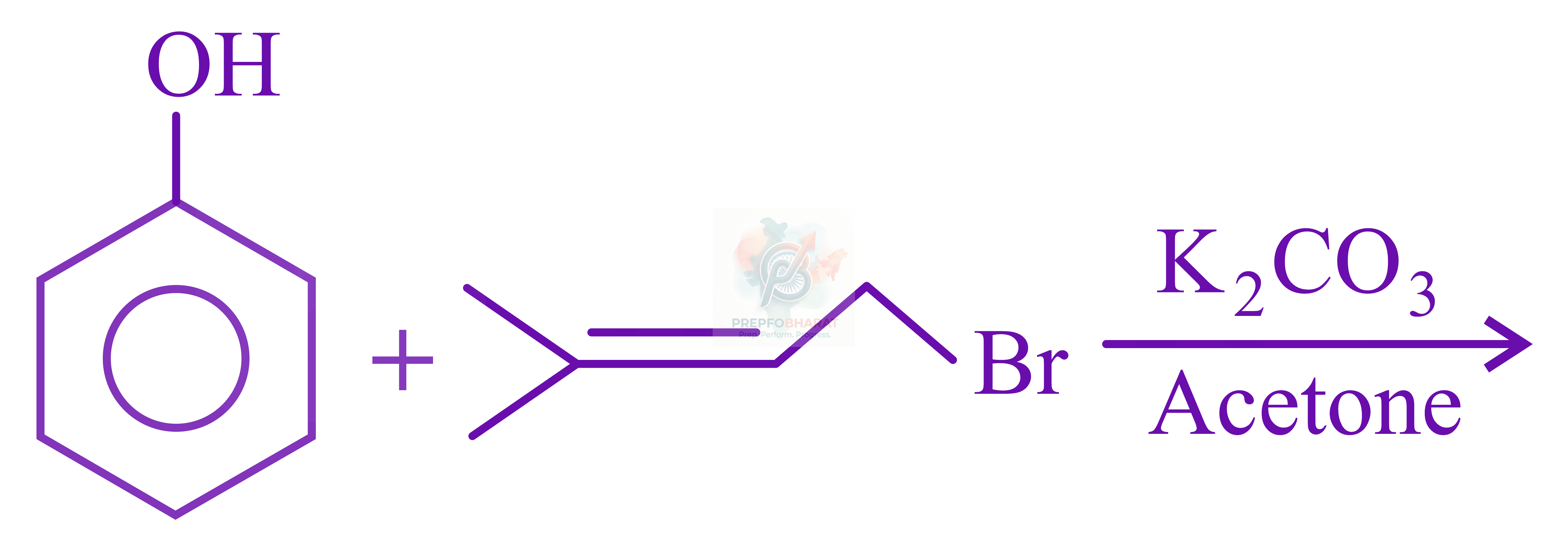
Given below are two statements : Statement I : The process of producing syn-gas is called gasification of coal. Statement II : The composition of syn-gas is $\mathrm{CO}+{\mathrm{CO}}_{2}+{H}_{2}(1:1:1).$ In the light of the above statements, choose the most appropriate answer from the options given below :
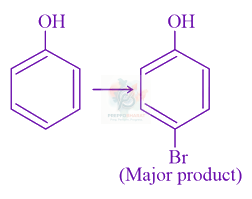 The given reaction can occur in the presence of : (a) Bromine water (b) ${\mathrm{Br}}_{2}$ in ${\mathrm{CS}}_{2},273K$ (c) ${\mathrm{Br}}_{2}/{\mathrm{FeBr}}_{3}$ (d) ${\mathrm{Br}}_{2}$ in ${\mathrm{CHCl}}_{3},273K$ Choose the correct answer from the options given below:
To synthesise $1$ mole of $2-$methylpropan$-2-$ol from Ethylethanoate equivalents of ${\mathrm{CH}}_{3}\mathrm{MgBr}$ reagent will be required. (Integer value)
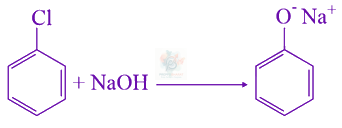 The above reaction requires which of the following reaction conditions?
Identify $A$ in the given reaction. 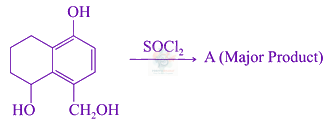
Identify the major products $A$ and $B$ respectively in the following reactions of phenol 
The major product (P) in the following reaction is: 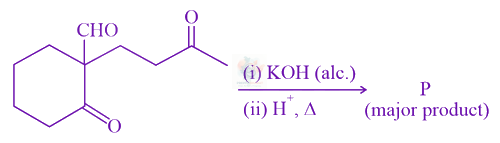
Identify $A$ in the following chemical reaction. 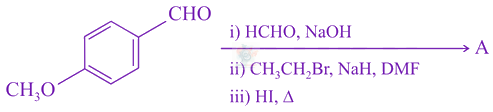
Which one of the following carbonyl compounds cannot be prepared by addition of water on an alkyne in the presence of ${\mathrm{HgSO}}_{4}$ and ${H}_{2}{\mathrm{SO}}_{4}?$
The major product of the following reaction is :${\mathrm{CH}}_{3}{\mathrm{CH}}_{2}\mathrm{CH}={\mathrm{CH}}_{2}\rightarrow _{\mathrm{Rh}\mathrm{catalyst}}^{{H}_{2}/\mathrm{CO}}$
In the following sequence of reactions a compound $A,$ (molecular formula ${C}_{6}{H}_{12}{O}_{2}$ ) with a straight chain structure gives a ${C}_{4}$ carboxylic acid. $A$ is : $A\frac{{\mathrm{LiAlH}}_{4}}{{H}_{3}{O}^{+}}B\overset{\text{ Oxidation }}{\longrightarrow }{C}_{4}-$ carboxylic acid
The major product formed in the following reaction is: 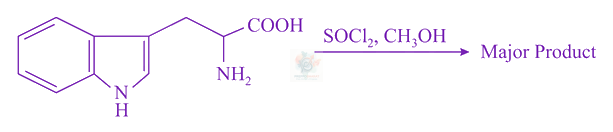
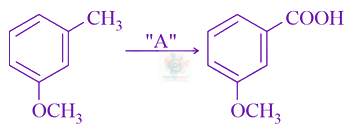 In the above reaction, the reagent "$A$" is :
Which one of the following compounds will liberate ${\mathrm{CO}}_{2}$, when treated with ${\mathrm{NaHCO}}_{3}?$
Which one of the products of the following reactions does not react with Hinsberg reagent to form sulphonamide?
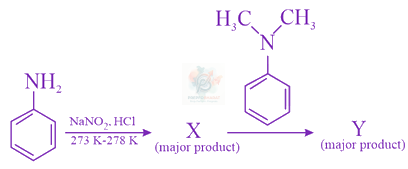 Considering the above reaction, $X$ and $Y$ respectively are:
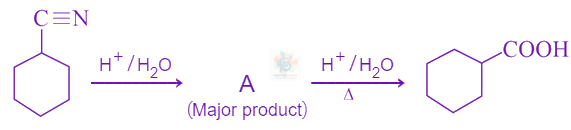 Consider the above chemical reaction and identify product $A$
Which of the following is least basic?
Which of the following reaction DOES NOT involve Hoffmann Bromamide degradation ?
Which of the following reagent is used for the following reaction? ${\mathrm{CH}}_{3}{\mathrm{CH}}_{2}{\mathrm{CH}}_{3}\overset{?}{\rightarrow }{\mathrm{CH}}_{3}{\mathrm{CH}}_{2}\mathrm{CHO}$
Out of following isomeric forms of uracil, which one is present in RNA?
Thiamine and pyridoxine are also known respectively as:
Fructose is an example of :-
Match List-$I$ with List-$\mathrm{II}$. <table class="pyq-table"><tbody><tr><td colspan="2" rowspan="1">List-$I$</td><td colspan="2" rowspan="1">List-$\mathrm{II}$</td></tr><tr><td>(a)</td><td>Sucrose</td><td>(i)</td><td>$\beta -D-$Galactose and $\beta -D-$Glucose</td></tr><tr><td>(b)</td><td>Lactose</td><td>(ii)</td><td>$\alpha -D-$Glucose and $\beta -D-$Fructose</td></tr><tr><td>(c)</td><td>Maltose</td><td>(iii)</td><td>$\alpha -D-$Glucose and $\alpha -D-$Glucose</td></tr></tbody></table>Choose the correct answer from the options given below:
Which of the following vitamin is helpful in the blood clotting?
Which of the following is an aromatic compound?
Which of the following reaction is an example of ammonolysis?
Which of the following is correct structure of tyrosine?
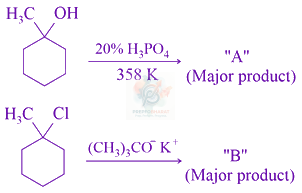 The product "$A$" and "$B$" formed in above reactions are
In $\overset{1}{C}{H}_{2}=\overset{2}{C}=\overset{3}{C}H-\overset{4}{C}{H}_{3}$ molecule, the hybridization of carbon $1,2,3$ and $4$ respectively, are :
Given below are two statements : $\mathrm{Statement}I:$ Aniline is less basic than acetamide. $\mathrm{Statement}\mathrm{II}:$ In aniline, the lone pair of electrons on nitrogen atom is delocalised over benzene ring due to resonance and hence less available to a proton. Choose the most appropriate option ;
The number of stereoisomers possible for $1,2$ -dimethyl cyclopropane is:
The number of sigma bonds in 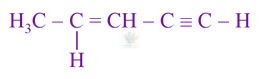 is _______.
The product formed in the first step of the reaction of 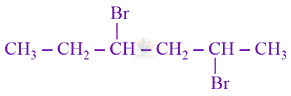with excess $\mathrm{Mg}/{\mathrm{Et}}_{2}O(\mathrm{Et}={C}_{2}{H}_{5})$ is
Which one of the following reactions will not yield propanoic acid?
Which one of the following reactions will not form acetaldehyde?
Identify products $A$ and $B.$ 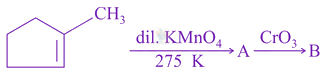
The secondary structure of protein is stabilised by:
In Duma's method of estimation of nitrogen, $0.1840g$ of an organic compound gave $30\mathrm{mL}$ of nitrogen collected at $287K$ and $758\mathrm{mm}$ of $\mathrm{Hg}$ pressure. The percentage composition of nitrogen in the compound is ______. (Round off to the Nearest Integer). [Given : Aqueous tension at $287K=14\mathrm{mm}$ of $\mathrm{Hg}$]
Identify $A$ and $B$ in the chemical reaction. 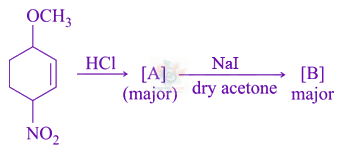
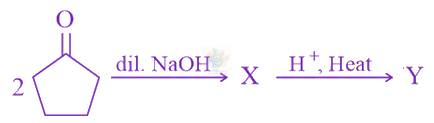 Consider the above reaction, the product $X$ and $Y$ respectively are :
The number of moles of $\mathrm{CuO},$ that will be utilized in Dumas method for estimating nitrogen in a sample of $57.5g$ of $N,N-$dimethylaminopentane is ________ $\times {10}^{-2}.$ (Nearest integer)
Arrange the following conformational isomers of n-butane in order of their increasing potential energy: 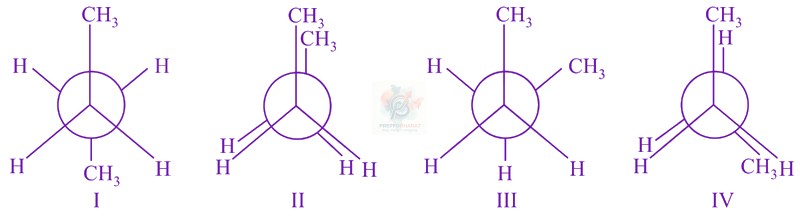
The correct order of reactivity of the given chlorides with acetate in acetic acid is :
In chromatography technique, the purification of a compound is independent of:
Given below are two statements : Statement I : ${C}_{2}{H}_{5}\mathrm{OH}$ and $\mathrm{AgCN}$ both can generate nucleophile. Statement II : $\mathrm{KCN}$ and $\mathrm{AgCN}$ both will generate nitrile nucleophile with all reaction conditions. Choose the most appropriate option :
Compound with molecular formula ${C}_{3}{H}_{6}O$ can show:
Which of the following compound is added to the sodium extract before addition of silver nitrate for testing of halogens?
$2,4-\mathrm{DNP}$ test can be used to identify :
Experimentally reducing a functional group cannot be done by which one of the following reagents ?
For the reaction given below : 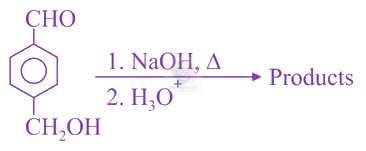 The compound which is not formed as a product in the reaction is a :
An organic compound is subjected to chlorination to get compound $A$ using $5.0g$ of chlorine. When $0.5g$ of compound $A$ is reacted with ${\mathrm{AgNO}}_{3}$ [Carius Method], the percentage of chlorine in compound $A$ is when it forms $0.3849g$ of $\mathrm{AgCl}.$ (Round off to the Nearest Integer) (Atomic masses of $\mathrm{Ag}$ and $\mathrm{Cl}$ are $107.87$ and $35.5$ respectively)
$R-\mathrm{CN}\frac{(i)\mathrm{DIBAL}-H}{(\mathrm{ii}){H}_{2}O}\longrightarrow R-Y$ Consider the above reaction and identify "Y"
An organic compound $A({C}_{6}{H}_{6}O)$ gives dark green colouration with ferric chloride. On treatment with ${\mathrm{CHCl}}_{3}$ and $\mathrm{KOH},$ followed by acidification gives compound $B.$ Compound $B$ can also be obtained from compound $C$ on reaction with pyridinium chlorochromate (PCC). Identify $A,B$ and $C.$
The correct decreasing order of densities of the following compounds is : 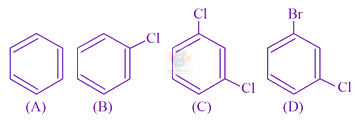
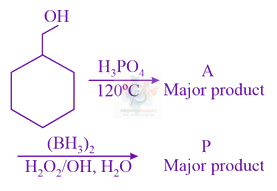 Consider the above reaction and identify the Product $P$ :
An amine on reaction with benzenesulphonyl chloride produces a compound insoluble in alkaline solution. This amine can be prepared by ammonolysis of ethyl chloride. The correct structure of amine is:
Which one of the following compounds is aromatic in nature?
 The product "A" in the above reaction is:
The potassium ferrocyanide solution gives a Prussian blue colour, when added to :
A. Phenyl methanamine B. $N,N$-Dimethylaniline C. $N$-Methyl aniline D. Benzenamine Choose the correct order of basic nature of the above amines.
What is $'X'$ in the given reaction? 
Which one of the following is correct structure for cytosine ?
The water soluble protein is:
Given below are two statements : Statement $I$ : The nucleophilic addition of sodium hydrogen sulphite to an aldehyde or a ketone involves proton transfer to form a stable ion. Statement $\mathrm{II}$ : The nucleophilic addition of hydrogen cyanide to an aldehyde or a ketone yields amine as final product. In the light of the above statements, choose the most appropriate answer from the options given below :
For the given reaction: 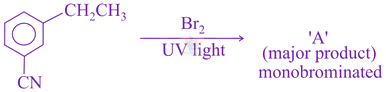 What is $A$?
The major products $A$ and $B$ formed in the following reaction sequence are : 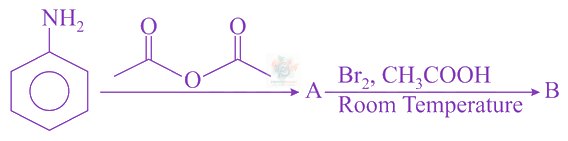
 Consider the given reaction, the product '$X$' is:
Given below are two statements: Statement-I : $2$ -methylbutane on oxidation with ${\mathrm{KMnO}}_{4}$ gives $2$ -methylbutan-$2$-ol. Statement-II : $n$ -alkanes can be easily oxidised to corresponding alcohol with ${\mathrm{KMnO}}_{4}$. Choose the correct option :
The correct sequence of reagents used in the preparation of $4$ -bromo-$2$-nitroethylbenzene from benzene is :
Which one among the following resonating structures is not correct?
Which among the following is the strongest acid?
Match List-$I$ with List-$\mathrm{II}$. <table class="pyq-table"><tbody><tr><td colspan="2" rowspan="1">List-$I$</td><td colspan="2" rowspan="1">List-$\mathrm{II}$</td></tr><tr><td>(a)</td><td><img src="https://prepforbharat.s3.ap-south-1.amazonaws.com/exam/615f0e999476412f48314daf/Chemistry/images/Haloalkanes_and_Haloarenes/648b5a6b417cc3fb48d674df/question_1__q_648b5a6b417cc3fb48d674df__cdn-question-pool.getmarks.app__d25a9af9-a4b5-4899-81c1-56eef1eec907-image__aee5241e95_final_ppt_sync.png" alt="JEE Main 2021 Chemistry, Haloalkanes and Haloarenes — question figure 1"></td><td>(i)</td><td>Wurtz reaction</td></tr><tr><td>(b)</td><td><img src="https://prepforbharat.s3.ap-south-1.amazonaws.com/exam/615f0e999476412f48314daf/Chemistry/images/Haloalkanes_and_Haloarenes/648b5a6b417cc3fb48d674df/question_2__q_648b5a6b417cc3fb48d674df__cdn-question-pool.getmarks.app__e8fe2604-80bb-4611-a19e-3d75e4eaad8e-image__2c706b28d9_final_ppt_sync.png" alt="JEE Main 2021 Chemistry, Haloalkanes and Haloarenes — question figure 2"></td><td>(ii)</td><td>Sandmeyer reaction</td></tr><tr><td>(c)</td><td>$2{\mathrm{CH}}_{3}{\mathrm{CH}}_{2}\mathrm{Cl}+2\mathrm{Na}\overset{\mathrm{Ether}}{\longrightarrow }{C}_{2}{H}_{5}-{C}_{2}{H}_{5}+2\mathrm{NaCl}$</td><td>(iii)</td><td>Fittig reaction</td></tr><tr><td>(d)</td><td>$2{C}_{6}{H}_{5}\mathrm{Cl}+2\mathrm{Na}\overset{\mathrm{Ether}}{\longrightarrow }{C}_{6}{H}_{5}-{C}_{6}{H}_{5}+2\mathrm{NaCl}$</td><td>(iv)</td><td>Gatterman reaction</td></tr></tbody></table>Choose the correct answer from the options given below:
Reaction of Grignard reagent, ${C}_{2}{H}_{5}\mathrm{MgBr}$ with ${C}_{8}{H}_{8}O$ followed by hydrolysis gives compound $A$, which reacts instantly with Lucas reagent to give compound $B({C}_{10}{H}_{13}\mathrm{Cl}).$ The Compound $B$ is:
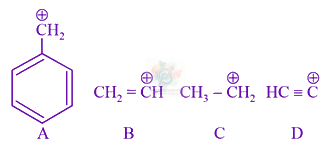 The correct order of stability of given carbocation is:
The correct sequential addition of reagents in the preparation of $3-$nitrobenzoic acid from benzene is:
A peptide synthesized by the reactions of one molecule each of Glycine, Leucine, Aspartic acid and Histidine will have _____ peptide linkages.
Benzene on nitration gives nitrobenzene in presence of ${\mathrm{HNO}}_{3}$ and ${H}_{2}{\mathrm{SO}}_{4}$ mixture, where:
Given below are two statements : Statement I : Hyperconjugation is a permanent effect. Statement II : Hyperconjugation in ethyl cation $({\mathrm{CH}}_{3}-\overset{+}{C}{H}_{2})$ involves the overlapping of ${C}_{{\mathrm{sp}}^{2}}-{H}_{1s}$ bond with empty $2p$ orbital of other carbon. Choose the correct option:
Which of the glycosidic linkage between galactose and glucose is present in lactose?
The number of compound/s given below which contain/s $-\mathrm{COOH}$ group is ___ . (Integer answer) (A) Sulphanilic acid (B) Picric acid (C) Aspirin (D) Ascorbic acid
The major product of the following chemical reaction is : 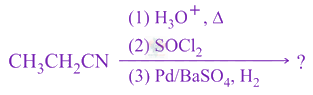
A chloro compound "A". (i) forms aldehydes on ozonolysis followed by the hydrolysis. (ii) when vaporized completely $1.53g$ of $A$, gives $448\mathrm{mL}$ of vapour at STP. The number of carbon atoms in a molecule of compound $A$ is
The major product of the following reaction is : 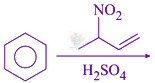
Reagent, $1-$naphthylamine and sulphanilic acid in acetic acid is used for the detection of
The major product formed in the following reaction is: 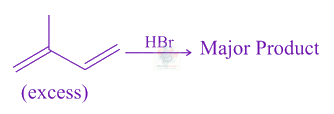
Which of the following is a FALSE statement?
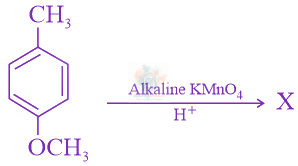 Considering the above chemical reaction, identify the product $X:$
Which of the following compounds will provide a tertiary alcohol on reaction with excess of ${\mathrm{CH}}_{3}\mathrm{MgBr}$ followed by hydrolysis ?
Among the following compounds $I-\mathrm{IV},$ which one forms a yellow precipitate on reacting sequentially with (i) $\mathrm{NaOH}$ (ii) dil. ${\mathrm{HNO}}_{3}$ (iii) ${\mathrm{AgNO}}_{3}?$ 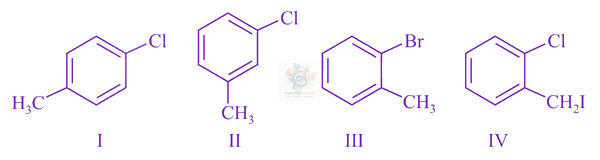
$\underset{({C}_{4}{H}_{8}{\mathrm{Cl}}_{2})}{A}\rightarrow _{373K}^{\mathrm{Hydrolysis}}\underset{({C}_{4}{H}_{8}O)}{B}$ $B$ reacts with Hydroxyl amine but does not give Tollen's test. Identify $A$ and $B$.
Match List - I with List - II. <table class="pyq-table"><tbody><tr><td></td><td>List - I (Chemical Reaction)</td><td></td><td>List - II (Reagent used)</td></tr><tr><td>a</td><td>${\mathrm{CH}}_{3}{\mathrm{COOCH}}_{2}{\mathrm{CH}}_{3}\rightarrow {\mathrm{CH}}_{3}{\mathrm{CH}}_{2}\mathrm{OH}$</td><td>i</td><td>${\mathrm{CH}}_{3}\mathrm{MgBr}/{H}_{3}{O}^{+}$ (one equivalent)</td></tr><tr><td>b</td><td>${\mathrm{CH}}_{3}{\mathrm{COOCH}}_{3}\rightarrow {\mathrm{CH}}_{3}\mathrm{CHO}$</td><td>ii</td><td>${H}_{2}{\mathrm{SO}}_{4}/{H}_{2}O$</td></tr><tr><td>c</td><td>${\mathrm{CH}}_{3}C\equiv N\rightarrow {\mathrm{CH}}_{3}\mathrm{CHO}$</td><td>iii</td><td>$\mathrm{DIBAL}-H/{H}_{2}O$</td></tr><tr><td>d</td><td><img src="https://prepforbharat.s3.ap-south-1.amazonaws.com/exam/615f0e999476412f48314daf/Chemistry/images/Carboxylic_Acid_Derivatives/648b5a6b417cc3fb48d6742a/question_1__q_648b5a6b417cc3fb48d6742a__cdn-question-pool.getmarks.app__ecb288d8-1f93-45c7-a4cf-d323dfa28a37-image__22aa15a4d6_final_ppt_sync.png" alt="JEE Main 2021 Chemistry, Carboxylic Acid Derivatives — question figure"></td><td>iv</td><td>${\mathrm{SnCl}}_{2},\mathrm{HCl}/{H}_{2}O$</td></tr></tbody></table>Choose the most appropriate match.
The structures of $A$ and $B$ formed in the following reaction are : $[\mathrm{Ph}=-{C}_{6}{H}_{5}]$ 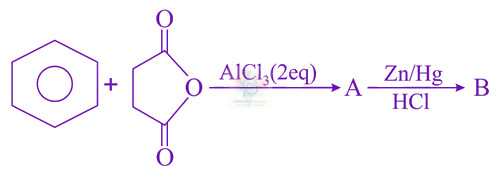
The number of nitrogen atoms in a semicarbazone molecule of acetone is_____
Hoffmann bromamide degradation of benzamide gives product $A,$ which upon heating with ${\mathrm{CHCl}}_{3}$ and $\mathrm{NaOH}$ gives product $B.$ The structures of $A$ and $B$ are:
Presence of which reagent will affect the reversibility of the following reaction, and change it to a irreversible reaction : $C{H}_{4}+{I}_{2}\rightleftharpoons _{\mathrm{Reversible}}^{\mathrm{hv}}{\mathrm{CH}}_{3}-I+\mathrm{HI}$
Which one of the following is the major product of the given reaction? 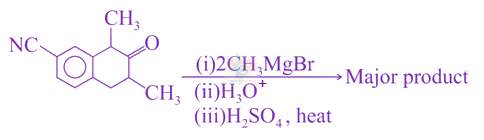
Which of the following is NOT an example of fibrous protein ?
Which one of the following compounds will give orange precipitate when treated with $2,4-$dinitrophenyl hydrazine ?
Choose the correct name for compound given below : 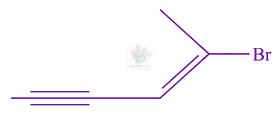
Given below are two statements : Statement I : Ethyl pent-$4$-yn-oate on reaction with ${\mathrm{CH}}_{3}\mathrm{MgBr}$ gives a $3^{\circ}$-alcohol. Statement II : In this reaction one mole of ethyl pent-$4$-yn-oate utilizes two moles of ${\mathrm{CH}}_{3}\mathrm{MgBr}$. In the light of the above statements, choose the most appropriate answer from the options given below :
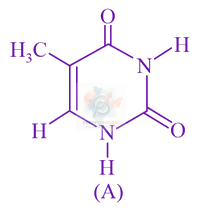 The compound $'A'$ is a complementary base of .......... in $\mathrm{DNA}$ strands.
In the following sequence of reactions, ${C}_{3}{H}_{6}\overset{{H}^{+}/{H}_{2}O}{\longrightarrow }A\frac{\mathrm{KIO}}{\mathrm{dilKOH}}B+C$. The compounds $B$ and $C$ respectively are :
Deficiency of vitamin K causes :
Using the provided information in the following paper chromatogram: 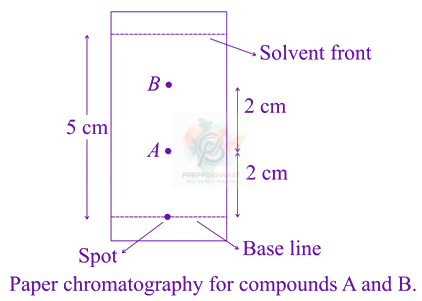 The calculated ${R}_{f}$ value of $A\mathrm{is}_____\times {10}^{-1}$.
Compound A gives D-Galactose and D-Glucose on hydrolysis. The compound A is :
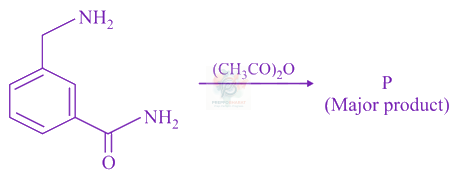 The Major Product in the above reaction is :
In the reaction of hypobromite with amide, the carbonyl carbon is lost as:
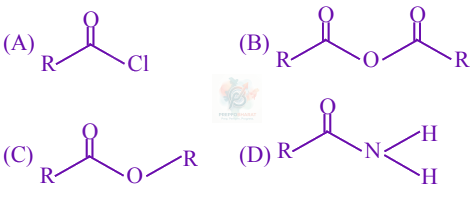 The correct order of their reactivity towards hydrolysis at room temperature is:
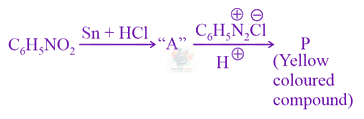 Consider the above reaction, the Product "P" is :
 Consider the above reaction sequence, Product "A" and Product "B" formed respectively are:
In the following sequence of reactions the $P$ is: 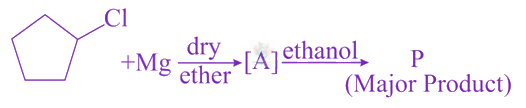
What is the correct sequence of reagents used for converting nitrobenzene into $m$-dibromobenzene?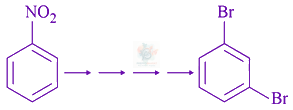
The major product (A) formed in the reaction given below is : 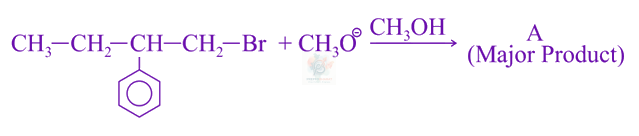
An organic compound $A$ on treatment with benzene sulfonyl chloride gives compound $B$. $B$ is soluble in dil. $\mathrm{NaOH}$ solution. Compound $A$ is :
Seliwanoff test and Xanthoproteic test are used for the identification of _ and _ respectively.
The diazonium salt of which of the following compounds will form a coloured dye on reaction with $\beta$-Naphthol in $\mathrm{NaOH}?$
An unsaturated hydrocarbon $X$ on ozonolysis gives $A$. Compound $A$ when warmed with ammoniacal silver nitrate forms a bright silver mirror along the sides of the test tube. The unsaturated hydrocarbon $X$ is :
Which one of the following set of elements can be detected using sodium fusion extract?
The total number of $C-C$ sigma bond/s in mesityl oxide $({C}_{6}{H}_{10}O)$ is (Round off to the Nearest Integer).
The correct sequence of correct reagents for the following transformation is :- 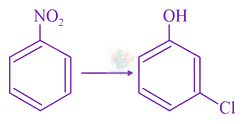
Ammonolysis of Alkyl halides followed by the treatment with $\mathrm{NaOH}$ solution can be used to prepare primary, secondary and tertiary amines. The purpose of $\mathrm{NaOH}$ in the reaction is.
Ceric ammonium nitrate and ${\mathrm{CHCl}}_{3}/\mathrm{alc}$. $\mathrm{KOH}$ are used for the identification of functional groups present in _ and _ respectively.
Which one of the following phenols does not give colour when condensed with phthalic anhydride in presence of conc. ${H}_{2}{\mathrm{SO}}_{4}$ ?
What is A in the following reaction? 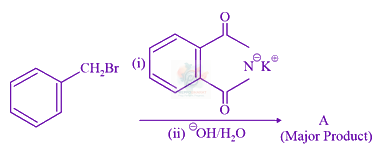
$A$ and $B$ in the following reactions are: 
Compound $A$ is converted to $B$ on reaction with ${\mathrm{CHCl}}_{3}$ and $\mathrm{KOH}$. The compound $B$ is toxic and can be decomposed by $C.A,B$ and $C$ respectively are:
Nitrogen can be estimated by Kjeldahl's method for which of the following compound?
The correct options for the products $A$ and $B$ of the following reactions are: 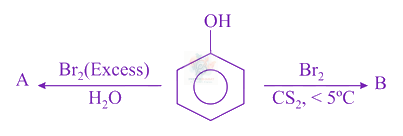
Identify correct $A,B$ and $C$ in the reaction sequence given below : 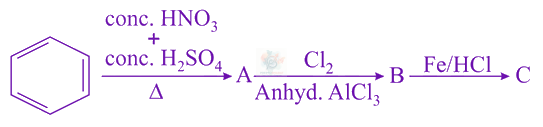
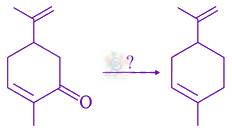 Which of the following reagent is suitable for the preparation of the product in the above reaction?
Which of the following reaction/s will not give $p$ -aminoazobenzene? 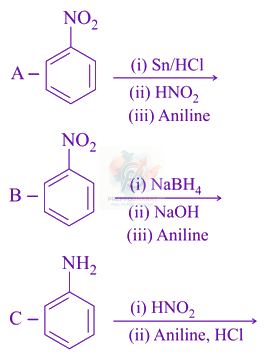
Which one among the following chemical tests is used to distinguish monosaccharide from disaccharide ?
The major product of the following reaction is: 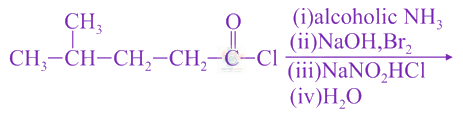
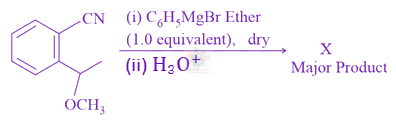 The structure of $X$ is:
Given below are two statements : one is labelled as Assertion (A) and the other is labelled as Assertion (A): A simple distillation can be used to separate a mixture of propanol and propanone. Reason (R): Two liquids with a difference of more than $20^{\circ}C$ in their boiling points can be separated by simple distillations. In the light of the above statements, choose the most appropriate answer from the options given below :
Excess of isobutane on reaction with ${\mathrm{Br}}_{2}$ in presence of light at $125^{\circ}C$ gives which one of the following, as the major product?
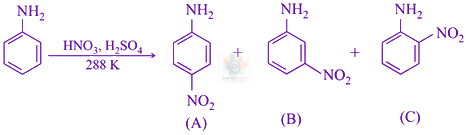 Correct statement about the given chemical reaction is
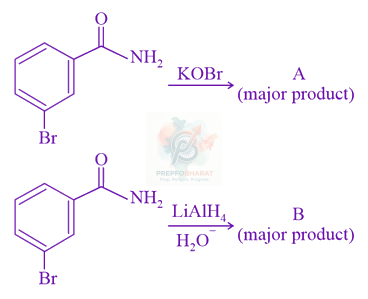 In the above reactions, product A and product B respectively are: