JEE Main 2020 — Organic Chemistry
Chemistry Organic Chemistry questions from JEE Main 2020.
Other Years
114 Organic Chemistry Questions from 2020
The product obtained when ethanol reacts with concentrated H₂SO₄ at 170°C is:
Which functional group is present in an ester?
A solution of phenol in chloroform when treated with aqueous $\mathrm{NaOH}$ gives compound $P$as a major product. The mass percentage of carbon in $P$ is ______ .
The number of chiral carbons present in sucrose is ……….
Consider the reaction sequence given below : 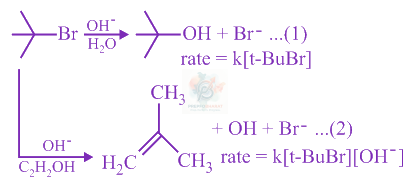 Which of the following statements is true:
The major product $[R]$ in the following sequence of reaction is : 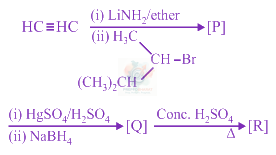
The increasing order of basicity for the following intermediates is (from weak to strong) 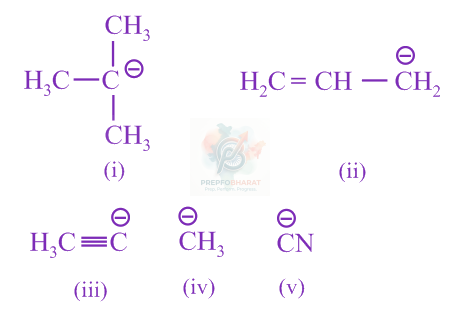
Kjeldahl’s method cannot be used to estimate nitrogen for which of the following compounds?
Which of the following statement is not true for glucose?
When neopentyl alcohol is heated with an acid, it slowly converted into an 85 : 15 mixture of alkenes A and B, respectively. What are these alkenes?
The increasing order of the acidity of the $\alpha$-hydrogen of the following compounds is:  $(A)(B)(C)(D)$
The major product of the following reaction is : 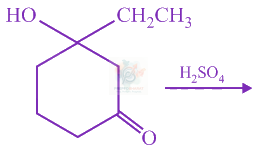
The total number of monohalogenated organic products in the following (including stereoisomers) reaction is $\underset{(\mathrm{Simplest}\mathrm{optically} \mathrm{active}\mathrm{alkene})}{A}\rightarrow _{(\mathrm{ii}){X}_{2}/\Delta }^{(i){H}_{2}/\mathrm{Ni}/\Delta }$
Consider the following reactions: 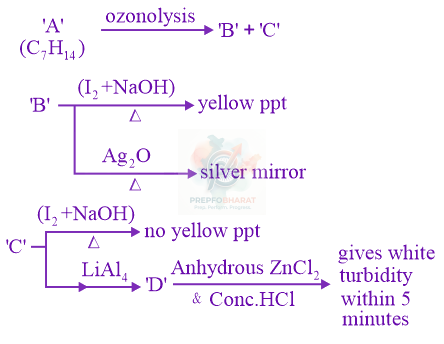 'A' is
What are the functional groups present in the structure of maltose?
Match the following : <table class="pyq-table"><tbody><tr><td></td><td>Test/Method</td><td></td><td>Reagent</td></tr><tr><td>(i)</td><td>Lucas Test</td><td>(a)</td><td>${C}_{6}{H}_{5}{\mathrm{SO}}_{2}\mathrm{Cl}/\mathrm{aq}.\mathrm{KOH}$</td></tr><tr><td>(ii)</td><td>Dumas method</td><td>(b)</td><td>${\mathrm{HNO}}_{3}/{\mathrm{AgNO}}_{3}$</td></tr><tr><td>(iii)</td><td>Kjeldahl's method</td><td>(c)</td><td>$\mathrm{CuO}/{\mathrm{CO}}_{3}$</td></tr><tr><td>(iv)</td><td>Hinsberg Test</td><td>(d)</td><td>Conc. $\mathrm{HCl}$ and ${\mathrm{ZnCl}}_{2}$</td></tr><tr><td></td><td></td><td>(e)</td><td>${H}_{2}{\mathrm{SO}}_{4}$</td></tr></tbody></table>
A chromatography column, packed with silica gel as stationary phase, was used to separate a mixture of compounds consisting of $(A)$ benzanilide $(B)$ aniline and $(C)$ acetophenone. When the column is eluted with a mixture of solvents, hexane:ethyl acetate $(20:80)$ , the sequence of obtained compounds is:
A solution of $m-$ chloroaniline, $m-$ chlorophenol and $m-$ chlorobenzoic acid in ethyl acetate was extracted initially with a saturated solution of $NaHC{O}_{3}$ to give fraction $A$ . The left over organic phase was extracted with dilute $NaOH$ solution to give fraction $B$ . The final organic layer was labelled as fraction $C$ . Fractions $A,B$ and $C,$ contain respectively:
The major product of the following reaction is: 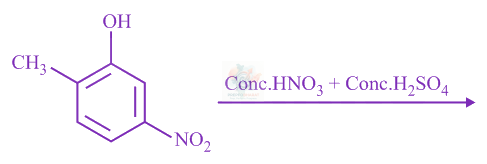
Consider the following plots of rate constant versus $\frac{1}{T}$ for four different reactions. Which of the following orders is correct for the activation energies of these reactions? 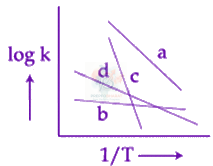
The major product formed in the following reaction is : ${\mathrm{CH}}_{2}\mathrm{CH}=\mathrm{CHCH}{({\mathrm{CH}}_{3})}_{2}\overset{\mathrm{HBr}}{\rightarrow }$
The major product obtained from the following reaction is : 
In an estimation of bromine by Carius method, $1.6g$ of an organic compound gave $1.88g$ of $\mathrm{AgBr}$. The mass percentage of bromine in the compound is $\ldots ..$ $($Atomic mass, $\mathrm{Ag}=108,\mathrm{Br}=80{\mathrm{gmol}}^{-1}$
In Carius method of estimation of halogen, $0.172g$ of an organic compound showed presence of $0.08g$ of bromine. Which of these is the correct structure of the compound ?
The IUPAC name of the following compound is: 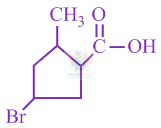
The major product obtained from ${E}_{2}$-elimination of $3-\mathrm{bromo}-2-\mathrm{fluoropentane}$ is
In the following reaction sequence, 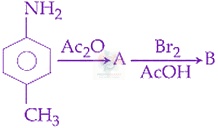 the major product $B$ is
Consider the following reaction: 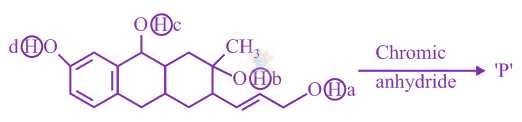 The product$'P'$gives positive ceric ammonium nitrate test. This is because of the presence of which of these$–\mathrm{OH}$ group(s)?
The correct order of heat of combustion for following alkadienes is: 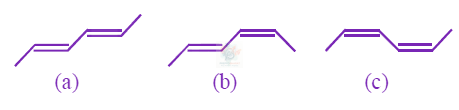
The major product of the following reaction is : 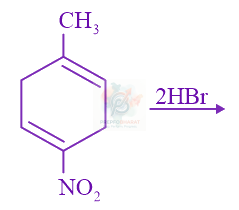
Which of the following will react with ${\mathrm{CHCl}}_{3}+\mathrm{alc}.\mathrm{KOH}$?
In the following sequence of reactions the maximum number of atoms present in molecule ‘ $C$ ’ in one plane is_______ $A\overset{Red hot}{\underset{Cu tube}{\rightarrow }}B\overset{C{H}_{3}Cl(1.eq)}{\underset{Anhydrous AlC{l}_{3}}{\rightarrow }}C$ (A is a lowest molecular weight alkyne)
Match the following :<table class="pyq-table"><tbody><tr><th>$(i)$</th><th>Riboflavin</th><th>$(a)$</th><th>Beriberi</th></tr><tr><td>$(ii)$</td><td>Thiamine</td><td>$(b)$</td><td>Scurvy</td></tr><tr><td>$(iii)$</td><td>Pyridoxine</td><td>$(c)$</td><td>Cheilosis</td></tr><tr><td>$(iv)$</td><td>Ascorbic acid</td><td>$(d)$</td><td>Convulsions</td></tr></tbody></table>
The Kjeldahl method of Nitrogen estimation fails for which of the following reaction products? 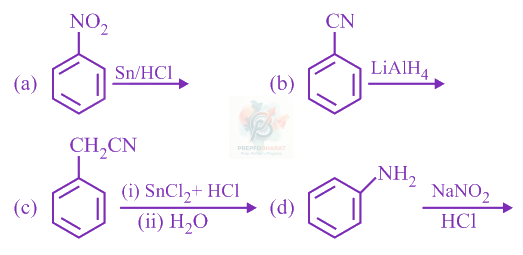
The number of chiral centres present in $[B]$ is _____ 
The number of chiral carbons present in the molecule given below is.............. 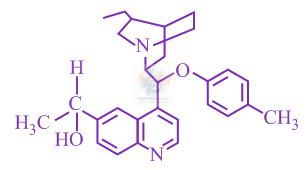
The major product $Z$ obtained in the following reaction scheme is: 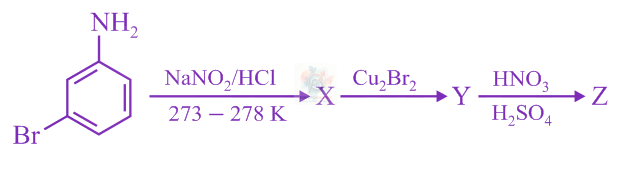
A flask contains a mixture of isohexane and $3$ -methylpentane. One of the liquids boils at ${63}^{o}C$ while the other boils at ${60}^{o}C.$ What is the best way to separate the two liquids and which one will be distilled out first?
Arrange the following labelled hydrogens in decreasing order of acidity: 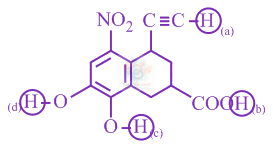
For the following reactions 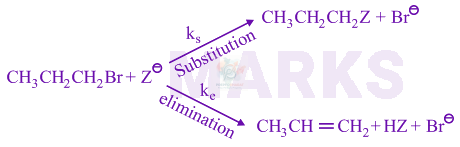 where, 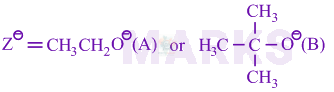 ${k}_{s}$ and ${k}_{e}$ , are respectively, the rate constants for substitution and elimination, and $\mu =\frac{{k}_{s}}{{k}_{e}}$ , the correct option is ________
The increasing order of $p{K}_{b}$ for the following compounds will be : 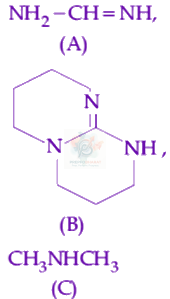
Which one of the following compounds possesses the most acidic hydrogen?
Consider the following reaction:  The product $'{X}^{'}$ is used:
Which of the following is not an essential amino acid?
The minimum number of moles of ${O}_{2}$ required for complete combustion of 1 mole of propane and 2 moles of butane is..............
The major aromatic product $C$ in the following reaction sequence will be : 
Which of the following compounds produces an optically inactive compound on hydrogenation?
The increasing order of the reactivity of the following compounds in nucleophile addition reaction is: Propanal, Benzaldehyde, Propanone, Butanone
Glycerol is separated in soap industries by :
The $\mathrm{IUPAC}$ name for the following compound is : 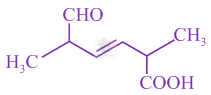
The major product $[B]$ in the following reaction is : 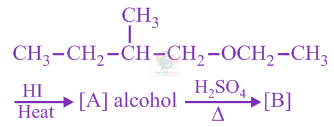
Which of the following statements is correct?
The number of  groups present in a tripeptide Asp – Glu – Lys is ____
In the following reaction sequence, structures of $A$ and $B$ are, respectively 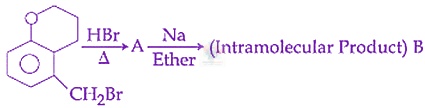
An organic compound (A) (molecular formula ${C}_{6}{H}_{12}{O}_{2}$) was hydrolysed with dil. ${H}_{2}{\mathrm{SO}}_{4}$ to give a carboxylic acid (B) and an alcohol (C). ‘$C$ ’ gives white turbidity immediately when treated with anhydrous ${\mathrm{ZnCl}}_{2}$ and conc. $\mathrm{HCl}$. The organic compound (A) is:
The major product of the following reaction is: 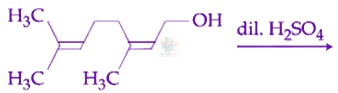
The compound A in the following reactions is: $A\rightarrow _{(\mathrm{ii})\mathrm{Conc}.{H}_{2}{\mathrm{SO}}_{4}/\Delta }^{(i){\mathrm{CH}}_{3}\mathrm{MgBr}/{H}_{2}O} B\rightarrow _{(\mathrm{ii})\mathrm{Zn}/{H}_{2}O}^{(i){O}_{3}}C+D$ 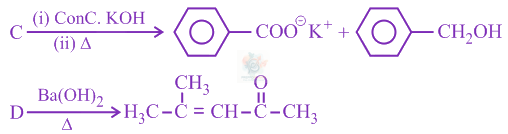
Which of the following derivatives of alcohols is unstable in an aqueous base?
$[P]$ on treatment with ${\mathrm{Br}}_{2}/{\mathrm{FeBr}}_{3}$ in ${\mathrm{CCl}}_{4}$ produced a single isomer ${C}_{8}{H}_{7}{O}_{2}\mathrm{Br}$ wile heating $[P]$ with sodalime gives toluene. The compound $[P]$ is:
The IUPAC name of following compound is : 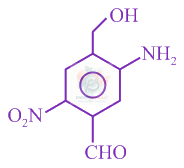
Which of the following compounds can be prepared in good yield by Gabriel phthalimide synthesis ?
In the following reaction sequence, $[C]$ is : 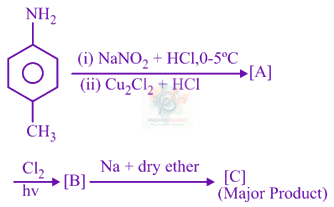
The major products $A$ and $B$ in the following reactions are 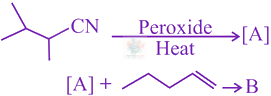
The number of chiral carbon(s) present in peptide, lle-Arg-Pro, is ................
Consider the following reactions : (i) Glucose $+\mathrm{ROH}\overset{\mathrm{dry} \mathrm{HCI}}{\rightarrow }\mathrm{Acetal} \rightarrow _{{({\mathrm{CH}}_{3}\mathrm{CO})}_{2}}^{x \mathrm{eq}. \mathrm{of}}$ acetyl derivative (ii) Glucose $\overset{\mathrm{Ni}/{H}_{2}}{\rightarrow }A\rightarrow _{{({\mathrm{CH}}_{3}\mathrm{CO})}_{2}O}^{y \mathrm{eq}. \mathrm{of}}$ acetyl derivative (iii) Glucose $\rightarrow _{{({\mathrm{CH}}_{3}\mathrm{CO})}_{2}O}^{z \mathrm{eq}. \mathrm{of}}$ acetyl derivative '$x$' , '$y$' and '$z$' in these reactions are respectively.
The major products of the following reaction are : 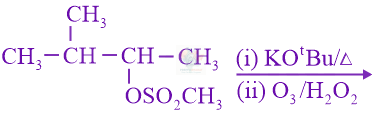
For the following Assertion and Reason, the correct option is: Assertion: For hydrogenation reactions, the catalytic activity increases from Group $5$ to Group $11$ metals with maximum activity shown by Group $7-9$ elements. Reason: The reactants are most strongly adsorbed on group $7-9$ elements.
Consider the following reactions, 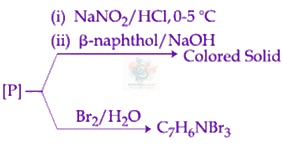 The compound $[P]$ is:
Among the following compounds, which one has the shortest $C–\mathrm{Cl}$ bond?
Which of the following reactions will not produce a racemic product ?
Which of the following compounds will show retention in configuration on nucleophile substitution by ${\mathrm{OH}}^{-}\mathrm{ion}$ ?
The decreasing order of reactivity of the following compounds towards nucleophilic substitution (${S}_{N}2$) is: 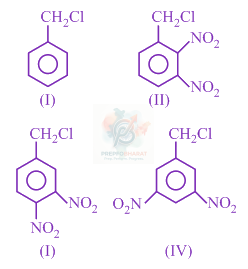
Arrange the following compounds in increasing order of $C-OH$ bond length: methanol, phenol, $p$ -ethoxyphenol
Which of the following has the shortest $C-Cl$ bond?
The correct order of stability for the following alkoxides is: 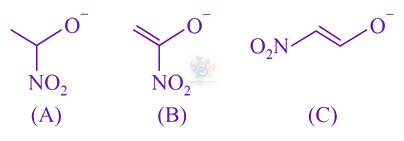
The major product in the following reaction is : 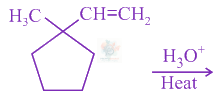
The most suitable reagent for the given conversion is: 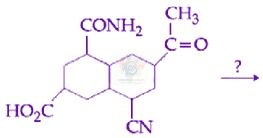 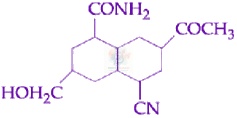
The increasing order of the boiling points of the major products $A,B$ and $C$ of the following reactions will be : (a) 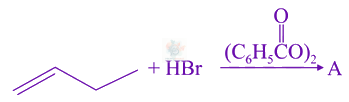 (b) 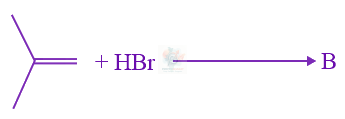 (c) 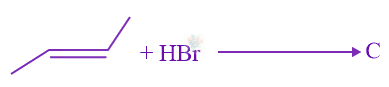
The correct observation in the following reaction is: $\mathrm{Sucrose}\rightarrow _{\mathrm{Cleavage}(\mathrm{Hydrolysis})}^{\mathrm{Gly}\mathrm{cosidic}\mathrm{bond}}A+B\rightarrow _{\mathrm{Reagent}}^{\mathrm{Seliw}\mathrm{anoff}}?$
An organic compound [A], molecular formula ${C}_{10}{H}_{20}{O}_{2}$ was hydrolyzed with dilute sulphuric acid to given a carboxylic acid [B] and an alcohol [C]. Oxidation of [C] with ${\mathrm{CrO}}_{3}-{H}_{2}{\mathrm{SO}}_{4}$ produced [B]. Which of the following structures are not possible for $[A]$
The increasing order of ${\mathrm{pK}}_{b}$ values of the following compounds is : 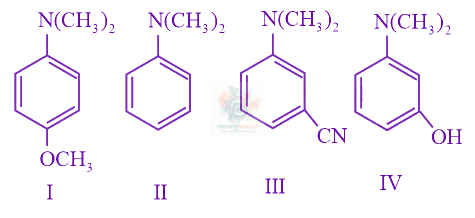
The increasing order of basicity of the following compounds is : 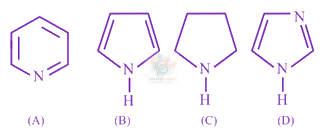
Which one of the following statement is not true?
The decreasing order of reactivity of the following organic molecules towards ${\mathrm{AgNO}}_{3}$ solution is: 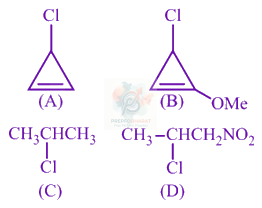
The final major product of the following reaction is : 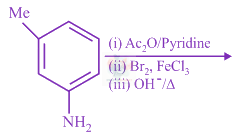
The increasing order of the following compounds towards $\mathrm{HCN}$ addition is : (i) 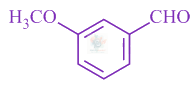 (ii) 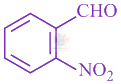 (iii)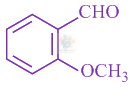(iv) 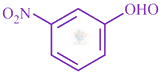
The major product in the following reaction is: 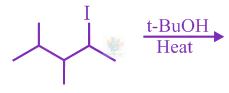
In the following reaction $A$ is 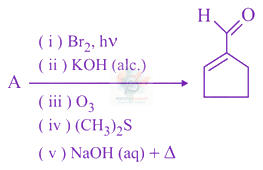
What is the product of following reaction? 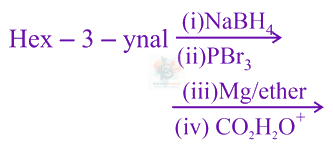 ?
The number of $s{p}^{2}$ hybrid orbitals in a molecule of benzene is:
The mechanism of Sn1 reaction is given as: $R-X\longrightarrow {R}^{\oplus }{X}^{\ominus }\longrightarrow {R}^{\oplus }\|{X}^{\ominus }\overset{{Y}^{\ominus }}{\longrightarrow }R-Y+{X}^{\ominus } \mathrm{lon}\mathrm{pair}\mathrm{Solvent} \mathrm{Speparated}\mathrm{ion} \mathrm{pair}$ A student writes general characteristics based on the given mechanism as : (a) The reaction is favoured by weak nucleophiles. (b) ${R}^{\oplus }$ would be easily formed if the substituents are bulky $y$ (c) The reaction is accompanied by recemization (d) The reaction is favoured by non-polar solvents. Which observations are correct?
Identify $(A)$ in the following reaction sequence: 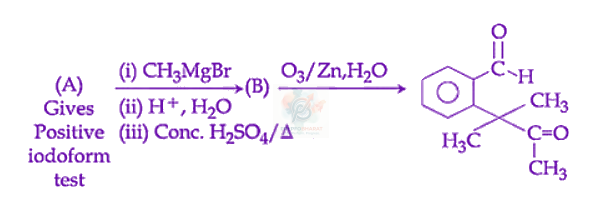
The decreasing order of basicity of the following amines is: 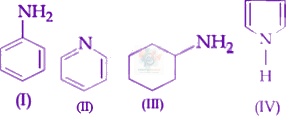
Consider the following reactions: $(a)$ ${(C{H}_{3})}_{3}CCH(OH)C{H}_{3}\overset{conc.{H}_{2}S{O}_{4}}{\rightarrow }$ $(b)$ ${(C{H}_{3})}_{2}CHCH(Br)C{H}_{3}\overset{alc.KOH}{\rightarrow }$ $(c)$ ${(C{H}_{3})}_{2}CHCH(Br)C{H}_{3}\overset{{(C{H}_{3})}_{3}{O}^{\ominus }{K}^{\oplus }}{\rightarrow }$ $(d)$ 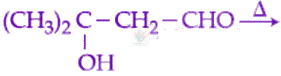 Which of the reaction(s) will not produce Saytzeff product?
An unsaturated hydrocarbon $X$ absorbs two hydrogen molecules on catalytic hydrogenation, and also gives following reaction: $X\overset{(i){O}_{3}}{\underset{\frac{(\mathrm{ii})\mathrm{Zn}}{{H}_{2}O}}{\rightarrow }}A\overset{{[\mathrm{Ag}{({\mathrm{NH}}_{3})}_{2}]}^{+}}{\rightarrow }B$ (3-oxo-hexanedicarboxylic acid) $X$ will be:
Three isomers A, B and C (mol. formula ${C}_{8}{H}_{11}N$ ) give the following results: $A$ and $C$$\overset{\mathrm{Dianotization}}{\rightarrow }P+Q\rightarrow _{(\mathrm{ii})\mathrm{acidation} ({\mathrm{KMnO}}_{4}+{H}^{+})}^{(i)\mathrm{Hydrolyds}}R(\mathrm{product}\mathrm{of}A)+S(\mathrm{product}\mathrm{of}C)$ R has lower boiling point than S $B\overset{{C}_{6}{H}_{5}{\mathrm{SO}}_{2}\mathrm{Cl}}{\rightarrow }$ alkali-insoluble product $A,B$ and $C,$ respectively are:
The major product $[C]$ of the following reaction sequence will be : 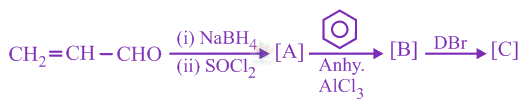
Consider the following reactions $A\frac{(i)C{H}_{3}MBr}{(ii){H}_{3}{O}^{+}}B\frac{Cu}{573K}2-methyl-2-butene$ . The mass percentage of carbon in $A$ is _____________.
The number of chiral centres present in threonine is _________
Among the following compounds, geometrical isomerism is exhibited by :
Which of the following compounds shows geometrical isomerism?
An organic compound '$A$' $({C}_{9}{H}_{10}O)$ when treated with conc. $\mathrm{HI}$ undergoes cleavage to yield compound '$B$' and '$C$'. '$B$' gives yellow precipitate with ${\text{AgNO}}_{3}$ where as '$C$' tautomerizes to '$D$'. '$D$' gives positive iodoform test. '$A$' could be:
Two compounds $A$ and $B$ with same molecular formula $({C}_{3}{H}_{6}O)$ undergo Grignard reaction with methylmagnesium bromide to give products $C$ and $D$. Products $C$ and $D$ show following chemical tests. <table class="pyq-table"><tbody><tr><td>Test</td><td>C</td><td>D</td></tr><tr><td>Ceric ammonium nitrate Test</td><td>Positive</td><td>Positive</td></tr><tr><td>Lucas Test</td><td>Turbidity obtained after five minutes</td><td>Turbidity obtained Immediately</td></tr><tr><td>Iodoform Test</td><td>Positive</td><td>Negative</td></tr></tbody></table>$C$ and $D$ respectively are
The most appropriate reagent for conversion of ${C}_{2}{H}_{5}\mathrm{CN}$ into ${\mathrm{CH}}_{3}{\mathrm{CH}}_{2}{\mathrm{CH}}_{2}{\mathrm{NH}}_{2}$ is :
In the following reaction sequence the major products $A$ and $B$ are : 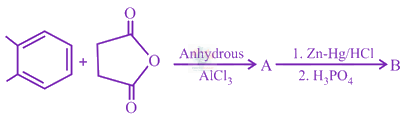
Which of these will produce the highest yield Friedel Crafts reaction?
$A,B$ and $C$ are three biomolecules. The results of the tests performed on them are given below:<table class="pyq-table"><tbody><tr><th></th><th>Molisch's test</th><th>Barfoed Test</th><th>Biuret Test</th></tr><tr><td>$A$</td><td>Positive</td><td>Negative</td><td>Negative</td></tr><tr><td>$B$</td><td>Positive</td><td>Positive</td><td>Negative</td></tr><tr><td>$C$</td><td>Negative</td><td>Negative</td><td>Positive</td></tr></tbody></table> $A,B$ and $C$ are respectively:
The correct match between Item-I (starting material) and Item-II (reagent) for the preparation of benzaldehyde is : <table class="pyq-table"><tbody><tr><td></td><td>Item-I</td><td></td><td>Item-II</td></tr><tr><td>(I)</td><td>Benzene</td><td>(P)</td><td>$\mathrm{HCl}$ and ${\mathrm{SnCl}}_{2},{H}_{3}O+$</td></tr><tr><td>(II)</td><td>Benzonitrile</td><td>(Q)</td><td>${H}_{2},\mathrm{Pd}-{\mathrm{BaSO}}_{4},S$ and quinoline</td></tr><tr><td>(III)</td><td>Benzoyl Chloride</td><td>(R)</td><td>$\mathrm{Co},\mathrm{HCl}\mathrm{and}{\mathrm{AlCl}}_{3}$</td></tr></tbody></table>
The decreasing order of reactivity towards dehydrohalogenation $({E}_{1})$ reaction of the following compounds is: 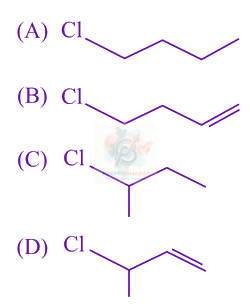
The major product $(Y)$ in the following reactions is: 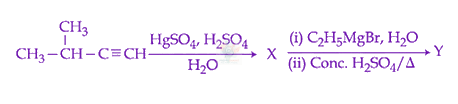
$1$-methyl ethylene oxide when treated with an excess of $HBr$ produces
The correct order of the calculated spin-only magnetic moments of complexes $(A)$ to $(D)$ is: $(A)$ $Ni{(CO)}_{4}$ $(B)$ $[Ni{({H}_{2}O)}_{6}]C{l}_{2}$ $(C)$ $N{a}_{2}[Ni{(CN)}_{4}]$ $(D)$ $PdC{l}_{2}{(PP{h}_{3})}_{2}$
Which of the following compounds will form the precipitate with $\mathrm{aq}.{\mathrm{AgNO}}_{3}$ solution most readily?
Consider the following reactions: 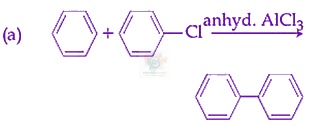 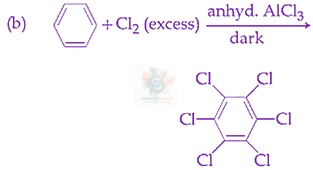 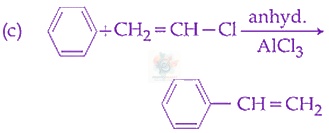 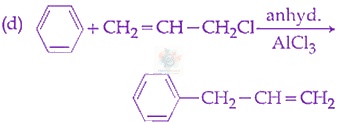 Which of these reactions are possible?