JEE Main 2022 — Organic Chemistry
Chemistry Organic Chemistry questions from JEE Main 2022.
Other Years
178 Organic Chemistry Questions from 2022
Identify the correct statement for the below given transformation. 
Which of the following is the strongest acid?
Markovnikovs rule is applicable to:
Which among the following is the strongest Bronsted base?
Sugar moiety in DNA and RNA molecules respectively are
Kjeldahl's method was used for the estimation of nitrogen in an organic compound. The ammonia evolved from $0.55g$ of the compound neutralised $12.5\mathrm{mL}$ of $1M{H}_{2}{\mathrm{SO}}_{4}$ solution. The percentage of nitrogen in the compound is (Nearest integer)
Which will have the highest enol content?
The number of chiral alcohol(s) with molecular formula ${C}_{4}{H}_{10}O$ is ________ (Assume stereoisomers as different chiral alcohols)
An organic compound '$A$' contains nitrogen and chlorine. It dissolves readily in water to give a solution that turns litmus red. Titration of compound '$A$' with standard base indicates that the molecular weight of '$A$' is $131\pm 2$. When a sample of '$A$' is treated with aq. $\mathrm{NaOH}$, a liquid separates which contains $N$ but not $\mathrm{Cl}$. Treatment of the obtained liquid with nitrous acid followed by phenol gives orange precipitate. The compound '$A$' is
Which one of the following is a water soluble vitamin, that is not excreted easily?
Arrange the following in increasing order of reactivity towards nitration A. $p$-xylene B. bromobenzene C. mesitylene D. nitrobenzene E. benzene Choose the correct answer from the options given below
In bromination of Propyne, with Bromine $1,1,2,2$-tetrabromopropane is obtained in $27%$ yield. The amount of $1,1,2,2$ tetrabromopropane obtained from $1g$ of Bromine in this reaction is_____$\times {10}^{-1}g$ . (Molar Mass : Bromine $=80g/\mathrm{mol}$)
Phenol on reaction with dilute nitric acid, gives two products. Which method will be most efficient for large scale separation?
In the given reaction 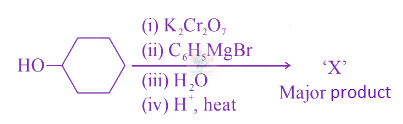 the number of ${\mathrm{sp}}^{2}$ hybridised carbon (s) in compound $'X'$ is _______.
Given below are two statements. Statement I: The presence of weaker $\pi$-bonds make alkenes less stable than alkanes Statement II: The strength of the double bond is greater than that of carbon-carbon single bond. In the light of the above statements, choose the correct answer from the options : given below.
${({C}_{7}{H}_{5}{O}_{2})}_{2}\overset{\mathrm{hv}}{\longrightarrow }[X]\rightarrow 2{\overset{˙}{C}}_{6}{H}_{5}+2{\mathrm{CO}}_{2}$ Consider the above reaction and identify the intermediated '$X$'
A compound '$A$' on reaction with '$X$' and '$Y$ produces the same major product but different by product '$a$' and '$b$'. Oxidation of '$a$' gives a substance produced by ants. 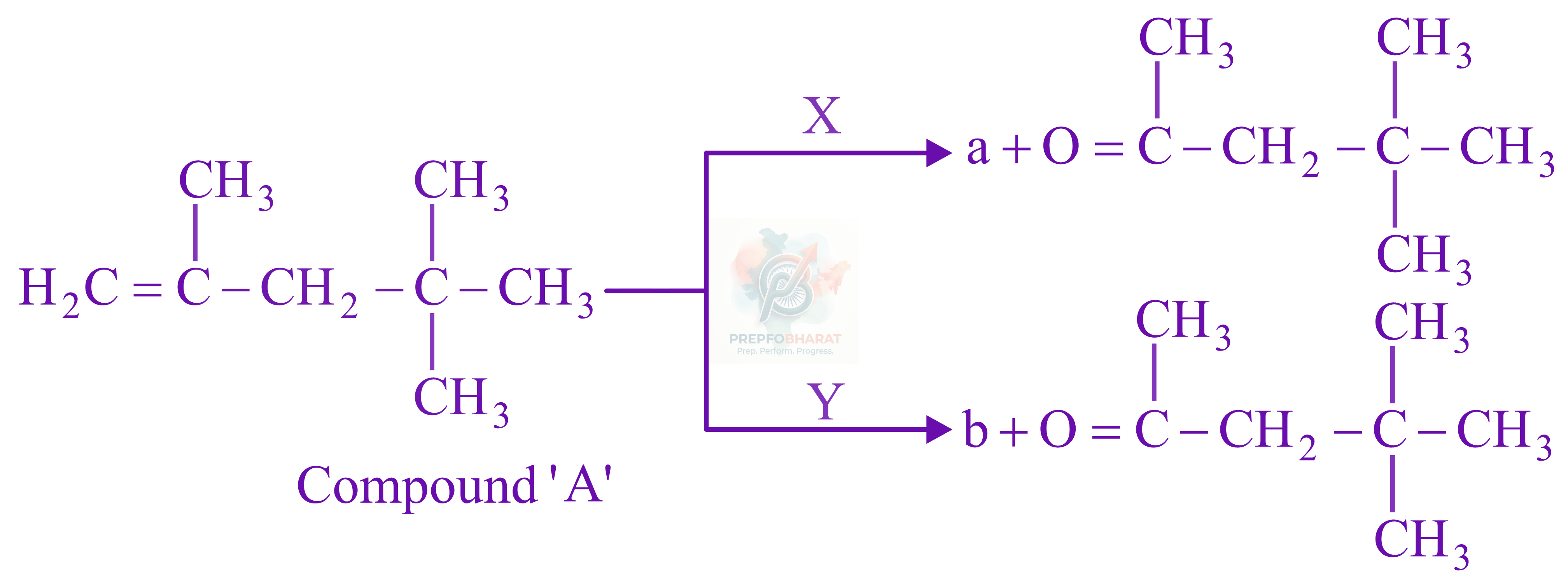 '$X$' and '$Y$' respectively are
Correct structure of $\gamma$-methylcyclohexane carbaldehyde is
Identify the major product $A$ and $B$ for the below given reaction sequence. 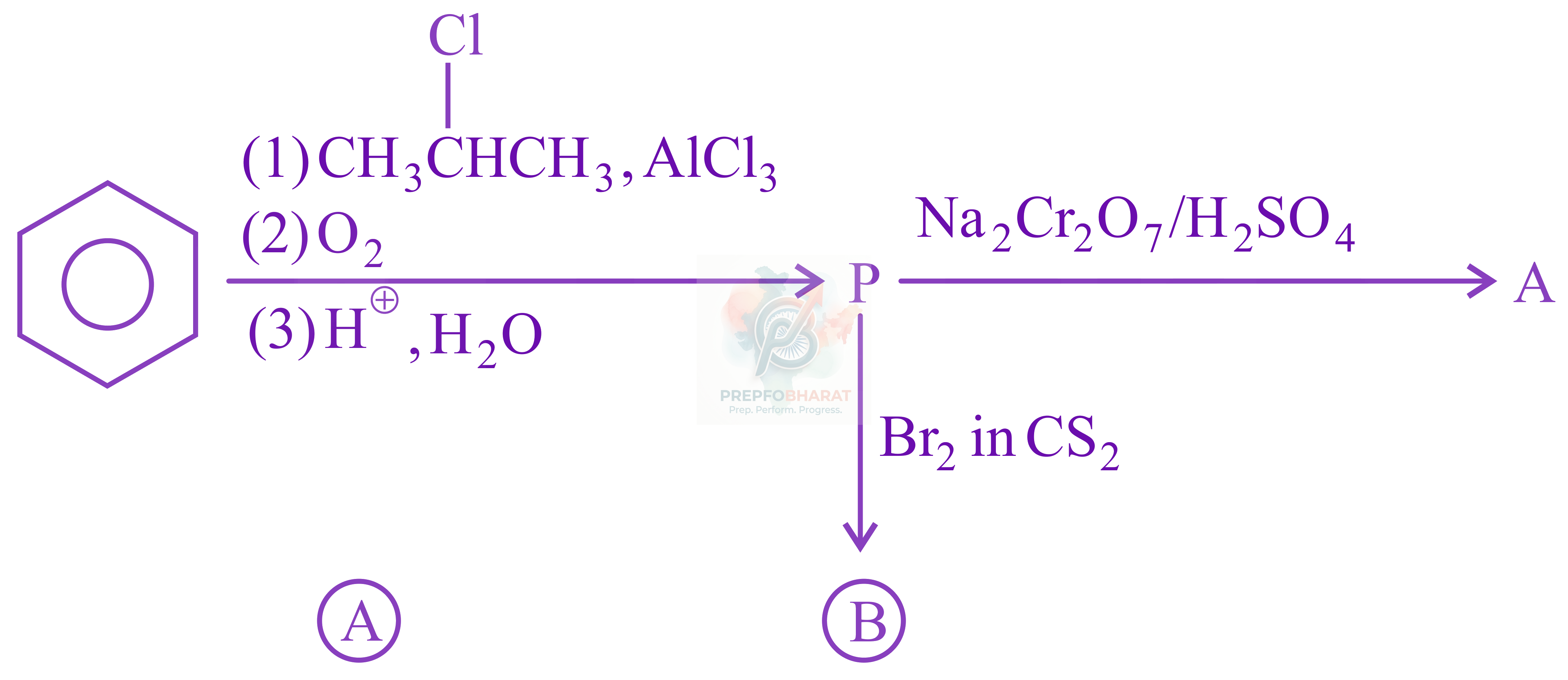
Two isomers $(A)$ and $(B)$ with Molar mass $184g/\mathrm{mol}$ and elemental compositio $C,52.2%;H,49%$ and $\mathrm{Br}42.9%$ gave benzoic acid and $p-$ bromobenzoic acid, respectively on oxidation with ${\mathrm{KMnO}}_{4}$. Isomer $'A'$ is optically active and gives a pale yellow precipitate when warmed with alcoholic ${\mathrm{AgNO}}_{3}$. Isomer $'A'$ and $'B'$ are, respectively :
A primary aliphatic amine on reaction with nitrous acid in cold $(273K)$ and there after raising temperature of reaction mixture to room temperature $(298K)$, gives a/an
A sugar '$X$' dehydrates very slowly under acidic condition to give furfural which on further reaction with resorcinol gives the coloured product after sometime. Sugar '$X$' is
Which of the following is most stable$?$
During halogen test, sodium fusion extract is boiled with concentrated ${\mathrm{HNO}}_{3}$ to
The number of stereoisomers formed in a reaction of $(\pm )\mathrm{PhC}(=O)C(\mathrm{OH})(\mathrm{CN})\mathrm{Ph}$ with $\mathrm{HCN}$ is
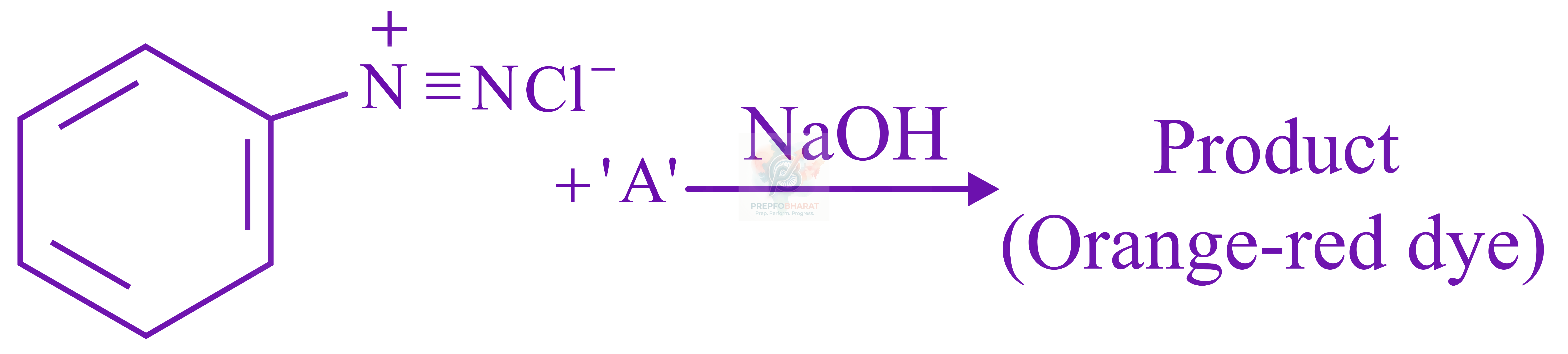 Which among the following represent reagent '$A$'?
The IUPAC name of ethylidene chloride is
Match List-I with List-II. <table class="pyq-table"><tbody><tr><td></td><td>List-I</td><td></td><td>List-II</td></tr><tr><td>A</td><td><img src="https://prepforbharat.s3.ap-south-1.amazonaws.com/exam/615f0e999476412f48314daf/Chemistry/images/Aldehydes_and_Ketones/648b5a6d417cc3fb48d67b3c/question_1__q_648b5a6d417cc3fb48d67b3c__cdn-question-pool.getmarks.app__58dba590-6e0a-401b-a2ba-377ad2198809-image__c897438e5a_final_ppt_sync.png" alt="JEE Main 2022 Chemistry, Aldehydes and Ketones — question figure 1"></td><td>I</td><td>Gatterman Koch reaction</td></tr><tr><td>B</td><td><img src="https://prepforbharat.s3.ap-south-1.amazonaws.com/exam/615f0e999476412f48314daf/Chemistry/images/Aldehydes_and_Ketones/648b5a6d417cc3fb48d67b3c/question_2__q_648b5a6d417cc3fb48d67b3c__cdn-question-pool.getmarks.app__d827c610-4cfe-438e-93c3-55600d7cd3bd-image__60dfe97188_final_ppt_sync.png" alt="JEE Main 2022 Chemistry, Aldehydes and Ketones — question figure 2"></td><td>II</td><td>Etard reaction</td></tr><tr><td>C</td><td><img src="https://prepforbharat.s3.ap-south-1.amazonaws.com/exam/615f0e999476412f48314daf/Chemistry/images/Aldehydes_and_Ketones/648b5a6d417cc3fb48d67b3c/question_3__q_648b5a6d417cc3fb48d67b3c__cdn-question-pool.getmarks.app__ebef09e3-2eb9-48a5-abc0-947f0e8dc5d3-image__8a4974de40_final_ppt_sync.png" alt="JEE Main 2022 Chemistry, Aldehydes and Ketones — question figure 3"></td><td>III</td><td>Stephen reaction</td></tr><tr><td>D</td><td><img src="https://prepforbharat.s3.ap-south-1.amazonaws.com/exam/615f0e999476412f48314daf/Chemistry/images/Aldehydes_and_Ketones/648b5a6d417cc3fb48d67b3c/question_4__q_648b5a6d417cc3fb48d67b3c__cdn-question-pool.getmarks.app__a6792151-d306-4d05-bb10-008c367b8676-image__acfbffbf7b_final_ppt_sync.png" alt="JEE Main 2022 Chemistry, Aldehydes and Ketones — question figure 4"></td><td>IV</td><td>Rosenmund reaction</td></tr></tbody></table>Choose the correct answer from the options given below
Halogenation of which one of the following will yield m-substituted product with respect to methyl group as a major product?
The correct decreasing order of priority of functional groups in naming an organic compound as per IUPAC system of nomenclature is
The correct stability order of the following diazonium salt is 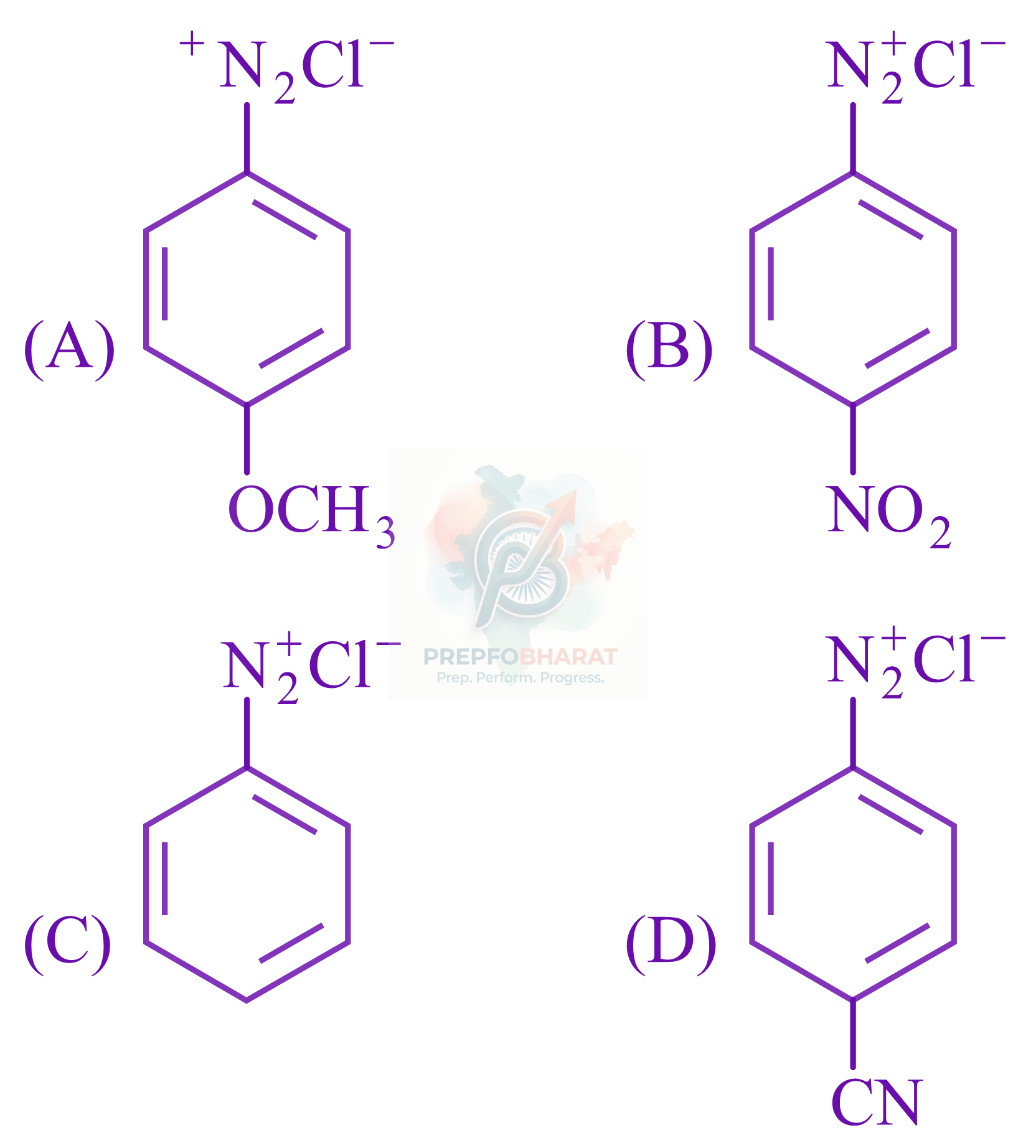
$0.2g$ of an organic compound was subjected to estimation of nitrogen by Dumas method in which volume of ${N}_{2}$ evolved (at STP) was found to be $22.400\mathrm{mL}$. The percentage of nitrogen in the compound is - [nearest integer] (Given: Molar mass of ${N}_{2}$ is $28g{\mathrm{mol}}^{-1}$, Molar volume of ${N}_{2}$ at $\mathrm{STP}:22.4L$)
The Hinsberg reagent is
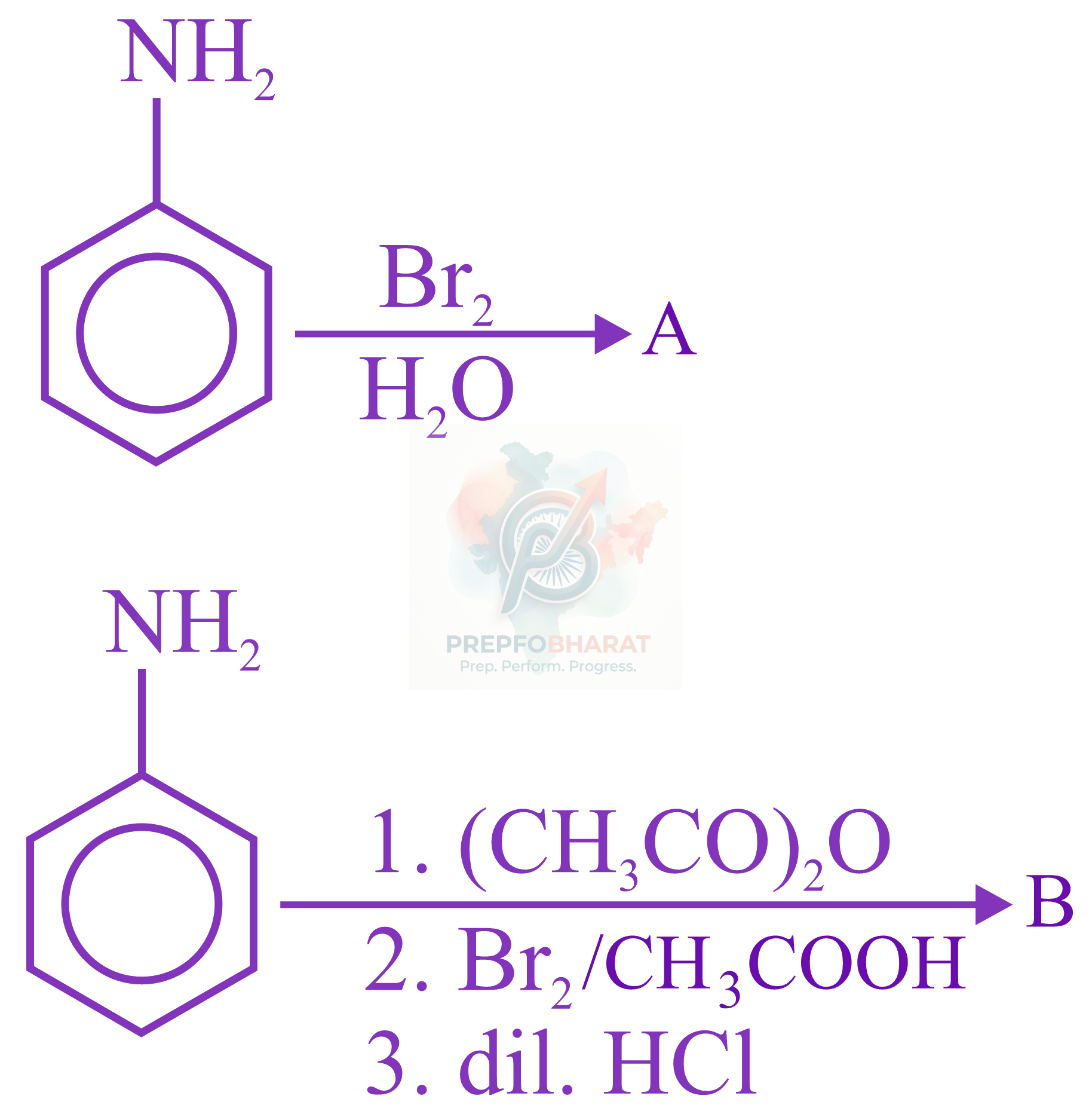 Consider the above reaction, the product $A$ and product $B$ respectively are
Given below are two statements. One is labelled as Assertion $A$ and the other is labelled as Reason $R$. Assertion $A:[6]$ Annulene. $[8]$ Annulene and cis $-[10]$ Annulene, are respectively aromatic, not-aromatic and aromatic. 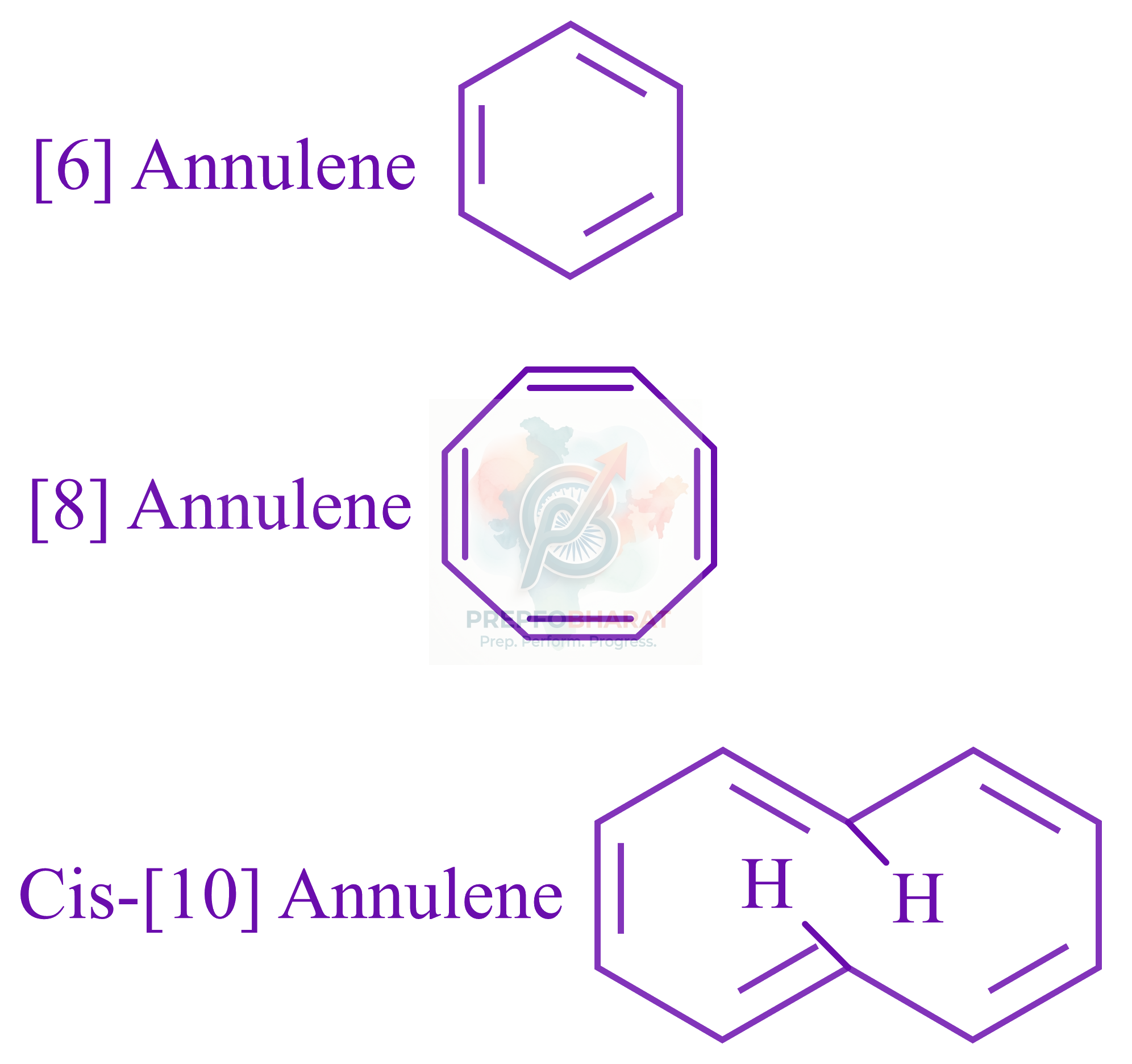 Reason $R$: Planarity is one of the requirements of aromatic systems. In the light of the above statements, choose the most appropriate answer from the options given below.
Which one of the following reactions does not represent correct combination of substrate and product under the given conditions?
$0.25g$ of an organic compound containing chlorine gave $0.40g$ of silver chloride in Carius estimation. The percentage of chlorine present in the compound is [in nearest integer] (Given: Molar mass of $\mathrm{Ag}$ is $108g{\mathrm{mol}}^{-1}$ and that of $\mathrm{Cl}$ is $35.5g{\mathrm{mol}}^{-1}$)
Which technique among the following, is most appropriate in separation of a mixture of $100\mathrm{mg}$ of $p$-nitrophenol and picric acid?
Two statements are given belwo : Statement I : The melting point of monocarboxylic acid with even number of carbon atoms is higher than that of with odd number of carbon atoms acid immediately below and above it in the series. Statement II : The solubility of monocarboxylic acids in water decreases with increase in molar mass. Choose the most appropriate option :
In the following structures, which one is having staggered conformation with maximum dihedral angle?
 In the given conversion the compound $A$ is
The major product in the reaction 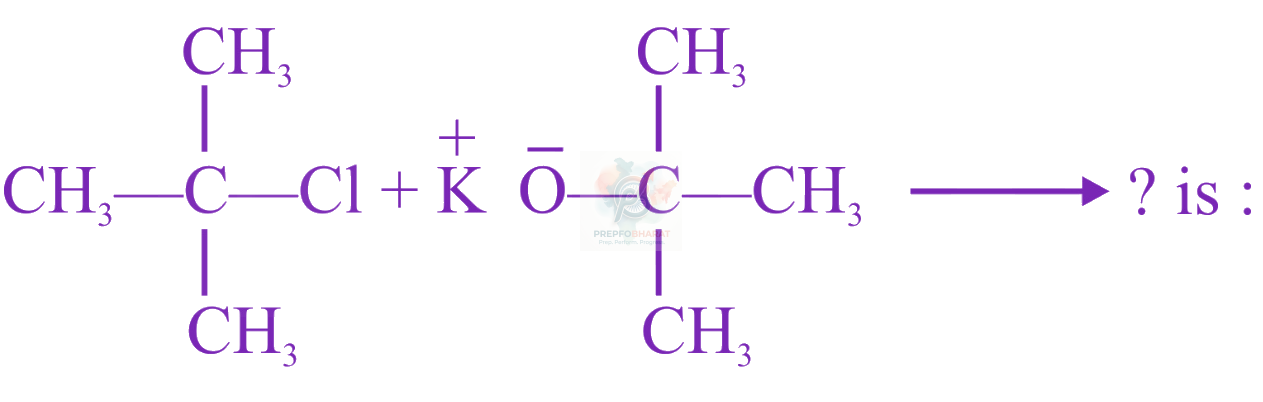
 The stable carbocation formed in the above reaction is :
Stability of $\alpha$ - Helix structure of proteins depends upon
In the presence of sunlight, benzene reacts with ${\mathrm{Cl}}_{2}$ to give product, $X$. The number of hydrogens in $X$ is
Given below are two statements. One is labelled as Assertion $A$ and the other is labelled as Reason $R$. Assertion $A$ : Amylose is insoluble in water. Reason $R$ : Amylose is a long linear molecule with more than $200$ glucose units. In the light of the above statements, choose the correct answer from the options given below.
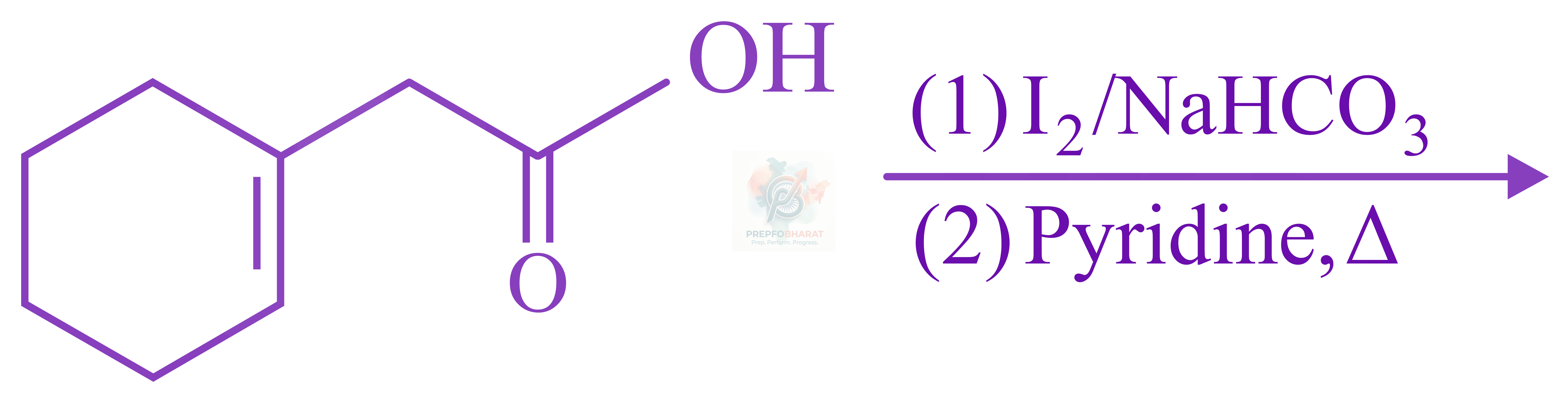 Find out the major product for the above reaction.
Given below are two statements. Statement I: Maltose has two $\alpha -D-\mathrm{glucose}$ units linked at ${C}_{1}$ and ${C}_{4}$ and is a reducing sugar. Statement II: Maltose has two monosaccharides: $\alpha$-$D$-glucose and $\beta$-$D$-glucose linked at ${C}_{1}$ and ${C}_{6}$ and it is a non-reducing sugar. In the light of the above statements, choose the correct answer from the options Question: given below.
Given below are two statements : Statement - I : In Hofmann degradation reaction, the migration of only an alkyl group takes place from carbonyl carbon of the amide to the nitrogen atom. Statement - II : The group is migrated in Hofmann degradation reaction to electron deficient atom. In the light of the above statements, choose the most appropriate answer from the options given below
The major product $P$ of the given reaction is (where, $\mathrm{Me}$ is $-{\mathrm{CH}}_{3}$) 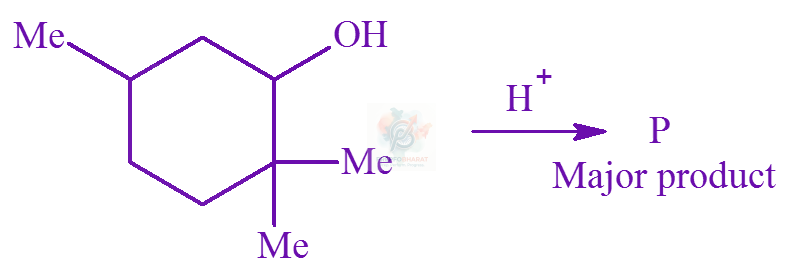
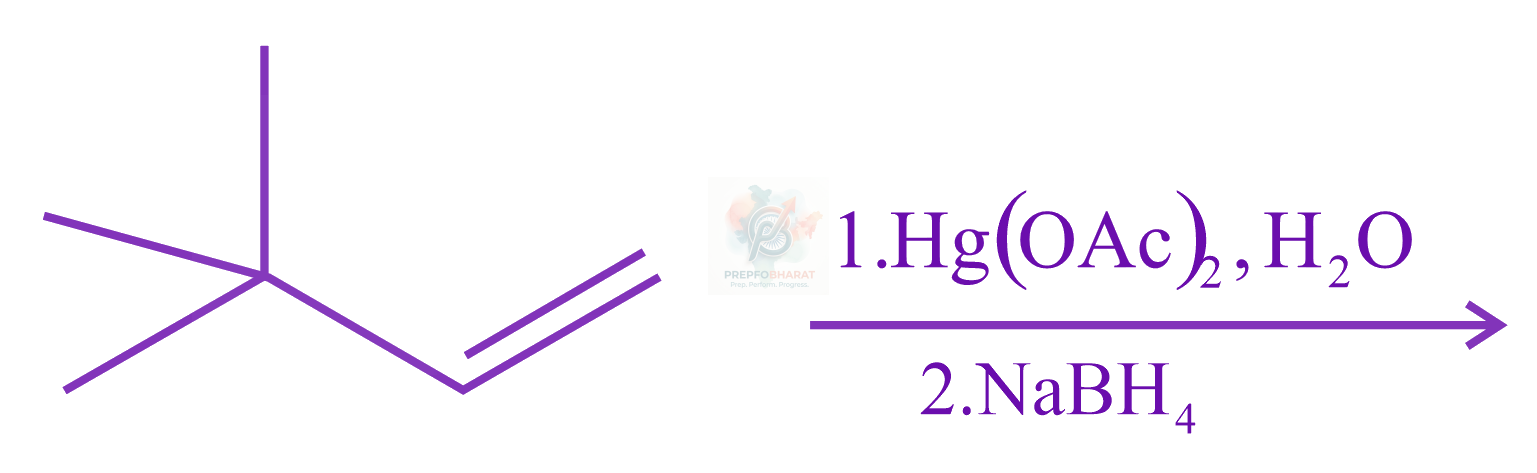
 Considering the above reactions, the compound '$A$' and compound '$B$' respectively are
Which of the following is an example of conjugated diketone?
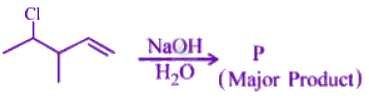 Consider the above reaction. The number of $\pi$ electrons present in the product '$P$' is
With respect to the following reaction, consider the given statements: 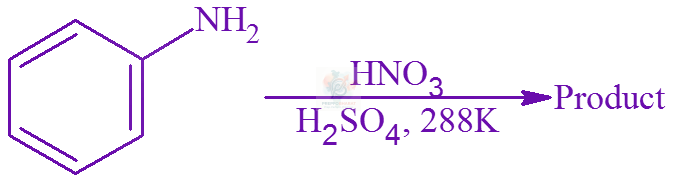 (A) $o$-Nitroaniline and $p$-nitroaniline are the predominant products. (B) $p$-Nitroaniline and $m$-nitroaniline are the predominant products. (C) ${\mathrm{HNO}}_{3}$ acts as an acid. (D) ${H}_{2}{\mathrm{SO}}_{4}$ acts as an acid. Choose the correct option.
In the given reaction, 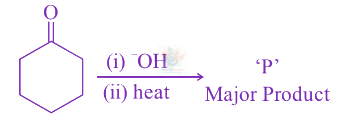 The number of $\pi$ electrons present in the product $'P'$ is ____________.
Match List-I with List-II <table class="pyq-table"><tbody><tr><td></td><td>List-I (Mixture)</td><td></td><td>List-II (Purification Process)</td></tr><tr><td>A</td><td>Chloroform & Aniline</td><td>I</td><td>Steam distillation</td></tr><tr><td>B</td><td>Benzoic acid & Napthalene</td><td>II</td><td>Sublimation</td></tr><tr><td>C</td><td>Water & Aniline</td><td>III</td><td>Distillation</td></tr><tr><td>D</td><td>Napthalene & Sodium chloride</td><td>IV</td><td>Crystallisation</td></tr></tbody></table>
Match List-I with List-II <table class="pyq-table"><tbody><tr><td></td><td>List-I</td><td></td><td>List-II</td></tr><tr><td>A</td><td>Benzenesulphonyl chloride</td><td>I</td><td>Test for primary amines</td></tr><tr><td>B</td><td>Hoffmann bromamide reaction</td><td>II</td><td>Anti Saytzeff</td></tr><tr><td>C</td><td>Carbylamine reaction</td><td>III</td><td>Hinsberg reagent</td></tr><tr><td>D</td><td>Hoffmann orientation</td><td>IV</td><td>Known reaction of Isocyanates.</td></tr></tbody></table>Choose the correct answer from the options given below
Given below are two statements : Statement I : On heating with ${\mathrm{KHSO}}_{4}$, glycerol is dehydrated and acrolein is formed. Statement II : Acrolein has fruity odour and can be used to test glycerol's presence. Choose the correct option.
An organic compound '$A$' on reaction with ${\mathrm{NH}}_{3}$ followed by heating gives compound $B$. Which on further strong heating gives compound $C$ $({C}_{8}{H}_{5}{\mathrm{NO}}_{2})$. Compound $C$ on sequential reaction with ethanolic $\mathrm{KOH}$, alkyl chloride and hydrolysis with alkali gives a primary amine. The compound $A$ is
Arrange the following carbocations in decreasing order of stability. 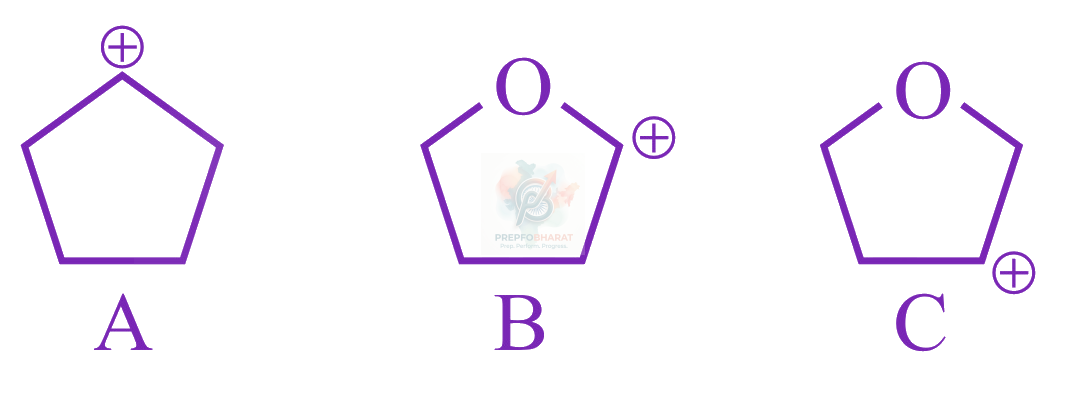
Hex-$4$-ene-$2$-ol on treatment with $\mathrm{PCC}$ gives '$A$'. '$A$' on reaction with sodium hypoiodite gives '$B$', which on further heating with soda lime gives '$C$'. The compound '$C$' is
The final product '$A$' in the following reaction sequence 
The formula of the purple colour formed in Laissaigne's test for sulphur using sodium nitroprusside is
In the given reaction 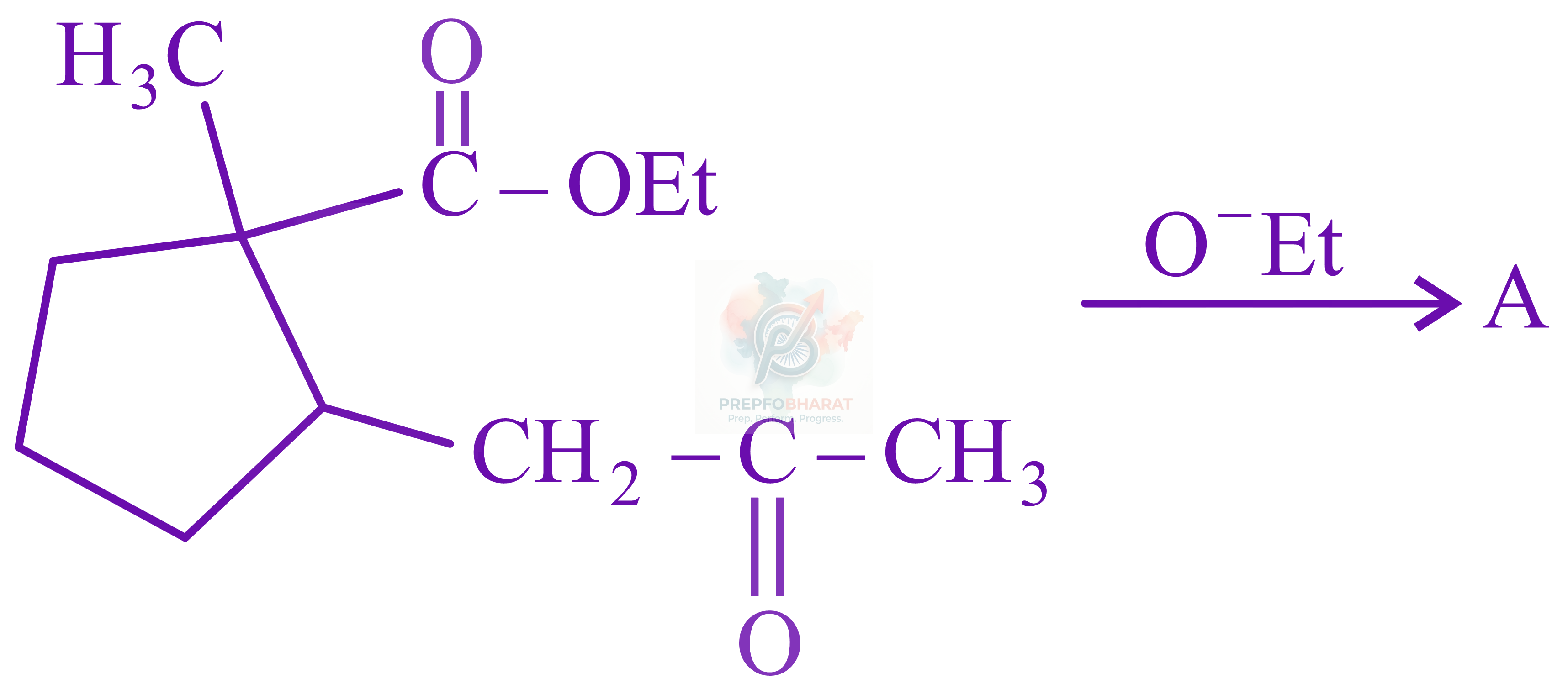 (Where Et is $-{C}_{2}{H}_{5}$) The number of chiral carbon/s in product $A$ is
Given below are two statements: one is labelled as Assertion and the other is labelled as Reason. Assertion: A mixture contains benzoic acid and napthalene. The pure benzoic acid can be separated out by the use of benzene. Reason: Benzoic acid is soluble in hot water. In the light of the above statements, choose the most appropriate answer from the options given below.
Given below are two statements: One is labelled as Assertion $A$ and the other is labelled as Reason $R$ Assertion $A$ : Thin layer chromatography is an adsorption chromatography. Reason $R$ : A thin layer of silica gel is spread over a glass plate of suitable size in thin layer chromatography which acts as an adsorbent. In the light of the above statements, choose the correct answer from the options given below
Total number of isomers (including stereoisomers) obtain on monochlorination of methylcyclohexane is
Which one of the following compounds is inactive towards ${S}_{N}1$ reaction?
Consider the following reaction, $A\rightarrow _{\begin{matrix}2.{\mathrm{CN}}^{-} \\ 3.{H}_{2}O/{H}^{+}/\Delta \end{matrix}}^{1.{\mathrm{Cl}}_{2}/\mathrm{hv}}4-\mathrm{bromophenylacetic}\mathrm{acid}$ What is $A$ in the above reaction?
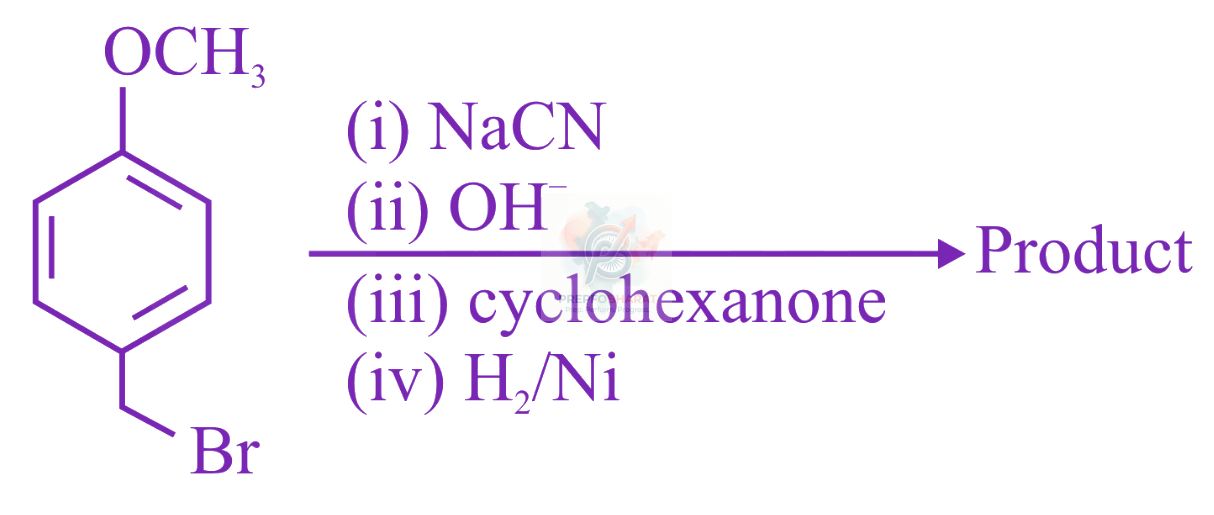 The major product of the above reactions is
The formulas of $A$ and $B$ for the following reaction sequence are 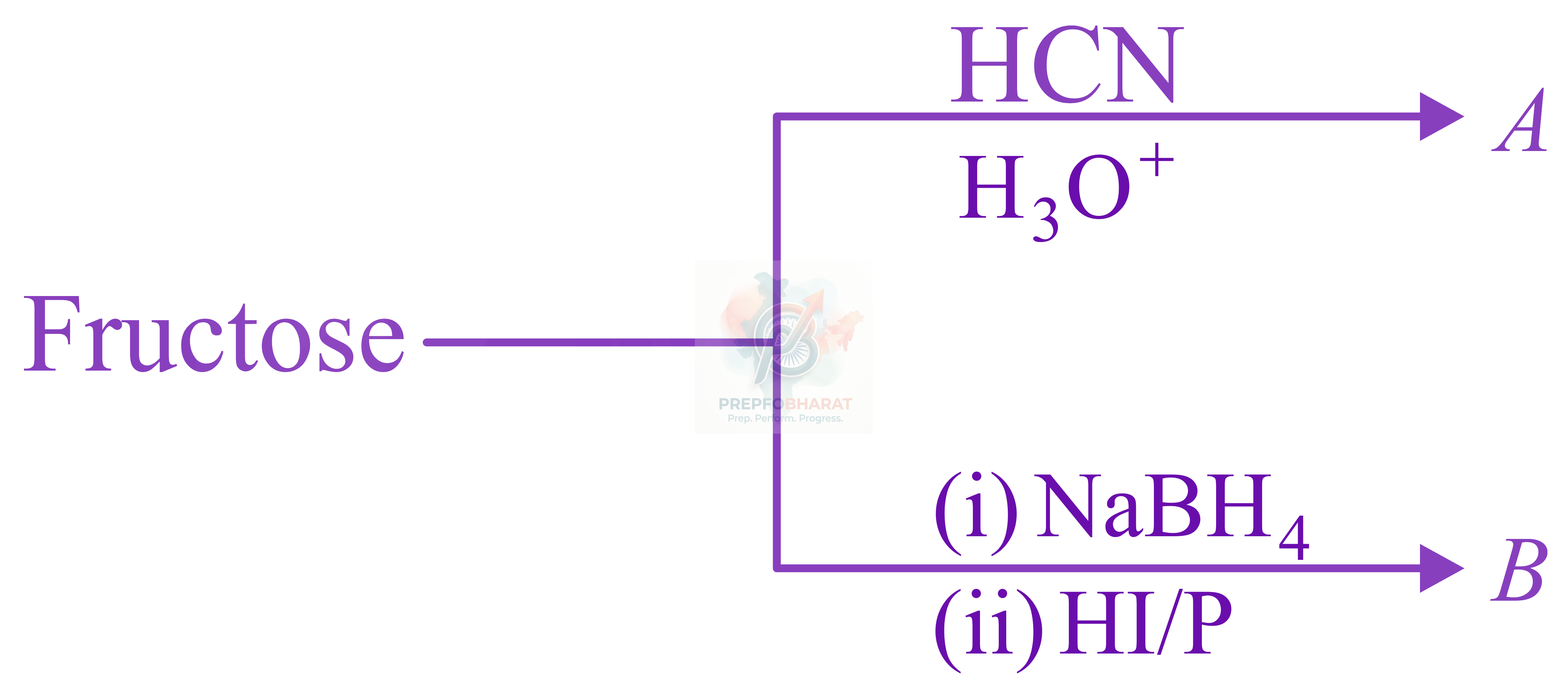
When enthanol is heated with conc. ${H}_{2}{\mathrm{SO}}_{4}$, a gas is produced. The compound formed, when this gas is treated with cold dilute aqueous solution of Baeyer's reagent, is
The difference in the reaction of phenol with bromine in chloroform and bromine in water medium is due to
Major product '$B$' of the following reaction sequence is 
Given below are two statements. Statement I : Phenols are weakly acidic. Statement II : Therefore they are freely soluble in $\mathrm{NaOH}$ solution and are weaker acids than alcohols and water. Choose the most appropriate option
The major product of the following reaction contains____bromine atom(s). 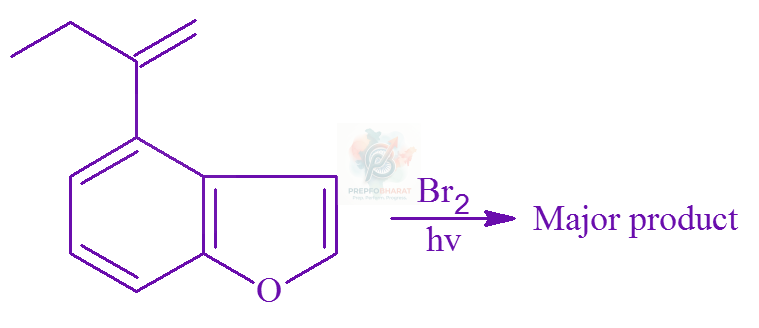
Match List-I with List-II <table class="pyq-table"><tbody><tr><td></td><td>List-I</td><td></td><td>List-II</td></tr><tr><td>A</td><td><img src="https://prepforbharat.s3.ap-south-1.amazonaws.com/exam/615f0e999476412f48314daf/Chemistry/images/Alcohols_Phenols_and_Ethers/648b5a6d417cc3fb48d67bf1/question_1__q_648b5a6d417cc3fb48d67bf1__cdn-question-pool.getmarks.app__116acc6d-c3ed-4635-81e0-bc1365245017-image__ad1e04b958_final_ppt_sync.png" alt="JEE Main 2022 Chemistry, Alcohols Phenols and Ethers — question figure 1"></td><td>I</td><td>${\mathrm{Br}}_{2}$ in ${\mathrm{CS}}_{2}$</td></tr><tr><td>B</td><td><img src="https://prepforbharat.s3.ap-south-1.amazonaws.com/exam/615f0e999476412f48314daf/Chemistry/images/Alcohols_Phenols_and_Ethers/648b5a6d417cc3fb48d67bf1/question_2__q_648b5a6d417cc3fb48d67bf1__cdn-question-pool.getmarks.app__d1bec61a-e4d5-4e89-ae36-7353eb7b5802-image__dea3866f00_final_ppt_sync.png" alt="JEE Main 2022 Chemistry, Alcohols Phenols and Ethers — question figure 2"></td><td>II</td><td>${\mathrm{Na}}_{2}{\mathrm{Cr}}_{2}{O}_{7}/{H}_{2}{\mathrm{SO}}_{4}$</td></tr><tr><td>C</td><td><img src="https://prepforbharat.s3.ap-south-1.amazonaws.com/exam/615f0e999476412f48314daf/Chemistry/images/Alcohols_Phenols_and_Ethers/648b5a6d417cc3fb48d67bf1/question_3__q_648b5a6d417cc3fb48d67bf1__cdn-question-pool.getmarks.app__871dc4ce-2b3f-4687-ac4a-b9b19a44f42e-image__e5c4dec309_final_ppt_sync.png" alt="JEE Main 2022 Chemistry, Alcohols Phenols and Ethers — question figure 3"></td><td>III</td><td>$\mathrm{Zn}$</td></tr><tr><td>D</td><td><img src="https://prepforbharat.s3.ap-south-1.amazonaws.com/exam/615f0e999476412f48314daf/Chemistry/images/Alcohols_Phenols_and_Ethers/648b5a6d417cc3fb48d67bf1/question_4__q_648b5a6d417cc3fb48d67bf1__cdn-question-pool.getmarks.app__04f8eef3-8007-44a7-99e0-9dc0be87e087-image__57c05f0286_final_ppt_sync.png" alt="JEE Main 2022 Chemistry, Alcohols Phenols and Ethers — question figure 4"></td><td>IV</td><td>${\mathrm{CHCl}}_{3}/\mathrm{NaOH}$</td></tr></tbody></table>Question: Choose the correct answer from the options given below
The major product formed in the following reaction, is 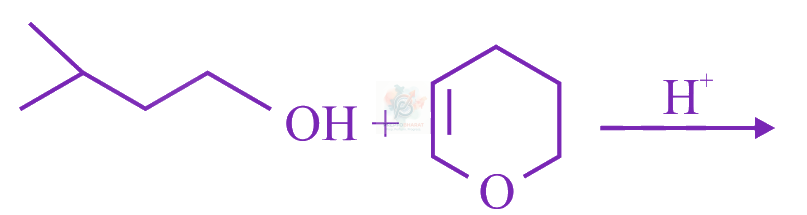
 Consider the above reaction sequence and identify the product $B$.
$\overset{˙}{\mathrm{Cl}}+{\mathrm{CH}}_{4}\rightarrow A+B$ $A$ and $B$ in the above atmospheric reaction step are
${\mathrm{CH}}_{3}-{\mathrm{CH}}_{2}-\mathrm{CN}\rightarrow _{\mathrm{Ether}}^{{\mathrm{CH}}_{3}\mathrm{MgBr}}A\overset{{H}_{3}{O}^{+}}{\rightarrow }B\rightarrow _{\mathrm{HCl}}^{\mathrm{Zn}-\mathrm{Hg}}C$. The correct structure of $C$ is
Which of the following conditions or reaction sequence will NOT give acetophenone as the major product?
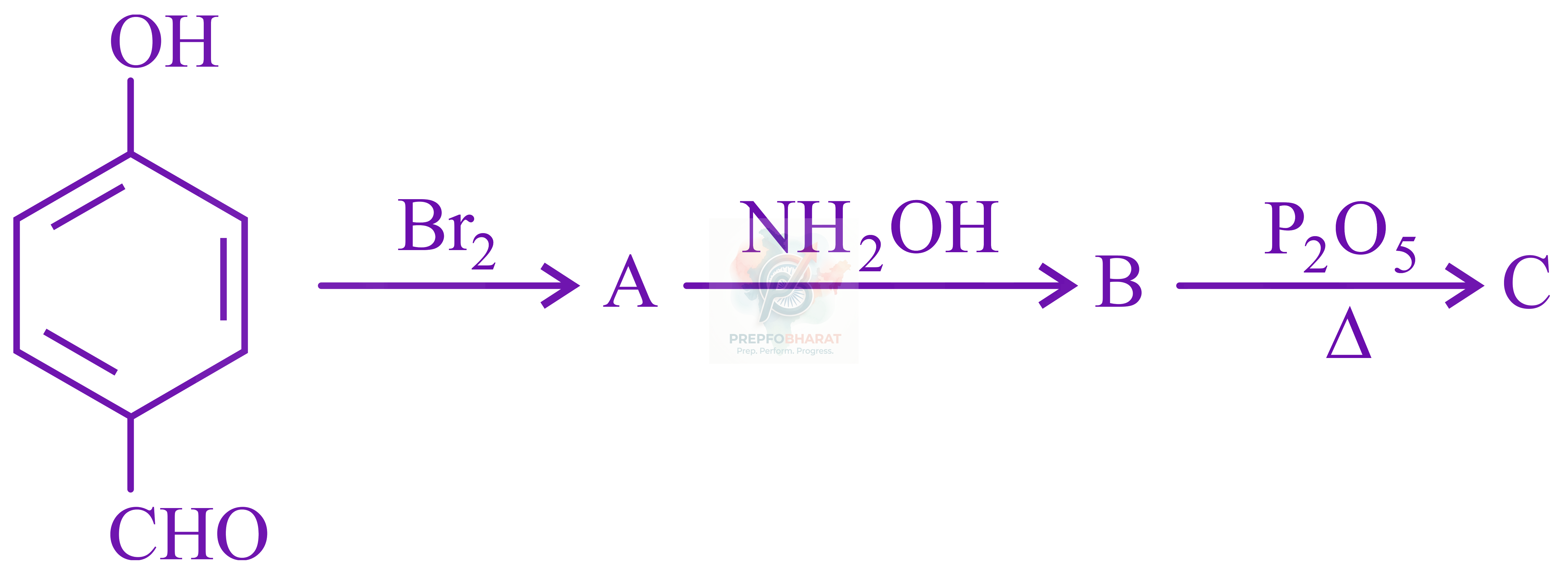 Consider the above reaction sequence, the Product ‘$C$’ is
Two isomers '$A$' and '$B$' with molecular formula ${C}_{4}{H}_{8}$ give different products on oxidation with ${\mathrm{KMnO}}_{4}$ in acidic medium. Isomer '$A$' on reaction with ${\mathrm{KMnO}}_{4}/{H}^{+}$ results in effervescence of a gas and gives ketone. The compound '$A$' is
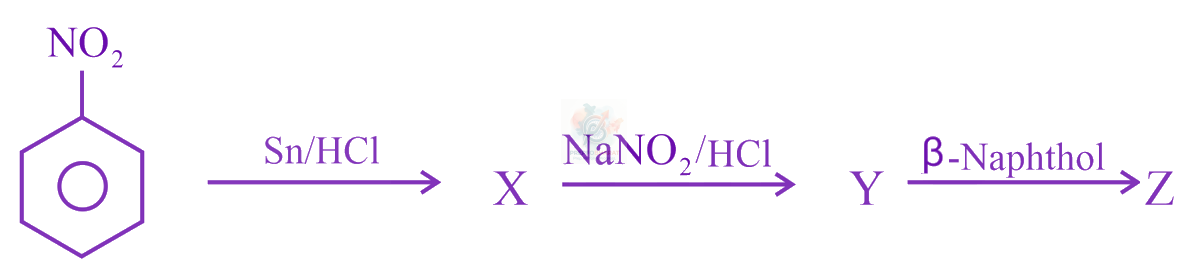 Identify '$Z$' among the following
The reaction of 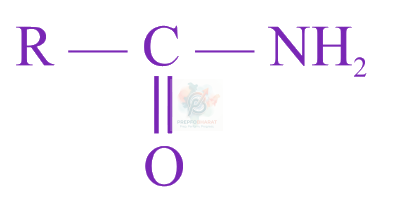 with bromine and $\mathrm{KOH}$ gives ${\mathrm{RNH}}_{2}$ as the end product. Which one of the following is the intermediate product formed in this reaction?
How many of the given compounds will give a positive Biuret test____? Glycine, Glycylalanine, Tripeptide, Biuret
During the denaturation of proteins, which of these structures will remain intact ?
$2.5g$ of protein containing only glycine $({C}_{2}{H}_{5}{\mathrm{NO}}_{2})$ is dissolved in water to make $500\mathrm{mL}$ of solution. The osmotic pressure of this solution at $300K$ is found to be $5.03\times {10}^{-3}$ bar. The total number of glycine units present in the protein is (Given : $R=0.083L\mathrm{bar}{K}^{-1}{\mathrm{mol}}^{-1})$
The number of oxygen present in a nucleotide formed from a base, that is present only in RNA is
A polysaccharide '$X$' on boiling with dil ${H}_{2}{\mathrm{SO}}_{4}$ at $393K$ under $2-3\mathrm{atm}$ pressure yields '$Y$' '$Y$' on treatment with bromine water gives gluconic acid. '$X$' contains $\beta$-glycosidic linkages only. Compound '$X$' is :
Compound '$P$' on nitration with dil. ${\mathrm{HNO}}_{3}$ yields two isomers $(A)$ and $(B)$. These isomers can be separated by steam distillations. Isomers $(A)$ and $(B)$ show the intramolecular and intermolecular hydrogen bonding respectively. Compound $(P)$ on reaction with conc. ${\mathrm{HNO}}_{3}$ yields a yellow compound '$C$', a strong acid. The number of oxygen atoms is present in compound '$C$'
Among the following structures, which will show the most stable enamine formation? (Where $\mathrm{Me}$ is $-{\mathrm{CH}}_{3}$)
Given below are two statements : Statement I: The esterification of carboxylic acid with an alcohol is a nucleophilic acyl substitution. Statement II: Electron withdrawing groups in the carboxylic acid will increase the rate of esterification reaction. Choose the most appropriate option
Animal starch is the other name of
Amongst the following, the major product of the given chemical reaction is 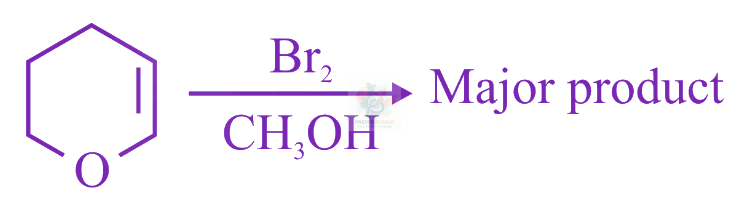
The product formed in the following reaction. 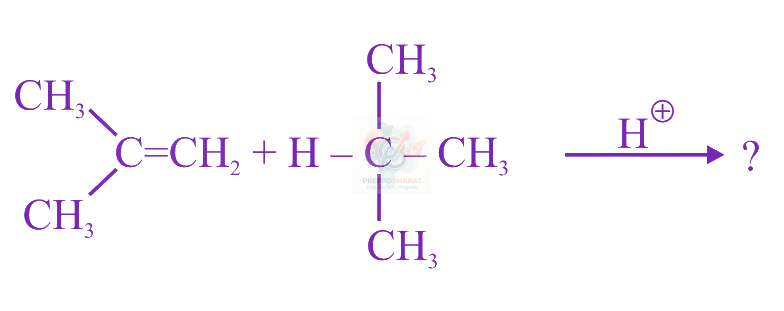 is:
Which statement is NOT correct for p-toluenesulphonyl chloride?
Choose the correct option for the following reactions. 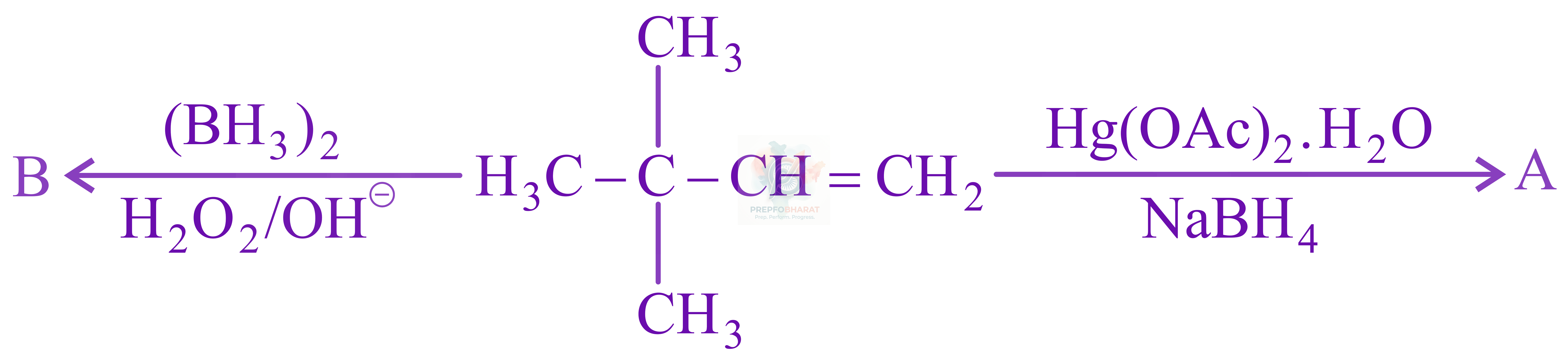
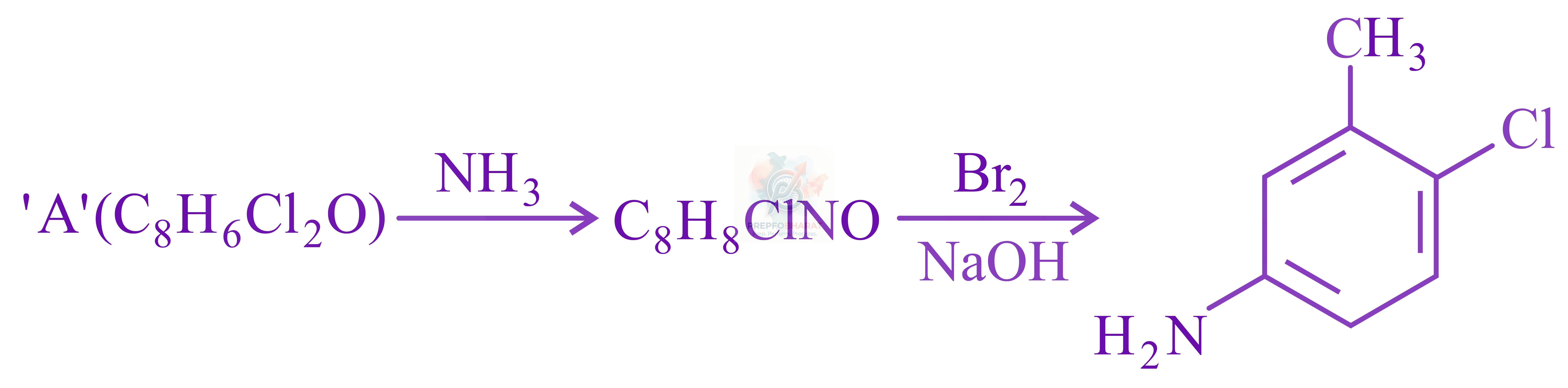 Consider the above reaction, the compound '$A$' is
Which reactant will give the following alcohol on reaction with one mole of phenyl magnesium bromide $(\mathrm{PhMgBr})$ followed by acidic hydrolysis? 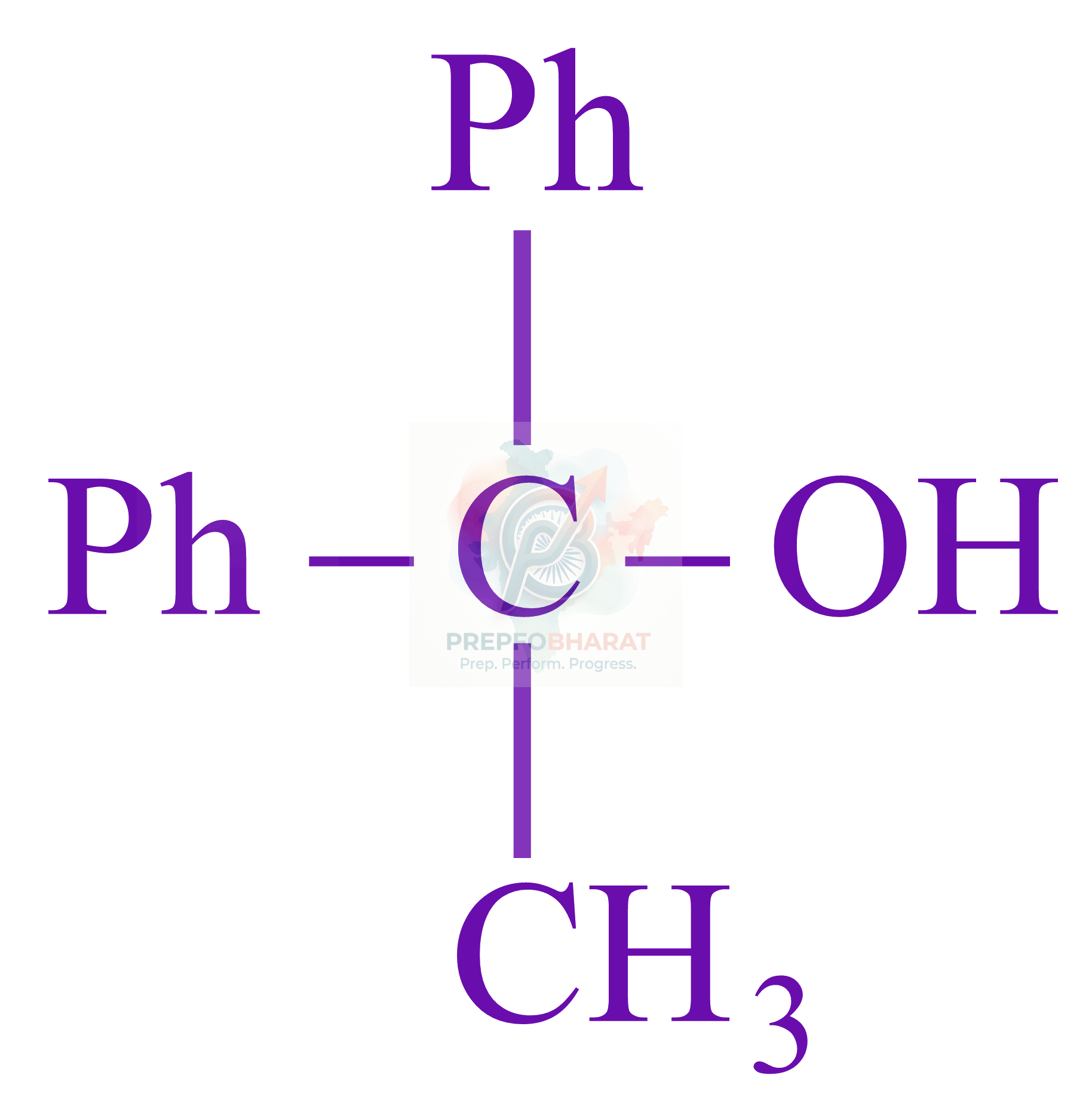
Total number of possible stereoisomers of dimethyl cyclopentane is
Given below are two statements : one is labelled as Assertion $A$ and the other is labelled as Reason $R$ Assertion $A$ : Aniline on nitration yields ortho, meta & para nitro derivatives of aniline. Reason $R$ : Nitrating mixture is a strong acidic mixture. In the light of the above statements, choose the correct answer from the options given below
The structure of $A$ in the given reaction is 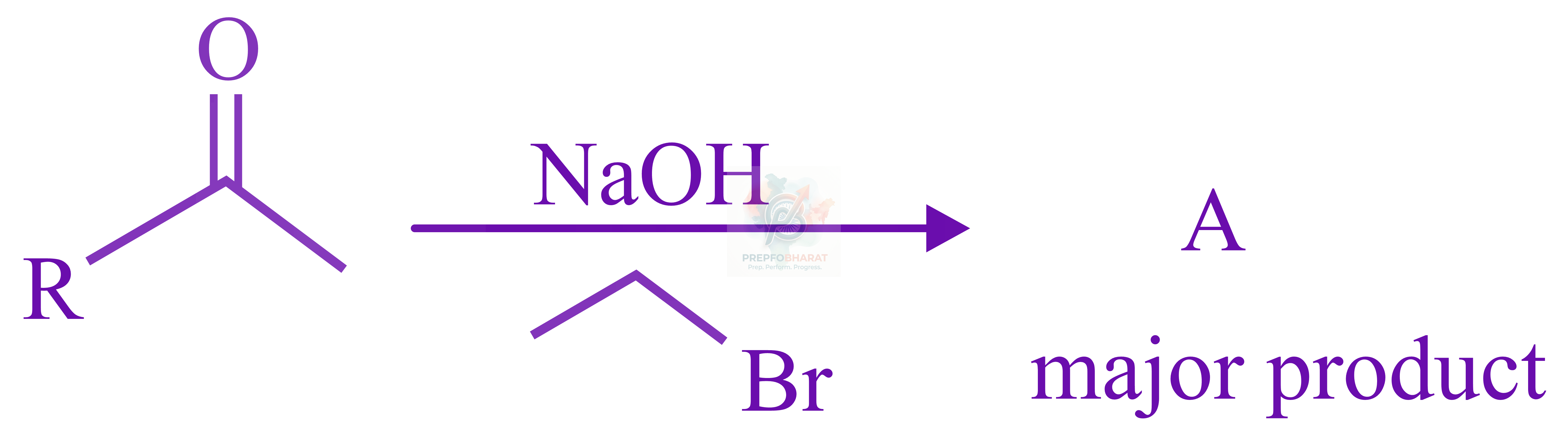
$L$-isomer of a compound $A''({C}_{4}{H}_{8}{O}_{4})$gives a positive test with ${[\mathrm{Ag}{({\mathrm{NH}}_{3})}_{2}]}^{+}$. Treatment of '$A$' with acetic anhydride yields triacetate derivative. Compound '$A$' produces an optically active compound $(B)$ and an optically inactive compound $(C)$ on treatment with bromine water and ${\mathrm{HNO}}_{3}$ respectively. Compound $(A)$ is :
Consider the following reaction sequence 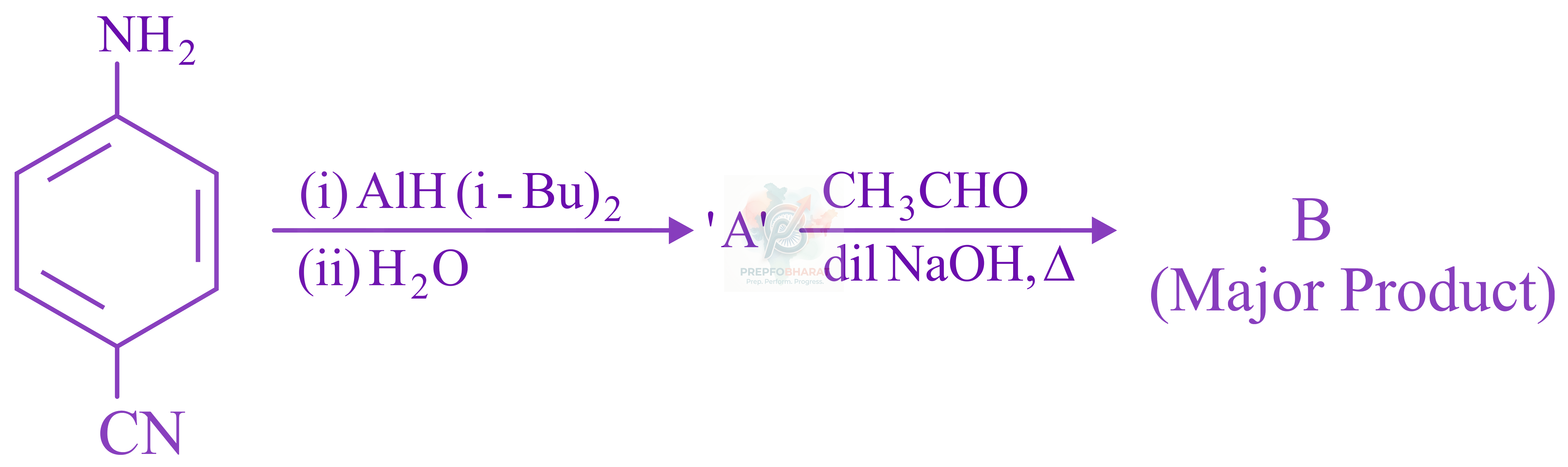 The product '$B$' is
Hydrolysis of which compound will give carbolic acid?
Toluene can be easily converted into benzaldehyde by which of the following reagents?
Arrange the following in decreasing acidic strength. 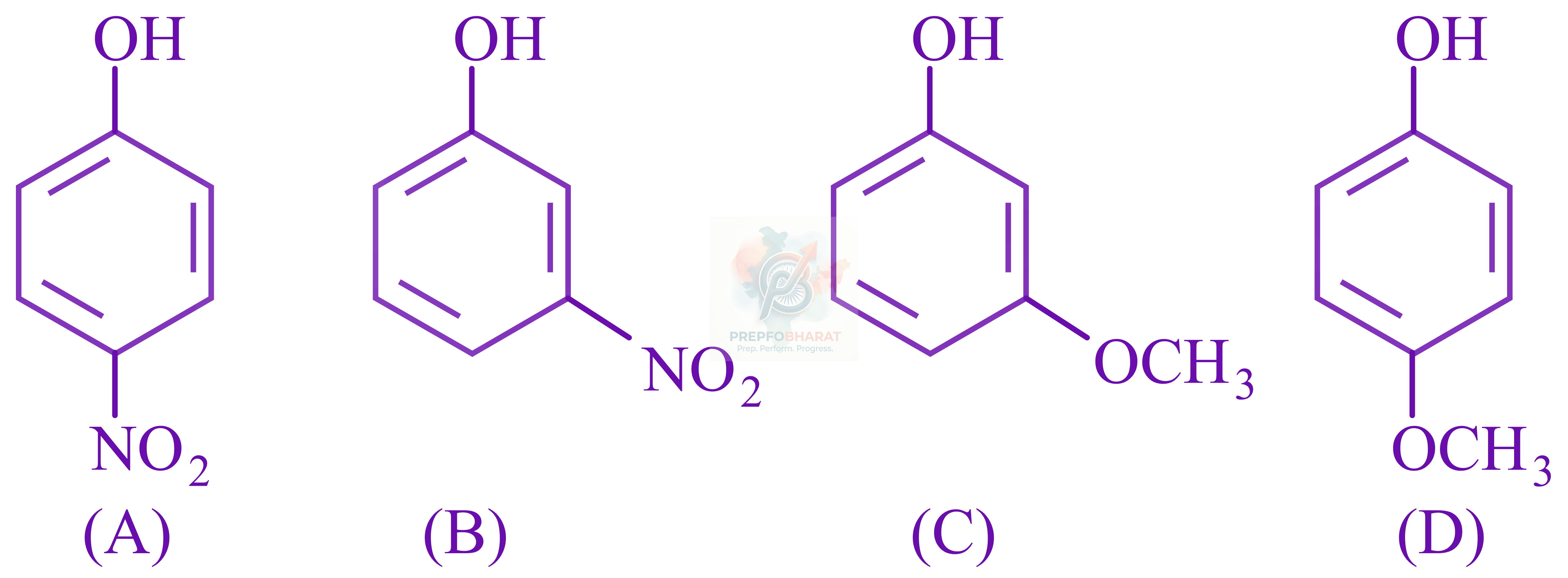
Which of the following is reducing sugar?
What will be the major product of following sequence of reactions? 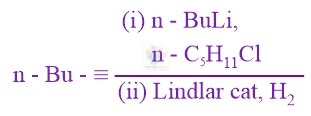
Observe structures of the following compounds  The total number of structures/compounds which possess asymmetric carbon atoms is
The major product '$A$' of the following given reaction has ${\mathrm{sp}}^{2}$ hybridized carbon atoms. $2,7$-Dimethyl-$2,6$-octadiene $\overset{{H}^{+}}{\longrightarrow }\underset{\mathrm{Major}\mathrm{Product}}{A}$
Identify the major product formed in the following sequence of reactions : 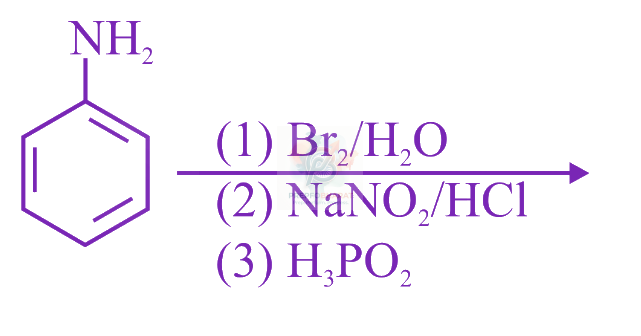
When sugar '$X$' is boiled with dilute ${H}_{2}{\mathrm{SO}}_{4}$ in alcoholic solution, two isomers '$A$' and '$B$' are formed. '$A$' on oxidation with ${\mathrm{HNO}}_{3}$ yields saccharic acid where as '$B$' is laevorotatory. The compound '$X$' is
The correct structure of product '$A$' formed in the following reaction, 
Among the following marked proton of which compound shows lowest ${\mathrm{pK}}_{a}$ value?
Given below are two statements : Statement I : In 'Lassaigne's Test', when both nitrogen and sulphur are present in an organic compound, sodium thiocyanate is formed. Statement II : If both nitrogen and sulphur are present in an organic compound, then the excess of sodium used in sodium fusion will decompose the sodium thiocyanate formed to give $\mathrm{NaCN}$ and ${\mathrm{Na}}_{2}S$. In the light of the above statements, choose the most appropriate answer from the options a: given below
Most stable product of the following reaction is 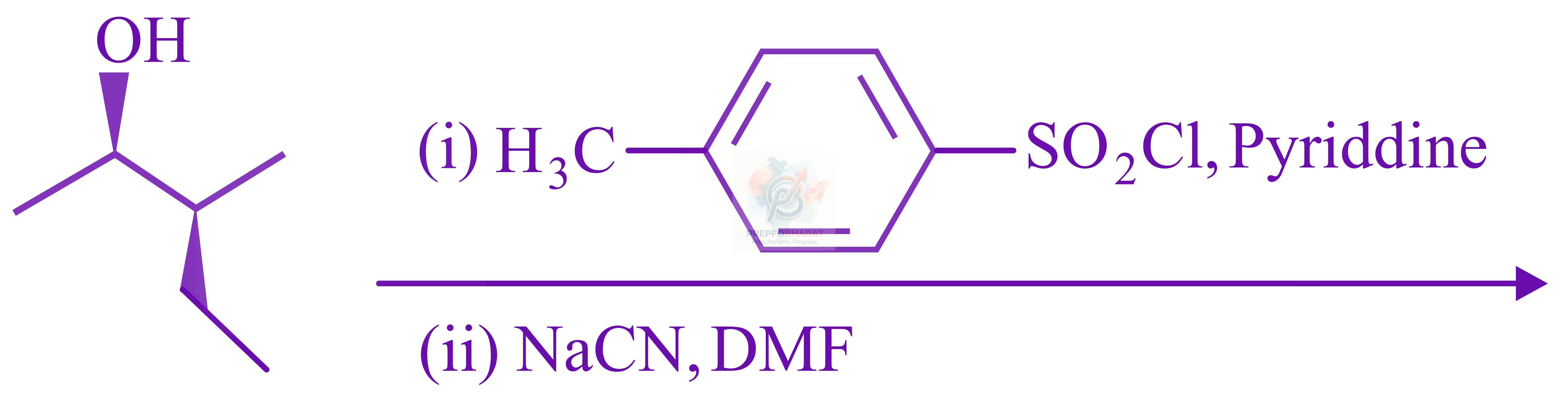
In alanylglycylleucylalanylvaline the number of peptide linkages is:
The major product formed in the given reaction is: 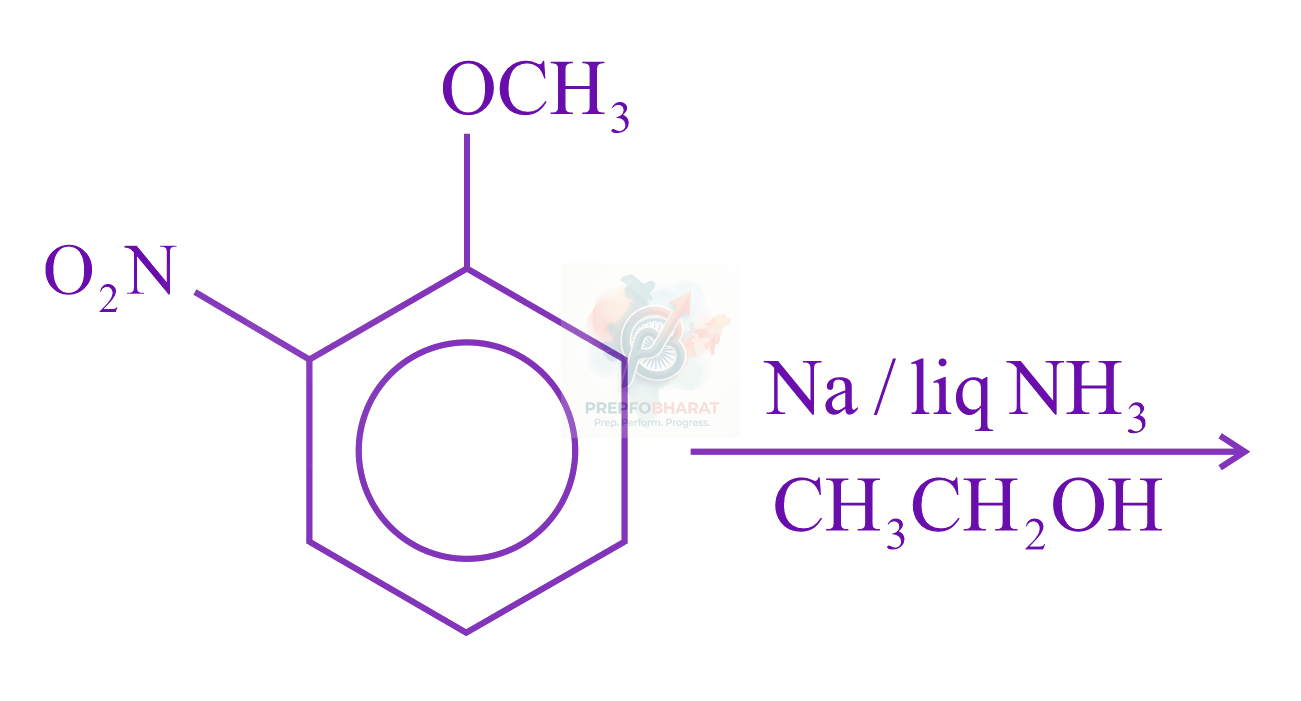
A sample of $4.5\mathrm{mg}$ of an unknown monohydric alcohol, $R-\mathrm{OH}$ was added to methylmagnesium iodide. A gas is evolved and is collected and its volume measured to be $3.1\mathrm{mL}$. The molecular weight of the unknown alcohol is $g/\mathrm{mol}$.
A $100\mathrm{mL}$ solution of ${\mathrm{CH}}_{3}{\mathrm{CH}}_{2}\mathrm{MgBr}$ on treatment with methanol produces $2.24\mathrm{mL}$ of a gas at STP. The weight of gas produced is____mg (nearest integer)
Which of the following compounds is not aromatic?
Wurtz reaction is used to prepare
Which of the following ketone will NOT give enamine on treatment with secondary amines? [where $t-\mathrm{Bu}$ is $-C{({\mathrm{CH}}_{3})}_{3}$]
Optical activity of an enantiomeric mixture is $+12.6^{\circ}$ and the specific rotation of $(+)$ isomer is $+30^{\circ}$. The optical purity is____$%$
The conversion of propan-$1$-ol to n-butylamine involves the sequential addition of reagents. The correct sequential order of reagents is
Which one of the following techniques is not used to spot components of a mixture separated on thin layer chromatographic plate?
The structure of protein that is unaffected by heating is :
In Carius method of estimation of halogen. $0.45g$ of an organic compound gave $0.36g$ of $\mathrm{AgBr}$. Find out the percentage of bromine in the compound. (Molar masses : $\mathrm{AgBr}=188g{\mathrm{mol}}^{-1}:\mathrm{Br}=80g{\mathrm{mol}}^{-1}$)
For the below given cyclic hemiacetal $(X)$, the correct pyranose structure is 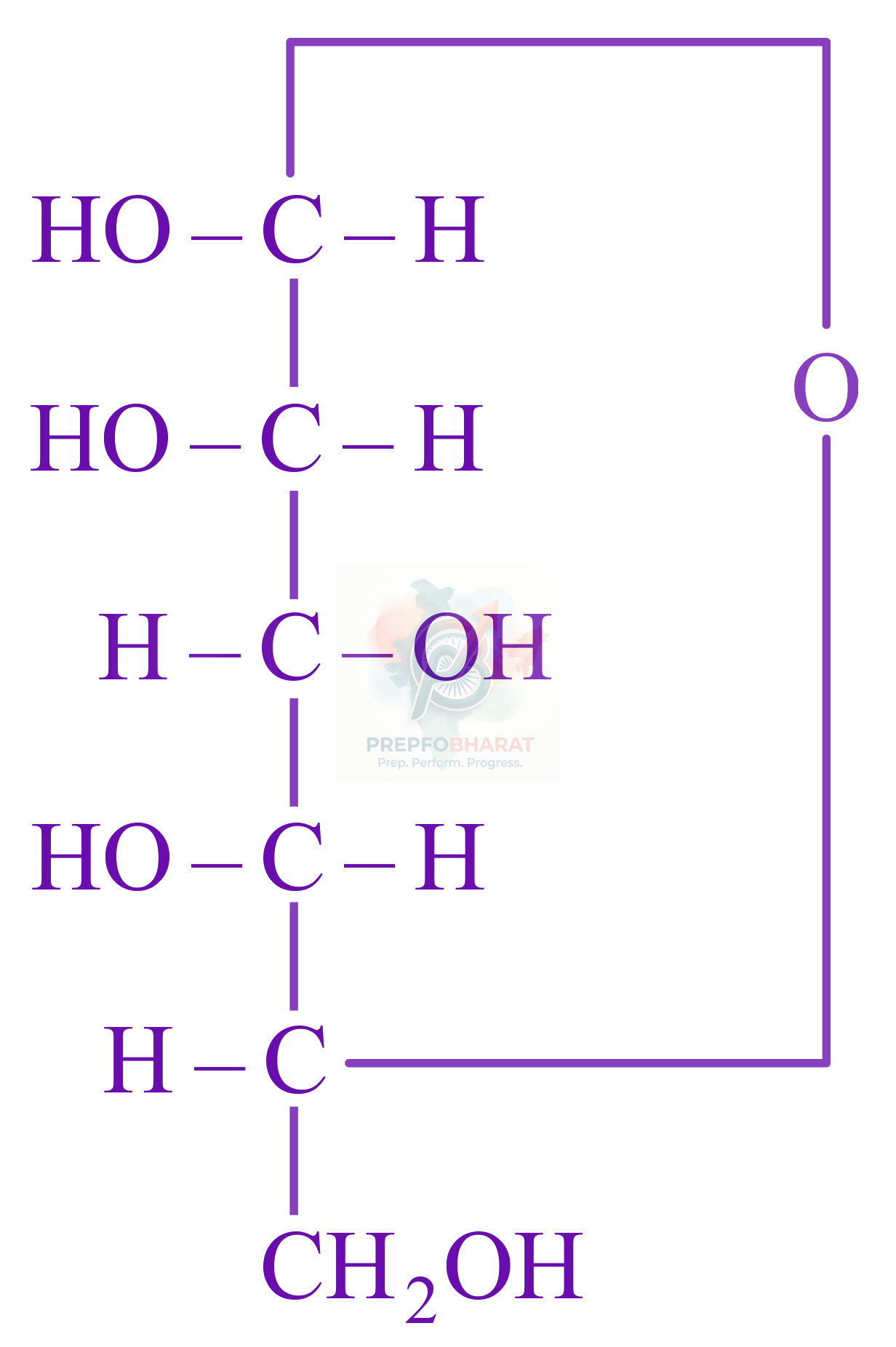
Major product of the following reaction is 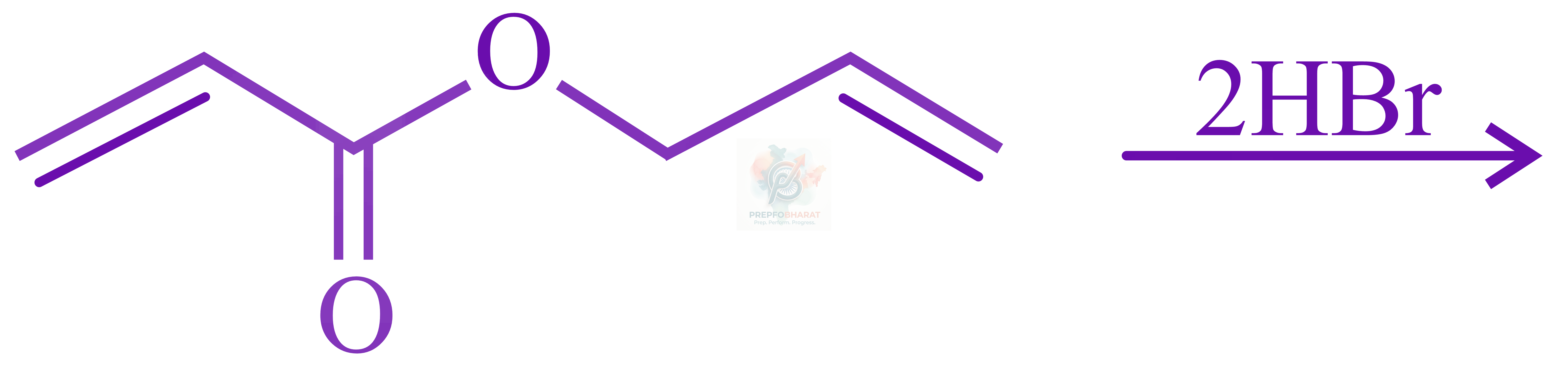
 Consider the above reaction and predict the major product.
A compound '$X$' is acidic and it is soluble in $\mathrm{NaOH}$ solution, but insoluble in ${\mathrm{NaHCO}}_{3}$ solution. Compound '$X$' also gives violet colour with neutral ${\mathrm{FeCl}}_{3}$ solution. The compound '$X$' is
Decarboxylation of all six possible forms of diaminobenzoic acids ${C}_{6}{H}_{3}{({\mathrm{NH}}_{2})}_{2}\mathrm{COOH}$ yields three products $A,B$ and $C$. Three acids give a product '$A$', two acids gives a product '$B$' and one acid give a product '$C$'. The melting point of product '$C$' is
Compound '$A$' undergoes following sequence of reactions to give compound '$B$'. The correct structure and chirality of compound '$B$' is [where $\mathrm{Et}$ is $-{C}_{2}{H}_{5}$] 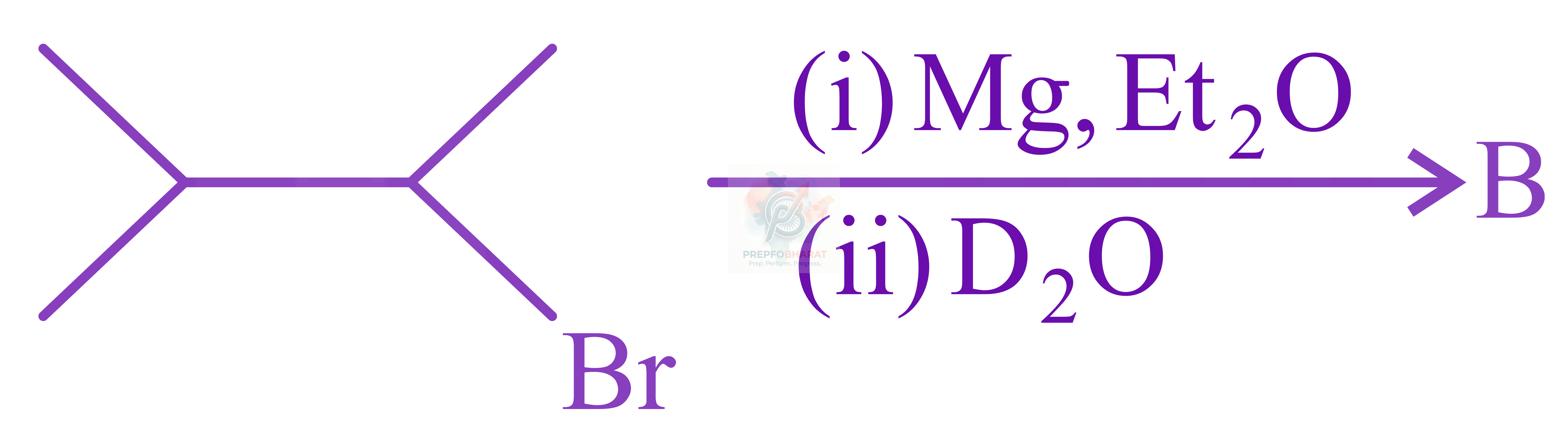 Compound '$A$'
In Friedel-Crafts alkylation of aniline, one gets:
Given below are two statements. Statement I : The compound 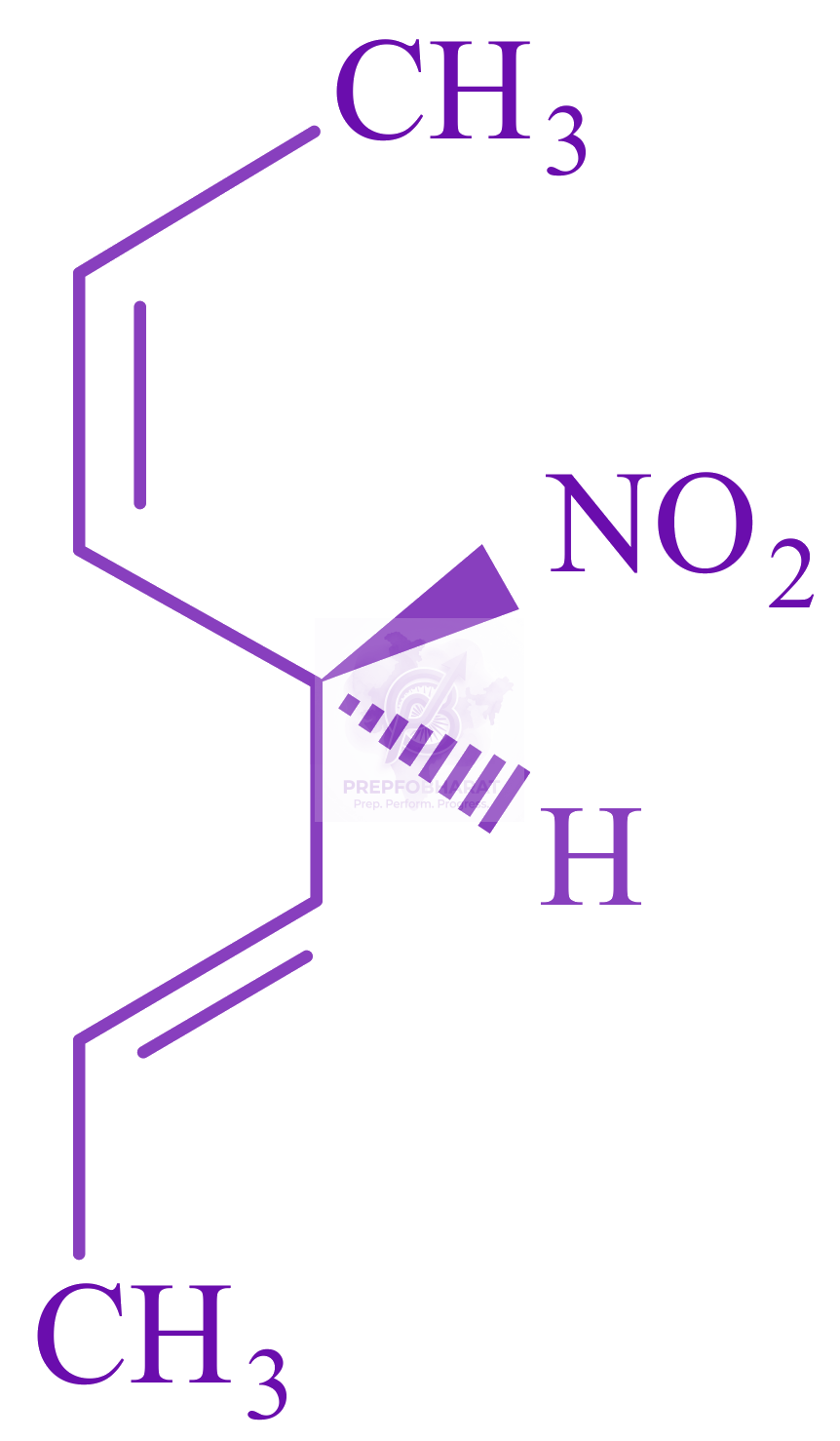 is optically active. Statement II : 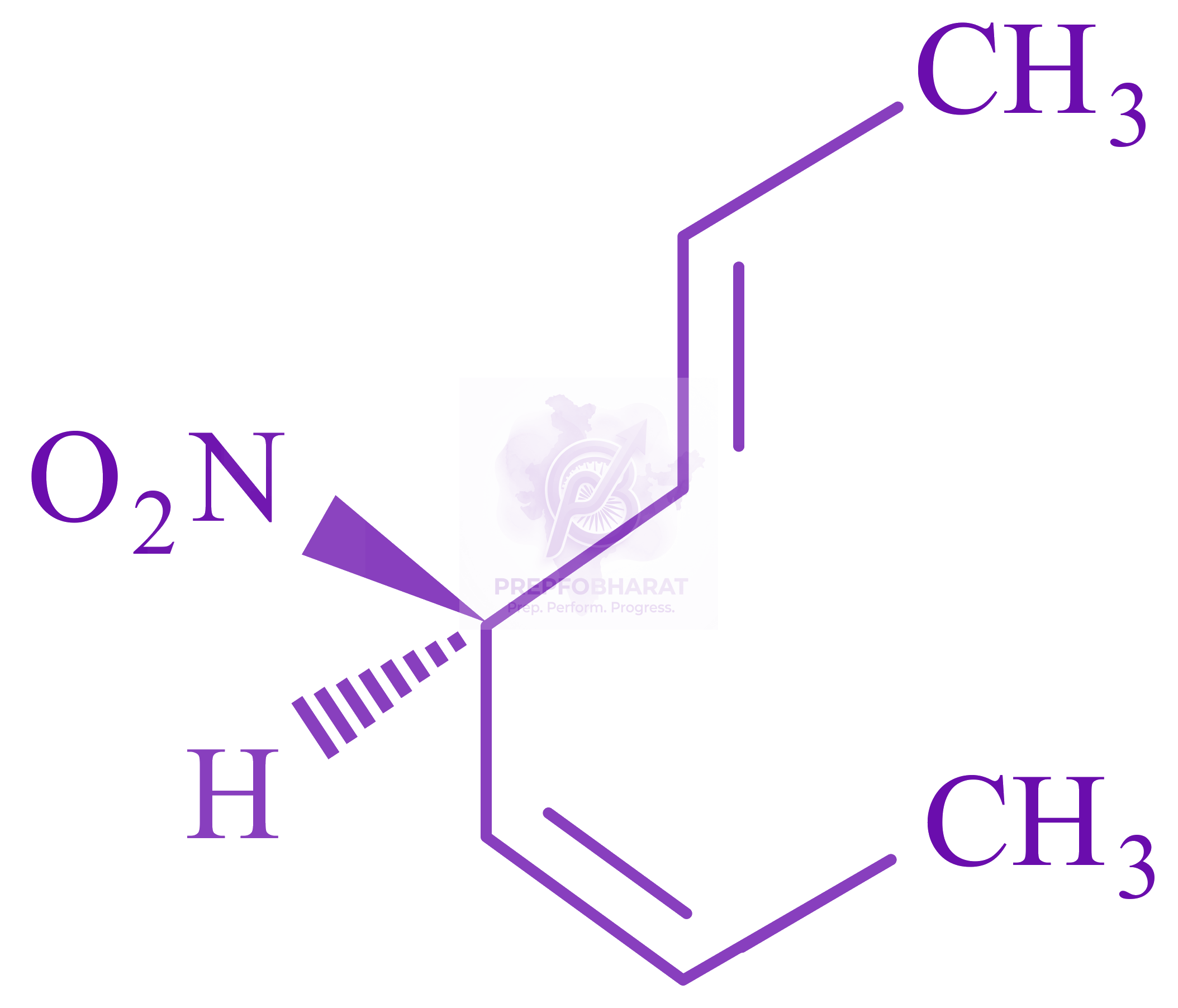 is mirror image of above compound $A$. In the light of the above statement, choose the most appropriate answer from the options given below.
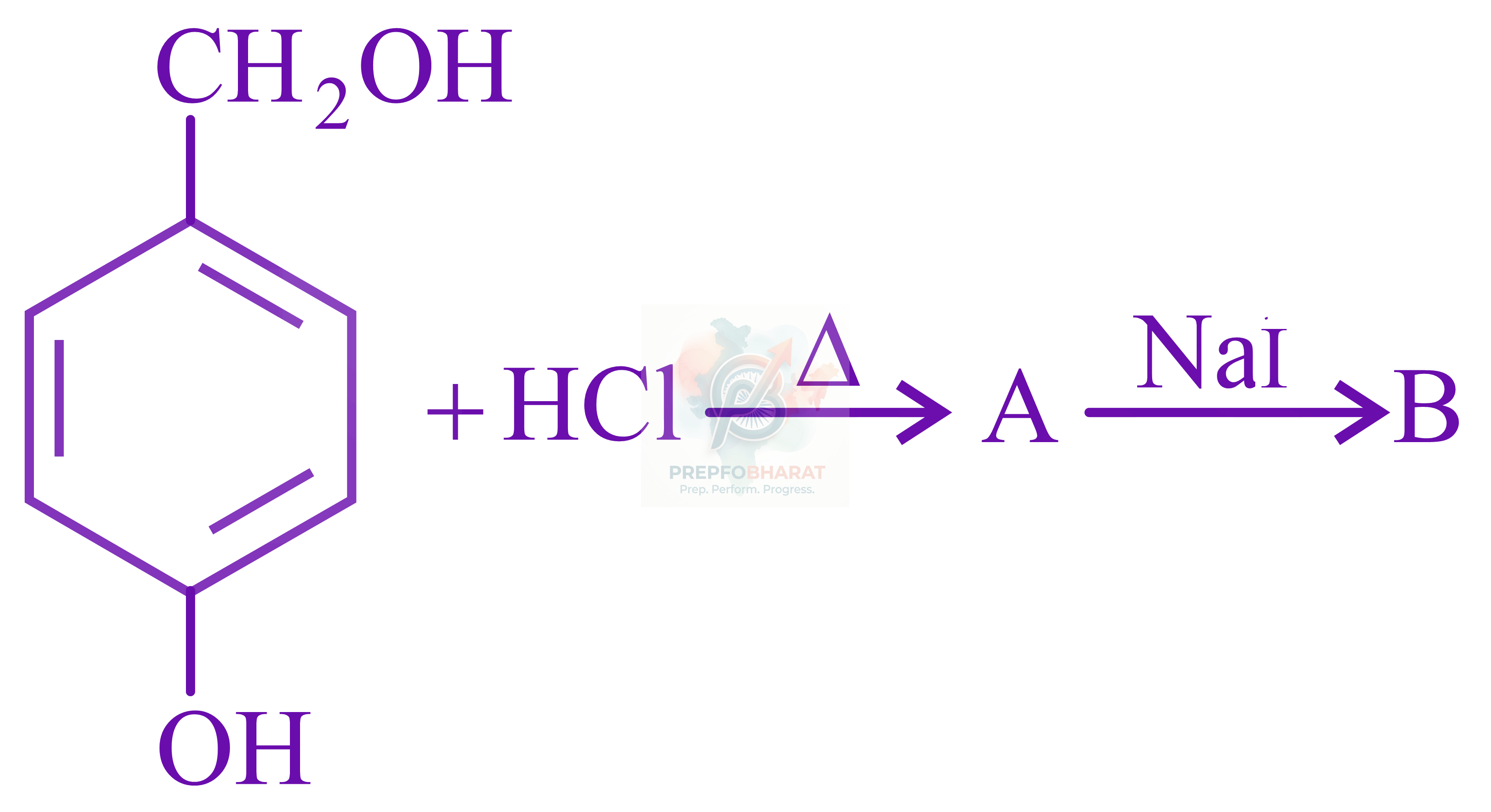 In the above reaction product $B$ is
Which of the following is not an example of benzenoid compound?
Number of electrophillic centres in the given compound is___ 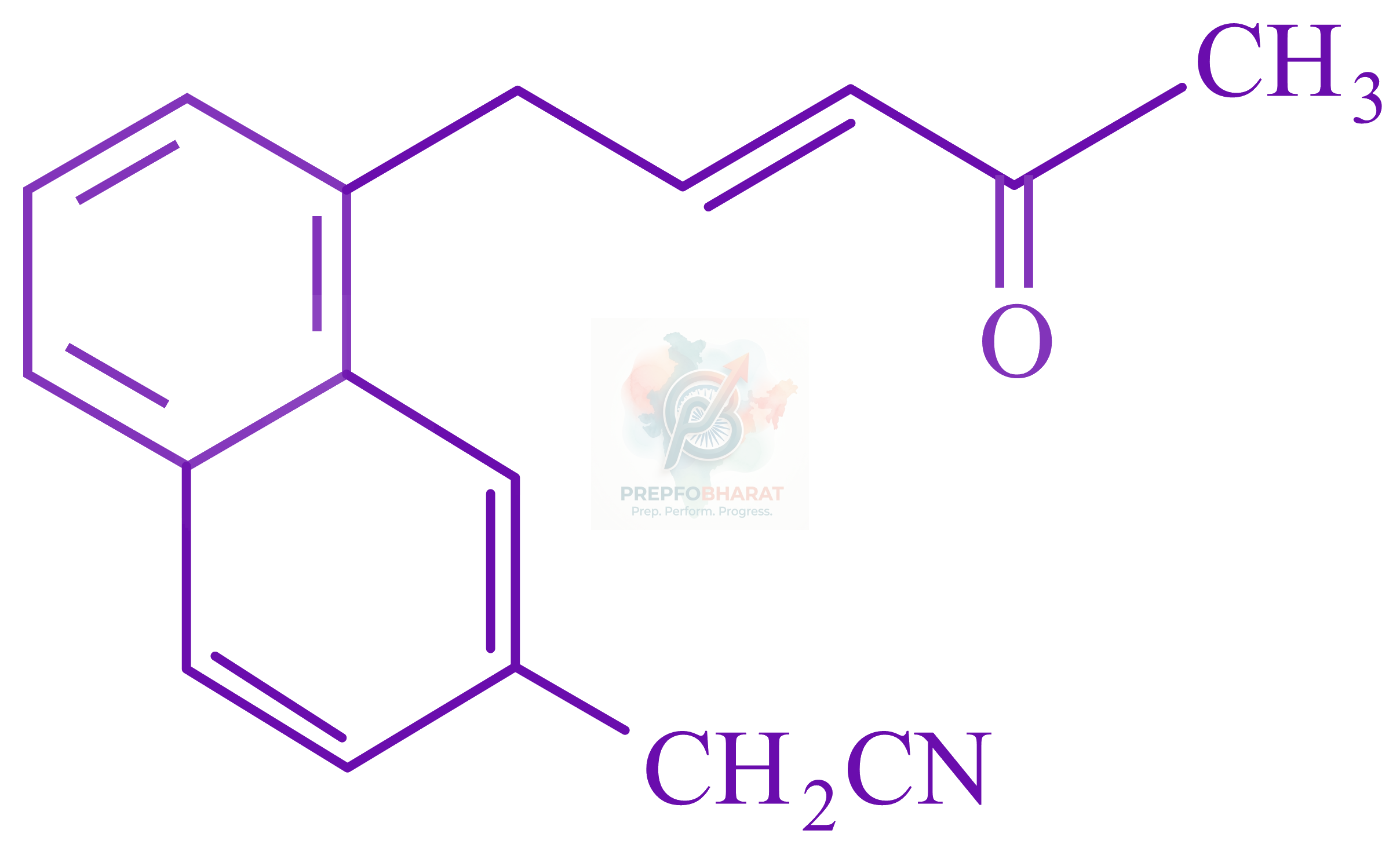
In the estimation of bromine, $0.5g$ of an organic compound gave $0.40g$ of silver bromide. The percentage of bromine in the given compound is $%$ (nearest integer) (Relative atomic masses of $\mathrm{Ag}$ and $\mathrm{Br}$ are $108u$ and $80u$, respectively).
In the following reaction : 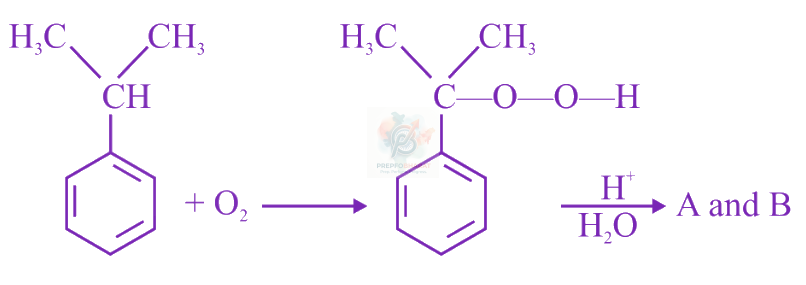 The compounds $A$ and $B$ respectively are
The correct order of nucleophilicity is
The number of ${\mathrm{sp}}^{3}$ hybridised carbons in an acyclic neutral compound with molecular formula ${C}_{4}{H}_{5}N$ is
${C}_{6}{H}_{12}{O}_{6}\overset{\mathrm{Zymase}}{\longrightarrow }A\rightarrow _{\Delta }^{\mathrm{NaOI}}B+{\mathrm{CHI}}_{3}$ The number of carbon atoms present in the product $B$ is
Which of the following carbocations is most stable:
The major product $(P)$ in the reaction 
Which of the following structures are aromatic in nature? 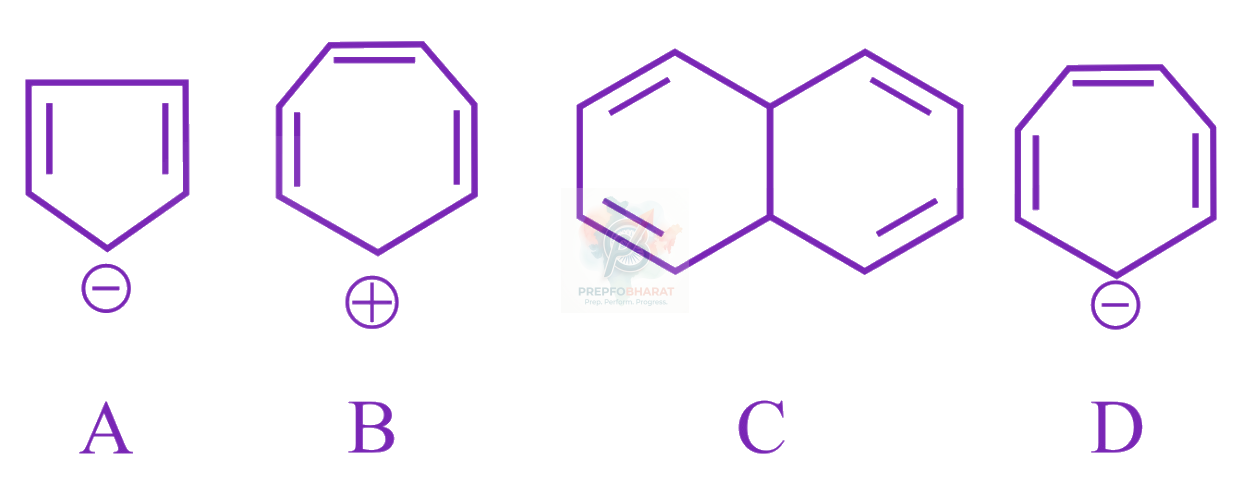
Which of the following reagents / reactions will convert '$A$' to '$B$'? 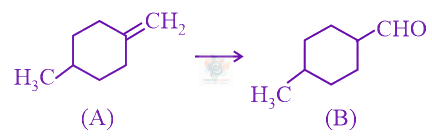
The correct IUPAC name of the following compound is 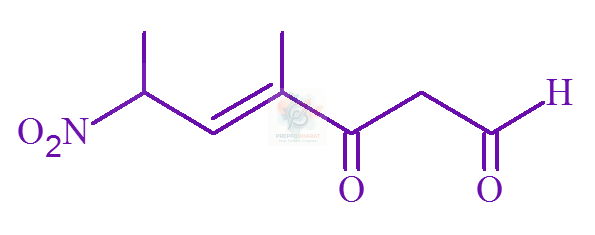
The separation of two coloured substances was done by paper chromatography. The distances travelled by solvent front, substance $A$ and substance $B$ from the base line are $3.25\mathrm{cm}.2.08\mathrm{cm}$ and $1.05\mathrm{cm}$. respectively. The ratio of ${R}_{f}$ values of $A$ to $B$ is (Answer the nearest integer)
While estimating the nitrogen present in an organic compound by Kjeldahl's method, the ammonia evolved from $0.25g$ of the compound neutralized $2.5\mathrm{mL}$ of $2{\mathrm{MH}}_{2}{\mathrm{SO}}_{4}$. The percentage of nitrogen present in organic compound is _____ .
The intermediate $X$, in the reaction 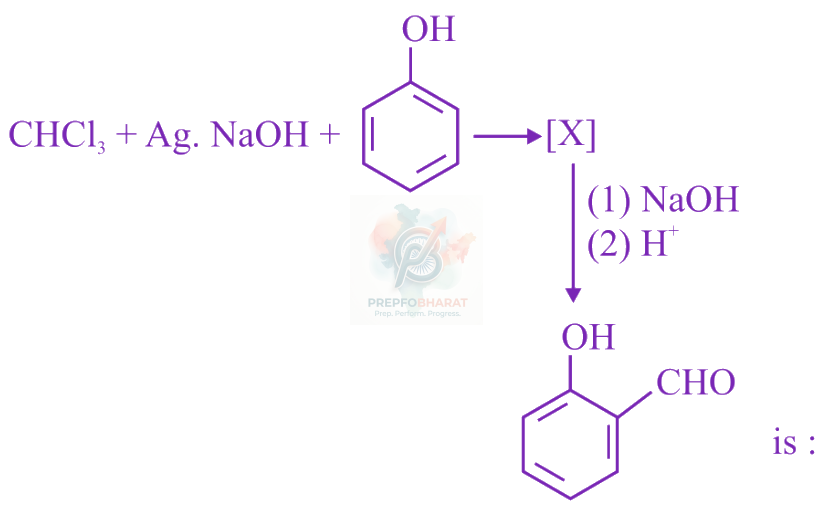
The total number of monobromo derivatives formed by the alkanes with molecular formula ${C}_{5}{H}_{12}$ is (excluding stereo isomers)
The correct sequential order of the reagents for the given reaction is 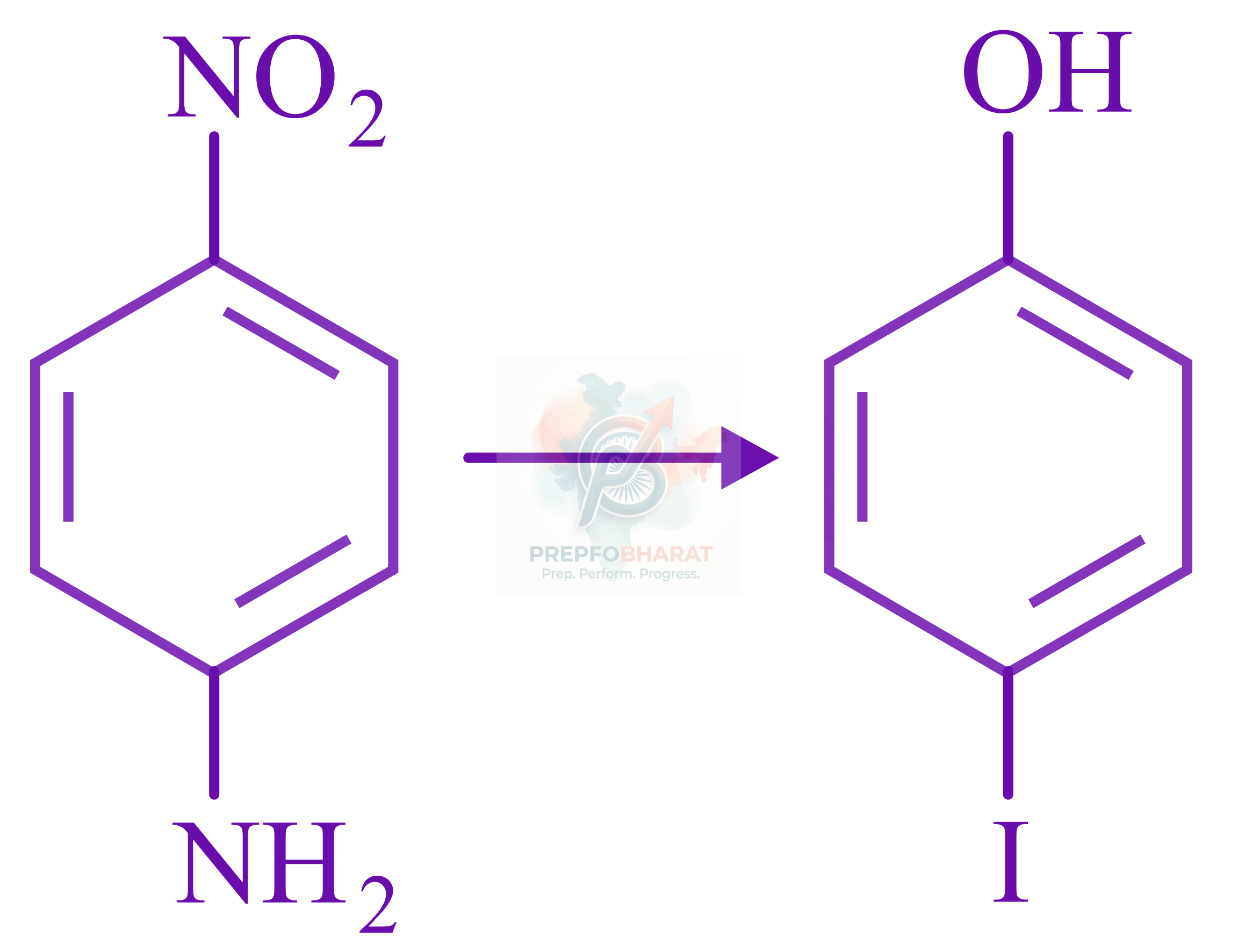
What is the major product of the following reaction? 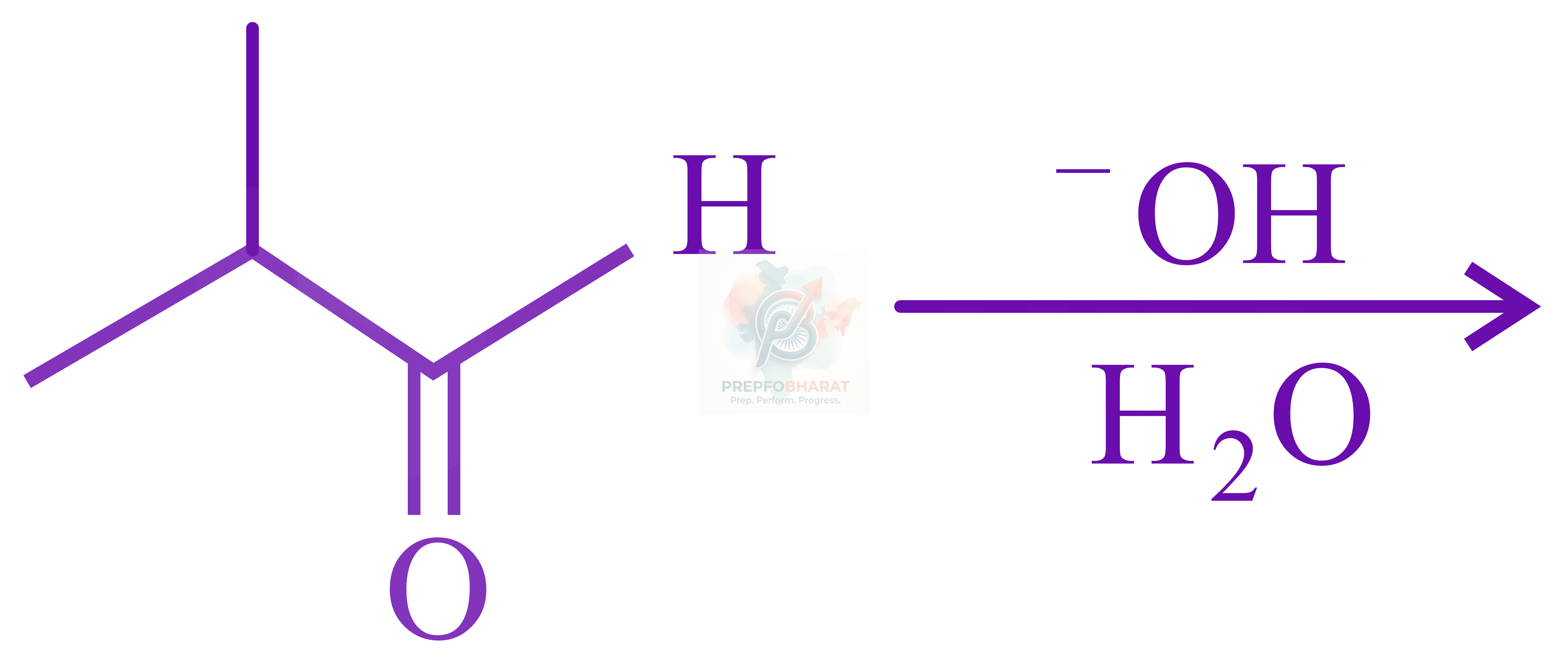
The products formed in the following reaction, $A$ and $B$ are 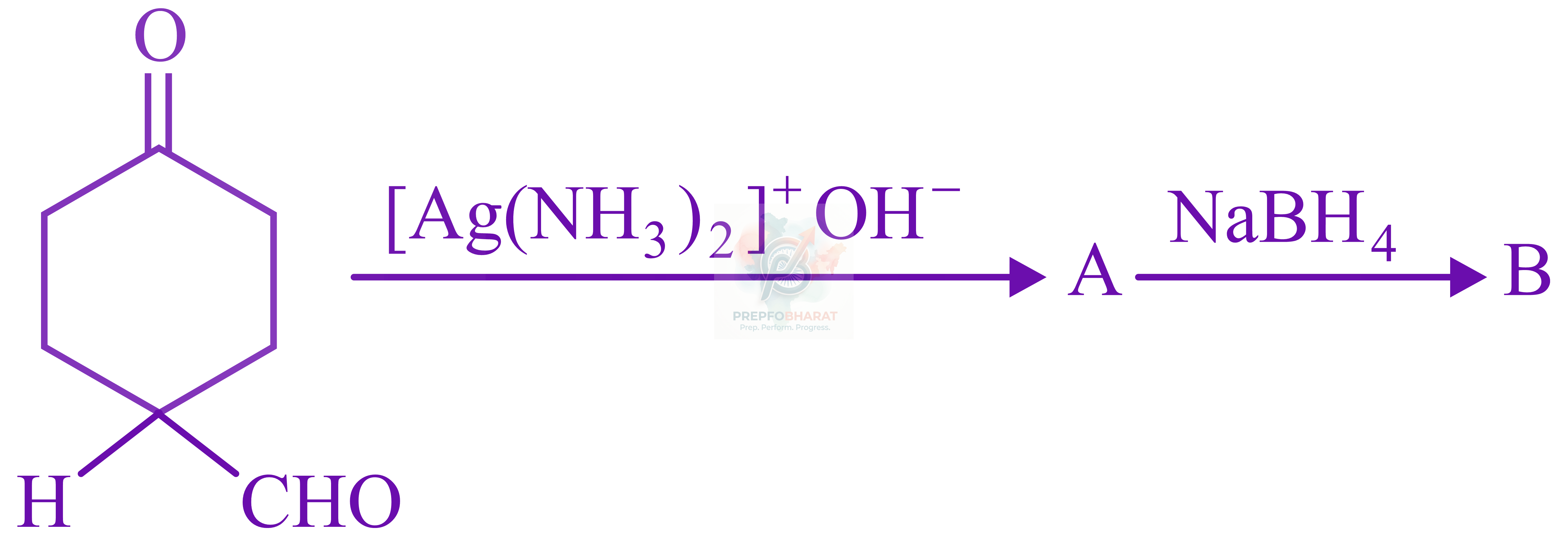
In the given reaction sequence, the major product '$C$' is : ${C}_{8}{H}_{10}\underset{{H}_{2}{\mathrm{SO}}_{4}}{\overset{{\mathrm{HNO}}_{3}}{\longrightarrow }}A\underset{\Delta }{\overset{{\mathrm{Br}}_{2}}{\longrightarrow }}B\underset{\mathrm{KOH}}{\overset{\mathrm{alcoholic}}{\longrightarrow }}C$
A sample of $0.125g$ of an organic compound when analysed by Duma's method yields $22.78\mathrm{mL}$ of nitrogen gas collected over $\mathrm{KOH}$ solution at $280K$ and $759\mathrm{mmHg}$. The percentage of nitrogen in the given organic compound is____ (a) The vapour pressure of water at $280K$ is $14.2\mathrm{mmHg}$ (b) $R=0.082L\mathrm{atm}{K}^{-1}{\mathrm{mol}}^{-1}$
In a linear tetrapeptide (Constituted with different amino acids), (number of amino acids) - (number of peptide bonds) is
Product '$A$' of following sequence of reactions is 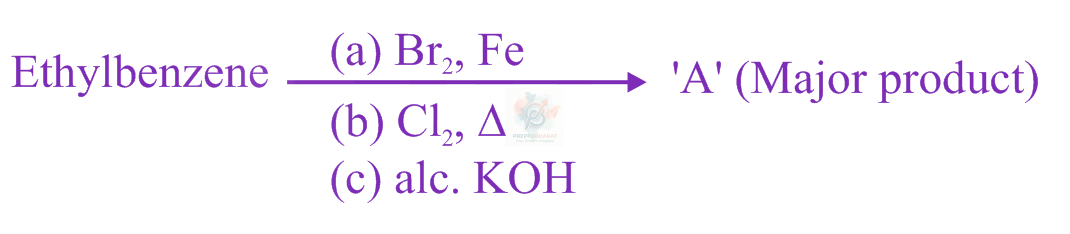
Which among the following pairs of the structures will give different products on ozonolysis? (Consider the double bonds in the structures are rigid and not delocalized.)
Isobutyraldehyde on reaction with formaldehyde and ${K}_{2}{\mathrm{CO}}_{3}$ gives compound '$A$'. Compound '$A$' reacts with $\mathrm{KCN}$ and yields compound '$B$', which on hydrolysis gives a stable compound '$C$'. The compound '$C$' is
In the following reaction 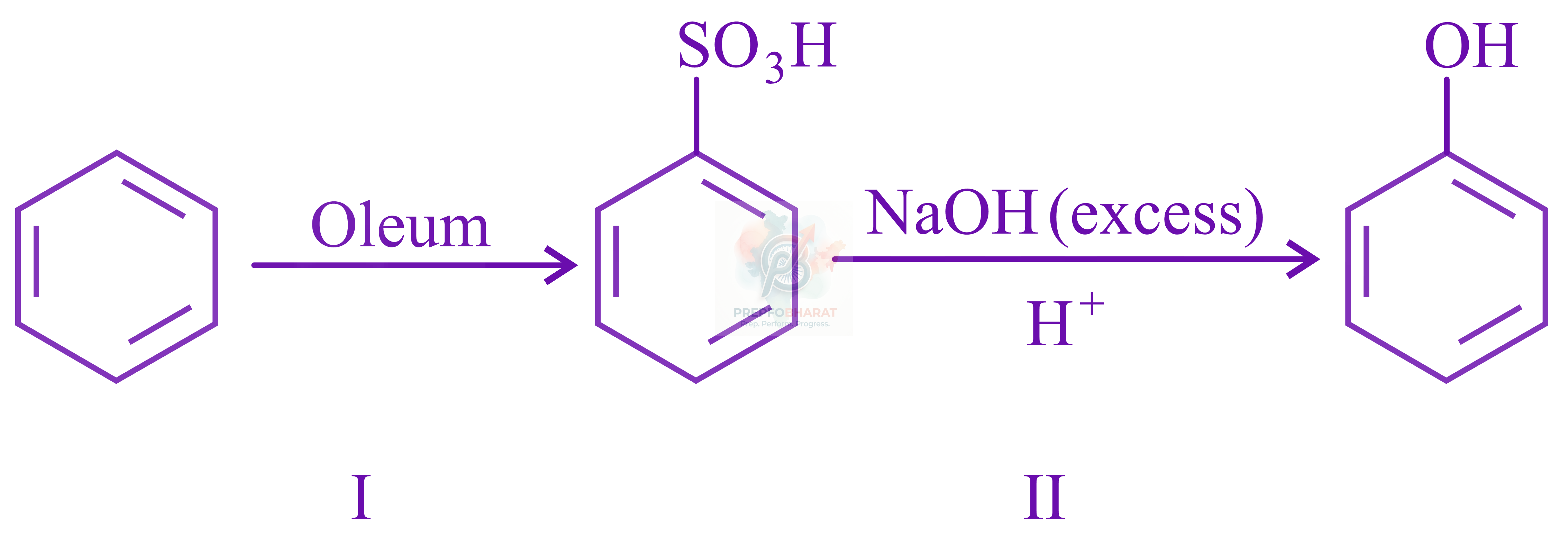 The $%$ yield for reaction $I$ is $60%$ and that of reaction II is $50%$. The overall yield of the complete reaction is$%$
The reagent, from the following, which converts benzoic acid to benzaldehyde in one step is 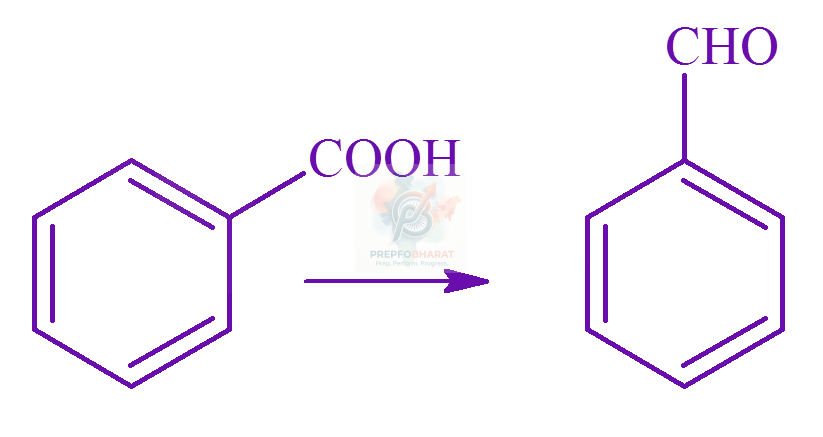
Match List-I with List-II. <table class="pyq-table"><tbody><tr><td></td><td>List-I</td><td></td><td>List-II</td></tr><tr><td>A</td><td><img src="https://prepforbharat.s3.ap-south-1.amazonaws.com/exam/615f0e999476412f48314daf/Chemistry/images/General_Organic_Chemistry/648b5a6d417cc3fb48d67c48/question_1__q_648b5a6d417cc3fb48d67c48__cdn-question-pool.getmarks.app__c428342f-79fb-4645-956e-913ec032a1a6-image__67208d0df2_final_ppt_sync.png" alt="JEE Main 2022 Chemistry, General Organic Chemistry — question figure 1"></td><td>I</td><td>Spiro compound</td></tr><tr><td>B</td><td><img src="https://prepforbharat.s3.ap-south-1.amazonaws.com/exam/615f0e999476412f48314daf/Chemistry/images/General_Organic_Chemistry/648b5a6d417cc3fb48d67c48/question_2__q_648b5a6d417cc3fb48d67c48__cdn-question-pool.getmarks.app__76cf310f-55b5-48ac-b14d-bb20f164b773-image__653fb76719_final_ppt_sync.png" alt="JEE Main 2022 Chemistry, General Organic Chemistry — question figure 2"></td><td>II</td><td>Aromatic compound</td></tr><tr><td>C</td><td><img src="https://prepforbharat.s3.ap-south-1.amazonaws.com/exam/615f0e999476412f48314daf/Chemistry/images/General_Organic_Chemistry/648b5a6d417cc3fb48d67c48/question_3__q_648b5a6d417cc3fb48d67c48__cdn-question-pool.getmarks.app__112a680f-8988-4665-87d4-e6f1290d384f-image__05c5654f8d_final_ppt_sync.png" alt="JEE Main 2022 Chemistry, General Organic Chemistry — question figure 3"></td><td>III</td><td>Non-planar Heterocyclic compound</td></tr><tr><td>D</td><td><img src="https://prepforbharat.s3.ap-south-1.amazonaws.com/exam/615f0e999476412f48314daf/Chemistry/images/General_Organic_Chemistry/648b5a6d417cc3fb48d67c48/question_4__q_648b5a6d417cc3fb48d67c48__cdn-question-pool.getmarks.app__71fed07a-666a-465e-b24e-c8411837ca36-image__15a2cf8b5b_final_ppt_sync.png" alt="JEE Main 2022 Chemistry, General Organic Chemistry — question figure 4"></td><td>IV</td><td>Bicyclo compound</td></tr></tbody></table>Choose the correct answer from the options given below
The major product in the given reaction is 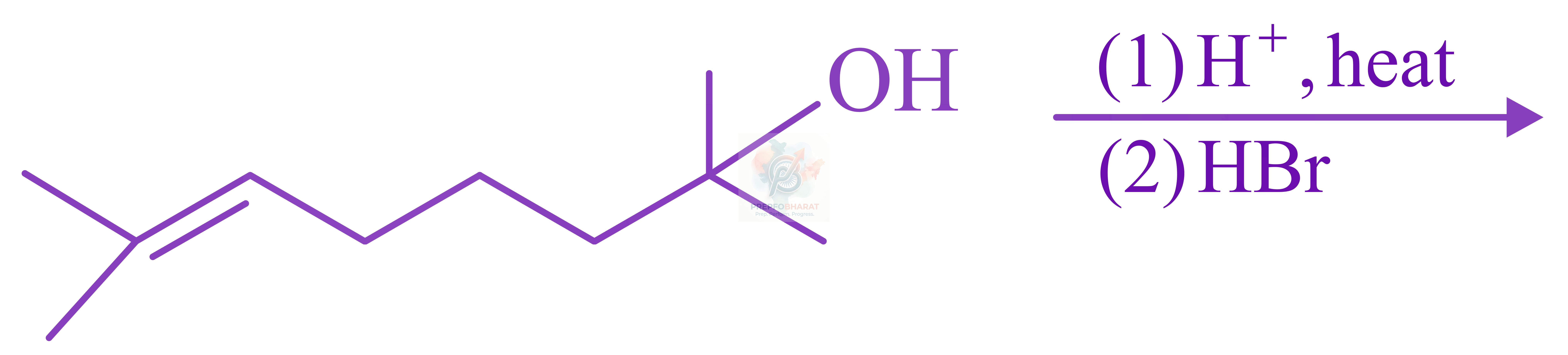
The major product of the following reaction is 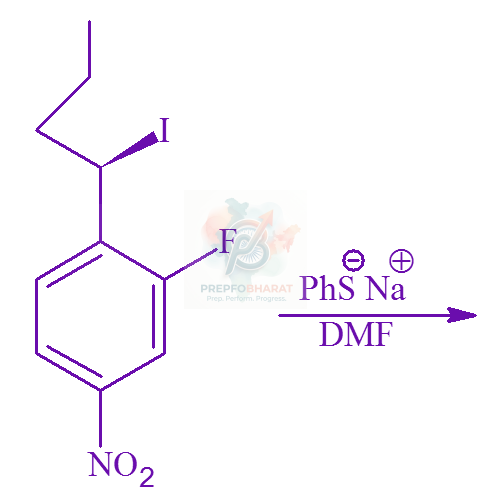
Which of the following reactions will yield benzaldehyde as a product? 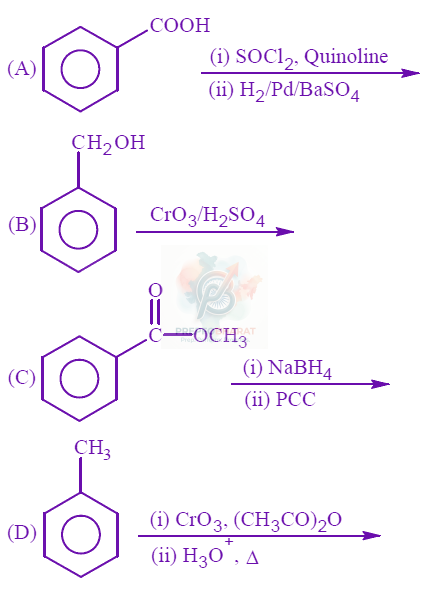
Compound $I$ is heated with Conc. $\mathrm{HI}$ to give a hydroxy compound A which is further heated with $\mathrm{Zn}$ dust to give compound $B$. Identify $A$ and $B$. 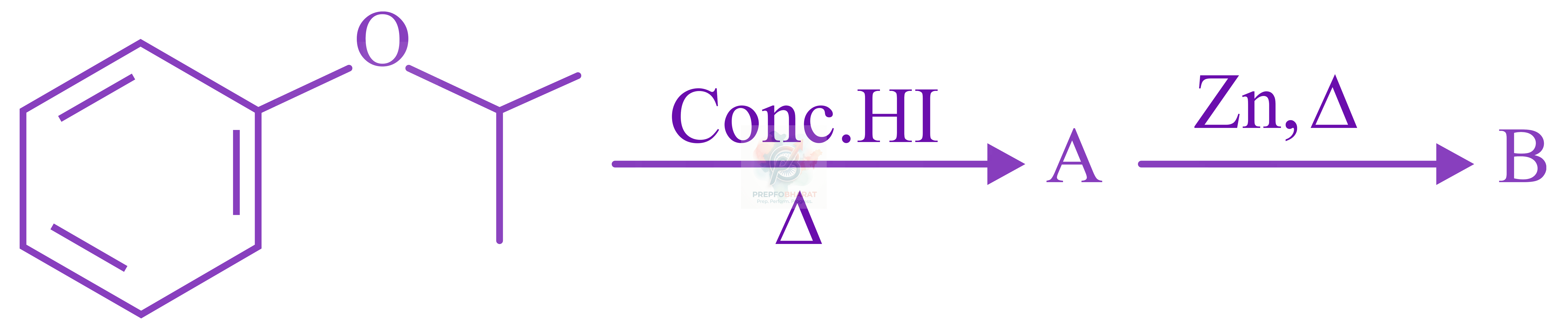
Glycosidic linkage between ${C}_{1}$ of $\alpha$-glucose and ${C}_{2}$ of $\beta$-fructose is found in
Match List-I with List-II <table class="pyq-table"><tbody><tr><td></td><td>List-I</td><td></td><td>List-II</td></tr><tr><td>A</td><td>Glucose $+\mathrm{HI}$</td><td>I</td><td>Gluconic acid</td></tr><tr><td>B</td><td>Glucose $+{\mathrm{Br}}_{2}$ water</td><td>II</td><td>Glucose pentacetate</td></tr><tr><td>C</td><td>Glucose $+$ acetic anhydride</td><td>III</td><td>Saccharic acid</td></tr><tr><td>D</td><td>Glucose $+{\mathrm{HNO}}_{3}$</td><td>IV</td><td>Hexane</td></tr></tbody></table>Choose the correct answer from the options given below
In the given reaction 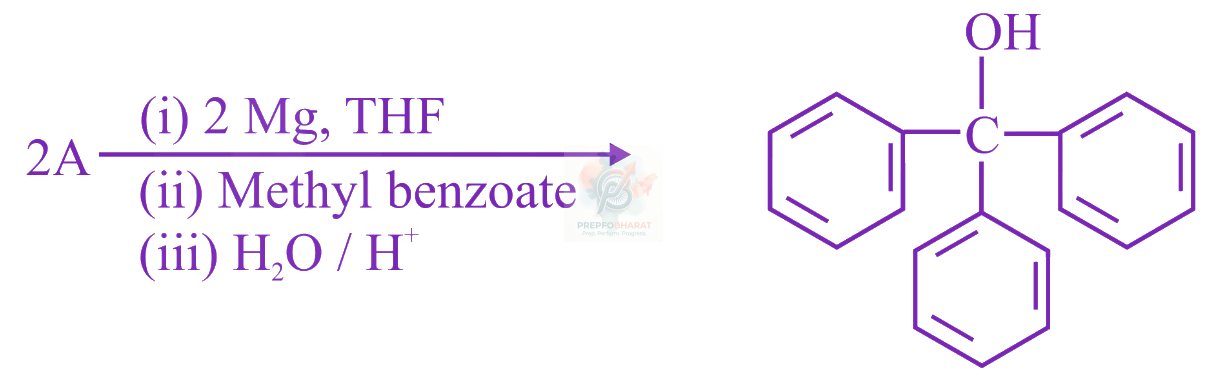 '$A$' can be
Given below are two statements: one is labelled as Assertion $(A)$ and the other is labelled as Reason $(R)$. Assertion $(A)$ : Experimental reaction of ${\mathrm{CH}}_{3}\mathrm{Cl}$ with aniline and anhydrous ${\mathrm{AlCl}}_{3}$ does not give $o$ and $p$-methylaniline. Reason $(R)$ : The $-{\mathrm{NH}}_{2}$ group of aniline becomes deactivating because of salt formation with anhydrous ${\mathrm{AlCl}}_{3}$ and hence yields $m$-methyl aniline as the product. In the light of the above statements, choose the most appropriate answer from the options given below
'$A$' and '$B$' respectively are A. $\rightarrow _{(2)\mathrm{Zn}-{H}_{2}O}^{(1){O}_{3}}$ Ethane-$1,2$-dicarbaldehyde $+$Glyoxal/Oxaldehyde B $\rightarrow _{(2)\mathrm{Zn}-{H}_{2}O}^{(1){O}_{3}}5-$ -oxohexanal