Organic Chemistry PYQ
JEE Main Chemistry — Organic Chemistry previous year questions with solutions.
Browse by Year
Organic Chemistry at a glance
Questions per year
1783 across 25 yearsDifficulty mix
1783 total- easy475 · 27%
- medium926 · 52%
- hard382 · 21%
Subtopic-wise weightage
Breakdown of the 1770 Organic Chemistry questions tagged to a subtopic, by year — darker cells mean more questions.
| Subtopic | Weightage | Total | 2026 | 2025 | 2024 | 2023 | 2022 | 2021 | 2020 | 2019 | 2018 | 2017 | 2016 | 2015 | 2014 | 2013 | 2012 | 2011 | 2010 | 2009 | 2008 | 2007 | 2006 | 2005 | 2004 | 2003 | 2002 |
|---|---|---|---|---|---|---|---|---|---|---|---|---|---|---|---|---|---|---|---|---|---|---|---|---|---|---|---|
| Basic Principles (GOC) | 25.3% | 448 | 38 | 43 | 85 | 41 | 43 | 52 | 27 | 23 | 8 | 5 | 4 | 7 | 5 | 10 | 11 | 3 | 3 | 4 | 2 | 3 | 4 | 6 | 8 | 6 | 7 |
| Aldehydes, Ketones & Carboxylic Acids | 13.8% | 244 | 17 | 25 | 26 | 25 | 24 | 37 | 16 | 31 | 6 | 3 | 5 | 5 | 3 | 4 | 2 | 1 | 1 | 1 | 1 | 2 | 4 | 3 | 2 | ||
| Hydrocarbons | 13.7% | 242 | 28 | 24 | 28 | 22 | 22 | 38 | 21 | 21 | 8 | 3 | 3 | 1 | 5 | 4 | 4 | 1 | 1 | 4 | 2 | 1 | 1 | ||||
| Amines (Nitrogen compounds) | 12.4% | 219 | 29 | 19 | 22 | 25 | 22 | 40 | 14 | 19 | 3 | 2 | 3 | 2 | 5 | 3 | 3 | 1 | 2 | 2 | 1 | 1 | 1 | ||||
| Biomolecules | 12.3% | 218 | 24 | 22 | 22 | 21 | 23 | 29 | 14 | 18 | 8 | 3 | 3 | 4 | 3 | 5 | 5 | 1 | 1 | 1 | 1 | 1 | 2 | 1 | 2 | 2 | 2 |
| Alcohols, Phenols & Ethers | 11.5% | 204 | 22 | 14 | 22 | 25 | 26 | 25 | 8 | 15 | 6 | 2 | 3 | 10 | 11 | 1 | 1 | 2 | 1 | 1 | 3 | 2 | 2 | 2 | |||
| Haloalkanes & Haloarenes | 11.0% | 194 | 19 | 15 | 22 | 20 | 15 | 14 | 12 | 15 | 4 | 7 | 5 | 2 | 9 | 5 | 7 | 1 | 1 | 1 | 1 | 2 | 6 | 5 | 1 | 2 | 3 |
| Chemistry in Everyday Life | 0.1% | 1 | 1 | ||||||||||||||||||||||||
| All subtopics | 1770 | 177 | 163 | 227 | 179 | 175 | 235 | 112 | 142 | 43 | 25 | 21 | 21 | 42 | 41 | 34 | 9 | 9 | 9 | 9 | 12 | 17 | 18 | 19 | 16 | 15 |
All Organic Chemistry Questions (1783)
Given below are two statements : Statement I: Compound $(X)$, shown below, dissolves in $\mathrm{NaHCO}_{3}$ solution and has two chiral carbon atoms 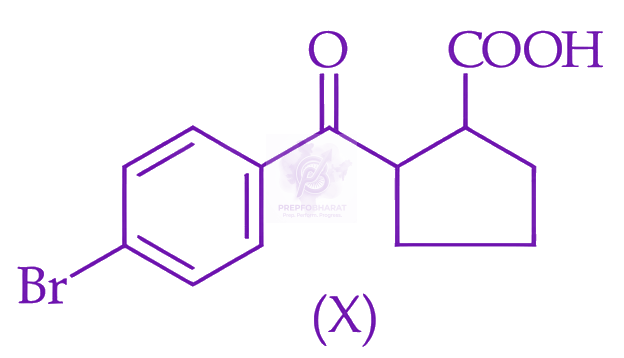 Statement II: Compound $(\mathrm{Y})$, shown below, has two carbons with $\mathrm{sp}^{3}$ hybridization, one carbon with $\mathrm{sp}^{2}$ and one carbon with sp hybridization 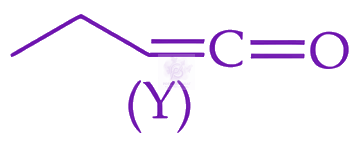 In the light of the above statements, choose the correct answer from the options given below :
A student has been given a compound " $x$ " of molecular formula- $\mathrm{C}_{6} \mathrm{H}_{7} \mathrm{~N}$. ' $x$ ' is sparingly soluble in water. However, on addition of dilute mineral acid, ' $x$ ' becomes soluble in water. ' $x$ ' when treated with $\mathrm{CHCl}_{3}$ and $\mathrm{KOH}($ alc $)$, ' $y$ ' is produced. ' y ' has a specific unpleasant smell. On treatment with benzenesulphonyl chloride, ' $x$ ' gives a compound ' $z$ ' which is soluble in alkali. The number of different " $H$ " atoms present in ' $z$ ' is:-
$4.7$ g of phenol is heated with Zn to give product X. If this reaction goes to $60\%$ completion then the number of moles of compound X formed will be _______ $\times 10^{-2}$. (Nearest Integer) (Given molar mass in g mol$^{-1}$: H:1, C:12, O:16)
The mass of benzanilide obtained from the benzoylation reaction of 5.8 g of aniline, if yield of product is $82 \%$, is $\_\_\_\_$ g (nearest integer). (Given molar mass in $\mathrm{g} \mathrm{mol}^{-1} \mathrm{H}: 1, \mathrm{C}: 12, \mathrm{~N}: 14, \mathrm{O}: 16$)
Consider the following sequence of reactions.  The percentage of nitrogen in the yellow product (X) formed is _______%. (Nearest Integer) (Given Molar mass in g mol$^{-1}$ H:1, C:12, N:14)
Identify A in the following reaction. 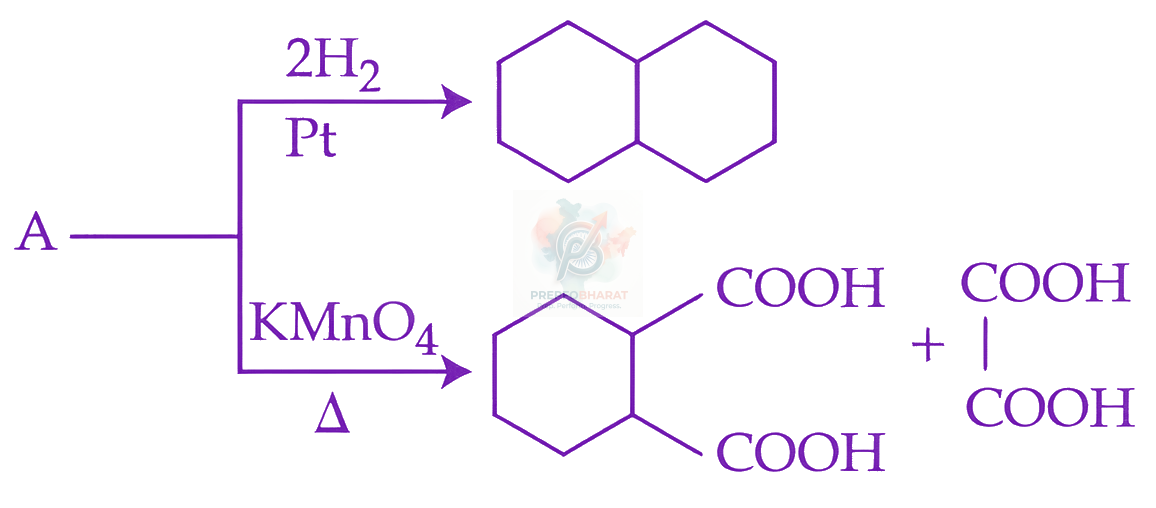
Match List - I with List - II. <table class="pyq-table"><tbody><tr><th>List - I Vitamin</th><th>List - II Name</th></tr><tr><td>A. Vitamin $B_1$</td><td>I. Pyridoxine</td></tr><tr><td>B. Vitamin $B_2$</td><td>II. Ascorbic acid</td></tr><tr><td>C. Vitamin $B_6$</td><td>III. Thiamine</td></tr><tr><td>D. Vitamin C</td><td>IV. Riboflavin</td></tr></tbody></table> Choose the correct answer from the options given below :
The descending order of acidity among the following compounds is: A. Phenol B. $4$-nitrophenol C. $4$-methoxyphenol D. $4$-nitrobenzoic acid E. Benzoic acid 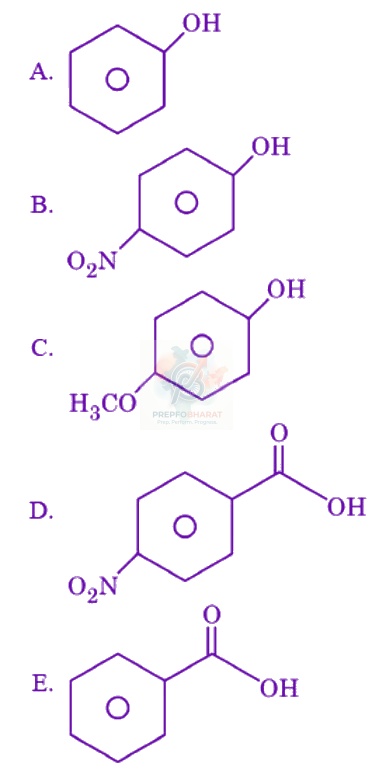 Choose the correct answer from the options given below:
The cycloalkene $(\mathrm{X})$ on bromination consumes one mole of bromine per mole of $(\mathrm{X})$ and gives the product $(\mathrm{Y})$ in which $\mathrm{C}: \mathrm{Br}$ ratio is 3:1. The percentage of bromine in the product $(\mathrm{Y})$ is $\_\_\_\_$%. (Nearest integer) (Given : molar mass in $\mathrm{g} \mathrm{mol}^{-1} \mathrm{H}: 1, \mathrm{C}: 12, \mathrm{O}: 16, \mathrm{Br}: 80$)
Consider the following reactions sequence 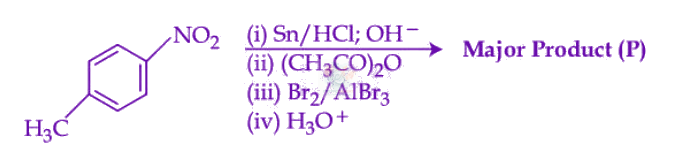 When the product (P) is subjected to Carius analysis using $AgNO_3$, $1.0$ g of the product (P) will produce _______ g of the precipitate of AgBr. (Nearest Integer) (Given: molar mass in g mol$^{-1}$ C : 12, H : 1, O : 16, N : 14, Br : 80, Ag : 108)
Match the LIST-I with LIST-II <table class="pyq-table"><tbody><tr><th>List-I (Reaction)</th><th>List-II (Mechanism)</th></tr><tr><td>A. Williamson Synthesis</td><td>I. Electrophilic addition</td></tr><tr><td>B. Friedel Craft Reaction</td><td>II. Free radical substitution</td></tr><tr><td>C. Bromination of vinyl benzene</td><td>III. Nucleophilic substitution</td></tr><tr><td>D. Chlorination of toluene in light</td><td>IV. Electrophilic substitution</td></tr></tbody></table> Choose the correct answer from the options given below:
For the following Friedel Craft's alkylation reaction, which of the statements are correct? 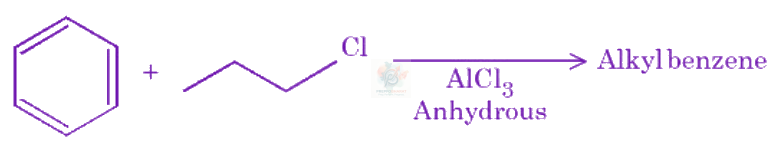 A. Major product is n-propyl benzene. B. iso-propyl carbocation intermediate is also generated. C. Multiple substitution is inevitable. D. Introducing electron-donating substituent on benzene will not produce any alkyl benzene. Choose the correct answer from the options given below:
Identify the incorrect statements. 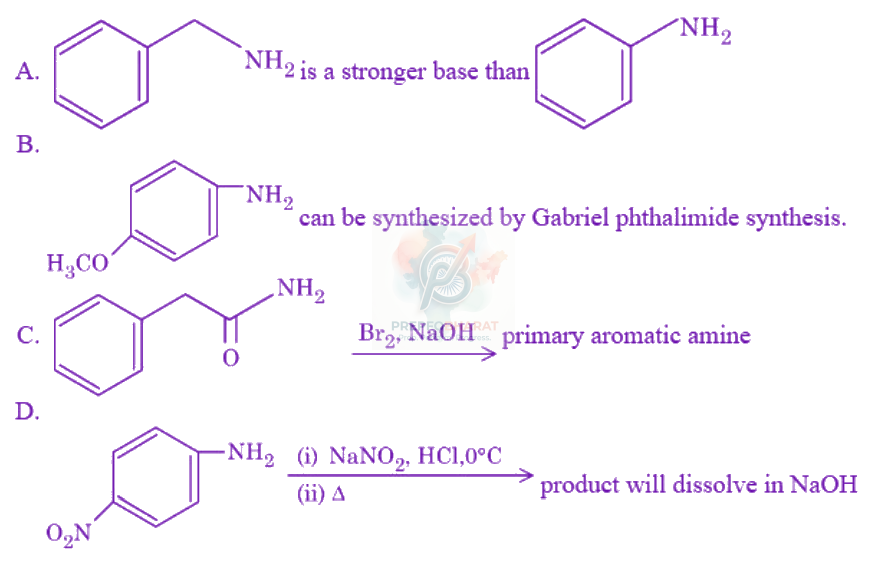 Choose the correct answer from the options given below:
The correct order of the rate of reaction of the following reactants with nucleophile by SN1 mechanism is: (Given : Structure I and II are rigid) 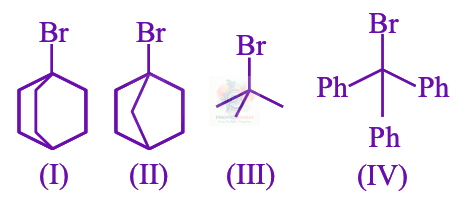
Product $C$ of the following reaction sequence will be 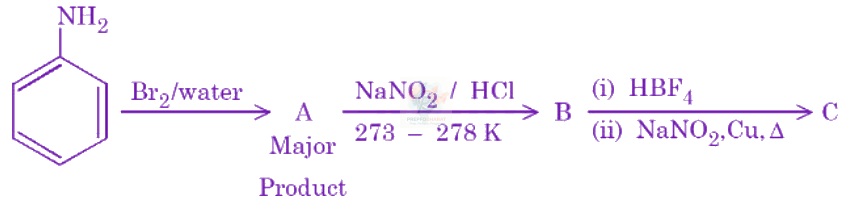
Identify the correct pair having amino acid (A) and the hormone (B) that is iodinated derivative of the amino acid (A). (T and Y represent one letter code for amino acids) <table class="pyq-table"><tbody><tr><th>Amino acid (A)</th><th>Hormone (B)</th></tr></tbody></table>
Arrange the following alkenes in decreasing order of stability. 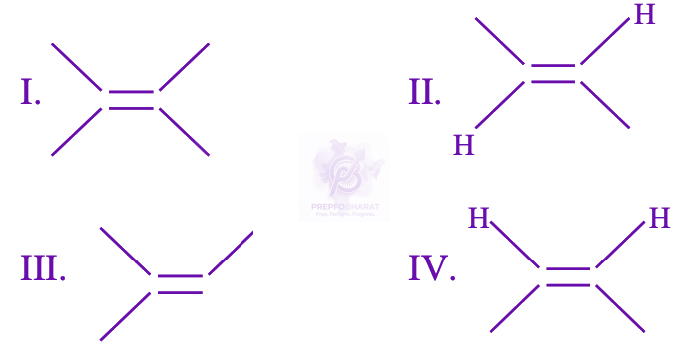 Choose the correct answer from the options given below:
Both human DNA and RNA are chiral molecules. The chirality in DNA and RNA arises due to the presence of
In sulphur estimation, $2.0 \times 10^{-3}$ mol of an organic compound (X) (molar mass $76$ g mol$^{-1}$) gave $0.4813$ g of barium sulphate (molar mass $233$ g mol$^{-1}$). The percentage of sulphur in the compound (X) is ______ $\times 10^{-1}$ % (Nearest integer)
$RMgI$ when treated with ice cold water liberated a gas which occupied $1.4\text{ dm}^3/\text{g}$ at STP. The gas produced is further reacted with iodine in presence of $HIO_3$ to give compound (X). Compound (X) in presence of Na and dry ether produced compound (Y). Molar mass of compound (Y) is _______ $\text{g mol}^{-1}$. (Nearest integer)
An organic compound " P " of molecular formula $\mathrm{C}_{6} \mathrm{H}_{12} \mathrm{O}_{3}$ gives positive Iodoform test but negative Tollen's test. When " P " is treated with dilute acid, it produces " Q ". " Q " gives positive Tollen's test and also iodoform test. The structure of " P " is :
The correct statements are : A. Activation energy for enzyme catalysed hydrolysis of sucrose is lower than that of acid catalysed hydrolysis. B. During denaturation, secondary and tertiary structures of a protein are destroyed but primary structure remains intact. C. Nucleotides are joined together by glycosidic linkage between $\mathrm{C}_{1}$ and $\mathrm{C}_{4}$ carbons of the pentose sugar. D. Quaternary structure of proteins represents overall folding of the polypeptide chain. Choose the correct answer from the options given below :
Which of the following reactions is an example of Wurtz reaction?
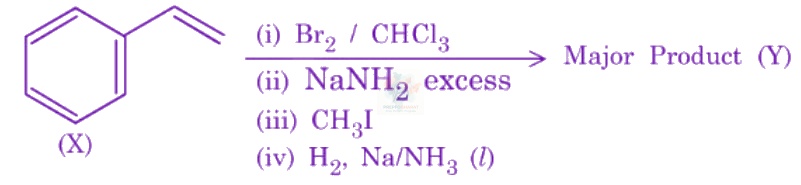 Compound (X) [styrene] is subjected to the sequence of reactions as shown above: (i) $Br_2/CHCl_3$ (ii) $NaNH_2$ excess (iii) $CH_3I$ (iv) $H_2$, $Na/NH_3$ $(l)$, giving Major Product (Y). Molar mass of the major product (Y) formed is ______ g mol$^{-1}$. (Given molar mass in g mol$^{-1}$ C:$12$, H: $1$, O: $16$)