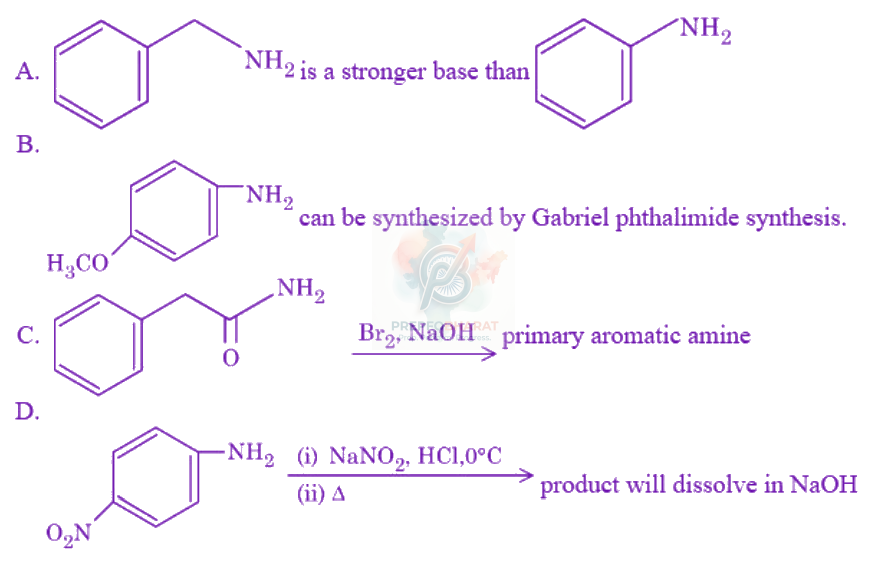
Statement A: In benzylamine (C6H5CH2NH2), the lone pair of electrons on the nitrogen atom is localized and not involved in resonance. In aniline (C6H5NH2), the lone pair is delocalized over the benzene ring. Hence, benzylamine is a stronger base than aniline. Statement A is correct.
Statement B: Gabriel phthalimide synthesis involves the nucleophilic substitution (SN2) of an alkyl halide by the phthalimide anion. Aryl halides do not undergo nucleophilic substitution easily due to the partial double bond character of the C-X bond. Therefore, primary aromatic amines (like p-methoxyaniline) cannot be synthesized by this method. Statement B is incorrect.
Statement C: The reaction of 2-phenylacetamide (C6H5CH2CONH2) with Br2 and NaOH is the Hoffmann bromamide degradation, which yields benzylamine (C6H5CH2NH2). Benzylamine is a primary aliphatic (aralkyl) amine, not a primary aromatic amine (where the −NH2 group must be directly attached to the benzene ring). Statement C is incorrect.
Statement D: p-Nitroaniline undergoes diazotization with NaNO2 and HCl at 0∘C to form p-nitrobenzenediazonium chloride. Heating this aqueous solution (Δ) yields p-nitrophenol. Since p-nitrophenol is acidic, it dissolves in aqueous NaOH to form a soluble sodium salt. Statement D is correct.
The incorrect statements are B and C.
Answer: B and C Only