Physical Chemistry PYQ
JEE Main Chemistry — Physical Chemistry previous year questions with solutions.
Browse by Year
Physical Chemistry at a glance
Questions per year
1826 across 25 yearsDifficulty mix
1826 total- easy527 · 29%
- medium1010 · 55%
- hard289 · 16%
Subtopic-wise weightage
Breakdown of the 1811 Physical Chemistry questions tagged to a subtopic, by year — darker cells mean more questions.
| Subtopic | Weightage | Total | 2026 | 2025 | 2024 | 2023 | 2022 | 2021 | 2020 | 2019 | 2018 | 2017 | 2016 | 2015 | 2014 | 2013 | 2012 | 2011 | 2010 | 2009 | 2008 | 2007 | 2006 | 2005 | 2004 | 2003 | 2002 |
|---|---|---|---|---|---|---|---|---|---|---|---|---|---|---|---|---|---|---|---|---|---|---|---|---|---|---|---|
| Equilibrium | 15.5% | 280 | 29 | 25 | 19 | 27 | 22 | 32 | 18 | 18 | 15 | 4 | 2 | 2 | 8 | 10 | 9 | 1 | 3 | 1 | 4 | 4 | 2 | 6 | 6 | 5 | 8 |
| Chemical Thermodynamics & Thermochemistry | 14.6% | 264 | 22 | 32 | 23 | 30 | 23 | 27 | 15 | 23 | 9 | 6 | 4 | 3 | 5 | 7 | 6 | 1 | 3 | 1 | 2 | 3 | 4 | 4 | 3 | 5 | 3 |
| Atomic Structure | 13.7% | 249 | 27 | 23 | 28 | 28 | 25 | 26 | 13 | 18 | 4 | 4 | 3 | 3 | 8 | 5 | 7 | 2 | 2 | 2 | 2 | 1 | 5 | 3 | 4 | 4 | 2 |
| Electrochemistry | 13.0% | 236 | 21 | 24 | 29 | 24 | 23 | 21 | 16 | 14 | 4 | 5 | 4 | 3 | 8 | 5 | 4 | 1 | 2 | 2 | 1 | 2 | 3 | 4 | 6 | 4 | 6 |
| Chemical Kinetics | 12.8% | 231 | 25 | 25 | 19 | 25 | 22 | 26 | 16 | 17 | 5 | 3 | 3 | 4 | 6 | 4 | 6 | 1 | 2 | 1 | 1 | 3 | 3 | 2 | 3 | 4 | 5 |
| Solutions | 12.8% | 231 | 25 | 23 | 24 | 31 | 21 | 29 | 13 | 19 | 3 | 3 | 3 | 3 | 5 | 3 | 5 | 2 | 3 | 2 | 2 | 1 | 1 | 2 | 1 | 4 | 3 |
| Some Basic Concepts (Mole Concept) | 11.7% | 211 | 23 | 25 | 17 | 19 | 28 | 24 | 13 | 12 | 5 | 4 | 3 | 4 | 5 | 9 | 7 | 1 | 1 | 2 | 3 | 2 | 2 | 2 | |||
| Redox Reactions | 5.9% | 107 | 8 | 6 | 15 | 14 | 14 | 21 | 10 | 6 | 1 | 1 | 1 | 2 | 2 | 1 | 1 | 2 | 2 | ||||||||
| States of Matter | 0.1% | 2 | 2 | ||||||||||||||||||||||||
| All subtopics | 1811 | 180 | 185 | 174 | 198 | 178 | 206 | 114 | 127 | 46 | 30 | 23 | 22 | 47 | 45 | 45 | 9 | 15 | 9 | 12 | 15 | 20 | 25 | 27 | 28 | 31 |
All Physical Chemistry Questions (1826)
Consider the following aqueous solutions. I. 2.2 g Glucose in 125 mL of solution. II. 1.9 g Calcium chloride in 250 mL of solution. III. 9.0 g Urea in 500 mL of solution. IV. 20.5 g Aluminium sulphate in 750 mL of solution. The correct increasing order of boiling point of these solutions will be : [Given : Molar mass in $\mathrm{g} \mathrm{mol}^{-1}: \mathrm{H}=1, \mathrm{C}=12, \mathrm{~N}=14, \mathrm{O}=16, \mathrm{Cl}=35.5, \mathrm{Ca}=40, \mathrm{Al}=27$ and $\mathrm{S}=32$]
A solution is prepared by dissolving 0.3 g of a non-volatile non-electrolyte solute 'A' of molar mass $60 \mathrm{~g} \mathrm{~mol}^{-1}$ and 0.9 g of a non-volatile non-electrolyte solute ' $B$ ' of molar mass $180 \mathrm{~g} \mathrm{~mol}^{-1}$ in $100 \mathrm{~mL} \mathrm{H}_{2} \mathrm{O}$ at $27^{\circ} \mathrm{C}$. Osmotic pressure of the solution will be [Given: $\mathrm{R}=0.082 \mathrm{~L} \mathrm{~atm} \mathrm{~K}^{-1} \mathrm{~mol}^{-1}$]
If $3.365$ g of ethanol $(l)$ is burnt completely in a bomb calorimeter at $298.15$ K, the heat produced is $99.472$ kJ. The $|\Delta H_f°|$ of ethanol at $298.15$ K is ______ $\times 10^2$ kJ mol$^{-1}$. (Nearest integer) Given: Standard enthalpy for combustion of graphite $=-393.5$ kJ mol$^{-1}$ Standard enthalpy of formation of water $(l)=-285.8$ kJ mol$^{-1}$ Molar mass in g mol$^{-1}$ of C, H, O are $12$, $1$ and $16$ respectively
Correct statements regarding Arrhenius equation among the following are : A. Factor $e^{-E a / R T}$ corresponds to fraction of molecules having kinetic energy less than Ea. B. At a given temperature, lower the Ea, faster is the reaction. C. Increase in temperature by about $10^{\circ} \mathrm{C}$ doubles the rate of reaction. D. Plot of $\log \mathrm{k}$ vs $\frac{1}{\mathrm{~T}}$ gives a straight line with slope $=-\frac{E a}{R}$. Choose the correct answer from the options given below :
$19.5$ g of fluoro acetic acid (molar mass $= 78$ g mol$^{-1}$) is dissolved in $500$ g of water at $298$ K. The depression in the freezing point of water was $1°$C. What is $K_a$ of fluoro acetic acid? (For water, $K_f = 1.86$ K kg mol$^{-1}$). Assume molarity and molality to have same values.
80 mL of a hydrocarbon on mixing with 264 mL of oxygen in a closed U-tube undergoes complete combustion. The residual gases after cooling to 273 K occupy 224 mL. When the system is treated with KOH solution, the volume decreases to 64 mL. The formula of the hydrocarbon is :
Arrange the following isothermal processes in order of the magnitude of the work ($p - V$) involved between states $1$ and $2$. A. Expansion in single stage $w_A$ B. Expansion in multi stages $w_B$ C. Compression in single stage $w_C$ D. Compression in multi stages $w_D$ Choose the correct option.
Identify the correct statements from the following: A. Heisenberg uncertainty principle is applicable to electrons. B. The size of $2p_x$ orbital is less than the size of $3p_x$ orbital. C. The energy of $2s$ orbital of H atom is equal to the energy of $2s$ orbital of Li. D. The electronic configuration of Cr is $[\text{Ar}] 3d^5 4s^1$ Choose the correct answer from the options given below:
$M_3 A_2$ is a sparingly soluble salt of molar mass $y$ g mol$^{-1}$ and solubility $x$ g L$^{-1}$. The ratio of the molar concentration of the anion ($A^{3-}$) to the solubility product of the salt is
Solid carbon, CaO and CaCO$_3$ are mixed and allowed to attain equilibrium at T K. $\text{CaCO}_3(s) \rightleftharpoons \text{CaO}(s) + \text{CO}_2(g) \quad K_{p_1} = 0.08$ atm $\text{C}(s) + \text{CO}_2(g) \rightleftharpoons 2\text{CO}(g) \quad K_{p_2} = 2$ atm The partial pressure of CO is ________ $\times 10^{-1}$ atm
Gas 'A' undergoes change from state 'X' to state 'Y'. In this process, the heat absorbed and work done by the gas is $10$ J and $18$ J respectively. Now gas is brought back to state 'X' by another process during which $6$ J of heat is evolved. In the reverse process of 'Y' to 'X',
Consider two radiations of wavelengths 1. $\lambda_1 = 2000$ Å 2. $\lambda_2 = 6000$ Å The ratio of the energies of these two radiations $\left(\dfrac{E_1}{E_2}\right)$ is ________ (Nearest integer).
14.0 g of calcium metal is allowed to react with excess HCl at 1.0 atm pressure and 273 K. Which of the following statements is incorrect? [Given : Molar mass in $\mathrm{g} \mathrm{mol}^{-1}$ of $\mathrm{Ca}-40, \mathrm{Cl}-35.5, \mathrm{H}-1$]
Arrange the following atomic orbitals of multi electron atoms in order of increasing energy. A. $n = 3, l = 2, m = +1$ B. $n = 4, l = 0, m = 0$ C. $n = 6, l = 1, m = 0$ D. $n = 5, l = 1, m = +1$ E. $n = 2, l = 1, m = +1$ Choose the correct answer from the options given below:
' W ' g of a non-volatile electrolyte solid solute of molar mass ' M ' $\mathrm{g} \mathrm{mol}^{-1}$ when dissolved in 100 mL water, decreases vapour pressure of water from 640 mm Hg to 600 mm Hg. If aqueous solution of the electrolyte boils at 375 K and $\mathrm{K}_{\mathrm{b}}$ for water is $0.52 \mathrm{~K} \mathrm{~kg} \mathrm{~mol}^{-1}$, then the mole fraction of the electrolyte solute $\left(x_{2}\right)$ in the solution can be expressed as (Given : density of water $=1 \mathrm{~g} / \mathrm{mL}$ and boiling point of water $=373 \mathrm{~K}$)
Observe the following reactions at $\mathrm{T}(\mathrm{K})$. I. $\mathrm{A} \rightarrow$ products. II. $5 \mathrm{Br}^{-}(\mathrm{aq})+\mathrm{BrO}_{3}{ }^{-}(\mathrm{aq})+6 \mathrm{H}^{+}(\mathrm{aq}) \rightarrow 3 \mathrm{Br}_{2}(\mathrm{aq})+3 \mathrm{H}_{2} \mathrm{O}(\mathrm{l})$ Both the reactions are started at 10.00 am. The rates of these reactions at 10.10 am are same. The value of $-\frac{\Delta\left[\mathrm{Br}^{-}\right]}{\Delta \mathrm{t}}$ at 10.10 am is $2 \times 10^{-4} \mathrm{~mol} \mathrm{~L}^{-1} \mathrm{~min}^{-1}$. The concentration of A at 10.10 am is $10^{-2} \mathrm{~mol} \mathrm{~L}^{-1}$. What is the first order rate constant (in $\mathrm{min}^{-1}$) of reaction $I$ ?
Two positively charged particles $\mathrm{m}_{1}$ and $\mathrm{m}_{2}$ have been accelerated across the same potential difference of 200 keV as shown below. 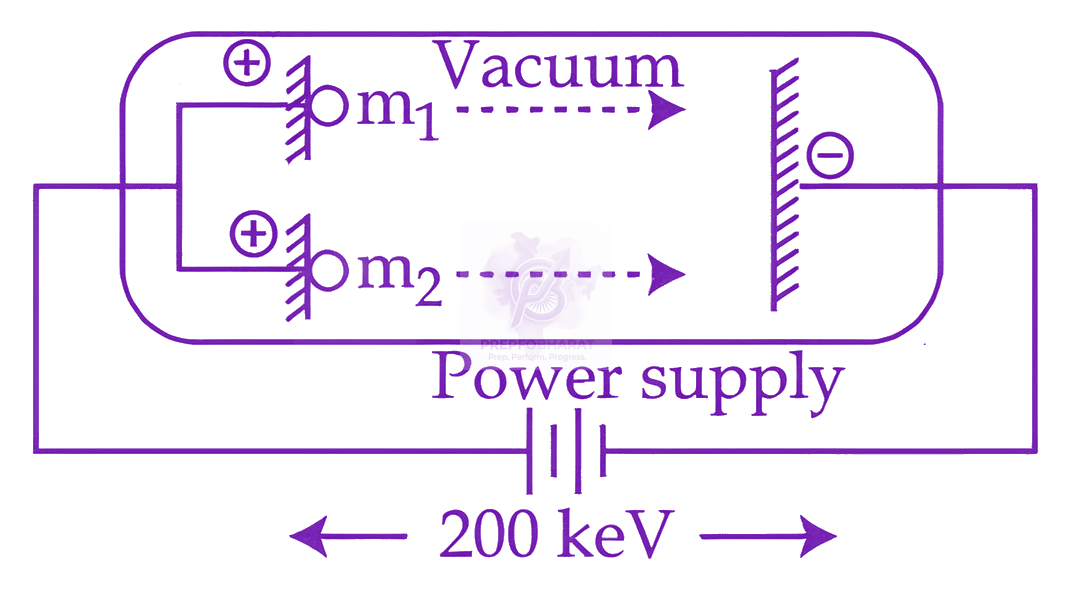 [Given mass of $\mathrm{m}_{1}=1$ amu and $\mathrm{m}_{2}=4$ amu] The deBroglie wavelength of $\mathrm{m}_{1}$ will be $x$ times of $\mathrm{m}_{2}$. The value of $x$ is $\_\_\_\_$ (nearest integer)
Which one of the following graphs accurately represents the plot of partial pressure of $\mathrm{CS}_{2}$ vs its mole fraction in a mixture of acetone and $\mathrm{CS}_{2}$ at constant temperature?
Which of the following mixture gives a buffer solution with $\mathrm{pH}=9.25$ ? Given : $\mathrm{pK}_{\mathrm{b}}\left(\mathrm{NH}_{4} \mathrm{OH}\right)=4.75$
Aqueous HCl reacts with $\mathrm{MnO}_{2}(\mathrm{~s})$ to form $\mathrm{MnCl}_{2}(\mathrm{aq}), \mathrm{Cl}_{2}(\mathrm{~g})$ and $\mathrm{H}_{2} \mathrm{O}(l)$. What is the weight (in g) of $\mathrm{Cl}_{2}$ liberated when 8.7 g of $\mathrm{MnO}_{2}(\mathrm{~s})$ is reacted with excess aqueous HCl solution? (Given Molar mass in $\mathrm{g} \mathrm{mol}^{-1} \mathrm{Mn}=55, \mathrm{Cl}=35.5, \mathrm{O}=16, \mathrm{H}=1$)
The energy of first (lowest) Balmer line of H atom is $x \mathrm{~J}$. The energy (in J) of second Balmer line of H atom is :
For the reaction, $\mathrm{N}_{2} \mathrm{O}_{4} \rightleftharpoons 2 \mathrm{NO}_{2}$, graph is plotted as shown below. Identify correct statements. A. Standard free energy change for the reaction is $-5.40 \mathrm{~kJ} \mathrm{~mol}^{-1}$. B. As $\Delta \mathrm{G}^{\ominus}$ in graph is positive, $\mathrm{N}_{2} \mathrm{O}_{4}$ will not dissociate into $\mathrm{NO}_{2}$ at all. C. Reverse reaction will go to completion. D. When 1 mole of $\mathrm{N}_{2} \mathrm{O}_{4}$ changes into equilibrium mixture, value of $\Delta \mathrm{G}^{\ominus}=-0.84 \mathrm{~kJ} \mathrm{~mol}^{-1}$ E. When 2 mole of $\mathrm{NO}_{2}$ changes into equilibrium mixture, $\Delta \mathrm{G}^{\ominus}$ for equilibrium mixture is $-6.24 \mathrm{~kJ} \mathrm{~mol}^{-1}$. 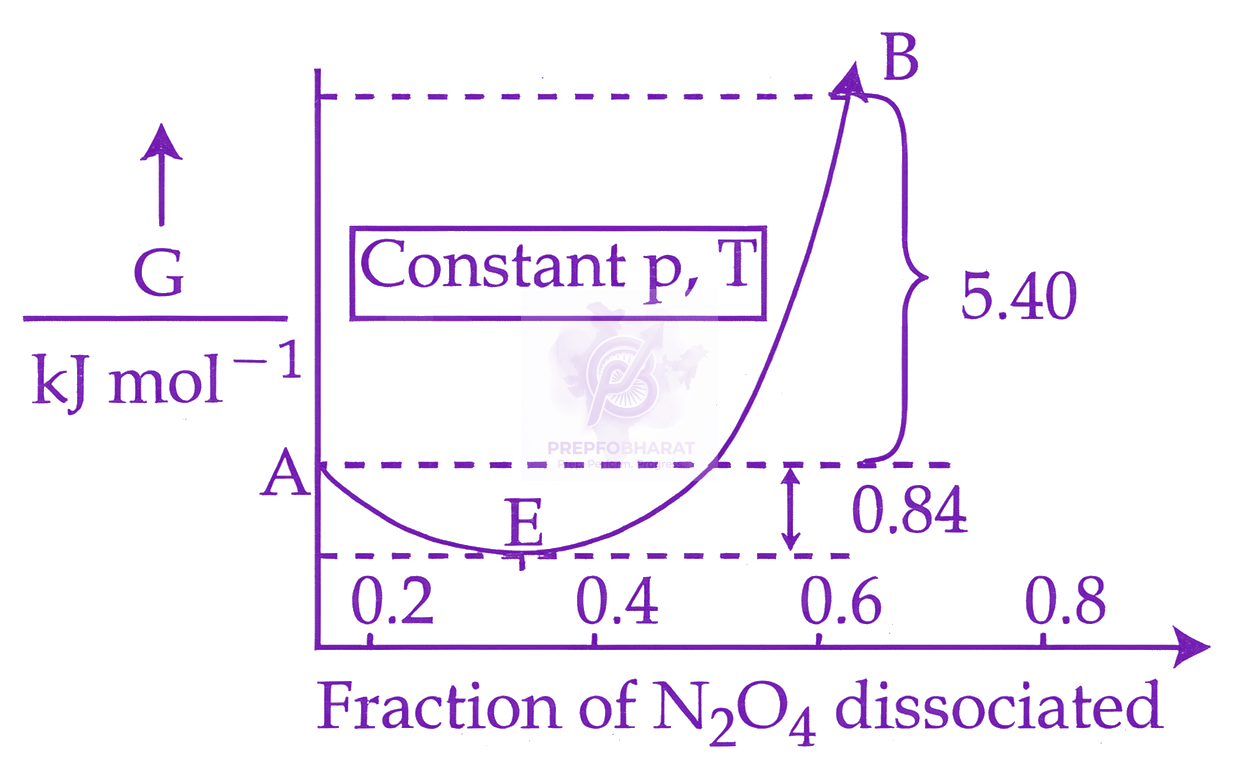 Choose the correct answer from the options given below :
For the following reaction at $50°$C and at $2$ atm pressure, $2N_2O_5(g) \rightleftharpoons 2N_2O_4(g)+O_2(g)$ $N_2O_5$ is $50\%$ dissociated. The magnitude of standard free energy change at this temperature is $x$. $x=$ ______ J mol$^{-1}$ [Nearest integer]. Given: $R=8.314$ J mol$^{-1}$ K$^{-1}$, $\log 2=0.30$, $\log 3=0.48$, $\ln 10=2.303$, $°C+273=K$
Consider the general reaction given below at 400 K $x \mathrm{~A}(\mathrm{~g}) \rightleftharpoons y \mathrm{~B}(\mathrm{~g})$ The values of $\mathrm{K}_{\mathrm{p}}$ and $\mathrm{K}_{\mathrm{c}}$ are studied under the same condition of temperature but variation in $x$ and $y$. (i) $\mathrm{K}_{\mathrm{p}}=85.87$ and $\mathrm{K}_{\mathrm{c}}=2.586$ appropriate units (ii) $\mathrm{K}_{\mathrm{p}}=0.862$ and $\mathrm{K}_{\mathrm{c}}=28.62$ appropriate units. The values of $x$ and $y$ in (i) and (ii) respectively are: