JEE Main 2019 — Physical Chemistry
Chemistry Physical Chemistry questions from JEE Main 2019.
Other Years
127 Physical Chemistry Questions from 2019
Enthalpy of sublimation of iodine is $24 cal {g}^{-1}$ at $200^{\circ}C$ . If specific heat of ${I}_{2}$ (s) and ${I}_{2}$ (vap) are $0.055$ and $0.031 cal {g}^{-1}{K}^{-1}$ respectively, then enthalpy of sublimation of iodine at $250^{\circ}C$ in $cal {g}^{-1}$ is:
If $p$ is the momentum of the fastest electron ejected from a metal surface after the irradiation of light having wavelength $\lambda ,$ then for $1.5 p$ momentum of the photoelectron, the wavelength of the light should be: (Assume kinetic energy of ejected photoelectron to be very high in comparison to work function)
Which one of the following about an electron occupying the 1s orbital in a hydrogen atom is incorrect? (The Bohr radius is represented by ${a}_{0}$ ).
The $pH$ of a $0.02 M$ $N{H}_{4}Cl$ solution will be [Given: ${K}_{b}(N{H}_{4}OH)={10}^{-5}$ and $\mathrm{log}2=0.301$]
For emission line of atomic hydrogen from ${n}_{i}=8$ to ${n}_{f}=n,$ the plot of wave number $(\overset{-}{v})$ against $(\frac{1}{{n}^{2}})$ will be: (The Rydberg constant, ${R}_{H}$ is in wave number unit)
The standard reaction Gibbs energy for a chemical reaction at an absolute temperature $\mathrm{T}$ is given by $\Delta \mathrm{G}^{\circ}=\mathrm{A}-\mathrm{BT}$ where A and $B$ are non-zero constants. Which of the following is true about this reaction?
$\mathrm{K}_{2} \mathrm{HgI}_{4}$ is $40 \%$ ionised in aqueous solution. The value of its van't Hoff factor (i) is:
In order to oxidize a mixture of one mole of each of $Fe{C}_{2}{O}_{4},F{e}_{2}{({C}_{2}{O}_{4})}_{3},FeS{O}_{4}$ and $F{e}_{2}{(S{O}_{4})}_{3}$ in acidic medium, the number of moles of $KMn{O}_{4}$ is:
The mole fraction of a solvent in aqueous solution of a solute is $0.8.$ The molality (in mol ${kg}^{-1}$ ) of the aqueous solution is:
$25 g$ of an unknown hydrocarbon upon burnig produces $88 g$ of $C{O}_{2}$ and $9g$ of ${H}_{2}O.$ This unknown hydrocarbon contains:
Among the following, the energy of $2s$ orbital is lowest in:
For silver, ${C}_{p}(J{K}^{-1}mo{l}^{-1})=23+0.01T.$ If the temperature $(T)$ of $3$ moles of silver is raised from $300 K to 1000 K at 1 atm$ pressure, the value of $\Delta H$ will be close to:
Which one of the following graphs between molar conductivity $({\Lambda }_{m})$ versus $\sqrt{C}$ is correct?
$50 \mathrm{mL}$ of $0.5 M$ oxalic acid is needed to neutralize $25 \mathrm{mL}$ of sodium hydroxide solution. What is the amount of $\mathrm{NaOH}$ in $50 \mathrm{mL}$ of the given sodium hydroxide solution?
A solution of $Ni{(N{O}_{3})}_{2}$ is electrolyzed between platinum electrode $0.1$ Faraday electricity. How many mole of $Ni$ will be deposited at the cathode?
At $300 K$ and $1$ atmospheric pressure, $10 mL$ of a hydrocarbon required $55 mL$ of ${O}_{2}$ for complete combustion, and $40 mL$ of $C{O}_{2}$ is formed. The formula of the hydrocarbon is:
For a reaction, ${N}_{2}(g)+3{H}_{2}(g)\longrightarrow 2N{H}_{3}(g)$, identify di-hydrogen $({H}_{2})$ as a limiting reagent in the following reaction mixtures.
For the following reaction, the mass of water produced from $445 g$ of ${C}_{57}{H}_{110}{O}_{6}$ is: $2 {C}_{57}{H}_{110}{O}_{6}(s)+163{O}_{2}(g)\rightarrow 114 {\mathrm{CO}}_{2}(g)+110{H}_{2}O(l)$
The decreasing order of electrical conductivity of the following aqueous solutions is: $(A)$ $0.1 M$ Formic acid, $(B)$ $0.1 M$ Acetic acid, $(C)$ $0.1 M$ Benzoic acid.
In the following reaction; $xA\rightarrow yB$ ${\mathrm{log}}_{10}[-\frac{d[A]}{dt}]={\mathrm{log}}_{10}[-\frac{d[B]}{dt}]+0.3010$ ‘A’ and ‘B’ respectively can be:
For the cell $\mathrm{Zn}(\mathrm{s})\left|\mathrm{Zn}^{2+}(\mathrm{aq}) \| \mathrm{M}^{\mathrm{x}+}(\mathrm{aq})\right| \mathrm{M}(\mathrm{s}),$ different half cells and their standard electrode potentials are given below: 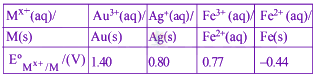 If $\mathrm{E}_{\mathrm{Zn}^{2+} / \mathrm{Zn}}^{\circ}=-0.76 \mathrm{~V},$ which cathode will give a maximum value of $E_{\text {cell }}^{0}$ per electron transferred?
$5$ moles of $A{B}_{2}$ weigh $125\times {10}^{-3} kg$ and $10$ moles of ${A}_{2}{B}_{2}$ weigh $300\times {10}^{-3} kg$ . The molar mass of A $({M}_{A})$ in $kg {mol}^{-1}$ are:
An ideal gas undergoes isothermal compression from $5 {m}^{3}$ to $1 {m}^{3}$ against a constant external pressure of $4 N{m}^{-2}$. The heat released in this process is $24 J {\mathrm{mol}}^{-1}{K}^{-1}$ and is used to increase the pressure of $1$ mole of $\mathrm{Al}$. The temperature of $\mathrm{Al}$ increases by:
Molal depression constant for a solvent is $4.0 K kg mo{l}^{-1}.$ The depression in the freezing point of the solvent for $0.03 mol k{g}^{-1}$ solution of ${K}_{2}S{O}_{4}$ is: (Assume complete dissociation of the electrolyte)
Which of the following combination of statements is true regarding the interpretation of the atomic orbitals? $(A)$ An electron in an orbital of high angular momentum stays away from the nucleus than an electron in the orbital of lower angular momentum. $(B)$ For a given value of the principal quantum number, the size of the orbit is inversely proportional to the azimuthal quantum number. $(C)$ According to wave mechanics, the ground state angular momentum is equal to $\frac{h}{2\pi }$ . $(D)$ The plot of $\psi$ Vs $r$ for various azimuthal quantum numbers, shows peak shifting towards higher $r$ value.
$5$ moles of an ideal gas at $100 K$ are allowed to undergo reversible compression till its temperature becomes $200 K.$ If ${C}_{V}=28 J {K}^{-1},$ calculate $\Delta U$ and $\Delta pV$ for the process. $(R=8.0 J {K}^{-1} mo{l}^{-1})$
In the reaction of oxalate with permanganate in acidic medium, the number of electrons involved in producing one molecule of ${\mathrm{CO}}_{2}$ is:
Consider the given plots for a reaction obeying Arrhenius equation $(0^{\circ}C<T<300^{\circ}C):$ ($K$and ${E}_{a}$ are rate constant and activetion energy, respectively ) (I) 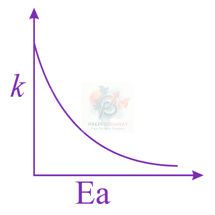 (II) 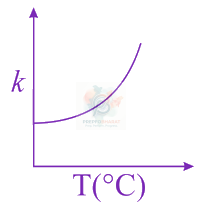
$1 g$ of a non-volatile non-electrolyte solute is dissolved in $100 g$ of two different solvents $A$ and B whose ebullioscopic constants are in the ratio of $1:5$. The ratio of the elevation in their boiling points, $\frac{\Delta {T}_{b}(A)}{\Delta {T}_{b}(B)}$, is: (assuming they have the same molar mass)
If the standard electrode potential for a cell is $2 V$ at $300 K,$ the equilibrium constant $(K)$ for the reaction. $Zn(s)+C{u}^{2+}(aq)\rightleftharpoons Z{n}^{2+}(aq)+Cu(s)$ at $300 K$ is approximately: $(R=8 J{K}^{-1}mo{l}^{-1}, F=96000 C mo{l}^{-1})$
Heat treatment of muscular pain involves radiation of wavelength of about $900 \mathrm{nm}$. Which spectral line of $\mathrm{H}$ atom is suitable for this purpose? $\left[\mathrm{R}_{\mathrm{H}}=1 \times 10^{5} \mathrm{~cm}^{-1} \cdot \mathrm{h}=6.6 \times 10^{-34} \mathrm{Js}, \mathrm{c}=3 \times 10^{8} \mathrm{~ms}^{-1}\right]$
The combination of plots which does not represent isothermal expansion of an ideal gas is $(A)$ 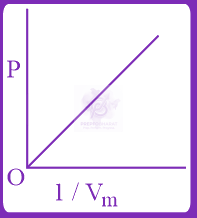 $(B)$ 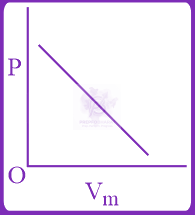 $(C)$ 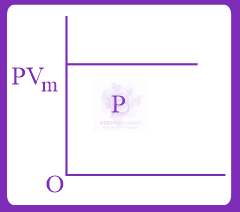 $(D)$ 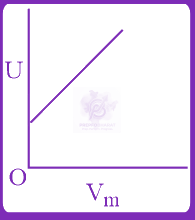
The amount of sugar $({C}_{12}{H}_{22}{O}_{11})$ required to prepare $2L$ of its $0.1 M$ aqueous solution is:
Consider the following reduction processes: ${\mathrm{Zn}}^{2+}+2{e}^{-}\rightarrow \mathrm{Zn}(s);{E}^{o}=-0.76 V$ ${\mathrm{Ca}}^{2+}+2{e}^{-}\rightarrow \mathrm{Ca}(s);{E}^{o}=-2.87 V$ ${\mathrm{Mg}}^{2+}+2{e}^{-}\rightarrow \mathrm{Mg}(s);{E}^{o}=-2.36 V$ ${\mathrm{Ni}}^{2+}+2{e}^{-}\rightarrow \mathrm{Ni}(s);{E}^{o}=-0.25 V$ The reducing power of the metals increases in the order:
The percentage composition of carbon by mole in methane is:
The ground state energy of a hydrogen atom is $-13.6 \mathrm{eV}$. The energy of second excited state of ${\mathrm{He}}^{+}$ ion in $\mathrm{eV}$ is:
Consider the following reversible chemical reactions: ${A}_{2}(g)+{B}_{2}(g)\overset{{k}_{1}}{\rightleftharpoons }2AB(g)$ .....(1) $6AB(g)\overset{{k}_{2}}{\rightleftharpoons }3{A}_{2}(g)+3{B}_{2}(g)$ .....(2) The relation between ${K}_{1}$ and ${K}_{2}$ is:
For the following reaction, equilibrium constant are given: $S(s)+{O}_{2}(g)\rightleftharpoons S{O}_{2}(g);{K}_{1}={10}^{52}$ $2S(s)+3{O}_{2}(g)\rightleftharpoons 2S{O}_{3}(g);{K}_{2}={10}^{129}$ The equilibrium constant for the reaction, $2{SO}_{2}(g)+{O}_{2}(g)\rightleftharpoons 2S{O}_{3}(g)$ is:
Which one of the following equations does not correctly represent the first law of thermodynamics for the given processes involving an ideal gas? (Assume non- expansion work is zero)
$5.1 g {\mathrm{NH}}_{4}\mathrm{SH}$ is introduced in $3.0 L$ evacuated flask at ${327}^{o}C$ . $30%$ of the solid ${\mathrm{NH}}_{4}\mathrm{SH}$ is decomposed to ${\mathrm{NH}}_{3}$ and ${H}_{2}S$ as gases. The ${K}_{P}$ of the reaction at ${327}^{o}C$ is $(R=0.082 L \mathrm{atm} {\mathrm{mol}}^{-1}{K}^{-1},\mathrm{Molar} \mathrm{mass} \mathrm{of} S=32 g {\mathrm{mol}}^{-1}, \mathrm{Molar} \mathrm{mass} \mathrm{of} N=14g {\mathrm{mol}}^{-1})$
What are the values of $\frac{{K}_{p}}{{K}_{c}}$ for the following reactions at $300 K$ respectively? (At $300 K, \mathrm{RT}=24.62 {\mathrm{dm}}^{2}\mathrm{atm} {\mathrm{mol}}^{-1}$ ) ${N}_{2}(g)+{O}_{2}(g)\rightleftharpoons 2\mathrm{NO}(g)$ ${N}_{2}{O}_{4}(g)\rightleftharpoons 2\mathrm{NO}(g)$ ${N}_{2}(g)+3{H}_{2}(g)\rightleftharpoons 2{\mathrm{NH}}_{3}(g)$
For the reaction $2A+B\rightarrow C$ , the values of initial rate at different reactant concentrations are given in the table below. The rate law for the reactions is:<table class="pyq-table"><tbody><tr><th>$[A](mol{L}^{-1})$</th><th>$[B](mol{L}^{-1})$</th><th>$Initial Rate$ $(mol{L}^{-1}{s}^{-1})$</th></tr><tr><td>0.05</td><td>0.05</td><td>0.045</td></tr><tr><td>0.10</td><td>0.05</td><td>0.090</td></tr><tr><td>0.20</td><td>0.10</td><td>0.72</td></tr></tbody></table>
The reaction $2 \mathrm{X} \rightarrow \mathrm{B}$ is a zeroth order reaction. If the initial concentration of $\mathrm{X}$ is $0.2 \mathrm{M}$, the half-life is $6 \mathrm{~h}$. When the initial concentration of $X$ is $0.5 \mathrm{M}$, the time required to reach its final concentration of $0.2 \mathrm{M}$ will be
The following results were obtained during kinetic studies of the reaction. $2A+B\rightarrow$ product <table class="pyq-table"><tbody><tr><td>Experiment</td><td>$[A]$ $(\mathrm{in} \mathrm{mol} {L}^{-1})$</td><td>$[B]$ $(in mol {L}^{-1})$</td><td>Initial rate of reaction $(\mathrm{in} \mathrm{mol} {L}^{-1} \mathrm{min}{ }^{-1})$</td></tr><tr><td>$I$</td><td>$0.10$</td><td>$0.20$</td><td>$6.93\times {10}^{-3}$</td></tr><tr><td>$\mathrm{II}$</td><td>$0.10$</td><td>$0.25$</td><td>$6.93\times {10}^{-3}$</td></tr><tr><td>$\mathrm{III}$</td><td>$0.20$</td><td>$0.30$</td><td>$1.386\times {10}^{-2}$</td></tr></tbody></table> The time (in minutes) required to consume half of $\text{A}$ is
The reaction $\mathrm{MgO}(\mathrm{s})+\mathrm{C}(\mathrm{s}) \rightarrow \mathrm{Mg}(\mathrm{s})+\mathrm{CO}(\mathrm{g}),$ for which $\Delta \mathrm{H}^{\circ}=+491.1 \mathrm{~kJ} \mathrm{~mol}^{-1}$ and $\Delta \mathrm{S}^{\circ}=198.0 \mathrm{JK}^{-1} \mathrm{~mol}^{-1}$ is not feasible at $298 \mathrm{~K}$. Temperature above which reaction will be feasible is
For a reaction, consider the plot of $ln k$ versus $1/T$ given in the figure. If the rate constant of this reaction at $400 K$ is ${10}^{-5}{s}^{-1}$ , then the rate constant at $500 K$ is: 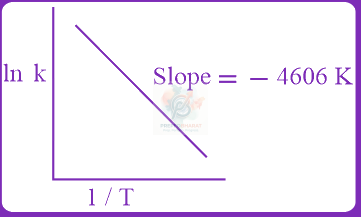
If a reaction follows the Arrhenius equation, the plot $\ln k$ vs $\frac{1}{(\mathrm{RT})}$ gives straight line with a gradient $(-\mathrm{y})$ unit. The energy required to activate the reactant is:
The elevation in boiling point for $1$ molal solution of glucose is $2 K$. The depression in freezing point for $2$ molal solution of glucose in the same solvent is $2 K.$ The relation between ${K}_{b}$ and ${K}_{f}$ is:
$8 g$ of $\mathrm{NaOH}$ is dissolved in $18g$ of ${H}_{2}O$. Mole fraction of $\mathrm{NaOH}$ in solution and molality (in $\mathrm{mol} {\mathrm{kg}}^{-1}$) of the solution respectively are:
The entropy change associated with the conversion of $1 kg$ of ice at $273 K$ to water vapours at $383 K$ is: (Specific heat of water liquid and water vapour are $4.2 kJ {K}^{-}$ and $2.0 kJ {K}^{-1}k{g}^{-1}$ ; heat of liquid fusion and vaporization of water are $334 kJ k{g}^{-1}$ and $2491 kJ k{g}^{-1}$ , respectively). ( $log$ $273=2.436,\mathrm{log}373=2.572,\mathrm{log}383=2.583$ )
A process has $\Delta H=200 J mo{l}^{-1}$ and $\Delta S=40 J{K}^{-1}mo{l}^{-1}.$ Out of the values given below choose the minimum temperature above which the process will be spontaneous:
In which one of the following equilibria, ${K}_{p}\neq {K}_{c}?$
The incorrect match in the following is:
The isoelectronic set of ions is:
If the de Broglie wavelength of the electron in ${n}^{th}$ Bohr orbit in a hydrogenic atom is equal to $1.5 \pi {a}_{0}$ $({a}_{0}$ is Bohr radius$)$, then the value of $\frac{n}{z}$ is:
Consider the following statements $(a)$ The pH of a mixture containing $400 mL$ of $0.1 M {H}_{2}S{O}_{4}$ and $400 mL$ of $0.1 M NaOH$ will be approximately $1.3.$ $(b)$ Ionic product of water is temperature dependent. $(c)$ A monobasic acid with ${K}_{a}={10}^{-5}$ has a $pH=5$ . The degree of dissociation of this acid is $50%$ . $(d)$ The Le Chatelier's principle is not applicable to common-ion effect. The correct statements are:
What is the work function of the metal if the light of wavelength $4000\overset{o}{A}$ generates photoelectrons of velocity $6\times {10}^{5} {\mathrm{ms}}^{-1}$ from it? (Mass of electron $=9\times {10}^{-31}\mathrm{kg}$, velocity of light $=3\times {10}^{8}{\mathrm{ms}}^{-1}$, Planck's constant $=6.626\times {10}^{-34}\mathrm{Js}$, Charge of electron $=6.626\times {10}^{-34}\mathrm{Js}$)
For any given series of spectral lines of atomic hydrogen, let $\Delta \overset{-}{v}={\overset{-}{v}}_{max}-{\overset{-}{v}}_{min}$ be the difference in maximum and minimum wave number in $c{m}^{-1}$. The ratio $\Delta {\overset{-}{v}}_{Lyman}/\Delta {\overset{-}{v}}_{Balmar}$ is
For the reaction of ${H}_{2}$ with ${I}_{2}$, the rate constant is $2.5\times {10}^{-4} d{m}^{3}mo{l}^{-1}{s}^{-1}$ at ${327}^{o}C$ and $1.0 d{m}^{3} mol-1{s}^{-1}$ at $527^{\circ}C$ . The activation energy for the reaction, in $kJ mol-1$ is: $(R=8.314 J{K}^{-1}mo{l}^{-1})$
If ${K}_{\mathrm{sp}}$ of ${\mathrm{Ag}}_{2}{\mathrm{CO}}_{3}$ is $8\times {10}^{-12}$ , the molar solubility of ${\mathrm{Ag}}_{2}{\mathrm{CO}}_{3}$ in $0.1 M {\mathrm{AgNO}}_{3}$ is:
In an acid-base titration, $0.1 M HCl$ solution was added to the $NaOH$ solution of unknown strength. Which of the following correctly shown the change of $pH$ of the titration mixture in this experiment? 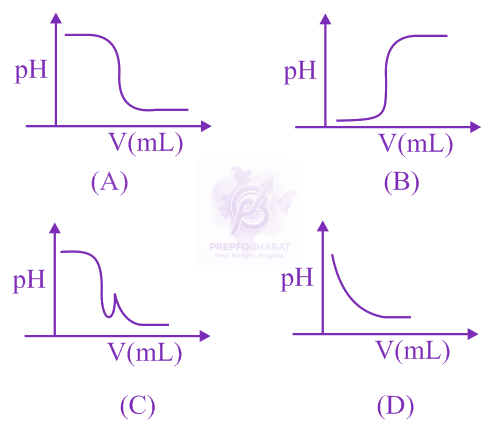
In a chemical reaction, $A+2B\overset{K}{\rightleftharpoons }2C+D$ , the initial concentration of $B$ was $1.5$ times of the concentration of $A$ , but the equilibrium concentrations of $A$ and $B$ were found to be equal. The equilibrium constant $(K)$ for the chemical reaction is:
The standard Gibbs energy for the given cell reaction in $kJ mo{l}^{-1}$ at $298 K$ is: $Zn(s)+C{u}^{2+}(aq)\longrightarrow Z{n}^{2+}(aq)+Cu(s)$ , ${E}^{0}=2 V at 298 K$ $(Faraday's constant ,F=96000 C mo{l}^{-1})$
Given the equilibrium constant: $\mathrm{K}_{\mathrm{C}}$ of the reaction: $\mathrm{Cu}(\mathrm{s})+2 \mathrm{Ag}^{+}(\mathrm{aq}) \rightarrow \mathrm{Cu}^{2+}(\mathrm{aq})+2 \mathrm{Ag}(\mathrm{s})$ is $10 \times 10^{15}$ calculate the $E_{\text {cell }}^{0}$ of this reaction at $298 \mathrm{~K}$ $\left[2.303 \frac{\mathrm{RT}}{\mathrm{F}}\right.$ at $\left.298 \mathrm{~K}=0.059 \mathrm{~V}\right]$
${\wedge }_{m}^{o}$ for $\mathrm{NaCl}, \mathrm{HCl}$ and $\mathrm{NaA}$ are $126.4, 425.9$ and $100.5 S {\mathrm{cm}}^{2}{\mathrm{mol}}^{-1}$ respectively. If the conductivity of $0.001 M \mathrm{HA}$ is $5\times {10}^{-5}S {\mathrm{cm}}^{-1}$, degree of dissociation of $\mathrm{HA}$ is
A solution is prepared by dissolving 0.6 g of urea (molar mass $=60 g mo{l}^{-1}$) and $1.8 g$ of glucose (molar mass $=180 g mo{l}^{-1}$) in 100 mL of water at ${27}^{o}C.$ The osmotic pressure of the solution is: ($R=0.08206 L$$\text{ atm}$ ${K}^{-1} mo{l}^{-1}$)
What would be the molality of 20% (mass/mass) aqueous solution of $KI$ ? (molar mass of $KI=166 g mo{l}^{-1}$ )
$0.27 g$ of a long chain fatty acid was dissolved in $100{ cm}^{3}$ of hexane. $10 mL$ of this solution was added dropwise to the surface of water in a round watch glass. Hexane evaporates and a monolayer is formed. The distance from edge to centre of the watch glass is $10 cm$ . What is the height of the monolayer? [Density of fatty acid $=0.9 g c{m}^{-3};\pi =3]$
For the solution of the gases $w,x,y$ and $z$ in water at $298 K,$ the Henry's law constants $({K}_{H})$ are $0.5,2,35$ and $40 kbar,$ respectively. The correct plot for the given data is:
For the reaction, $2S{O}_{2}(g)+{O}_{2}(g)\rightleftharpoons 2S{O}_{3}(g),$ $\Delta H=-57.2 kJ mo{l}^{-1} and {K}_{c}=1.7\times {10}^{16}.$ Which of the following statements is incorrect?
The ${71}^{\mathrm{st}}$ electron of an element $X$ with an atomic number of $71$ enters the orbital:
Consider the given plot of enthalpy of the following reaction between $A$ and $B.$ $A+B\rightarrow C+D.$ Identify the incorrect statement. 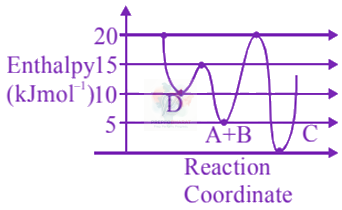
Two solids dissociate as follows: $A(s)\rightleftharpoons B(g)+C(g); {K}_{{P}_{1}}=x {\mathrm{atm}}^{2}$ $D(s)\rightleftharpoons C(g)+E(g); {K}_{{P}_{2}}=y {\mathrm{atm}}^{2}$ The total pressure when both the solids dissociate simultaneously is:
$20 \mathrm{ml}$ of ${\text{0.1 M H}}_{2}{\mathrm{SO}}_{4}$ solution is added to $30 \mathrm{mL}$ of $0.2 M {\mathrm{NH}}_{4}\mathrm{OH}$ solution. The $\mathrm{pH}$ of the resultant mixture is: $[{\mathrm{pk}}_{b} \mathrm{of} {\mathrm{NH}}_{4}\mathrm{OH}=4.7]$
In the cell, $\mathrm{Pt}(s)|{H}_{2}(g, 1\mathrm{bar})| \mathrm{HCl} (\mathrm{aq})|\mathrm{AgCl}(s)|\mathrm{Ag}(s)|\mathrm{Pt}(s),$the cell potential is $0.92 V$ when a ${10}^{-6}$ molar $\mathrm{HCl}$ solution is used. The standard electrode potential of $\mathrm{Ag}|\mathrm{AgCl}|{\mathrm{Cl}}^{-}$ electrode is: (Given, $\frac{2.303\mathrm{RT}}{F}=0.06 V$ at $298 K$)
For a diatomic ideal gas in a closed system, which of the following plots does not correctly describe the relation between various thermodynamic quantities?
Consider the reversible isothermal expansion of an ideal gas in a closed system at two different temperatures ${T}_{1}$ and ${T}_{2}({T}_{1}<{T}_{2})$ . The correct graphical depiction of the dependence of work done $(w)$ vs the final volume $(V)$ is:
For the chemical reaction $\mathrm{X} \rightleftharpoons \mathrm{Y},$ the standard reaction Gibbs energy depends on temperature $T$ (in $K$ ) as $\Delta_{\mathrm{r}} \mathrm{G}^{\circ}\left(\right.$ in $\left.\mathrm{kJ} \mathrm{mol}^{-1}\right)=120-\frac{3}{8} \mathrm{~T}$ The major component of the reaction mixture at $\mathrm{T}$ is :
The freezing point of a diluted milk sample is found to be $-0.2^{\circ} \mathrm{C},$ while it should have been $-0.5^{\circ} \mathrm{C}$ for pure milk. How much water has been added to pure milk to make the diluted sample?
A solution of sodium sulphate contains $92 g$ of ${\mathrm{Na}}^{+}$ ions per kilogram of water. The molality of ${\mathrm{Na}}^{+}$ ions in that solution in $\mathrm{mol} {\mathrm{kg}}^{-1}$ is:
Molecules of benzoic acid $({C}_{6}{H}_{5}\mathrm{COOH})$ dimerise in $30 g$ of benzene. ' $w$ ' $g$ of benzoic acid shows a depression in freezing point equal to $2 K$. If the percentage association of the acid to form dimer in the solution is $80$, then $w$ is: $($ Given that ${K}_{f}=5{\mathrm{Kmol}}^{-1}$, molar mass of benzoic acid $=122 {\mathrm{gmol}}^{-1})$
The electrons are more likely to be found: 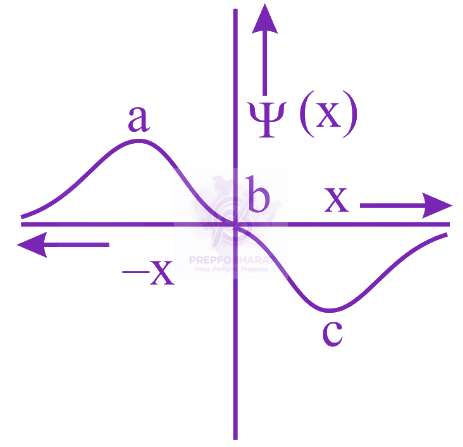
The anodic half-cell of lead-acid battery is recharged using electricity of $0.05$ Faraday. The amount of ${\mathrm{PbSO}}_{4}$ electrolyzed in $g$ during the process is: (Molar mass of ${\mathrm{PbSO}}_{4}=303g {\mathrm{mol}}^{-1}$)
Which one of the following statements regarding Henry's law is not correct?
The ratio of the shortest wavelength of two spectral series of hydrogen spectrum is found to be about $9$. The spectral series are:
The freezing point of a $4%$ aqueous solution of $X$ is equal to the freezing point of a $12%$ aqueous solution of $Y$. If the molecular weight of $X$ is $A$, then the molecular weight of $Y$ will be
$N{O}_{2}$ required for a reaction is produced by the decomposition of ${N}_{2}{O}_{5}$ in $CC{l}_{4}$ as per the equation, $2{N}_{2}{O}_{5}(g)\rightarrow 4N{O}_{2}(g)+{O}_{2}(g).$ The initial concentration of ${N}_{2}{O}_{5}$ is $3.00 mol {L}^{-1}$ and it is $2.75 mol {L}^{-1}$ after 30 minutes. The rate of formation of $N{O}_{2}$ is:
The given plots represent the variation of the concentration of a reactant $R$ with time for two different reactions $(i)\mathrm{and}(\mathrm{ii})$. The respective orders of the reaction are (i) 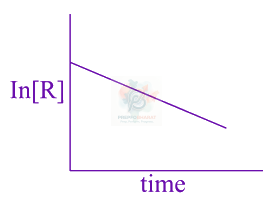 (ii) 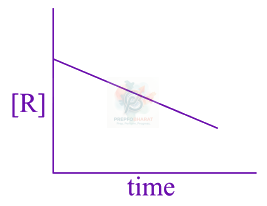
Consider the reaction $\mathrm{N}_{2}(\mathrm{~g})+3 \mathrm{H}_{2}(\mathrm{~g}) \rightleftharpoons 2 \mathrm{NH}_{3}(\mathrm{~g})$ The equilibrium constant of the above reaction is $\mathrm{K}_{\mathrm{P}}$. If pure ammonia is left to dissociate, the partial pressure of ammonia at equilibrium is given by (Assume that $\mathrm{P}_{\mathrm{NH}_{3}}< < \mathrm{P}_{\text {total }}$ at equilibrium)
An example of a disproportionation reaction is
Calculate the standard cell potential (in V) of the cell in which the following reaction takes place: ${Fe}^{2+} (aq)+A{g}^{+}(aq)\rightarrow F{e}^{3+}(aq)+Ag(s)$ Given that ${E}_{{\mathrm{Ag}}^{+}/Ag}^{o}=x V$ ${E}_{{Fe}^{2+}/Fe}^{o}=y V$ ${E}_{{Fe}^{3+}/Fe}^{o}=z V$
For a reaction scheme $A\overset{{ k}_{1} }{\rightarrow }B\overset{{ k}_{2} }{\rightarrow }C,$ if the net rate of formation of B is set to be zero then the concentration of B is given by:
What is the molar solubility of $AI{(OH)}_{3}$ in $0.2$ $M NaOH$ solution? Given that, solubility product of $\mathrm{Al}{(OH)}_{3}=2.4\times {10}^{-24}$ :
The standard electrode potential ${E}^{o}$ and its temperature coefficient $(\frac{\mathrm{dE}}{\mathrm{dT}})$ for a cell are $2V$ and $-5{\times 10}^{-4} V{K}^{-1}$ at $300 K$, respectively. The reaction is $\mathrm{Zn}(s)+{\mathrm{Cu}}^{2+}(\mathrm{aq})\rightarrow {\mathrm{Zn}}^{2+}(\mathrm{aq})+\mathrm{Cu}(s)$. The standard reaction enthalpy $({\Delta }_{r}{H}^{-})$ at $300K$ in $mo{l}^{-1}$ is $[$Use $R=8J{K}^{-1}{\mathrm{mol}}^{-1}$ and $F=96,500C{\mathrm{mol}}^{-1}]$
At room temperature, a dilute solution of urea is prepared by dissolving $0.60 g$ of urea in $360 g$ of water. If the vapour pressure of pure water at this temperature is $35 mm Hg$ , lowering of vapour pressure will be: (molar mass of urea $=60 g mo{l}^{-1}$ )
A mixture of $100 m\mathrm{mol}$ of $\mathrm{Ca}{(\mathrm{OH})}_{2}$ and $2g$ of sodium sulphate was dissolved in water and the volume was made up to $100 \mathrm{mL}.$ What is the mass of calcium sulphate formed and the concentration of ${\mathrm{OH}}^{-}$ in resulting solution, respectively? (Molar mass of $\mathrm{Ca}{(\mathrm{OH})}_{2}, {\mathrm{Na}}_{2}{\mathrm{SO}}_{4}$ and ${\mathrm{CaSO}}_{4}$ are $74, 143$ and $136g {\mathrm{mol}}^{-1},$ respectively; ${K}_{\mathrm{sp}}$ of $\mathrm{Ca}{(\mathrm{OH})}_{2}\mathrm{is} 5.5\times {10}^{-6}$)
Liquids $A$ and $B$ form an ideal solution in the entire composition range. At $350K,$ the vapour pressure of pure A and pure B are $7\times {10}^{3}\mathrm{Pa}$ and $12\times {10}^{3}\mathrm{Pa}$ , respectively. The composition of the vapour in equilibrium with a solution containing 40 mole percent of A at this temperature is:
The amphoteric hydroxide is:
Among the following, the set of parameters that represents path functions, is: i) $q+w$ ii) $q$ iii) $w$ iv) $H-TS$
The quantum number of four electrons are given below: $I. n=4, l=2, {m}_{l}=–2, {m}_{s}=–1/2$ $II. n=3, l=2, {m}_{l}=1, {m}_{s}=+1/2$ $III. n=4, l=1, {m}_{l}=0, {m}_{s}=+1/2$ $IV. n=3, l=1, {m}_{l}=1, {m}_{s}=–1/2$ The correct order of their increasing energies will be:
A solution containing $62 g$ ethylene glycol in $250 g$ water is cooled to $-{10}^{o}C$ . If ${K}_{f}$ for water is $1.86 K \mathrm{kg} {\mathrm{mol}}^{-1}$ , the amount of water (in $g$ ) separated as ice is:
Given: $(i)$ $\text{C}(\mathrm{graphite})+{O}_{2}(g)\rightarrow {\mathrm{CO}}_{2}(g);$ ${\Delta rH}^{\Theta }=x \mathrm{kJ} {\mathrm{mol}}^{-1}$ $(\mathrm{ii})$ $C(\mathrm{graphite})+\frac{1}{2}{O}_{2}(g)\rightarrow \mathrm{CO}(g);$ ${\Delta rH}^{\Theta }=y \mathrm{kJ} {\mathrm{mol}}^{-1}$ $(\mathrm{iii}) \mathrm{CO}(g)+\frac{1}{2}{O}_{2}(g)\rightarrow {\mathrm{CO}}_{2}(g);$ ${\Delta rH}^{\Theta }=z \mathrm{kJ} {\mathrm{mol}}^{-1}$ Based on the above thermochemical equations, find out which one of the following algebraic relationships is correct?
$25 \mathrm{~mL}$ of the given $\mathrm{HCl}$ solution requires $30 \mathrm{~mL}$ of $0.1 \mathrm{M}$ sodium carbonate solution. What is the volume of this $\mathrm{HCl}$ solution required to titrate $30 \mathrm{~mL}$ of $0.2 \mathrm{M}$ aqueous $\mathrm{NaOH}$ solution?
Which of the graphs shown below does not represent the relationship between incident light and the electron ejected from metal surface?
Two blocks of the same metal having same mass and at temperature $\mathrm{T}_{1},$ and $\mathrm{T}_{2}$, respectively, are brought in contact with each other and allowed to attain thermal equilibrium at constant pressure. The change in entropy, $\Delta \mathrm{S}$, for this process is :
Consider the statements $S1$ and $S2$ : $S1$ : Conductivity always increases with decreases in the concentration of electrolyte. $S2$ : Molar conductivity always increases with decreases in the concentration of electrolyte. The correct option among the following
Liquid $M$ and liquid $N$ form an ideal solution. The vapour pressures of pure liquids $M$ and $N$ are $450$ and $700 mmHg,$ respectively, at the same temperature. Then correct statements is: ( ${x}_{M}=Mole fraction of {'M}^{'} in solution;$ ${x}_{N}=Mole fraction of {'N}^{'}in solution;$ ${y}_{M}=Mole fraction of {'M}^{'} in vapour phase;$ ${y}_{N}=Mole fraction of {'N}^{'} in vapour phase;$ )
The graph between ${|\psi |}^{2}$ and $r$ (radical distance) is shown below. This represents: 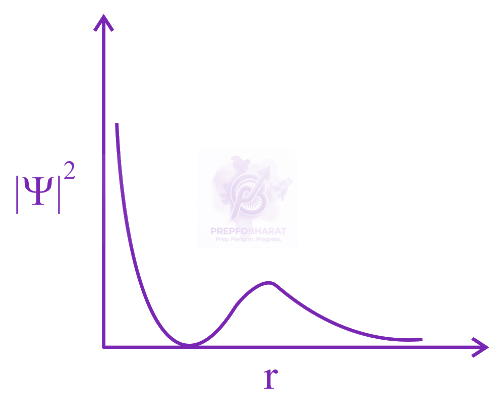
For an elementary chemical reaction, ${A}_{2}⇄_{{k}_{-1}}^{{k}_{1}}2A$ , the expression for $\frac{d[A]}{\mathrm{dt}}$ is:
During compression of a spring the work done is $10 kJ$ and $2 kJ$ escaped to the surroundings as heat. The change in internal energy, $\Delta U(in kJ)$ is:
The minimum amount of ${O}_{2}(g)$ consumed per gram of reactant is for the reaction: (Given atomic mass: $Fe=56, O=16, Mg=24, P=31, C=12,H=1$ )
A bacterial infection in an internal wound grows as ${N}^{'}(t)={N}_{0}exp(t)$ , where the time $t$ is in hours. A dose of antibiotic, taken orally, needs 1 hour to reach the wound. Once it reaches there, the bacterial population goes down as $\frac{dN}{dt}=-5{N}^{2}$ . What will be the plot of $\frac{{N}_{0}}{N}$ vs $t$ after $1$ hour?
An ideal gas is allowed to expand from $1 L$ to $10 L$ against a constant external pressure of $1$ bar. The work done in $kJ$ is:
The vapour pressures of pure liquids $A$ and $B$are $400$ and $600\mathrm{mm}\mathrm{Hg}$ respectively at $298 K.$On mixing the two liquids, the sum of their volumes is equal to the volume of the final mixture. The mole fraction of liquid $B$ is $0.5$ in the mixture. The vapour pressure of the final solution, the mole fractions of components $A$ and $B$ in the vapour phase, respectively are
The process with negative entropy change is:
The osmotic pressure of a dilute solution of an ionic compound $XY$ in water is four times that of a solution $0.01 M BaC{l}_{2}$ in water. Assuming complete dissociation of the given ionic compounds in water, the concentration of $XY$ ( $in mol {L}^{-1}$ ) in solution is
Given that, ${E}_{{O}_{2}/{H}_{2}O}^{o}=+1.23V;$ ${E}_{{S}_{2}{O}_{8}^{2-}/{\mathrm{SO}}_{4}^{2-}}^{o}=2.05V$ ${E}_{{\mathrm{Br}}_{2}/{\mathrm{Br}}^{-}}^{o}=+1.09V;$ ${E}_{{\mathrm{Au}}^{3+}/\mathrm{Au}}^{o}=1.4V$ The strongest oxidizing agent is
Decomposition of $X$ exhibits a rate constant of $0.05 \mu g/\mathrm{year}$. How many years are required for the decomposition of $5 \mu g$ of $X$ into $2.5 \mu g$?
If solubility product of $Z{r}_{3}{(P{O}_{4})}_{4}$ is denoted by ${K}_{sp}$ and its molar solubility is denoted by $S$ , then which of the following relation between $S$ and ${K}_{sp}$ is correct?
A $10 \mathrm{mg}$ effervescent tablet containing sodium bicarbonate and oxalic acid releases $0.25 \mathrm{~mL}$ of $\mathrm{CO}_{2}$ at $\mathrm{T}=298.15 \mathrm{~K}$ and $\mathrm{P}=1$ bar. If molar volume of $\mathrm{CO}_{2}$ is $25.0 \mathrm{~L}$ under such condition, what is the percentage of sodium bicarbonate in each tablet? [Molar mass of $\left.\mathrm{NaHCO}_{3}=84 \mathrm{~g} \mathrm{~mol}^{-1}\right]$
Given: $C{o}^{3+}+{e}^{-}\rightarrow C{o}^{2+};E^{\circ}=+1.81V$ ${Pb}^{3+}+{2e}^{-}\rightarrow {Pb}^{2+};E^{\circ}=+1.67V$ $C{e}^{4+}+{e}^{-}\rightarrow C{e}^{3+};E^{\circ}=+1.61V$ ${Bi}^{3+}+{3e}^{-}\rightarrow Bi;E^{\circ}=+0.20V$ Oxidizing power of the species will increase in the order:
For the equilibrium $2 \mathrm{H}_{2} \mathrm{O} \rightleftharpoons \mathrm{H}_{3} \mathrm{O}^{+}+\mathrm{OH}^{-} ;$ the value of $\Delta \mathrm{G}^{\circ}$ at $298 \mathrm{~K}$ is approximately:
For the reaction, $2A+B\rightarrow$ products, when the concentration of $A$ and $B$ both were doubled, the rate of the reaction increased from $0.3 mol {L}^{-1}{s}^{-1}$ to $2.4 mol {L}^{-1}{s}^{-1}.$ When the concentration of $A$ alone is doubled, the rate increased from $0.3 mol {L}^{-1}{s}^{-1}$ to $0.6 mol {L}^{-1}{s}^{-1}.$ Which one of the following statements is correct?
The molar solubility of $Cd{(OH)}_{2}$ is $1.84\times {10}^{-5}M$ in water. The expectes solunility of $Cd{(OH)}_{2}$ in a buffer solution of $pH=12$ is:
A process will be spontaneous at all temperatures if:
The de Broglie wavelength $(\lambda)$ associated with a photoelectron varies with the frequency $(v)$ of the incident radiation as,$\left[v_{0}\right.$ is threshold frequency]:
The difference between $\Delta H$ and $\Delta U$ is $(\Delta H-\Delta U)$, when the combustion of one mole of heptane $(l)$ is carried out at a temperature $T$ , is equal to: