JEE Main 2022 — Physical Chemistry
Chemistry Physical Chemistry questions from JEE Main 2022.
Other Years
180 Physical Chemistry Questions from 2022
For a first order reaction, the half-life is 10 minutes. What fraction of reactant remains after 40 minutes?
The cell potential for $\mathrm{Zn}|{\mathrm{Zn}}^{2+}(\mathrm{aq})\|{\mathrm{Sn}}^{x+}|\mathrm{Sn}$ is $0.801V$ at $298K$. The reaction quotient for the above reaction is ${10}^{-2}$. The number of electrons involved in the given electrochemical cell reaction is _____ . (Given ${E}_{{\mathrm{Zn}}^{2+}\mid \mathrm{Zn}}^{0}=-0.763V,{E}_{{\mathrm{Sn}}^{x+}|\mathrm{Sn}}^{0}=+0.008V$ and $\frac{2.303\mathrm{RT}}{F}=0.06V$)
The wavelength of an electron and a neutron will become equal when the velocity of the electron is $x$ times the velocity of neutron. The value of $x$ is____(the nearest integer)(Mass of electron is $9.1\times {10}^{-31}\mathrm{kg}$ and mass of neutron is $1.6\times {10}^{-27}\mathrm{kg}$)
The quantity of electricity in Faraday needed to reduce $1\mathrm{mol}$ of ${\mathrm{Cr}}_{2}{O}_{7}^{2-}$ to ${\mathrm{Cr}}^{3+}$ is
Which of the following pair is not isoelectronic species? (Atomic numbers $\mathrm{Sm}=62;\mathrm{Er}=68;\mathrm{Yb}=70;\mathrm{Lu}=71;\mathrm{Eu}=63;\mathrm{Tb}=65;Tm=69$)
At $600K,2\mathrm{mol}$ of $\mathrm{NO}$ are mixed with $1\mathrm{mol}$ of ${O}_{2}$. $2{\mathrm{NO}}_{(g)}+{O}_{2}(g)⇄2{\mathrm{NO}}_{2}(g)$ The reaction occurring as above comes to equilibrium under a total pressure of $1$ atm. Analysis of the system shows that $0.6\mathrm{mol}$ of oxygen are present at equilibrium. The equilibrium constant for the reaction is____.
On complete combustion of $0.492g$ of an organic compound containing $C,H$ and $O,0.7938g$ of ${\mathrm{CO}}_{2}$ and $0.4428g$ of ${H}_{2}O$ was produced. The $%$ composition of oxygen in the compound is____. (Nearest Integer)
A company dissolves '$x$' amount of ${\mathrm{CO}}_{2}$ at $298K$ in $1$ litre of water to prepare soda water. $X=\times {10}^{-3}g$. (nearest integer) (Given: partial pressure of ${\mathrm{CO}}_{2}$ at $298K=0.835$ bar. Henry's law constant for ${\mathrm{CO}}_{2}$ at $298K=1.67\mathrm{kbar}$. Atomic mass of $H,C$ and $O$ is $1,12$, and $6g{\mathrm{mol}}^{-1}$, respectively)
The reaction between $X$ and $Y$ is first order with respect to $X$ and zero order with respect to $Y$. <table class="pyq-table"><tbody><tr><td>Experiment</td><td>$\frac{[X]}{{\mathrm{molL}}^{-1}}$</td><td>$\frac{[Y]}{{\mathrm{molL}}^{-1}}$</td><td>$\frac{\mathrm{Initial}rate}{\mathrm{mol}{L}^{-1}{\mathrm{min}}^{-1}}$</td></tr><tr><td>I</td><td>$0.1$</td><td>$0.1$</td><td>$2\times {10}^{-3}$</td></tr><tr><td>II</td><td>$L$</td><td>$0.2$</td><td>$4\times {10}^{-3}$</td></tr><tr><td>III</td><td>$0.4$</td><td>$0.4$</td><td>$M\times {10}^{-3}$</td></tr><tr><td>IV</td><td>$0.1$</td><td>$0.2$</td><td>$2\times {10}^{-3}$</td></tr></tbody></table>Examine the data of table and calculate ratio of numerical values of $M$ and $L$.
The number of $N$ atoms in $681g$ of ${C}_{7}{H}_{5}{N}_{3}{O}_{6}$ is $x\times {10}^{21}$. The value of $x$ is $({N}_{A}=6.02\times {10}^{23}{\mathrm{mol}}^{-1})$ (Nearest Integer)
For a reaction, given below is the graph of $\mathrm{lnk}\mathrm{vs}\frac{1}{T}$. The activation energy for the reaction is equal to____$\mathrm{cal}{\mathrm{mol}}^{-1}$.(Given : $R=2{\mathrm{calK}}^{-1}{\mathrm{mol}}^{-1}$) 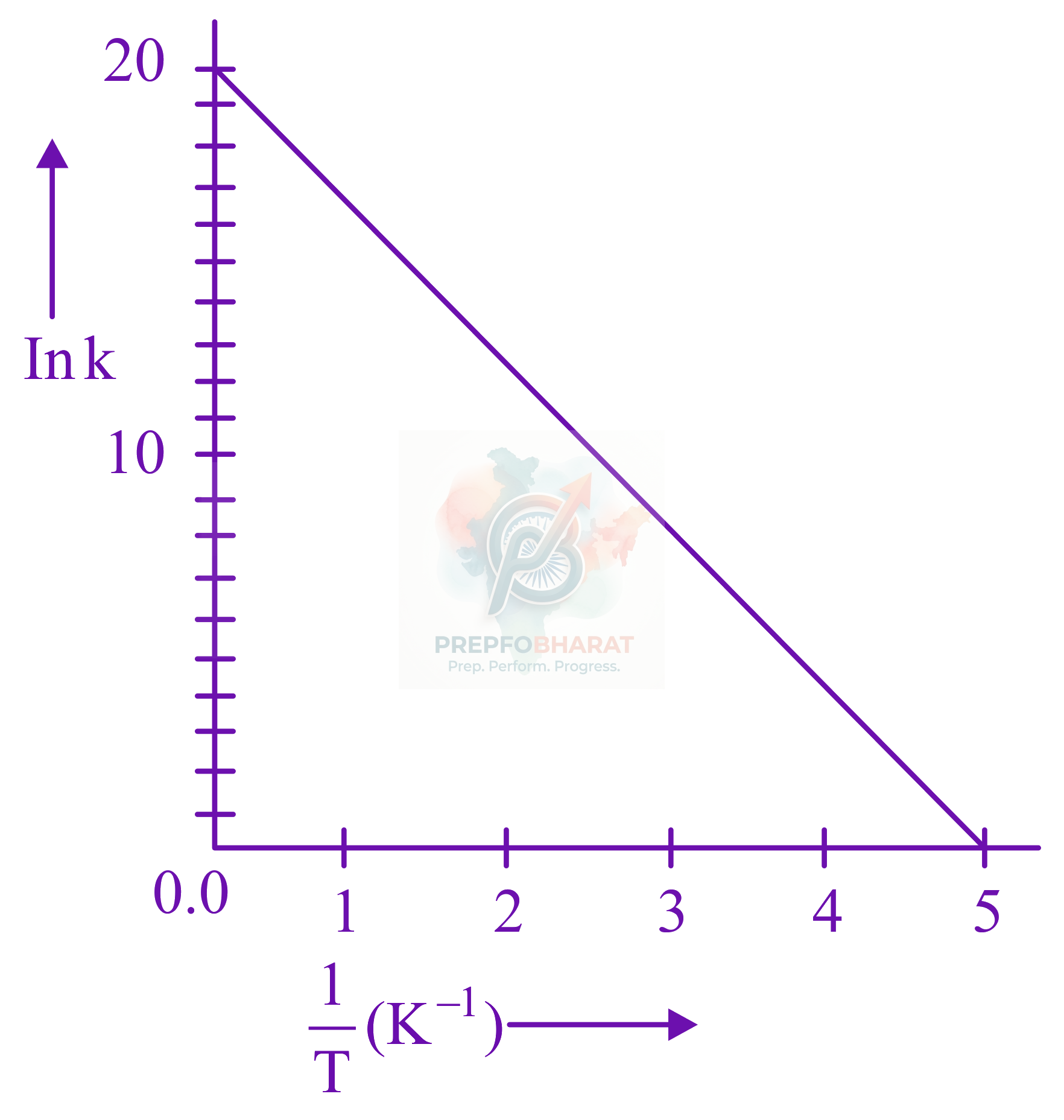
$2.2g$ of nitrous oxide $({N}_{2}O)$ gas is cooled at a constant pressure of $1$ atm from $310K$ to $270K$ causing the compression of the gas from $217.1\mathrm{mL}$ to $167.75\mathrm{mL}$. The change in internal energy of the process, $\triangle U$ is $'-x'J$. The value of $'x'$ is _____. [nearest integer] (Given: atomic mass of $N=14g{\mathrm{mol}}^{-1}$ and of $O=16g{\mathrm{mol}}^{-1}$. Molar heat capacity of ${N}_{2}O$ is $100{\mathrm{JK}}^{-1}{\mathrm{mol}}^{-1}$)
$120g$ of an organic compound which contains only carbon and hydrogen on complete combustion gives $330g$ of ${\mathrm{CO}}_{2}$ and $270g$ of water. The percentage of carbon and hydrogen in the organic compound are respectively
${\mathrm{SO}}_{2}{\mathrm{Cl}}_{2}$ on reaction with excess of water results into acidic mixture ${\mathrm{SO}}_{2}{\mathrm{Cl}}_{2}+2{H}_{2}O\rightarrow {H}_{2}{\mathrm{SO}}_{4}+2\mathrm{HCl}$ $16$ moles of $\mathrm{NaOH}$ is required for the complete neutralisation of the resultant acidic mixture. The number of moles of ${\mathrm{SO}}_{2}{\mathrm{Cl}}_{2}$ used is
Which of the given reactions is not an example of disproportionation reaction?
Which one of the following is an example of disproportionation reaction?
The normality of ${H}_{2}{\mathrm{SO}}_{4}$ in the solution obtained on mixing $100\mathrm{mL}$ of $0.1M{H}_{2}{\mathrm{SO}}_{4}$ with $50\mathrm{mL}$ of $0.1M\mathrm{NaOH}$ is____$\times {10}^{-1}N$.
If the uncertainty in velocity and position of a minute particle in space are, $2.4\times {10}^{-26}({\mathrm{ms}}^{-1})$ and ${10}^{-7}(m)$ respectively. The mass of the particle in $g$ is___(Nearest integer) (Given : $h=6.626\times {10}^{-34}\mathrm{Js}$)
If the work function of a metal is $6.63\times {10}^{-19}J$, the maximum wavelength of the photon required to remove a photoelectron from the metal is____$\mathrm{nm}$. Nearest integer) [Given : $h=6.63\times {10}^{-34}Js$, and $c=3\times {10}^{8}m{s}^{-1}$]
$2L$ of $0.2{\mathrm{MH}}_{2}{\mathrm{SO}}_{4}$ is reacted with $2L$ of $0.1\mathrm{MNaOH}$ solution, the molarity of the resulting product ${\mathrm{Na}}_{2}{\mathrm{SO}}_{4}$ in the solution is____millimolar.
Production of iron in blast furnace follows the following equation ${\mathrm{Fe}}_{3}{O}_{4}(s)+4\mathrm{CO}(g)\rightarrow 3\mathrm{Fe}(l)+4{\mathrm{CO}}_{2}(g)$ when $4.640\mathrm{kg}$ of ${\mathrm{Fe}}_{3}{O}_{4}$ and $2.520\mathrm{kg}$ of $\mathrm{CO}$ are allowed to react then the amount of iror (in $g$) produced is : [Given: Molar Atomic mass $({\mathrm{gmol}}^{-1}):\mathrm{Fe}=56$ Molar Atomic mass $({\mathrm{gmolm}}^{-1}):O=16$ Molar Atomic mass $({\mathrm{gmolm}}^{-1}):C=12$]
The energy of one mole of photons of radiation of wavelength $300\mathrm{nm}$ is (Given : $h=6.63\times {10}^{-34}Js,{N}_{A}=6.02\times {10}^{23}{\mathrm{mol}}^{-1}c=3\times {10}^{8}m{s}^{-1}$)
The correct order of reduction potentials of the following pairs is A. ${\mathrm{Cl}}_{2}/{\mathrm{Cl}}^{-}$ B. ${I}_{2}/{I}^{-}$ C. ${\mathrm{Ag}}^{+}/\mathrm{Ag}$ D. ${\mathrm{Na}}^{+}/\mathrm{Na}$ E. ${\mathrm{Li}}^{+}/\mathrm{Li}$ Choose the correct answer from the options given below.
Consider the following set of quantum numbers. <table class="pyq-table"><tbody><tr><td></td><td>$n$</td><td>$l$</td><td>${m}_{1}$</td></tr><tr><td>A</td><td>$3$</td><td>$3$</td><td>$-3$</td></tr><tr><td>B</td><td>$3$</td><td>$2$</td><td>$-2$</td></tr><tr><td>C</td><td>$2$</td><td>$1$</td><td>$+1$</td></tr><tr><td>D</td><td>$2$</td><td>$2$</td><td>$+2$</td></tr></tbody></table>The number of correct sets of quantum numbers is
Consider the reaction $4{\mathrm{HNO}}_{3}(l)+3\mathrm{KCl}(s)\rightarrow {\mathrm{Cl}}_{2}(g)+\mathrm{NOCl}(g)+2{H}_{2}O(g)+3{\mathrm{KNO}}_{3}(s)$ The amount of ${\mathrm{HNO}}_{3}$ required to produce$110.0g$ of ${\mathrm{KNO}}_{3}$ is (Given : Atomic masses of $H,O,N$ and $K$ are $1,16,14$ and $39$, respectively.)
Among the following the number of state variable is Internal energy $(U)$ Volume $(V)$ Heat $(q)$ Enthalpy $(H)$
$2g$ of a non-volatile non-electrolyte solute is disolved in $200g$ of two different solvents $A$ and $B$ whose ebullioscopic constants are in the ratio of $1:8$. The elevation in boiling points of $A$ and $B$ are in the ratio $\frac{x}{y}(x:y)$. The value of $y$ is____(Nearest Integer)
$\mathrm{CNG}$ is an important transportation fuel. When $100\mathrm{gCNG}$ is mixed with $208g$ oxygen in vehicles, it leads to the formation of ${\mathrm{CO}}_{2}$ and ${H}_{2}O$ and produces large quantity of heat during this combustion, then the amount of carbon dioxide, produced in grams is [nearest integer] [Assume CNG to be methane]
$1.2\mathrm{mL}$ of acetic acid is dissolved in water to make $2.0L$ of solution. The depression in freezing point observed for this strength of acid is $0.0198^{\circ}C$. The percentage of dissociation of the acid is (Nearest integer) [Given : Density of acetic acid is $1.02g{\mathrm{mL}}^{-1}$ Molar mass of acetic acid is $60g{\mathrm{mol}}^{-1}$ ${K}_{f}({H}_{2}O)=1.85K\mathrm{kg}{\mathrm{mol}}^{-1}$]
Solute A associates in water. When $0.7g$ of solute $A$ is dissolved in $42.0g$ of water, it depresses the freezing point by $0.2^{\circ}C$. The percentage association of solute $A$ in water, is [Given: Molar mass of $A=93g{\mathrm{mol}}^{-1}$. Molal depression constant of water is $1.86K\mathrm{kg}{\mathrm{mol}}^{-1}$]
The osmotic pressure exerted by a solution prepared by dissolving $2.0g$ of protein of molar mass $60\mathrm{kg}{\mathrm{mol}}^{-1}$ in $200\mathrm{mL}$ of water at $27^{\circ}C$ is____$\mathrm{Pa}$. [integer value] (use $R=0.083L$ bar ${\mathrm{mol}}^{-1}{K}^{-1}$)
$116g$ of a substance upon dissociation reaction, yields $7.5g$ of hydrogen, $60g$ of oxygen and $48.5g$ of carbon. Given that the atomic masses of $H,O$ and $C$ are $1,16$ and $12$, respectively. The data agrees with how many formulae of the following? A. ${\mathrm{CH}}_{3}\mathrm{COOH}$ B. $\mathrm{HCHO}$ C. ${\mathrm{CH}}_{3}{\mathrm{OOCH}}_{3}$ D. ${\mathrm{CH}}_{3}\mathrm{CHO}$
The vapour pressures of two volatile liquids $A$ and $B$ at $25^{\circ}C$ are $50$ Torr and $100$ Torr, respectively. If the liquid mixture contains $0.3$ mole fraction of $A$, then the mole fraction of liquid $B$ in the vapour phase is $\frac{x}{17}$. The value of $x$ is
When $600\mathrm{mL}$ of $0.2M{\mathrm{HNO}}_{3}$ is mixed with $400\mathrm{mL}$ of $0.1M\mathrm{NaOH}$ solution in a flask, the rise in temperature of the flask is_____$\times {10}^{-2}^{\circ}C$ (Enthalpy of neutralisation $=57\mathrm{kJ}{\mathrm{mol}}^{-1}$ and Specific heat of water $=4.2{\mathrm{JK}}^{-1}{g}^{-1}$) (Neglect heat capacity of flask)
The number of radial and angular nodes in $4d$ orbital are, respectively
For a reaction at equilibrium $A(g)\rightleftharpoons B(g)+\frac{1}{2}C(g)$ the relation between dissociation constant $(K)$, degree of dissociation $(\alpha )$ and equilibrium pressure $(p)$ is given by :
Chlorophyll extracted from the crushed green leaves was dissolved in water to make $2L$ solution of $\mathrm{Mg}$ of concentration $48 \mathrm{ppm}$. The number of atoms of $\mathrm{Mg}$ in this solution is $x\times {10}^{20}$ atoms. The value of $x$ is (Nearest Integer) (Given : Atomic mass of $\mathrm{Mg}$ is $24g{\mathrm{mol}}^{-1}$, ${N}_{A}=6.02\times {10}^{23}{\mathrm{mol}}^{-1}$)
Two solutions $A$ and $B$ are prepared by dissolving $1g$ of non-volatile solutes $X$ and $Y$. respectively in $1\mathrm{kg}$ of water. The ratio of depression in freezing points for $A$ and $B$ is found to be $1:4$. The ratio of molar masses of $X$ and $Y$ is
The molar heat capacity for an ideal gas at constant pressure is $20.785J{K}^{-1}{\mathrm{mol}}^{-1}$. The change in internal energy is $5000J$ upon heating it from $300K$ to $500K$. The number of moles of the gas at constant volume is____ (Given: $R=8.314J{K}^{-1}{\mathrm{mol}}^{-1}$)
$17.0g$ of ${\mathrm{NH}}_{3}$ completely vapourises at $-33.42^{\circ}C$ and $1$ bar pressure and the enthalpy change in the process is $23.4\mathrm{kJ}{\mathrm{mol}}^{-1}$. The enthalpy change for the vapourisation of $85g$ of ${\mathrm{NH}}_{3}$ under the same conditions is $\mathrm{kJ}$.
$2.4g$ coal is burnt in a bomb calorimeter in excess of oxygen at $298K$ and $1\mathrm{atm}$ pressure. The temperature of the calorimeter rises from $298K$ to $300K$. The enthalpy change during the combustion of coal is $-x\mathrm{kJ}{\mathrm{mol}}^{-1}$. The value of $x$ is_____(Given : Heat capacity of bomb calorimeter $20.0{\mathrm{kJK}}^{-1}$. Assume coal to be pure carbon)
When $5$ moles of $\mathrm{He}$ gas expand isothermally and reversibly at $300K$ from $10$ litre to $20$ litre, the magnitude of the maximum work obtained is $J$. [nearest integer ] (Given : $R=8.3J{K}^{-1}{\mathrm{mol}}^{-1}$ and $\mathrm{log}2=0.3010$)
For combustion of one mole of magnesium in an open container at $300K$ and $1$ bar pressure, ${\Delta }_{C}{H}^{\ominus }=-601.70\mathrm{kJ}{\mathrm{mol}}^{-1}$, the magnitude of change in internal energy for the reaction is $\mathrm{kJ}$. (Nearest integer) (Given : $R=8.3J{K}^{-1}{\mathrm{mol}}^{-1}$)
For complete combustion of methanol ${\mathrm{CH}}_{3}\mathrm{OH}(l)+\frac{3}{2}{O}_{2}(g)\rightarrow {\mathrm{CO}}_{2}(g)+2{H}_{2}O(l)$ the amount of heat produced as measured by bomb calorimeter is $726\mathrm{kJ}{\mathrm{mol}}^{-1}$ at $27^{\circ}C$. The enthalpy of combustion for the reaction is $-x\mathrm{kJ}{\mathrm{mol}}^{-1}$, where $x$ is integer) (Given : $R=8.3{\mathrm{JK}}^{-1}{\mathrm{mol}}^{-1}$)
At $298K$, the equilibrium constant is $2\times {10}^{15}$ for the reaction: $\mathrm{Cu}(s)+2{\mathrm{Ag}}^{+}(\mathrm{aq})\rightleftharpoons {\mathrm{Cu}}^{2+}(\mathrm{aq})+2\mathrm{Ag}(s)$ The equilibrium constant for the reaction $\frac{1}{2}{\mathrm{Cu}}^{2+}(\mathrm{aq})+\mathrm{Ag}(s)\rightleftharpoons \frac{1}{2}\mathrm{Cu}(s)+{\mathrm{Ag}}^{+}(\mathrm{aq})$ is $x\times {10}^{-8}$. The value of $x$ is ______. (Round off the answer to the nearest integer)
$2\mathrm{NOCl}(g)\rightleftharpoons 2\mathrm{NO}(g)+{\mathrm{Cl}}_{2}(g)$ In an experiment, $2.0$ moles of $\mathrm{NOCl}$ was placed in a one-litre flask and the concentration of $\mathrm{NO}$ after equilibrium established, was found to be $0.4\mathrm{mol}/L$. The equilibrium constant at $30^{\circ}C$ is_____$\times {10}^{-4}$.
If the solubility product of $\mathrm{PbS}$ is $8\times {10}^{-28}$, then the solubility of $\mathrm{PbS}$ in pure water at $298K$ is $x\times {10}^{-16}\mathrm{mol}{L}^{-1}$. The value of $x$ is____ (Nearest integer) [Given $\sqrt{2}=1.41$]
For the reaction given below: ${\mathrm{CoCl}}_{3}.{\mathrm{xNH}}_{3}+{\mathrm{AgNO}}_{3}(\mathrm{aq})\rightarrow$ If two equivalents of $\mathrm{AgCl}$ precipitate out, then the value of $x$ will be _______
$200\mathrm{mL}$ of $0.01\mathrm{MHCl}$ is mixed with $400\mathrm{mL}$ of $0.01{\mathrm{MH}}_{2}{\mathrm{SO}}_{4}$. The $\mathrm{pH}$ of the mixture is
If ${O}_{2}$ gas is bubbled through water at $303K$, the number of millimoles of ${O}_{2}$ gas that dissolve in $1$ litre of water is____(Nearest integer) (Given : Henry's Law constant for ${O}_{2}$ at $303K$ is $46.82k$ bar and partial pressure of ${O}_{2}=0.920$ bar) (Assume solubility of ${O}_{2}$ in water is too small, nearly negligible)
A solution of ${\mathrm{Fe}}_{2}{({\mathrm{SO}}_{4})}_{3}$ is electrolyzed for '$x$' min with a current of $1.5A$ to deposit $0.3482g$ of $\mathrm{Fe}$. The value of $x$ is - [nearest integer] Given : $1F=96500{\mathrm{Cmol}}^{-1}$. Atomic mass of $\mathrm{Fe}=56{\mathrm{gmol}}^{-1}$
At $25^{\circ}C$ and $1$ atm pressure, the enthalpies of combustion are as given below: <table class="pyq-table"><tbody><tr><td>Substance</td><td>${H}_{2}$</td><td>$C$ (graphite)</td><td>${C}_{2}{H}_{6}(g)$</td></tr><tr><td>$\frac{{\Delta }_{c}{H}^{\Theta }}{{\mathrm{kJmol}}^{-1}}$</td><td>$-286.0$</td><td>$-394.0$</td><td>$-1560.0$</td></tr></tbody></table>The enthalpy of formation of ethane is
It has been found that for a chemical reaction with rise in temperature by $9K$ the rate constant gets doubled. Assuming a reaction to be occurring at $300K$, the value of activation energy is found to be ${\mathrm{kJmol}}^{-1}$. [nearest integer] (Given $\mathrm{ln}10=2.3,R=8.3J{K}^{-1}{\mathrm{mol}}^{-1},\mathrm{log}2=0.30$)
Given below are two statements : one is labelled as Assertion and the other is labelled as Reason. Assertion: At $10^{\circ}C$, the density of a $5M$ solution of $\mathrm{KCl}$ [atomic masses of $K&\mathrm{Cl}$ are $39&35.5g{\mathrm{mol}}^{-1}$ respectively], is '$x$' ${\mathrm{gml}}^{-1}$. The solution is cooled to $-21^{\circ}C$. The molality of the solution will remain unchanged. Reason: The molality of a solution does not change with temperature as mass remains unaffected with temperature. In the light of the above statements, choose the correct answer from the options given below.
A commercially sold conc. $\mathrm{HCl}$ is $35%\mathrm{HCl}$ by mass. If the density of this commercial acid is $1.46g/\mathrm{mL}$, the molarity of this solution is : (Atomic mass : $\mathrm{Cl}=35.5\mathrm{amu},H=1\mathrm{amu}$)
Given below are two statements: Statement I: For $\mathrm{KI}$, molar conductivity increases steeply with dilution. Statement II: For carbonic acid, molar conductivity increases slowly with dilution. In the light of the above statements, choose the correct answer from the options given below
The enthalpy of combustion of propane, graphite and dihydrogen at $298K$ are: $-2220.0\mathrm{kJ}{\mathrm{mol}}^{-1}$, $-393.5\mathrm{kJ}{\mathrm{mol}}^{-1}$ and $-285.8\mathrm{kJ}{\mathrm{mol}}^{-1}$ respectively. The magnitude enthalpy of formation of propane $({C}_{3}{H}_{8})$ is _____ ${\mathrm{kJmol}}^{-1}$. (Nearest integer)
${\mathrm{PCl}}_{5}$ dissociates as ${\mathrm{PCl}}_{5}(g)\rightleftharpoons {\mathrm{PCl}}_{3}(g)+{\mathrm{Cl}}_{2}(g)$ $5$ moles of ${\mathrm{PCl}}_{5}$ are placed in a $200$ litre vessel which contains $2$ moles of ${N}_{2}$ and is maintained at $600K$. The equilibrium pressure is $2.46\mathrm{atm}$. The equilibrium constant ${K}_{p}$ for the dissociation of ${\mathrm{PCl}}_{5}$ is___$\times {10}^{-3}$. (nearest integer) (Given: $R=0.082L$ atm ${K}^{-1}{\mathrm{mol}}^{-1}$; Assume ideal gas behaviour)
The half life for the decomposition of gaseous compound $A$ is $240s$ when the gaseous pressure was $500$ Torr initially. When the pressure was $250$ Torr, the half life was found to be $4.0\mathrm{min}$. The order of the reaction is _____ (Nearest integer)
Given below are two statements: One is labelled as Assertion $A$ and the other is labelled as Reason $R$ Assertion $A$ : The reduction of a metal oxide is easier if the metal formed is in liquid state than solid state. Reason $R$ : The value of ${\Delta G}^{\Theta }$ becomes more on negative side as entropy is higher in liquid state than solid state. In the light of the above statements. Choose the most appropriate answer from the options given below
Given below are two statements: one is labelled as Assertion $A$ and the other is labelled as Reason $R$. Assertion $A$ :Phenolphthalein is a $\mathrm{pH}$ dependent indicator, remains colourless in acidic solution and gives pink colour in basic medium Reason $R$ : Phenolphthalein is a weak acid. It doesn't dissociate in basic medium. In the light of the above statements, choose the most appropriate answer from the options given below
$4.0$ moles of argon and $5.0$ moles of ${\mathrm{PCl}}_{5}$ are introduced into an evacuated flask of $100$ litre capacity at $610K$. The system is allowed to equilibrate. At equilibrium, the total pressure of mixture was found to be $6.0\mathrm{atm}$. The ${K}_{p}$ for the reaction is [Given : $R=0.082L$ atm ${K}^{-1}{\mathrm{mol}}^{-1}$ ]
Which of the following statements are correct? (A) The electronic configuration of $\mathrm{Cr}$ is $[\mathrm{Ar}]3{d}^{5}4{s}^{1}$. (B) The magnetic quantum number may have a negative value. (C) In the ground state of an atom, the orbitals are filled in order of their increasing energy order. (D) The total number of nodes are given by $n-2$. Choose the most appropriate answer from the options given below.
Given below are two statements. One is labelled as Assertion $A$ and the other is labelled as Reason $R$. Assertion $A$ : Energy of $2s$ orbital of hydrogen atom is greater than that of $2s$ orbital of lithium. Reason $R$ : Energies of the orbitals in the same subshell decrease with increase in the atomic number. In the light of the above statements, choose the correct answer from the options given below.
A protein '$A$' contains $0.30%$ of glycine (molecular weight $75$). The minimum molar mass of the protein '$A$' is____$\times {10}^{3}g{\mathrm{mol}}^{-1}$ [nearest integer]
Given below are two statements: One is labelled as Assertion $A$ and the other is labelled as Reason $R$ Assertion $A$ : Permanganate titration are not performed in presence of hydrochloric acid. Reason $R$ : Chlorine is formed as a consequence of oxidation of hydrochloric acid. In the light of the above statements, choose the correct answer from the options given below
Elevation in boiling point for $1.5$ molal solution of glucose in water is $4K$. The depression in freezing point for $4.5$ molal solution of glucose in water is $4K$. The ratio of molal elevation constant to molal depression constant $({K}_{b}/{K}_{f})$ is
The osmotic pressure of blood is $7.47$ bar at $300K$. To inject glucose to a patient intravenously, it has to be isotonic with blood. The concentration of glucose solution in ${\mathrm{gL}}^{-1}$ is (Molar mass of glucose $=180g{\mathrm{mol}}^{-1}$, $R=0.083{\mathrm{Lbar}}^{-1}{\mathrm{mol}}^{-1}$) (Nearest integer)
Identify the incorrect statement from the following.
For the reaction taking place in the cell: $\mathrm{Pt}(s){H}_{2}(g){H}^{+}(\mathrm{aq})||{\mathrm{Ag}}^{+}(\mathrm{aq})|\mathrm{Ag}(s)$ ${E}_{\mathrm{cell}}^{^{\circ}}=+0.5332V.$ The value of ${\Delta }_{f}{G}^{\ominus }$ is ${\mathrm{kJmol}}^{-1}$. (in nearest integer)
A compound '$X$' is a weak acid and it exhibits colour change at $\mathrm{pH}$ close to the equivalence point during neutralization of $\mathrm{NaOH}$ with ${\mathrm{CH}}_{3}\mathrm{COOH}$. Compound '$X$' exists in ionized form in basic medium. The compound '$X$' is
When $800\mathrm{mL}$ of $0.5M$ nitric acid is heated in a beaker, its volume is reduced to half and $11.5g$ of nitric acid is evaporated. The molarity of the remaining nitric acid solution is $x\times {10}^{-2}M$. (Molar mass of nitric acid is $63g{\mathrm{mol}}^{-1}$)
Match List - I with List - II. <table class="pyq-table"><tbody><tr><td></td><td>List-I</td><td></td><td>List-II</td></tr><tr><td>$(A)$</td><td>Spontaneous process</td><td>$(I)$</td><td>$\Delta H<0$</td></tr><tr><td>$(B)$</td><td>Process with $\Delta P=0,\Delta T=0$</td><td>$(\mathrm{II})$</td><td>${\Delta G}_{T,P}<0$</td></tr><tr><td>$(C)$</td><td>${\Delta H}_{\mathrm{reaction}}$</td><td>$(\mathrm{III})$</td><td>Isothermal and isobaric process</td></tr><tr><td>$(D)$</td><td>Exothermic Process</td><td>$(\mathrm{IV})$</td><td>[Bond energies of molecules in reactants] - [Bond energies of product molecules]</td></tr></tbody></table>Choose the correct answer from the options given below
Assuming $1\mu g$ of trace radioactive element $X$ with a half life of $30$ years is absorbed by a growing tree. The amount of $X$ remaining in the tree after $100$ years is_____$\times {10}^{-1}\mu g$. [Given : $\mathrm{ln}10=2.303;\mathrm{log}2=0.30$]
A $0.166g$ sample of an organic compound was digested with conc. ${H}_{2}{\mathrm{SO}}_{4}$ and then distilled with $\mathrm{NaOH}$. The ammonia gas evolved was passed through $50.0\mathrm{mL}$ of $0.5N{H}_{2}{\mathrm{SO}}_{4}$. The used acid required $30.0\mathrm{mL}$ of $0.25N\mathrm{NaOH}$ for complete neutralization. The mass percentage of nitrogen in the organic compound is
The cell potential for the following cell $\mathrm{Pt}|{H}_{2}(g)|{H}^{+}(\mathrm{aq})||{\mathrm{Cu}}^{2+}(0.01M)|\mathrm{Cu}(s)$ is $0.576V$ at $298K$. The $\mathrm{pH}$ of the solution is (Nearest integer) (Given : ${E}_{{\mathrm{Cu}}^{2+}/\mathrm{Cu}}^{o}=0.34V$ and $\frac{2.303\mathrm{RT}}{F}=0.06V$)
The activation energy of one of the reactions in a biochemical process is $532611J{\mathrm{mol}}^{-1}$. When the temperature falls from $310K$ to $300K$, the change in rate constant observed is ${k}_{300}=x\times {10}^{-3}{k}_{310^{\circ}}$. The value of $x$ is [Given: $\mathrm{ln}10=2.3R=8.3J{K}^{-1}{\mathrm{mol}}^{-1}$]
When the excited electron of a $H$ atom from $n=5$ drops to the ground state, the maximum number of emission lines observed are
The moles of methane required to produce $81g$ of water after complete combustion is____$\times {10}^{-2}\mathrm{mol}$. [nearest integer]
The pair, in which ions are isoelectronic with ${\mathrm{Al}}^{3+}$ is
The rate constants for decomposition of acetaldehyde have been measured over the temperature range $700-1000K$. The data has been analysed by plotting $\mathrm{lnk}$ vs $\frac{{10}^{3}}{T}$ graph. The value of activation energy for the reaction is ${\mathrm{kJmol}}^{-1}$. (Nearest integer) (Given : $R=8.31J{K}^{-1}{\mathrm{mol}}^{-1}$) 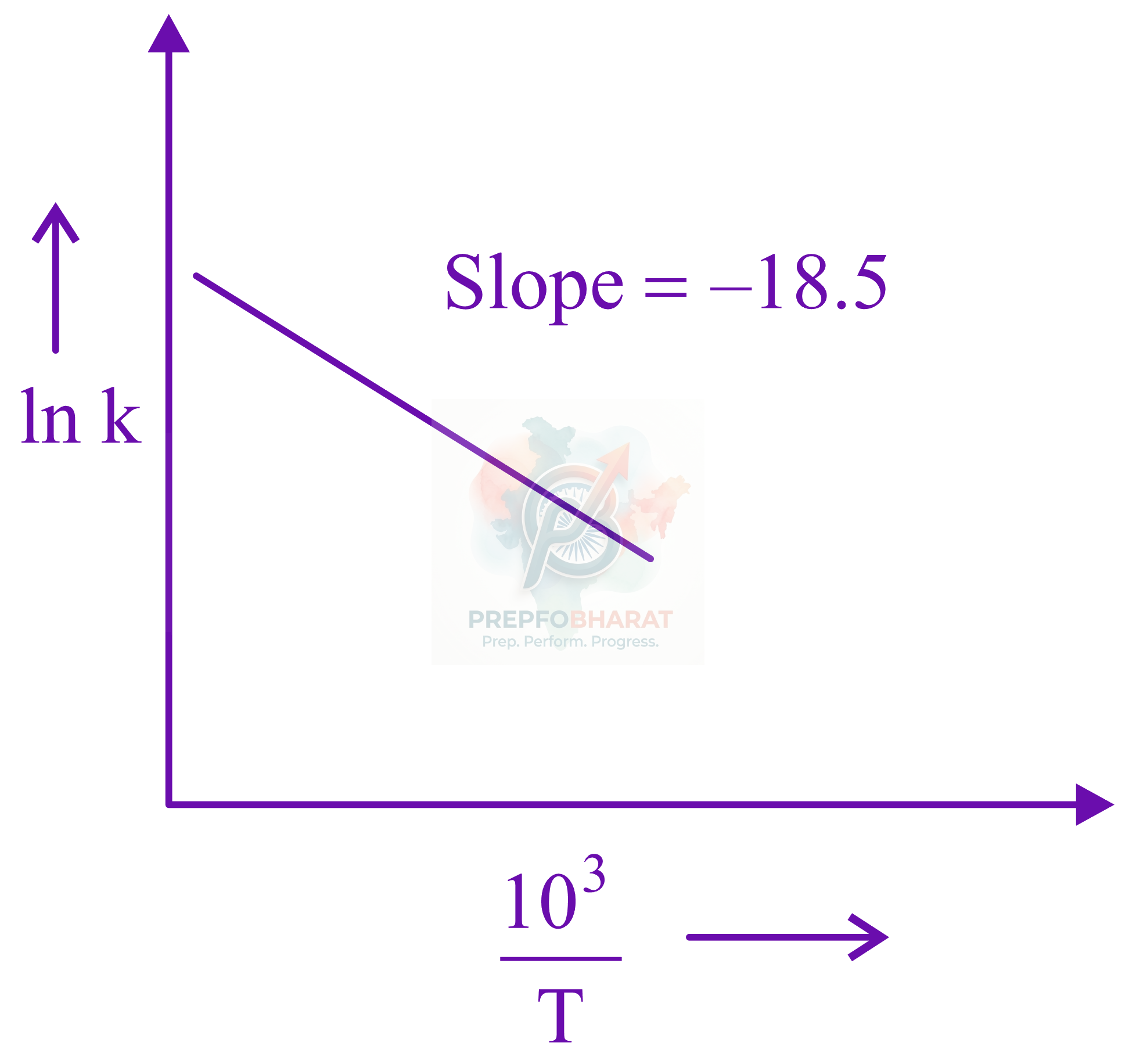
Assertion: The amphoteric behaviour of water is explained by Lewis acid base theory Reason: water acts as acid with ${\mathrm{NH}}_{3}$ and base with ${H}_{2}S$
The equation $k=(6.5\times {10}^{12}{s}^{-1}){e}^{-26000K/T}$ is followed for the decomposition of compound $A$. The activation energy for the reaction is ____ $\mathrm{KJ}{\mathrm{mol}}^{-1}$. [nearest integer] (Given: $R=8.314J{K}^{-1}{\mathrm{mol}}^{-1}$)
In the given reaction, $X+Y+3Z⇄{\mathrm{XYZ}}_{3}$ if one mole of each of $X$ and $Y$ with $0.05\mathrm{mol}$ of $Z$ gives compound ${\mathrm{XYZ}}_{3}$. (Given : Atomic masses of $X,Y$ and $Z$ are 10,20 and $30\mathrm{amu}$, respectively). The yield of ${\mathrm{XYZ}}_{3}$ is____$g$.
At $345K$, the half life for the decomposition of a sample of a gaseous compound initially at $55.5\mathrm{kPa}$ was $340s$. When the pressure was $27.8\mathrm{kPa}$, the half life was found to be $170s$. The order of the reaction is - [integer answer]
The standard free energy change $(\Delta G^{\circ})$ for $50%$ dissociation of ${N}_{2}{O}_{4}$ into ${\mathrm{NO}}_{2}$ at $27^{\circ}C$ and $1\mathrm{atm}$ pressure is $-xJ{\mathrm{mol}}^{-1}$. The value of $x$ is $-.....J$. (Nearest Integer) [Given : $R=8.31J{K}^{-1}{\mathrm{mol}}^{-1},\mathrm{log}1.33=0.1239\mathrm{ln}10=2.3$]
The standard electrode potential of hydrogen electrode at pH = 7 is:
Which of the following relation is not correct?
$2{O}_{3}(g)\rightleftharpoons 3{O}_{2}(g)$ At $300K$, ozone is fifty percent dissociated. The standard free energy change at this temperature and $1\mathrm{atm}$ pressure is $(-)......J{\mathrm{mol}}^{-1}$. (Nearest integer) [Given: $\mathrm{ln}1.35=0.3$ and $R=8.3J{K}^{-1}{\mathrm{mol}}^{-1}$]
${p}^{H}$ value of $0.001\mathrm{MNaOH}$ solution is
'$x$' $g$ of molecular oxygen $({O}_{2})$ is mixed with $200g$ of neon $(\mathrm{Ne})$. The total pressure of the nonreactive mixture of ${O}_{2}$ and $\mathrm{Ne}$ in the cylinder is $25$ bar. The partial pressure of $\mathrm{Ne}$ is $20$ bar at the same temperature and volume. The value of '$x$' is [Given: Molar mass of ${O}_{2}=32g{\mathrm{mol}}^{-1}$. Molar mass of $\mathrm{Ne}=20g{\mathrm{mol}}^{-1}$]
For the given reactions ${\mathrm{Sn}}^{2+}+2{e}^{-}\rightarrow \mathrm{Sn}$ ${\mathrm{Sn}}^{4+}+4{e}^{-}\rightarrow \mathrm{Sn}$ the electrode potentials are ; ${E}_{{\mathrm{Sn}}^{2+}/\mathrm{Sn}}^{^{\circ}}=-0.140V$ and ${E}_{{\mathrm{Sn}}^{4+}/\mathrm{Sn}}^{^{\circ}}=0.010V$. The magnitude of standard electrode potential for ${\mathrm{Sn}}^{4+}/{\mathrm{Sn}}^{2+}$ i.e. ${E}_{{\mathrm{Sn}}^{4+}/{\mathrm{Sn}}^{2+}}^{^{\circ}}$ is____$\times {10}^{-2}V$(Nearest integer)
At $310K$, the solubility of ${\mathrm{CaF}}_{2}$ in water is $2.34\times {10}^{-3}g/100\mathrm{mL}$. The solubility product of ${\mathrm{CaF}}_{2}$ is ---- $\times {10}^{-8}{(\mathrm{mol}/L)}^{3}$(nearest integer). (Given molar mass : ${\mathrm{CaF}}_{2}=78g{\mathrm{mol}}^{-1}$)
Which of the following sets of quantum numbers is not allowed?
${K}_{a}$ for butyric acid $({C}_{3}{H}_{7}\mathrm{COOH})$ is $2\times {10}^{-5}$. The$\mathrm{pH}$ of $0.2M$ solution of butyric acid is____$\times {10}^{-1}$. (Nearest integer) [Given $\mathrm{log}2=0.30$]
Resistance of a conductivity cell (cell constant $129{m}^{-1}$) filled with $74.5\mathrm{ppm}$ solution of $\mathrm{KCl}$ is $100\Omega$ (labelled as solution $1$). When the same cell is filled with $\mathrm{KCl}$ solution of $149\mathrm{ppm}$, the resistance is $50\Omega$ (labelled as solution $2$). The ratio of molar conductivity of solution $1$ and solution $2$ is i.e. $\frac{{\wedge }_{1}}{{\wedge }_{2}}=x\times {10}^{-3}$. The value of $x$ is____Given, molar mass of $\mathrm{KCl}$ is $74.5g{\mathrm{mol}}^{-1}$)
In a cell, the following reactions take place ${\mathrm{Fe}}^{2+}\rightarrow {\mathrm{Fe}}^{3+}+{e}^{-}{{E}^{o}}_{{\mathrm{Fe}}^{3+}/{\mathrm{Fe}}^{2+}}=0.77V$ $2{I}^{-}\rightarrow {I}_{2}+2{e}^{-}{E}_{{I}_{2}/{I}^{-}}^{0}=0.54V$ The standard electrode potential for the spontaneous reaction in the cell is $x\times {10}^{-2}V\mathrm{at}298K$. The value of $x$ is - (Nearest Integer)
$250g$ solution of $D$-glucose in water contains $10.8%$ of carbon by weight. The molality of the solution is nearest to (Given: Atomic Weights are $H=1u;C=12u;O=16u$)
Class $\mathrm{XII}$ students were asked to prepare one litre of buffer solution of $\mathrm{pH}8.26$ by their chemistry teacher. The amount of ammonium chloride to be dissolved by the student in $0.2M$ ammonia solution to make one litre of the buffer is (Given ${\mathrm{pK}}_{b}({\mathrm{NH}}_{3})=4.74;$ Molar mass of ${\mathrm{NH}}_{3}=17g{\mathrm{mol}}^{-1}$. Molar mass of ${\mathrm{NH}}_{4}\mathrm{Cl}=53.5g{\mathrm{mol}}^{-1}$)
A $1.84\mathrm{mg}$ sample of polyhydric alcoholic compound '$X$' of molar mass $92.0g/\mathrm{mol}$ gave $1.344\mathrm{mL}$ of ${H}_{2}$ gas at STP. The number of alcoholic hydrogen present in compound '$X$' is
The molar conductivity of a conductivity cell filled with $10$ moles of $20\mathrm{mL}\mathrm{NaCl}$ solution is ${\Lambda }_{m1}$ and that of $20$ moles another identical cell heaving $80\mathrm{mL}\mathrm{NaCl}$ solution is ${\Lambda }_{m2}$, The conductivities exhibited by these two cells are same. The relationship between ${\Lambda }_{m2}$ and ${\Lambda }_{m1}$ is
A gas ( Molar mass $=280g{\mathrm{mol}}^{-1}$) was burnt in excess ${O}_{2}$ in a constant volume calorimeter and during combustion the temperature of calorimeter increased from $298.0K$ to $298.45K$. If the heat capacity of calorimeter is $2.5\mathrm{kJ}{K}^{-1}$ and enthalpy of combustion of gas is $9\mathrm{kJ}{\mathrm{mol}}^{-1}$ then amount of gas burnt is____$g$.
A solution containing $2.5\times {10}^{-3}\mathrm{kg}$ of a solute dissolved in $75\times {10}^{-3}\mathrm{kg}$ of water boils at $373.535K$. The molar mass of the solute is ${\mathrm{mol}}^{-1}\cdot$ [nearest integer] (Given : ${K}_{b}({H}_{2}O)=0.52K\mathrm{kg}{\mathrm{mol}}^{-1}$ and boiling point of water $=373.15K$)
A flask is filled with equal moles of $A$ and $B$. The half lives of $A$ and $B$ are $100s$ and $50s$ respectively and are independent of the initial concentration. The time required for the concentration of $A$ to be four times that of $B$ is____$s$. (Given : $\mathrm{ln}2=0.693$)
A dilute solution of sulphuric acid is electrolysed using a current of $0.10A$ for $2$ hours to produce hydrogen and oxygen gas. The total volume of gases produced at $\mathrm{STP}$ is ${\mathrm{cm}}^{3}$. (Nearest integer) [Given : Faraday constant $F=96500{\mathrm{Cmol}}^{-1}$ at $\mathrm{STP}$, molar volume of an ideal gas is $22.7L{\mathrm{mol}}^{-1}$]
Manganese $(\mathrm{VI})$ has ability to disproportionate in acidic solution. The difference in oxidation states of two ions it forms in acidic solution is
Consider the following statements : (A) The principal quantum number '$n$' is a positive integer with values of '$n$' $=1,2,3,\ldots$ (B) The azimuthal quantum number '$l$' for a given '$n$' (principal quantum number) can have values as '$l$' $=0,1,2,\ldots .n$ has $(2n+1)$ values. (C) Magnetic orbital quantum number '$\mathrm{m}$' for a particular '$\mathrm{l}$' (azimuthal quantum number) has $(2\mathrm{l}+1)$ values. (D) $\pm \frac{1}{2}$ are the two possible orientations of electron spin. (E) For $l=5$, there will be a total of $9$ orbital Which of the above statements are correct?
The rate constant for a first order reaction is given by the following equation : $\mathrm{lnk}=33.24-\frac{2.0\times {10}^{4}K}{T}$ The Activation energy for the reaction is given by ${\mathrm{kJmol}}^{-1}$. (In Nearest integer) (Given : $R=8.3J{K}^{-1}{\mathrm{mol}}^{-1}$)
Consider the following pairs of electrons (A) (a) $n=3,l=1,{m}_{l}=1,{m}_{s}=+\frac{1}{2}$ (b) $n=3,l=2,{m}_{l}=1,{m}_{s}=+\frac{1}{2}$ (B) (a) $n=3,l=2,{m}_{l}=-2,{m}_{s}=-\frac{1}{2}$ (b) $n=3,l=2,{m}_{l}=-1,{m}_{s}=-\frac{1}{2}$ (C) (a) $n=4,l=2,{m}_{l}=2,{m}_{s}=+\frac{1}{2}$ (b) $n=3,l=2,{m}_{l}=2,{m}_{s}=+\frac{1}{2}$ The pairs of electrons present in degenerate orbitals is/are
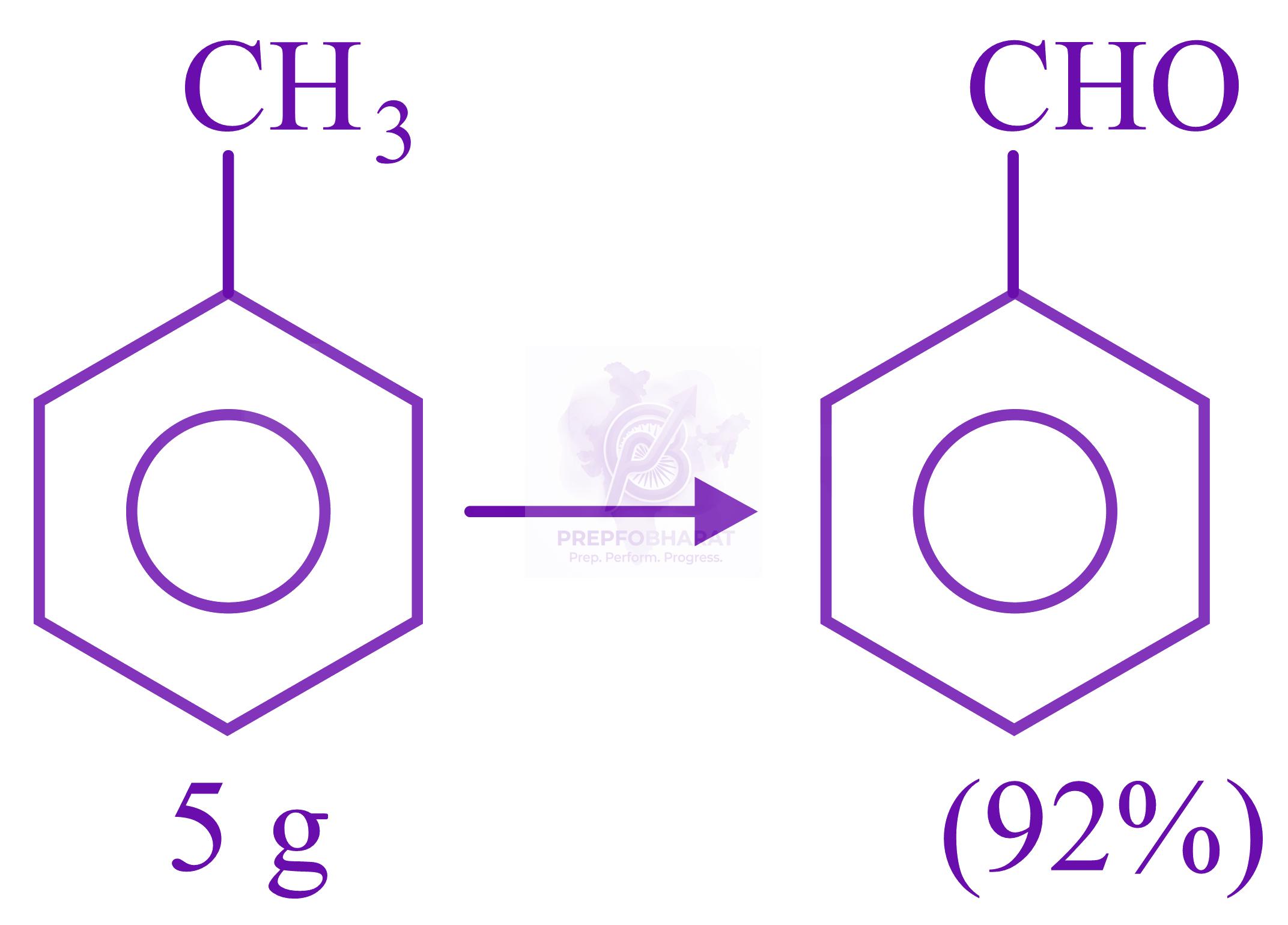 In the above reaction, $5g$ of toluene is converted into benzaldehyde with $92%$ yield. The amount of benzaldehyde produced is____ $\times {10}^{-2}g$
For the given first order reaction $A\rightarrow B$ the half life of the reaction is $0.3010\mathrm{min}$. The ratio of the initial concentration of reactant to the concentration of reactant at time $2.0\mathrm{min}$ will be equal to _____. (Nearest integer)
The cell potential for the given cell at $298K\mathrm{Pt}|{H}_{2}(g,1\mathrm{bar})||{H}^{+}(\mathrm{aq})\|{\mathrm{Cu}}^{2+}(\mathrm{aq})|\mathrm{Cu}(s)$ is $0.31V$. The $\mathrm{pH}$ of the acidic solution is found to be $3$, whereas the concentration of ${\mathrm{Cu}}^{2+}$ is ${10}^{x}M$. The value of $x$ is _________. (Given: ${E}_{{\mathrm{Cu}}^{2+}/\mathrm{Cu}}^{\Theta }=0.34V$ and $\frac{2.303\mathrm{RT}}{F}=0.06V$)
For a cell, $\mathrm{Cu}(s){\mathrm{Cu}}^{2+}(0.001M)|{\mathrm{Ag}}^{+}(0.01M)|\mathrm{Ag}(s)$the cell potential is found to be $0.43V$ at $298K$. The magnitude of standard electrode potential for ${\mathrm{Cu}}^{2+}|\mathrm{Cu}$ is____$\times {10}^{-2}V$ $[\mathrm{Given}:{E}_{{\mathrm{Ag}}^{+}/\mathrm{Ag}}^{\Theta }=0.80V\mathrm{and}\frac{2.303\mathrm{RT}}{F}=0.06V]$
The solubility product of a sparingly soluble salt ${A}_{2}{X}_{3}$ is $1.1\times {10}^{-23}$. If specific conductance of the solution is $3\times {10}^{-5}{\mathrm{Sm}}^{-1}$, the limiting molar conductivity of the solution is $x\times {10}^{-3}S{m}^{2}{\mathrm{mol}}^{-1}$. The value of $x$ is
Consider an imaginary ion $X3-2248$. The nucleus contains '$a$'$%$ more neutrons than the number of electrons in the ion. The value of '$a$' is
The depression in freezing point observed for a formic acid solution of concentration $0.5\mathrm{mL}{L}^{-1}$ is $0.0405^{\circ}C$. Density of formic acid is $1.05g{\mathrm{mL}}^{-1}$. The Van't Hoff factor of the formic acid solution is nearly: (Given for water ${k}_{f}=1.86K\mathrm{kg}{\mathrm{mol}}^{-1}$)
For a reaction $A\rightarrow 2B+C$ the half lives are $100s$ and $50s$ when the concentration of reactant $A$ is $0.5$ and $1.0\mathrm{mol}L=$ respectively. The order of the reaction is
$2\mathrm{NO}+2{H}_{2}\rightarrow {N}_{2}+2{H}_{2}O$ The above reaction has been studied at $800^{\circ}C$. The related data are given in the table below <table class="pyq-table"><tbody><tr><td>Reaction serial number</td><td>Initial pressure of${H}_{2}/\mathrm{kPa}$</td><td>Initial Pressure of $\mathrm{NO}/\mathrm{kPa}$</td><td>Initial rate $(\frac{-\mathrm{dp}}{\mathrm{dt}})/(\mathrm{kPa}/s)$</td></tr><tr><td>$1$</td><td>$65.6$</td><td>$40.0$</td><td>$0.135$</td></tr><tr><td>$2$</td><td>$65.6$</td><td>$20.1$</td><td>$0.033$</td></tr><tr><td>$3$</td><td>$38.6$</td><td>$65.6$</td><td>$0.214$</td></tr><tr><td>$4$</td><td>$19.2$</td><td>$65.6$</td><td>$0.106$</td></tr></tbody></table>The order of the reaction with respect to NO is____
$20\mathrm{mL}$ of $0.02{\mathrm{MK}}_{2}{\mathrm{Cr}}_{2}{O}_{7}$ solution is used for the titration of $10\mathrm{mL}$ of ${\mathrm{Fe}}^{2+}$ solution in the acidic medium. The molarity of ${\mathrm{Fe}}^{2+}$ solution is____$\times {10}^{-2}M$
The ${(\frac{\partial E}{\partial T})}_{P}$ of different types of half cells are as follows : $\begin{matrix}A & B & C & D \\ 1\times {10}^{-4} & 2\times {10}^{-4} & 0.1\times {10}^{-4} & 0.2\times {10}^{-4}\end{matrix}$ (Where $E$ is the electromotive force). Which of the above half cells would be preferred to be used as reference electrode
${\mathrm{Ka}}_{1},{\mathrm{Ka}}_{2}$ and ${\mathrm{Ka}}_{3}$ are the respective ionization constants for the following reactions $(a),(b)$ and $(c)$. (a) ${H}_{2}{C}_{2}{O}_{4}\rightleftharpoons {H}^{+}+{\mathrm{HC}}_{2}{O}_{4}^{-}$ (b) ${\mathrm{HC}}_{2}{O}_{4}^{-}\rightleftharpoons {H}^{+}+{\mathrm{HC}}_{2}{O}_{4}^{2-}$ (c) ${H}_{2}{C}_{2}{O}_{4}\rightleftharpoons 2{H}^{+}+{C}_{2}{O}_{4}^{2-}$ The relationship between ${K}_{{a}_{1}},{K}_{{a}_{2}}$ and ${K}_{{a}_{3}}$ is given as
The standard entropy change for the reaction $4\mathrm{Fe}(s)+3{O}_{2}(g)\rightarrow 2{\mathrm{Fe}}_{2}{O}_{3}(s)$ is $-550J{K}^{-1}$ at $298K$ [Given : The standard enthalpy change for the reaction is $-165\mathrm{kJ}{\mathrm{mol}}^{-1}$]. The temperature in $K$ at which the reaction attains equilibrium is (Nearest Integer)
$1L$ aqueous solution of ${H}_{2}{\mathrm{SO}}_{4}$ contains $0.02m\mathrm{mol}{H}_{2}{\mathrm{SO}}_{4}.50%$ of this solution is diluted with deionized water to give $1L$ solution $(A)$. In solution $(A)$, $0.01m\mathrm{mol}$ of ${H}_{2}{\mathrm{SO}}_{4}$ are added. Total $m$ mols of ${H}_{2}{\mathrm{SO}}_{4}$ in the final solution is____$\times {10}^{-3}m\mathrm{moles}$.
$4.0L$ of an ideal gas is allowed to expand isothermally into vacuum until the total volume is $20L$. The amount of heat absorbed in this expansion is $L$ atm.
$\mathrm{Cu}(s)+{\mathrm{Sn}}^{2+}(0.001M)\rightarrow {\mathrm{Cu}}^{2+}(0.01M)+\mathrm{Sn}(s)$ The Gibbs free energy change for the above reaction at $298K$ is $x\times {10}^{-1}\mathrm{kJ}{\mathrm{mol}}^{-1}$. The value of $x$ is____[nearest integer] [Given : ${E}_{{\mathrm{Cu}}^{2+}/\mathrm{Cu}}^{\ominus }=0.34V;{E}_{{\mathrm{Sn}}^{2+}/\mathrm{Sn}}^{\ominus }=-0.14V;F=96500{\mathrm{Cmol}}^{-1}$]
Catalyst A reduces the activation energy for a reaction by $10\mathrm{kJ}{\mathrm{mol}}^{-1}$ at $300K$. The ratio of rate constants, $\frac{{k}_{T},\mathrm{Catalysed}}{{k}_{T},\mathrm{Uncatalysed}}$ is ${e}^{x}$. The value of $x$ is____[nearest integer] [Assume that the pre-exponential factor is same in both the cases. Given $R=8.31J{K}^{-1}{\mathrm{mol}}^{-1}$]
A student needs to prepare a buffer solution of propanoic acid and its sodium salt with $\mathrm{pH}4$. The ratio of $\frac{[{\mathrm{CH}}_{3}{\mathrm{CH}}_{2}{\mathrm{COO}}^{-}]}{[{\mathrm{CH}}_{3}{\mathrm{CH}}_{2}\mathrm{COOH}]}$ required to make buffer is Given : ${K}_{a}({\mathrm{CH}}_{3}{\mathrm{CH}}_{2}\mathrm{COOH})=1.3\times {10}^{-5}$
The longest wavelength of light that can be used for the ionisation of lithium ion $\mathrm{(Li^{2+})}$ is $x\times {10}^{-8}m$. The value of $x$ is (Nearest Integer) (Given : Energy of the electron in the first shell of the hydrogen atom is $-2.2\times {10}^{-18}J$; $h=6.63\times {10}^{-34}\mathrm{Js}$ and $c=3\times {10}^{8}{\mathrm{ms}}^{-1}$)
$50\mathrm{mL}$ of $0.1M{\mathrm{CH}}_{3}\mathrm{COOH}$ is being titrated against $0.1M\mathrm{NaOH}$. When $25\mathrm{mL}$ of $\mathrm{NaOH}$ has been added, the $\mathrm{pH}$ of the solution will be____$\times {10}^{-2}$. (Nearest integer) (Given : ${\mathrm{pK}}_{a}({\mathrm{CH}}_{3}\mathrm{COOH})=4.76$) $\mathrm{log}2=0.30$ $\mathrm{log}3=0.48$ $\mathrm{log}5=0.69$ $\mathrm{log}7=0.84$ $\mathrm{log}11=1.04$
The neutralization occurs when $10\mathrm{mL}$ of $0.1M$ acid '$A$' is allowed to react with $30\mathrm{mL}$ of $0.05M$ base $M{(\mathrm{OH})}_{2}$. The basicity of the acid '$A$' is [$M$ is a metal]
$20\mathrm{mL}$ of $0.1M{\mathrm{NH}}_{4}\mathrm{OH}$ is mixed with $40\mathrm{mL}$ of $0.05M\mathrm{HCl}$. The $\mathrm{pH}$ of the mixture is nearest to: (Given: ${K}_{b}({\mathrm{NH}}_{4}\mathrm{OH})=1\times {10}^{-5},\mathrm{log}2=0.30$, $\mathrm{log}3=0.48,\mathrm{log}5=0.69,\mathrm{log}7=0.84$, $\mathrm{log}11=1.04$)
If the wavelength for an electron emitted from $H-$ atom is $3.3\times {10}^{-10}m$, then energy absorbed by the electron in its ground state compared to minimum energy required for its escape from the atom, is____times. [Given : $h=6.626\times {10}^{-34}\mathrm{Js}$, Mass of electron $=9.1\times {10}^{-31}$]
The electronic configuration of $\mathrm{Pt}$ (atomic number $78$) is
$20\mathrm{mL}$ of $0.02M$ hypo solution is used for the titration of $10\mathrm{mL}$ of copper sulphate solution, in the presence of excess of $\mathrm{KI}$ using starch as an indicator. The molarity of ${\mathrm{Cu}}^{2+}$ is found to be $_____\times {10}^{-2}M$ (nearest integer) Given : $2{\mathrm{Cu}}^{2+}+4{I}^{-}\rightarrow {\mathrm{Cu}}_{2}{I}_{2}+{I}_{2} {I}_{2}+2{S}_{2}{O}_{3}^{-2}\rightarrow 2{I}^{—}+{S}_{4}{O}_{6}^{-2}$
In the industrial production of which of the following, molecular hydrogen is obtained as a bye product.
On complete combustion $0.30g$ of an organic compound gave $0.20g$ of carbon dioxide and $0.10g$ of water. The percentage of carbon in the given organic compound is____(Nearest Integer)
The amount of charge in $F$ (Faraday) required to obtain one mole of iron from ${\mathrm{Fe}}_{3}{O}_{4}$ is ______. (Round off the answer to the nearest integer)
In $3d$ series, the metal having the highest ${M}^{2+}/M$ standard electrode potential is
For a given chemical reaction ${\gamma }_{1}A+{\gamma }_{2}B\rightarrow {\gamma }_{3}C+{\gamma }_{4}D$. Concentration of $C$ changes from $10\mathrm{mmol}{\mathrm{dm}}^{-3}$ to $20\mathrm{mmol}{\mathrm{dm}}^{-3}$ in $10s.$ Rate of appearance of $D$ is $1.5$ times the rate of disappearance of $B$ which is twice the rate of disappearance $A$. The rate of appearance of $D$ has been experimentally determined to be $9\mathrm{mmol}{\mathrm{dm}}^{-3}{s}^{-1}.$ Therefore the rate of reaction is____$\mathrm{mmol}{\mathrm{dm}}^{-3}{s}^{-1}.$ (Nearest Integer)
Which of the following is the correct plot for the probability density ${\psi }^{2}(r)$ as a function of distance $'r'$ of the electron form the nucleus for $2s$ orbital?
At $30^{\circ}C$, the half life for the decomposition of ${\mathrm{AB}}_{2}$ is $200s$ and is independent of the initial concentration of ${\mathrm{AB}}_{2}$. The time required for $80%$ of the ${\mathrm{AB}}_{2}$ to decompose is (Given: $\mathrm{log}2=0.30$; $\mathrm{log}3=0.48$)
The correct decreasing order of energy, for the orbitals having, following set of quantum numbers: (A) $n=3,1=0,m=0$ (B) $n=4,l=0,m=0$ (C) $n=3,l=1,m=0$ (D) $n=3,1=2,m=1$
$C(s)+{O}_{2}(g)\rightarrow {\mathrm{CO}}_{2}(g)+400\mathrm{kJ}$ $C(s)+\frac{1}{2}{O}_{2}(g)\rightarrow \mathrm{CO}(g)+100\mathrm{kJ}$ When coal of purity $60%$ is allowed to burn in presence of insufficient oxygen, $60%$ of carbon is converted into ' $\mathrm{CO}$' and the remaining is converted into '${\mathrm{CO}}_{2}$'. The heat generated when $0.6\mathrm{kg}$ of coal is burnt is
A gaseous mixture of two substances $A$ and $B$, under a total pressure of $0.8\mathrm{atm}$ is in equilibrium with an ideal liquid solution. The mole fraction of substance $A$ is $0.5$ in the vapour phase and $0.2$ in the liquid phase. The vapour pressure of pure liquid $A$ is____atm.(Nearest integer)
$A$ fish swimming in water body when taken out from the water body is covered with a film of water of weight $36g$. When it is subjected to cooking at $100^{\circ}C$, then the internal energy for vaporization in ${\mathrm{kJmol}}^{-1}$ is integer] [Assume steam to be an ideal gas. Given ${\Delta }_{\mathrm{vap}}{H}^{\ominus }$ for water at $373K$ and $1$ bar is $41.1\mathrm{kJ}{\mathrm{mol}}^{-1}:R=8.31J{K}^{-1}{\mathrm{mol}}^{-1}$]
The ${K}_{\mathrm{sp}}$ for bismuth sulphide $({\mathrm{Bi}}_{2}{S}_{3})$ is $1.08\times {10}^{-73}$. The solubility of ${\mathrm{Bi}}_{2}{S}_{3}$ in ${\mathrm{molL}}^{-1}$ at $298K$ is
$150g$ of acetic acid was contaminated with $10.2g$ ascorbic acid $({C}_{6}{H}_{8}{O}_{6})$ to lower down its freezing point by $(x\times {10}^{-1})^{\circ}C$. The value of $x$ is____ (Nearest integer). [Given ${K}_{f}=3.9K\mathrm{kg}{\mathrm{mol}}^{-1}$; Molar mass of ascorbic acid $=176g{\mathrm{mol}}^{-1}$]
A $2.0g$ sample containing ${\mathrm{MnO}}_{2}$ is treated with $\mathrm{HCl}$ liberating ${\mathrm{Cl}}_{2}$. The ${\mathrm{Cl}}_{2}$ gas is passed into a solution of $\mathrm{KI}$ and $60.0\mathrm{mL}$ of $0.1{\mathrm{MNaS}}_{2}{O}_{3}$ is required to titrate the liberated iodine. The percentage of ${\mathrm{MnO}}_{2}$ in the sample is____. Nearest integer) [Atomic masses (in $u$) $\mathrm{Mn}=55;\mathrm{Cl}=35.5:O=16,I=127,\mathrm{Na}=23,K=39,S=32$]
If the radius of the ${3}^{\mathrm{nd}}$ Bohr's orbit of hydrogen atom is ${r}_{3}$ and the radius of ${4}^{\mathrm{th}}$ Bohr's orbit is ${r}_{4}$. Then
In base vs. Acid titration, at the end point methyl orange is present as
The solubility of $\mathrm{AgCl}$ will be maximum in which of the following?
For a first order reaction, the time required for completion of $90%$ reaction is '$x$' times the half life of the reaction. The value of '$x$' is (Given: $\mathrm{ln}10=2.303$ and $\mathrm{log}2=0.3010$)
While performing a thermodynamics experiment, a student made the following observations, $\mathrm{HCl}+\mathrm{NaOH}\rightarrow \mathrm{NaCl}+{H}_{2}O\Delta H=-57.3\mathrm{kJ}{\mathrm{mol}}^{-1}$ ${\mathrm{CH}}_{3}\mathrm{COOH}+\mathrm{NaOH}\rightarrow {\mathrm{CH}}_{3}\mathrm{COONa}+{H}_{2}O$ $\Delta H=-55.3\mathrm{kJ}{\mathrm{mol}}^{-1}$. The enthalpy of ionization of ${\mathrm{CH}}_{3}\mathrm{COOH}$ as calculated by the student is $\mathrm{kJ}{\mathrm{mol}}^{-1}$.
Match List-I with List-II. <table class="pyq-table"><tbody><tr><td></td><td>List-I</td><td></td><td>List-II</td></tr><tr><td>A</td><td>$\mathrm{Cd}(s)+2\mathrm{Ni}{(\mathrm{OH})}_{3}(s)\rightarrow \mathrm{CdO}(s)+2\mathrm{Ni}{(\mathrm{OH})}_{2}(s)+{H}_{2}O(l)$</td><td>I</td><td>Primary battery</td></tr><tr><td>B</td><td>$\mathrm{Zn}(\mathrm{Hg})+\mathrm{HgO}(s)\rightarrow \mathrm{ZnO}(s)+\mathrm{Hg}(l)$</td><td>II</td><td>Discharging of secondary battery</td></tr><tr><td>C</td><td>$2{\mathrm{PbSO}}_{4}(s)+2{H}_{2}O(I)\rightarrow \mathrm{Pb}(s)+{\mathrm{PbO}}_{2}(s)+2{H}_{2}{\mathrm{SO}}_{4}(\mathrm{aq})$</td><td>III</td><td>Fuel cell</td></tr><tr><td>D</td><td>$2{H}_{2}(g)+{O}_{2}(g)\rightarrow 2{H}_{2}O(l)$</td><td>IV</td><td>Charging of secondary battery</td></tr></tbody></table>Choose the correct answer from the options given below
A $0.5$ percent solution of potassium chloride was found to freeze at $-0.24^{\circ}C$. The percentage dissociation of potassium chloride is (Nearest integer) (Molal depression constant for water is $1.80K\mathrm{kg}{\mathrm{mol}}^{-1}$ and molar mass of $\mathrm{KCl}$ is $74.6g{\mathrm{mol}}^{-1}$)
Given below are the quantum numbers for $4$ electrons. A. $n=3,l=2,{m}_{1}=1,{m}_{s}=+\frac{1}{2}$ B. $n=4,l=1,{m}_{1}=0,{m}_{s}=+\frac{1}{2}$ C. $n=4,l=2,{m}_{1}=-2,{m}_{s}=-\frac{1}{2}$ D. $n=3,l=1,{m}_{1}=-1,{m}_{s}=+\frac{1}{2}$ The correct order of increasing energy is
The resistance of a conductivity cell containing $0.01\mathrm{MKCl}$ solution at $298K$ is $1750\Omega$. If the conductivity of $0.01\mathrm{MKCl}$ solution at $298K$ is $0.152\times {10}^{-3}S{\mathrm{cm}}^{-1}$, then the cell constant of the conductivity cell is____$\times {10}^{-3}{\mathrm{cm}}^{-1}$
A radioactive element has a half life of $200$ days. The percentage of original activity remaining after $83$ days is____(Nearest integer) (Given : antilog $0.125=1.333$, antilog $0.693=4.93$)
Compound $A$ contains $8.7%$ Hydrogen, $74%$ Carbon and $17.3%$ Nitrogen. The molecular formula of the compound is, Given : Atomic masses of $C,H$ and $N$ are $12,1$ and $14$ amu respectively. The molar mass of the compound $A$ is $162g{\mathrm{mol}}^{-1}$.
$56.0L$ of nitrogen gas is mixed with excess of hydrogen gas and it is found that $20L$ of ammonia gas is produced, The volume of unused nitrogen gas is found to be_____ $L$.
Hemoglobin contains $0.34%$ of iron by mass. The number of $\mathrm{Fe}$ atoms in $3.3g$ of hemoglobin is (Given : Atomic mass of Fe is $56u,{N}_{A}$ in$6.022\times {10}^{23}{\mathrm{mol}}^{-1}$)
When a certain amount of solid $A$ is dissolved in $100g$ of water at $25^{\circ}C$ to make a dilute solution, the vapour pressure of the solution is reduced to one-half of that of pure water. The vapour pressure of pure water is $23.76\mathrm{mmHg}$. The number of moles of solute $A$ added is
$\begin{matrix}[A] & \rightarrow & [B] \\ \mathrm{Reactant} & & \mathrm{Product}\end{matrix}$ If formation of compound $[B]$ follows the first order of kinetics and after $70$ minutes the concentration of $[A]$ was found to be half of its initial concentration. Then the rate constant of the reaction is $x\times {10}^{-6}{s}^{-1}$. The value of $x$ is____
The elevation in boiling point for $1$ molal solution of non-volatile solute $A$ is $3K$. The depression in freezing point for $2$ molal solution of $A$ in the same solvent is $6K$. The ratio of ${K}_{b}$ and ${K}_{f}$ i.e., ${K}_{b}/{K}_{f}$ is $1:X$. The value of $X$ is
The minimum uncertainty in the speed of an electron in one dimensional region of length $2{a}_{o}$ (Where ${a}_{o}=$ Bohr radius $52.9\mathrm{pm}$) is____${\mathrm{kms}}^{-1}$ (Nearest integer) (Given : Mass of electron $=9.1\times {10}^{-31}\mathrm{kg}$, Planck's constant $h=6.63\times {10}^{-34}\mathrm{Js}$)
The Plot of $\mathrm{pH}$-metric titration of weak base ${\mathrm{NH}}_{4}\mathrm{OH}$ vs strong acid $\mathrm{HCl}$ looks like
If a rocket runs on a fuel $({C}_{15}{H}_{30})$ and liquid oxygen, the weight of oxygen required and ${\mathrm{CO}}_{2}$ released for every litre of fuel respectively are : (Given : density of the fuel is $0.756g/\mathrm{mL}$)
$40%$ of $\mathrm{HI}$ undergoes decomposition to ${H}_{2}$ and ${I}_{2}$ at $300K.{\Delta G}^{\Theta }$ for this decompostion reaction at one atmopsphere pressure is____${\mathrm{Jmol}}^{-1}$-[nearest integer] $(\mathrm{Use}R=8.31{\mathrm{JK}}^{-1}{\mathrm{mol}}^{-1};\mathrm{log}2=0.3010,\mathrm{ln}10=2.3,\mathrm{log}3=0.477)$
At $25^{\circ}C$ and $1\mathrm{atm}$ pressure, the enthalpy of combustion of benzene $(1)$ and acetylene $(g)$ are $-3268\mathrm{kJ}{\mathrm{mol}}^{-1}$ and $-1300\mathrm{kJ}{\mathrm{mol}}^{-1}$, respectively. The change in enthalpy for the reaction $3{C}_{2}{H}_{2}(g)\rightarrow {C}_{6}{H}_{6}(l)$, is
${N}_{2(g)}+3{H}_{2(g)}\rightleftharpoons 2{\mathrm{NH}}_{3(g)} 20g5g$ Consider the above reaction. If $20$g of dinitrogen reacts with $5$g of dihydrogen, then the limiting reagent of the reaction and number of moles of ${\mathrm{NH}}_{3}$ formed respectively are
The minimum energy that must be possessed by photons in order to produce the photoelectric effect with platinum metal is: [Given: The threshold frequency of platinum is $1.3\times {10}^{15}{s}^{-1}$ and $h=6.6\times {10}^{-34}\mathrm{Js}$]
The limiting molar conductivities of $\mathrm{NaI},{\mathrm{NaNO}}_{3}$ and ${\mathrm{AgNO}}_{3}$ are $12.7,12.0$ and $13.3{\mathrm{mSm}}^{2}{\mathrm{mol}}^{-1}$, respectively (all at $25^{\circ}C$). The limiting molar conductivity of $\mathrm{AgI}$ at this temperature is____${\mathrm{mSm}}^{2}{\mathrm{mol}}^{-1}$.
$1.80g$ of solute A was dissolved in $62.5{\mathrm{cm}}^{3}$ of ethanol and freezing point of the solution was found to be $155.1K$. The molar mass of solute $A$ is ${\mathrm{gmol}}^{-1}$. [Given: Freezing point of ethanol is $156.0K$. Density of ethanol is $0.80g{\mathrm{cm}}^{-3}$. Freezing point depression constant of ethanol is $2.00K\mathrm{kg}{\mathrm{mol}}^{-1}$]
The complete combustion of $0.492g$ of an organic compound containing '$C$', '$H$' and '$O$' gives $0.793g$ of ${\mathrm{CO}}_{2}$ and $0.442g$ of ${H}_{2}O$. The percentage of oxygen composition in the organic compound is____.(nearest integer)
For the reaction ${H}_{2}{F}_{2}(g)\rightarrow {H}_{2}(g)+{F}_{2}(g)$ $\Delta U=-59.6\mathrm{kJ}{\mathrm{mol}}^{-1}$ at $27^{\circ}C$ The enthalpy change for the above reaction is $(-)$____ ${\mathrm{kJmol}}^{-1}$ (nearest integer) (Given : $R=8.314{\mathrm{JK}}^{-1}{\mathrm{mol}}^{-1}$) .
$0.01{\mathrm{MKMnO}}_{4}$ solution was added to $20.0\mathrm{mL}$ of $0.05M\mathrm{Mohr}$ 's salt solution through a burette. The initial reading of $50\mathrm{mL}$ burette is zero. The volume of ${\mathrm{KMnO}}_{4}$ solution left in the burette after the end point is....... $\mathrm{mL}$. (nearest integer)
For the decomposition of azomethane. ${\mathrm{CH}}_{3}{N}_{2}{\mathrm{CH}}_{3}(g)\rightarrow {\mathrm{CH}}_{3}{\mathrm{CH}}_{3}(g)+{N}_{2}$ a first order reaction, the variation in partial pressure with time at $600K$ is given as 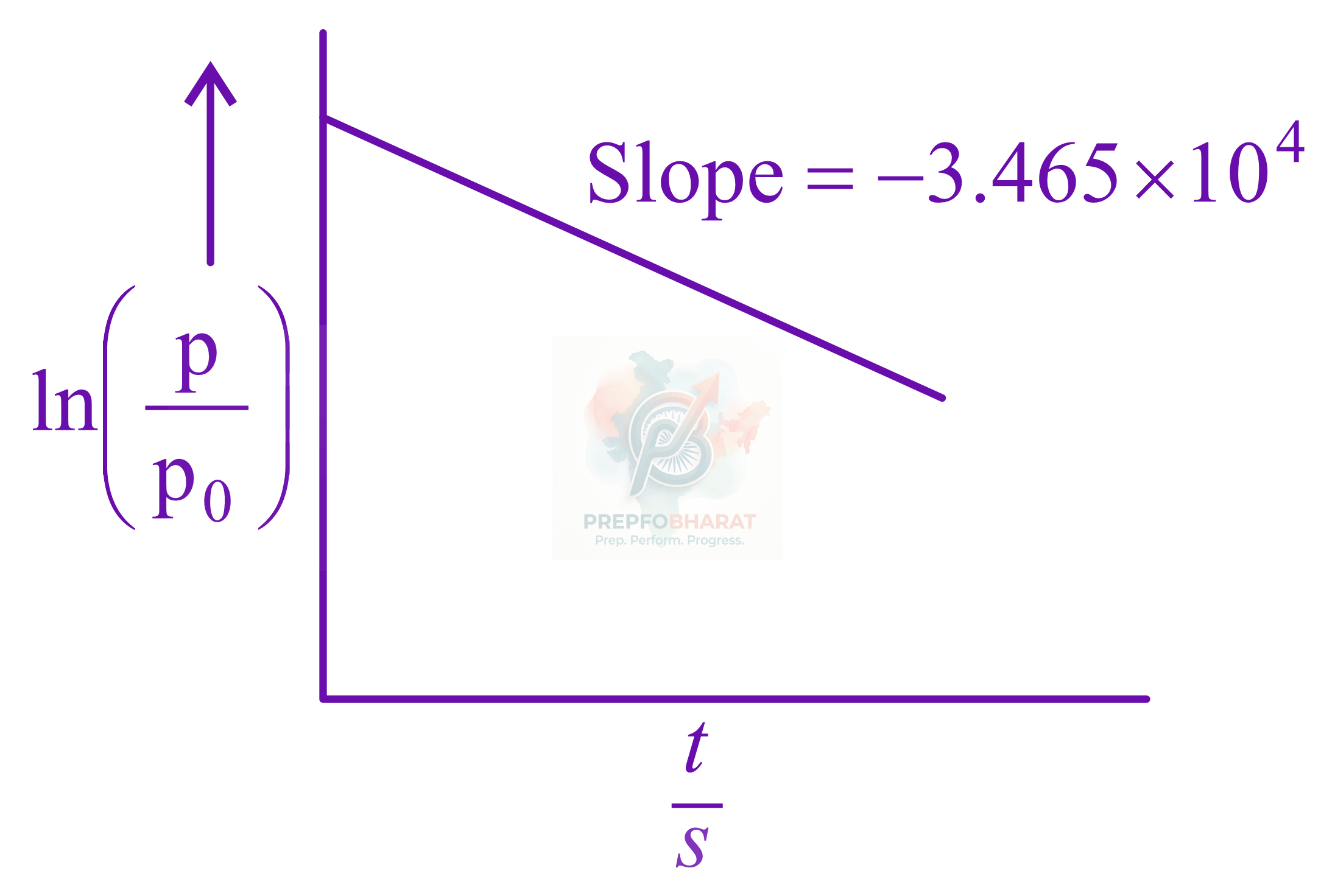 The half life of the reaction is____$\times {10}^{-5}s$
Boiling point of a $2%$ aqueous solution of a nonvolatile solute $A$ is equal to the boiling point of $8%$ aqueous solution of a non-volatile solute $B$. The relation between molecular weights of $A$ and $B$ is.
Number of grams of bromine that will completely react with $5.0g$ of pent-$1$-ene is____$\times {10}^{-2}g$. (Atomic mass of $\mathrm{Br}=80g/\mathrm{mol}$) [Nearest integer]
For a first order reaction $A\rightarrow B$, the rate constant, $k=5.5\times {10}^{-14}{s}^{-1}$. The time required for $67%$ completion of reaction is $x\times {10}^{-1}$ times the half life of reaction. The value of $x$ is Nearest integer) (Given : $\mathrm{log}3=0.4771$)