JEE Main 2018 — Physical Chemistry
Chemistry Physical Chemistry questions from JEE Main 2018.
Other Years
46 Physical Chemistry Questions from 2018
Which of the following lines correctly show the temperature dependence of equilibrium constant $K,$ for an exothermic reaction? 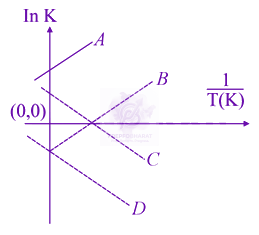
Two 5 molal solutions are prepared by dissolving a non-electrolyte, non-volatile solute separately in the solvents $\mathrm{X}$ and $\mathrm{Y}$. The molecular weights of the solvents are $\mathrm{M}_{\mathrm{X}}$ and $\mathrm{M}_{\mathrm{Y}}$, respectively where $\mathrm{M}_X=\frac{3}{4} \mathrm{M}_{\mathrm{Y}}$. The relative lowering of vapour pressure of the solution in $\mathrm{X}$ is " $\mathrm{m}$ " times that of the solution in Y. Given that the number of moles of solute is very small in comparison to that of solvent, the value of "m" is:
A sample of ${\mathrm{NaClO}}_{3}$ is converted by heat to $\mathrm{NaCl}$ with a loss of $0.16g$ of oxygen. The residue is dissolved in water and precipitated as $\mathrm{AgCl}$. The mass of $\mathrm{AgCl}$ (in $g$) obtained will be: (Given: Molar mass of $\mathrm{AgCl}=143.5 g {\mathrm{mol}}^{-1}$)
$\Delta_{\mathrm{f}} \mathrm{G}^{\circ}$ at $500 \mathrm{~K}$ for substance ' $\mathrm{S}$ ' in liquid state and gaseous state are $+100.7 \mathrm{kcal} \mathrm{mol}^{-1}$ and $+103$ $\mathrm{kcal} \mathrm{mol}^{-1}$, respectively. Vapour pressure of liquid ' $\mathrm{S}$ ' at $500 \mathrm{~K}$ is approximately equal to: $$ \left(\mathrm{R}=2 \mathrm{cal} \mathrm{K}^{-1} \mathrm{~mol}^{-1}\right) \text {. } $$
For$1\mathrm{molal}$aqueous solution of the following compounds, which one will show the highest freezing point?
An ideal gas undergoes a cyclic process as shown in the figure 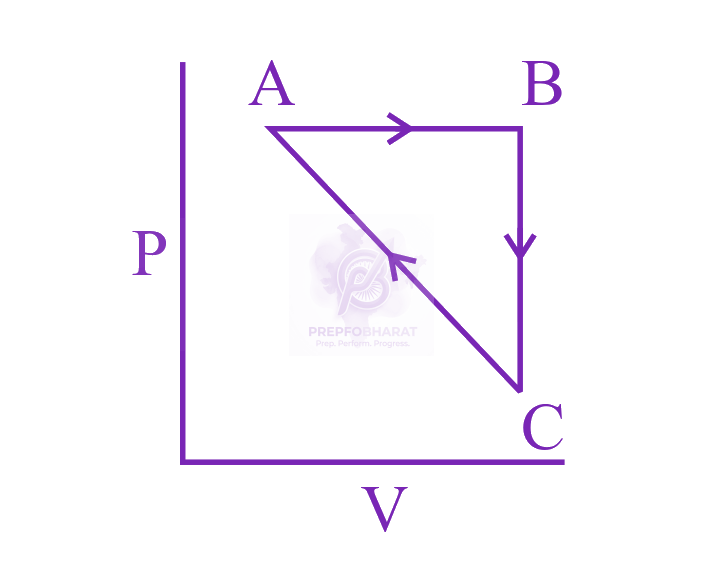 $\Delta {U}_{\mathrm{BC}}=-5{\mathrm{KJmol}}^{-1},{q}_{\mathrm{AB}}=2{\mathrm{KJmol}}^{-1}$ ${W}_{\mathrm{AB}}=-5{\mathrm{KJmol}}^{-1},{W}_{\mathrm{CA}}=3{\mathrm{KJmol}}^{-1}$ Heat absorbed by the system during process $\mathrm{CA}$is
Given (i) $2 \mathrm{Fe}_2 \mathrm{O}_3(\mathrm{~s}) \rightarrow 4 \mathrm{Fe}(\mathrm{s})+3 \mathrm{O}_2(\mathrm{~g})$; $$ \Delta_{\mathrm{r}} \mathrm{G}^{\circ}=+1487.0 \mathrm{~kJ} \mathrm{~mol}^{-1} $$ (ii) $2 \mathrm{CO}(\mathrm{g})+\mathrm{O}_2(\mathrm{~g}) \rightarrow 2 \mathrm{CO}_2(\mathrm{~g})$; $$ \Delta_{\mathrm{r}} \mathrm{G}^{\circ}=-514.4 \mathrm{~kJ} \mathrm{~mol}^{-1} $$ Free energy change, $\Delta_{\mathrm{r}} \mathrm{G}^{\circ}$ for the reaction $2 \mathrm{Fe}_2 \mathrm{O}_3(\mathrm{~s})+6 \mathrm{CO}(\mathrm{g}) \rightarrow 4 \mathrm{Fe}(\mathrm{s})+6 \mathrm{CO}_2(\mathrm{~g})$ will be:
The minimum volume of water required to dissolve 0.1 g lead (II) chloride to get a saturated solution ( ${K}_{sp}$ of ${PbCl}_{2}=3.2\times {10}^{-8}$ ;atomic mass of $Pb=207 u$ ) is:
Ejection of the photoelectron from metal in the photoelectric effect experiment can be stopped by applying $0.5V$, when the radiation of $250\mathrm{nm}$ is used. The work function of the metal is
An unknown chlorohydrocarbon has 3.55 % of chlorine. If each molecule of the hydrocarbon has one chlorine atom only; chlorine atoms present in 1 g of chlorohydrocarbon are :(Atomic wt. of $\mathrm{Cl}=35.5 u;$ Avogadro constant $=6.023\times {10}^{23} {\mathrm{mol}}^{–1}$)
Which of the following are Lewis acids?
Which of the following salts is the most basic in aqueous solution?
In which of the following reactions, an increase in the volume of the container will favour the formation of products?
Ejection of the photoelectron from metal in the photoelectric effect experiment can be stopped by applying $0.5 \mathrm{~V}$ when the radiation of $250 \mathrm{~nm}$ is used. The work function of the metal is :
The de-Broglie's wavelength of electron present in first Bohr orbit of ' $\mathrm{H}$ ' atom is:
$\mathrm{N}_2 \mathrm{O}_5$ decomposes to $\mathrm{NO}_2$ and $\mathrm{O}_2$ and follows first order kinetics. After $50$ minutes, the pressure inside the vessel increases from $50 \mathrm{~mm} \mathrm{~Hg}$ to $87.5 \mathrm{~mm} \mathrm{~Hg}$. The pressure of the gaseous mixture after $100$ minutes at constant temperature will be ______.
For which of the following reactions, $\Delta H$ is equal to $\Delta U$?
The combustion of benzene $(l)$ gives ${\mathrm{CO}}_{2}(g)$ and ${H}_{2}O(l).$ Given that heat of combustion of benzene at constant volume is $-3263.9 \mathrm{kJ} {\mathrm{mol}}^{-1}$ at $25^{\circ}C;$ the heat of combustion $(\mathrm{in} \mathrm{kJ} {\mathrm{mol}}^{-1})$ of benzene at constant pressure will be $(R=8.314 {\mathrm{JK}}^{-1} {\mathrm{mol}}^{-1})$
An alkali is titrated against acid with methyl orange as an indicator, which of the following is a correct combination?
In which of the following reactions, an increase in the volume of the container will favour the formation of products?
Which of the following is a Lewis acid?
For which of the following processes, $\Delta S$ is negative?
For standardizing $\mathrm{NaOH}$ solution, which of the following is used as a primary standard?
A sample of $\mathrm{NaClO}_3$ is converted by heat to $\mathrm{NaCl}$ with a loss of $0.16 \mathrm{~g}$ of oxygen. The residue is dissolved in water and precipitated as $\mathrm{AgCl}$. The mass of $\mathrm{AgCl}$ (in $\mathrm{g}$) obtained will be: (Given: Molar mass of $\mathrm{AgCl}=143.5 \mathrm{~g} \mathrm{~mol}^{-1}$ )
An ideal gas undergoes a cyclic process as shown in Figure. 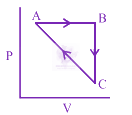 $\begin{aligned} &\Delta \mathrm{U}_{\mathrm{BC}}=-5 \mathrm{~kJ} \mathrm{~mol}^{-1}, \mathrm{q}_{\mathrm{AB}}=2 \mathrm{~kJ} \mathrm{~mol}^{-1} \\ &\mathrm{~W}_{\mathrm{AB}}=-5 \mathrm{~kJ} \mathrm{~mol}^{-1}, \mathrm{~W}_{\mathrm{CA}}=3 \mathrm{~kJ} \mathrm{~mol}^{-1} \end{aligned}$ Heat absorbed by the system during process CA is:
Which of the following is a Lewis acid?
An aqueous solution contains an unknown concentration of ${\mathrm{Ba}}^{2+}$. When $50\mathrm{mL}\mathrm{of}a1M$ solution of ${\mathrm{Na}}_{2}{\mathrm{SO}}_{4}$ is added, ${\mathrm{BaSO}}_{4}$ just begins to precipitate. The final volume is $500\mathrm{mL}$. The solubility product of ${\mathrm{BaSO}}_{4}$ is $1\times {10}^{-10}$. What is the original concentration of ${\mathrm{Ba}}^{2+}$?
At 320 K, a gas ${A}_{2}$ is 20 % dissociated to $A(g)$ . The standard Gibbs free energy change at $320 K and 1 atm in J mo{l}^{–1}$ is approximately: $(R = 8.314 {\mathrm{JK}}^{–1} {\mathrm{mol}}^{–1} ;\mathrm{ln}2 = 0.693 ;\mathrm{ln}3 = 1.098)$
The mass of a non-volatile, non-electrolyte solute (molar mass $= 50 g {\mathrm{mol}}^{-1}$) needed to be dissolved in 114 g octane to reduce its vapour pressure by 75 %, is:
At ${518}^{o}C,$ the rate of decomposition of a sample of gaseous acetaldehyde, initially at a pressure of $363 \mathrm{Torr}$ was $1.00 \mathrm{Torr} {s}^{-1}$ when $5%$ had reacted and $0.50 \mathrm{Torr} {s}^{-1}$ when 33% had reacted. The order of the reaction is:
When 9.65 ampere current was passed for 1.0 hour into nitrobenzene in acidic medium, the amount of p-aminophenol produced is:
${N}_{2}{O}_{5}$ decomposes to ${\mathrm{NO}}_{2}$ and ${O}_{2}$ follows the first order kinetics. After $50$ minutes, the pressure inside the vessel increases from $50\mathrm{mm}\mathrm{Hg}$ to $87.5\mathrm{mm}\mathrm{Hg}$. The pressure of the gaseous mixture after $100$ minutes at constant temperature will be:
For per gram of reactant, the maximum quantity of $\mathrm{N}_2$ gas is produced in which of the following thermal decomposition reactions? (Given: Atomic wt. : $\mathrm{Cr}=52 \mathrm{u}, \mathrm{Ba}=137 \mathrm{u}$ ).
When an electric current is passed through acidified water, 112 mL of hydrogen gas at N.T.P was collected at the cathode in 965 seconds. The current passed, in ampere, is:
The minimum volume of water required to dissolve $0.1 \mathrm{~g}$ lead (II) chloride to get a saturated solution $\left(K_{\mathrm{SP}}\right.$ of $\mathrm{PbCl}_2=3.2 \times 10^{-8}$; atomic mass of $\mathrm{Pb}=207 \mathrm{~u})$ is :
For which of the following reactions, $\Delta \mathrm{H}$ is equal to $\Delta \mathrm{U}$ ?
An aqueous solution contains $0.10M {H}_{2}S$ and $0.20M\mathrm{HCl}$. If the equilibrium constant for the formation of ${\mathrm{HS}}^{-}$ from ${H}_{2}S$ is $1.0\times {10}^{-7}$ and that of ${S}^{2-}$ from ${\mathrm{HS}}^{-}$ ions is $1.2\times {10}^{-13}$, then, the concentration of ${S}^{2-}$ ions in the aqueous solution is:
The ratio of mass percent of $C\mathrm{and}H$ of an organic compound $({C}_{X}{H}_{Y}{O}_{Z})$ is $6:1.$ If one molecule of the above compound $({C}_{X}{H}_{Y}{O}_{Z})$ contains half as much oxygen as required to burn one molecule of compound ${C}_{X}{H}_{Y}$ completely to ${\mathrm{CO}}_{2}$ and ${H}_{2}O.$ The empirical formula of the compound ${C}_{X}{H}_{Y}{O}_{Z}$ is
If 50 % of a reaction occurs in 100 second and 75 % of the reaction occurs in 200 second, the order of this reaction is:
When an electric current is passes through acidified water, $112 \mathrm{~mL}$ of hydrogen gas at N.T.P. was collected at the cathode in $965$ seconds. The current passed, in ampere, is :
Following four solutions are prepared by mixing different volumes of $\mathrm{NaOH}$ and $\mathrm{HCl}$ of different concentrations, $\mathrm{pH}$ of which one of them will be equal to 1 ?
The gas phase reaction $2{\mathrm{NO}}_{2}(g) \rightarrow {N}_{2}{O}_{4} (g)$ is an exothermic reaction. The decomposition of ${N}_{2}{O}_{4}$ , in equilibrium mixture of ${\mathrm{NO}}_{2} (g) \mathrm{and} {N}_{2}{O}_{4} (g)$ can be increased by:
At a certain temperature in a 5L vessel, 2 moles of carbon monoxide and 3 moles of chlorine were allowed to reach equilibrium according to the reaction, $\mathrm{CO}+\mathrm{Cl}_2 \rightleftharpoons \mathrm{COCl}_2$. At equilibrium, if one mole of $\mathrm{CO}$ is present then equilibrium constant $\left(K_{\mathrm{c}}\right)$ for the reaction is:
How long (approximate) should water be electrolysed by passing through $100$$\mathrm{amperes}$current so that the oxygen released can completely burn $27.66g$ of diborane? (Atomic weight of $B=10.8u$)
Which of the following statements is false?
For a first order reaction, $\mathrm{A} \rightarrow \mathrm{P}, \mathrm{t}_{1 / 2}$ (half-life) is 10 days. The time required for $\frac{1}{4}^{\text {th }}$ conversion of $\mathrm{A}$ (in days) is: $(\ln 2=0.693, \ln 3=1.1)$.