JEE Main 2020 — Physical Chemistry
Chemistry Physical Chemistry questions from JEE Main 2020.
Other Years
116 Physical Chemistry Questions from 2020
The unit of rate constant for a zero order reaction is:
According to Raoults law, the relative lowering of vapor pressure of a solution is equal to:
The true statement amongst the following is:
The strengths of $5.6$ volume hydrogen peroxide (of density $1g/\mathrm{mL}$ ) in terms of mass percentage and molarity$(M)$ respectively, are: (Take molar mass of hydrogen peroxide as $34g/\mathrm{mol}$)
Amongst the following, the form of water with the lowest ionic conductance at $298K$ is:
The difference between the radii of ${3}^{\mathrm{rd}}$ and ${4}^{\text{th }}$ orbits of ${L}_{i}^{2+}$ is ${\Delta R}_{1}$. The difference between the radii of ${3}^{\mathrm{rd}}$ and ${4}^{\text{th }}$ orbits of ${\mathrm{He}}^{+}$ $\Delta {R}_{2}.$ Ratio $\Delta {R}_{1}:\Delta {R}_{2}$ is :
$108 g$ of silver (molar mass $108 g{mol}^{-1}$ ) is deposited at cathode from ${AgNO}_{3}(aq)$ solution by a certain quantity of electricity. The volume (in $L$ ) of oxygen gas produced at $273 K$ and $1$ bar pressure from water by the same quantity of electricity is ________
At $300K$, the vapour pressure of a solution containing $1$ mole of $n$ -hexane and $3$ moles of $n$ -heptane is $550\mathrm{mm}$ of $\mathrm{Hg}$. At the same temperature, if one more mole of $n$ -heptane is added to this solution, the vapour pressure of the solution increases by $10\mathrm{mm}$ of $\mathrm{Hg}$. What is the vapour pressure in $\mathrm{mmHg}$ of $n$ - heptane in its pure state______?
The ${K}_{sp}$ for the following dissociation is $1.6\times {10}^{-5}$ ${PbCl}_{2(s)}\rightleftharpoons P{b}_{(aq)}^{2+}+2C{l}_{(aq)}^{-}$ Which of the following choices is correct for a mixture of $300mL 0.134 MPb{(N{O}_{3})}_{2}$ and $100mL$ $0.4 M NaCl?$
For the reaction ${\mathrm{Fe}}_{2}N(s)+\frac{3}{2}{H}_{2}(g)\rightleftharpoons 2\mathrm{Fe}(s)+{\mathrm{NH}}_{3}(g)$
For the following Assertion and Reason, the correct option is: Assertion: The $pH$ of water increases with increase in temperature. Reason: The dissociation of water into ${H}^{+}$ and $O{H}^{-}$ is an exothermic reaction.
Among $(a)-(d),$ the complexes that can show geometrical isomerism are: $(a)$ ${[Pt{(N{H}_{3})}_{3}Cl]}^{+}$ $(b)$ ${[Pt(N{H}_{3})C{l}_{5}]}^{-}$ $(c)$ $[Pt{(N{H}_{3})}_{2}Cl(N{O}_{2})]$ $(d)$ ${[Pt{(N{H}_{3})}_{4}ClBr]}^{2+}$
For the following reactions $\text{A}\overset{700\text{K}}{\rightarrow }\text{Product}$ $\text{A}\overset{500\text{K}}{\underset{\text{catalyst}}{\rightarrow }}\text{Product}$ It was found that the ${E}_{a}$ is decreased by $30 KJ/mol$ in the presence of catalyst. If the rate remains unchanged, the activation energy for catalysed reaction is (Assume pre-exponential factor is same)
If enthalpy of atomization for $B{r}_{2}(l)$ is $x kJ/mol$ and bond enthalpy for $B{r}_{2}$ is $y kJ/mol$, the relation between them
The size of a raw mango shrinks to a much smaller size when kept in a concentrated salt solution. Which one of the following process can explain this?
The region in the electromagnetic spectrum where the Balmer series lines appear is:
The value of ${K}_{c}\mathrm{us}64\mathrm{at}800K$ for the reaction ${N}_{2}(g)+3{H}_{2}(g)\rightarrow 2{\mathrm{NH}}_{3}(g)$ The value of ${K}_{c}$ for the following reaction is : ${\mathrm{NH}}_{3}(g)\rightarrow \frac{1}{2}{N}_{2}(g)+\frac{3}{2}{H}_{2}(g)$
A solution of two components containing ${n}_{1}$ moles of the ${1}^{\text{st }}$ component and ${n}_{2}$moles of the ${2}^{\text{nd }}$ component is prepared. ${M}_{1}$ and ${M}_{2}$ are the molecular weights of component 1 and 2 respectively. If $d$ is the density of the solution in ${\mathrm{gmI}}^{-1},{C}_{2}$ is the molarity and ${x}_{2}$ is the mole fraction of the ${2}^{\text{nd }}$ component, then ${C}_{2}$ can be expressed as :
For the Balmer series, in the spectrum of $H$ atom, $\overset{-}{v}={R}_{H}{\frac{1}{{n}_{1}^{2}}-\frac{1}{{n}_{2}^{2}}},$ the correct statements among $(I)$ to $(IV)$ are, $(I)$ As wavelength decreases, the lines in the series converge. $(II)$ The integer ${n}_{1}$ is equal to $2$/ $(III)$ The lines of the longest wavelength correspond to ${n}_{2}=3$. $(IV)$ The ionization energy of hydrogen can be calculated from the wave number of these lines.
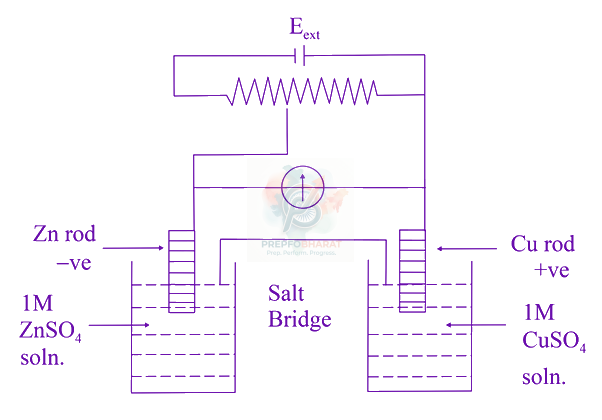 ${E}_{{\mathrm{Cu}}^{2+}|\mathrm{Cu}}^{0}=+0.34V$ ${E}_{{\mathrm{Zn}}^{2+}|\mathrm{Zn}}^{0}=-0.76V$ Identify the incorrect statement from the options below for the above cell:
The magnitude of work done by a gas that undergoes a reversible expansion along the path $ABC$ shown in the figure is _________. 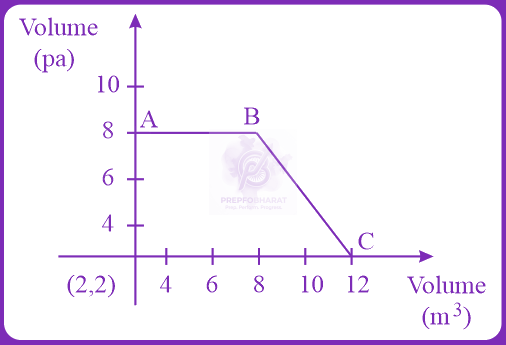
The variation of equilibrium constant with temperature is given below : $\begin{matrix}\mathrm{Temperature} & \mathrm{EquilibriumConstant} \\ {T}_{1}=25^{\circ}C & {K}_{1}=10 \\ {T}_{2}=100^{\circ}C & {K}_{2}=100\end{matrix}$ The values of $\Delta H^{\circ},\Delta G^{\circ}$ at ${T}_{1}$ and $\Delta G^{\circ}$ at ${T}_{2}$ (in $\mathrm{kJ}{\mathrm{mol}}^{-1}$ ) respectively, are close to [use $R=8.314{\mathrm{JK}}^{-1}{\mathrm{mol}}^{-1}$]
A sample of milk splits after $60min$ . at $300K$ and after $40min$ . at $400K$ when the population of Iactobacillus acidophilus in it doubles. The activation energy (in $\mathrm{kJ}/\mathrm{mol}$ ) for this process is closest to ______________. (Given, $R=8.3Jmo{l}^{-1}{K}^{-1},ln(\frac{2}{3})=0.4,{e}^{-3}=4.0$ )
An acidic solution of dichromate is electrolyzed for 8 minutes using 2 A current. As per the following equation ${\mathrm{Cr}}_{2}{O}_{7}^{2}+14{H}^{+}+6{e}^{-}\rightarrow 2{\mathrm{Cr}}^{3+}+7{H}_{2}O$ The amount of ${\mathrm{Cr}}^{3+}$. obtained was $0.104g$. The efficiency of the process $(\mathrm{in}%)$ is (Take : $F=960000C$, At. mass of chromium $=52$)
The volume strength of $8.9{\mathrm{MH}}_{2}{O}_{2}$ solution calculated at $273K$ and 1 atm is $........(R=0.0821L\mathrm{atm}{K}^{-1}{\mathrm{mol}}^{-1})$ (rounded off to the nearest integer)
Oxidation number of potassium in ${K}_{2}O,{K}_{2}{O}_{2}$ and $K{O}_{2},$ respectively, is:
The number of subshells associated with $n=4$ and $m=-2$ quantum numbers is:
Consider the following reaction: ${N}_{2}{O}_{4}(g)=2{\mathrm{NO}}_{2}(g):\Delta {H}^{0}=+58k$ For each of the following cases $(a,b)$, the direction in which the equilibrium shifts is: (a) Temperature is decreased. (b) Pressure is increased by adding ${N}_{2}$ at constant T.
The number of orbitals associated with quantum numbers $n=5,{m}_{s}=+\frac{1}{2}$ is:
A graph of vapour pressure and temperature for three different liquids $X,Y$ and $Z$ is shown below: 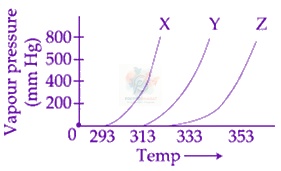 The following inferences are made: $(A)X$ has higher intermolecular interactions compared to $Y.$ $(B)X$ has lower intermolecular interactions compared to $Y.$ $(C)Z$ has lower intermolecular interactions compared to $Y.$ The correct inferences is/are:
The equation that is incorrect is:
Amongst the following statements, that which was not proposed by Dalton was :
The work function of sodium metal is $4.41\times {10}^{-19}J.$ If photons of wavelength $300\mathrm{nm}$ are incident on the metal, the kinetics energy of the ejected electrons will be $(h=6.63\times {10}^{-34}Js;c=3\times {10}^{8}m{s}^{-1})$__________$\times {10}^{-21}J$
The Gibbs energy change (in $J$) for the given reaction at $[{\mathrm{Cu}}^{2+}]=[{\mathrm{Sn}}^{2}+]=1\text{ M}$ and $298K$ is : $\mathrm{Cu}(s)+{\mathrm{Sn}}^{2+}(\mathrm{aq}.)\rightarrow {\mathrm{Cu}}^{2+}(\mathrm{aq}.)+\mathrm{Sn}(s)$; $({E}_{{\mathrm{Sn}}^{2+}|\mathrm{Sn}}^{0}=-0.16 V, {E}_{{\mathrm{Cu}}^{2+}|\mathrm{Cu}}^{0}=0.34 V,$Take $F=96500 C {\mathrm{mol}}^{-1})$
The photoelectric current from Na (work function, ${w}_{0}=2.3\mathrm{eV}$) is stopped by the output voltage of the cell $\mathrm{Pt}(s)\|{H}_{2}(g,1\mathrm{bar})|\mathrm{HCl}(\mathrm{aq}\cdot ,\mathrm{pH}=1)|\mathrm{AgCl}(s)\mid \mathrm{Ag}(s)$ the $pH$ of aq. $\mathrm{HCl}$ required to stop the photoelectric current from $K({w}_{0}=2.25\mathrm{eV})$, all other conditions remaining the same, is $\ldots \ldots \ldots .\times {10}^{-2}$ (to the nearest integer). Given $2.303\frac{\mathrm{RT}}{F}=0.06V;{E}_{\mathrm{AgCl}/\mathrm{Ag}/Cl}^{0}=0.22V$
For an electrochemical cell $\mathrm{Sn}(s)|{\mathrm{Sn}}^{2}+(\mathrm{aq}, 1M)||{\mathrm{Pb}}^{2+}(\mathrm{aq}, 1M)|\mathrm{Pb}(s)$ the ratio $\frac{[{\mathrm{Sn}}^{2+}]}{[{\mathrm{Pb}}^{2+}]}$ when this cell attains equilibrium is _______ (Given: ${E}_{{\mathrm{Sn}}^{2+}|\mathrm{Sn}}^{0}=-0.14 V,{E}_{{\mathrm{Pb}}^{2+}|\mathrm{Pb}}^{0}=-0.13 V, \frac{2.303\mathrm{RT}}{F}=0.06$)
Potassium chlorate is prepared by the electrolysis of $\mathrm{KCl}$ in basic solution $6{\mathrm{OH}}^{-}+{\mathrm{Cl}}^{-}\rightarrow {\mathrm{ClO}}_{3}^{-}+3{H}_{2}O+6{e}^{-}$ . If only $60%$ of the current is utilized in the reaction, the time (rounded to the nearest hour) required to produce$10g$ of ${\mathrm{KClO}}_{3}$ using a current of $2A$ is $\ldots \ldots ..$ (Given :$F=96,500C$$\mathrm{mol}$; molar mass of ${\mathrm{KClO}}_{3}=122g{\mathrm{mol}}^{-1}$)
Consider the following reactions $A\rightarrow P1;B\rightarrow P2;C\rightarrow P3;D\rightarrow P4$ The order of the above reactions are $a,b,c\mathrm{and}d,$respectively. The following graph is obtained when log[rate] vs.log[conc.] are plotted: 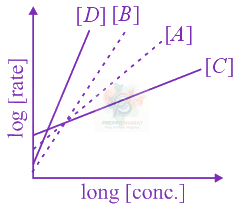 Among the following, the correct sequence for the order of the reactions is :
The rate of a certain biochemical reaction at physiological temperature $(T)$ occurs ${10}^{6}$ times faster with enzyme than without. The change in the activation energy upon adding enzyme is:
The de Broglie wavelength of an electron in the ${4}^{th}$ Bohr orbit is:
The number of molecules with energy greater than the threshold energy for a reaction increases five fold by a rise of temperature from ${27}^{o}C$ to ${42}^{o}C$. Its energy of activation in $J/\mathrm{mol}$ is _________ (Take $\mathrm{ln}5=1.6094;R=8.314J{\mathrm{mol}}^{-1}$)
Consider the hypothetical situation where the azimuthal quantum number, $l$, takes values $0,1,2,\ldots \ldots ..n+1$. Where n is the principal quantum number. Then, the element with atomic number:
The rate of a reaction decreased by $3.555$ times when the temperature was changed from $40^{\circ}C\mathrm{to}30^{\circ}C$. the activation energy (in $\mathrm{kJ}{\mathrm{mol}}^{-1}$) of the reaction is ________ .
The compound that cannot act both as oxidizing and reducing agent is
The mole fraction of glucose $({C}_{6}{H}_{12}{O}_{6})$ in an aqueous binary solution is $0.1.$ The mass percentage of water in it, to the nearest integer, is $\ldots \ldots \ldots$
The osmotic pressure of a solution of $\mathrm{NaCl}$ is $0.10$ atm and that of a glucose solution is $0.20$ atm. The osmotic pressure of a solution formed by mixing $1L$ of the sodium chloride solution with $2L$ of the glucose solution is $x\times {10}^{-3}$ atm. $x$ is ________ (nearest integer)
During the nuclear explosion, one of the products is ${}^{90}Sr$ with half life of $6.93$ years. If $1\mu g$ of ${}^{90}Sr$ was absorbed in the bones of a newly born baby in place of $Ca,$ how much time, in years, is required to reduce it by $90%$ if it is not lost metabolically ____________.
How much amount of $NaCl$ should be added to $600g$ of water $(\rho =1.00g/mL)$ to decrease the freezing point of water to $-0.2{}^{o}C$? ________. (The freezing point depression constant for water $=2 K kg{mol}^{-1}$ )
For the following Assertion and Reason, the correct option is Assertion (A) : When $\mathrm{Cu}$ (II) and sulphide ions are mixed, they react together extremely quickly to give a solid. Reason (R) : The equilibrium constant of ${\mathrm{Cu}}^{2+}(\mathrm{aq})+{S}^{2-}(\mathrm{aq})\rightleftharpoons \mathrm{Cus}(s)$ is high because the solubility product is low.
Five moles of an ideal gas at $1$ bar and $298K$ is expanded into vacuum to double the volume. The work done is :
Henry's constant (in kbar) for four gases $\alpha ,\beta ,\gamma$ and $\delta$ in water at $298K$ is given below : $\begin{matrix} & \alpha & \beta & \gamma & \delta \\ {K}_{H} & 50 & 2 & 2\times {10}^{-5} & 0.5\end{matrix}$ (density of water $={10}^{3}k{\mathrm{gm}}^{-3}$ at $298K$ ) This table implies that :
Ferrous sulphate heptahydrate is used to fortify foods with iron. The amount (in grams) of the salt required to achieve $10ppm$ of iron in $100kg$ of wheat is ____________. Atomic weight: $Fe=55.85;S=32.00;O=16.00$
The heat of combustion of ethanol into carbon dioxides and water is $-327$ Kcal at constant pressure. The heat evolved (in cal) at constant volume at $27^{\circ}C$ (if all gases behave ideally) is $(R=2{\mathrm{calmol}}^{-1}{K}^{-1})$________
$0.023\times {10}^{22}$ molecules are present in $10g$of a substance $x''.$ The molarity of a solution containing $5g$ of substance 'x' in 2 L solution is $_________\times {10}^{-3}$
For the reaction $2A+3B+\frac{3}{2}C\rightarrow 3P$, which statement is correct?
For the disproportionation reaction $2{\mathrm{Cu}}^{+}(\mathrm{aq})\rightleftharpoons \mathrm{Cu}(s)+{\mathrm{Cu}}^{2+}(\mathrm{aq})$ at $298K,$$\mathrm{ln}K$ (where $K$ is the equilibrium constant) is _______$\times {10}^{-1}$ Given $:(E{^{\circ}}_{{\mathrm{Cu}}^{2+}/{\mathrm{Cu}}^{+}}=0.16VE{^{\circ}}_{{\mathrm{Cu}}^{+}/\mathrm{Cu}}=0.52V\frac{\mathrm{RT}}{F}=0.025)$
For the given cell; $\mathrm{Cu}(s)|{\mathrm{Cu}}^{2+}({C}_{1}M)||{\mathrm{Cu}}^{2+}({C}_{2}M)|\mathrm{Cu}(s)$ change in Gibbs energy $(\Delta G)$ is negative, it :
The variation of molar conductively with concentration of an electrolyte (X) in aqueous solution is shown in the given figure. 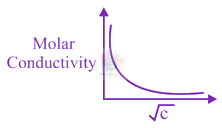 The electrolyte X is :
The redox reaction among the following is
The shortest wavelength of $H$ atom in the Lyman series is ${\lambda }_{1}$. The longest wavelength in the Balmer series of ${\mathrm{He}}^{+}$ is :
The oxidation states of transition metal atoms in ${K}_{2}{\mathrm{Cr}}_{2}{O}_{7},{\mathrm{KMnO}}_{4}$ and ${K}_{2}{\mathrm{FeO}}_{4},$ respectively, are $x,y$ and $z$ . The sum of $x,y$ and $z$ is______
An oxidation-reduction reaction in which 3 electrons are transferred has a ${\Delta G}^{0}$ of $17.37\mathrm{kJ}{\mathrm{mol}}^{-1}$ at $25^{\circ}C.$ The value of ${E}_{\mathrm{cell}}^{o}$ (in V) is $_______\times {10}^{-2}$. $(1F=96500C{\mathrm{mol}}^{-1})$
Two solutions, $A$ and $B,$ each of $100L$ was made by dissolving $4g$ of $NaOH$ and $9.8g$ of ${H}_{2}S{O}_{4}$ in water, respectively. The $pH$ of the resultant solution obtained from mixing $40L$ of solution $A$ and $10L$ of solution $B$ is ____________. $(\mathrm{log}2=0.3)$
For a dimerization reaction, $2A(g)\rightarrow {A}_{2}(g)$ at $298K,\Delta {U}^{-}=-20{\mathrm{kJmol}}^{-1},\Delta {S}^{-}=-30{\mathrm{JK}}^{-1}{\mathrm{mol}}^{-1}$,then the $\Delta {G}^{-}$ will be …..J.
The solubility product of $Cr{(OH)}_{3}$ at $298K$ is $6.0\times {10}^{-31}.$ The concentration of hydroxide ions in a saturated solution of $Cr{(OH)}_{3}$ will be
For the equilibrium $A\rightleftharpoons B$, the variation of the rate of the forward (a) and reverse (b) reaction with time is given by:
For a reaction $4M(s)+{\mathrm{nO}}_{2}(g)\rightarrow 2{M}_{2}{O}_{n}(s)$ The free energy change is plotted as a function of temperature. The temperature below which the oxide is stable could be inferred from the plot as the point at which :
A soft drink was bottled with a partial pressure of ${\mathrm{CO}}_{2}$ of 3 bar over the liquid at room temperature. The partial pressure of ${\mathrm{CO}}_{2}$ over the solution approaches a value of 30 bar when $44g$ of ${\mathrm{CO}}_{2}$ is dissolved in $1\mathrm{kg}$ of water at room temperature. The approximate $\mathrm{pH}$ of the soft drink is ___________$\times {10}^{-1}$. (First dissociation constant of ${H}_{2}{\mathrm{CO}}_{3}=4.0\times {10}^{-7};\mathrm{log}2=0.3;$ density of the soft drink $=1g{\mathrm{mL}}^{-1}$)
Let ${C}_{\mathrm{NaCl}}$ and ${{C}_{\mathrm{BaSO}}}_{4}$, be the conductances (in S) measured for saturated aqueous solutions of $\mathrm{NaCl}$ and $BaS{O}_{4}$ respectively, at a temperature T. Which of the following is false?
$100\mathrm{mL}$ of $0.1M\mathrm{HCl}$ is taken in a beaker and to it $100\mathrm{mL}$ $0.1M\mathrm{NaOH}$ of is added in steps of $2\mathrm{mL}$ and the $\mathrm{pH}$ is continuously measured. Which of the following graphs correctly depicts the change in $\mathrm{pH}$ ?
$250\mathrm{mL}$ of a waste solution obtained from the workshop of a goldsmith contains $0.1M{\mathrm{AgNO}}_{3}$ and $0.1M\mathrm{AuCl}$. The solution was electrolyzed at $2V$ by passing a current of $1A$ for $15$ minutes. The metal/metals electrodeposited will be : $({\text{E}}_{{\text{Ag}}^{+}/\text{Ag}}^{0}=0.80\text{V},{\text{E}}_{{\text{Au}}^{+}/\text{Au}}^{0}=1.69\text{V})$
The molarity of ${HNO}_{3}$ in a sample which has density $1.4g/mL$ and mass percentage of $63%$ is ________ (Molecular Weight of ${HNO}_{3}=63$ )
Preparation of Bakelite proceeds via reactions:
The average molar mass of chlorine is $35.5g{\mathrm{mol}}^{-1}$. The ratio of $\mathrm{Cl}35$ to $\mathrm{Cl}37$ in naturally occurring chlorine is close to :
An open beaker of water in equilibrium with water vapour is in a sealed container. When a few grams of glucose are added to the beaker of water, the rate at which water molecules :
The mass of ammonia in grams produced when $2.8\mathrm{kg}$ of dinitrogen quantitatively reacts with $1\mathrm{kg}$ of dihydrogen is _____
The stoichiometry and solubility product of a salt with the solubility curve given below is, respectively: 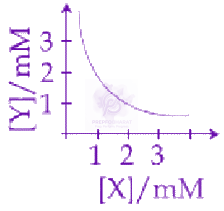
At constant volume, $4mol$ of an ideal gas when heated from $300K$ to $500K$ changes its internal energy by $5000J.$ The molar heat capacity at constant volume is ________
A cylinder containing an ideal gas ( $0.1mol$ of $1.0d{m}^{3}$ ) is in thermal equilibrium with a large volume of $0.5$ molal aqueous solution of ethylene glycol at its freezing point. If the stoppers ${S}_{1}$ and ${S}_{2}$ (as shown in the figure) are suddenly withdrawn, the volume of the gas in litres after equilibrium is achieved will be _____________. (Given, ${K}_{f}(water)=2.0Kkgmo{l}^{-1},R=0.08d{m}^{3}atm{K}^{-1}mo{l}^{-1})$ 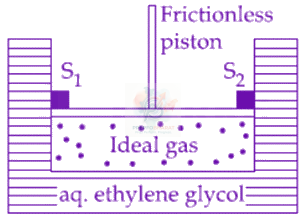
The elevation of boiling point of $0.10m$ aqueous ${\mathrm{CrCl}}_{3}.{\mathrm{xNH}}_{3}$ solution is two times that of $0.05m$ aqueous ${\mathrm{CaCl}}_{2}$ solution. The value of $x$ is $\ldots \ldots \ldots \ldots ..$ [Assume $100%$ ionisation of the complex and ${\mathrm{CaCl}}_{2},$ coordination number of $\mathrm{Cr}$ as $6,$ and that all ${\mathrm{NH}}_{3}$ molecules are present inside the coordination sphere]
For the reaction; $A(l)\rightarrow 2B(g)$ $\Delta U=2.1kcal,\Delta S=20cal{K}^{-1}$ at $300K.$ Hence $\Delta G$ in $kcal$ is _____________.
The internal energy change (in $J$) when $90g$ of water undergoes complete evaporation at $100^{\circ}C$ is .............. (Given : ${\Delta H}_{\mathrm{vap}}$ for water at $373K=41\mathrm{kJ}/\mathrm{mol}$, $R=8.314{\mathrm{JK}}^{-1}{\mathrm{mol}}^{-1}$)
If $75%$ of a first order reaction was completed in $90$ minutes, $60%$ of the same reaction would be completed in approximately (in minutes) _____ (Take: $\mathrm{log}2=0.30;\mathrm{log}2.5=0.40$)
What would be the electrode potential for the given half-cell reaction at $pH=5?_________.$ $2{H}_{2}O\rightarrow {O}_{2}+4\overset{\oplus }{\text{H}}+4{e}^{-};{E}_{red}^{0}=1.23V$ $(R=8.314J{mol}^{-1}{K}^{-1};Temp=298K;oxygen under s\mathrm{tan}dard .atm.pressureof1bar)$
Given that the standard potentials $({E}^{o})$ of ${\mathrm{Cu}}^{2+}/\mathrm{Cu}$ and ${\mathrm{Cu}}^{+}/\mathrm{Cu}$ are $0.34V$ and $0.522V$ respectively, the ${E}^{o}$ of ${\mathrm{Cu}}^{2+}/{\mathrm{Cu}}^{+}$ is:
While titration dilute $\mathrm{HCI}$ solution with aqueous $\mathrm{NaOH}$, which of the following will not be required ?
For a reaction $X+Y=2Z,1.0\mathrm{mol}$ of $X,1.5\mathrm{mol}$ of $Y$ and $0.5\mathrm{mol}$ of $Z$ were taken in a $1L$ vessel and allowed to react. At equilibrium, the concentration of $Z$ was $1.0{\mathrm{molL}}^{-1}$. the equilibrium constant of the reaction is $\ldots \ldots \ldots \ldots \frac{x}{15}.$ The value of x is $\ldots \ldots .$
The strength of an aqueous $NaOH$ solution is most accurately determined by titrating: (Note: consider that an appropriate indicator is used)
If the equilibrium constant for $A\rightleftharpoons B+C$ is ${K}_{\mathrm{eq}}^{(1)}$ and that of $B+C\rightleftharpoons P$ is ${K}_{\mathrm{eq}}^{(2)},$ the equilibrium constant for $A\rightleftharpoons P$ is :
A flask contains a mixture of compounds $A$ and $B$. Both compounds decompose by first-order kinetics. The half-lives for $A$ and $B$ are $300s$ and $180s$, respectively. If the concentrations of $A$ and $B$ are equal initially, the time required for the concentration of A to be four times that of $B$ (in s) is : $(\mathrm{Use}\mathrm{ln}2=0.693)$
Lattice enthalpy and enthalpy of solution of $\mathrm{NaCl}$ are $788{\mathrm{kJmol}}^{-1}$and $4kJmol{}^{-1}$, respectively. The hydration enthalpy of $NaCl$is:
In the figure shown below reactant $A$ (represented by square) is in equilibrium with product $B$ (represented by circle). The equilibrium constant is (approx): 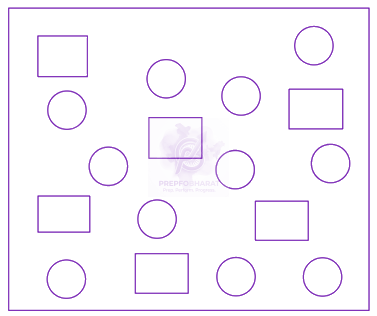
Arrange the following solutions in the decreasing order of pOH : (A) $0.01\mathrm{MHCl}$ (B) $0.01\mathrm{MNaOH}$ (C) $0.01{\mathrm{MCH}}_{3}\mathrm{COONa}$ (D) $0.01\mathrm{MNaCl}$
In the sixth period, the orbitals that are filled are :
If $250{\mathrm{cm}}^{3}$of an aqueous solution containing $0.73g$ of a protein $A$ is isotonic with one litre of another aqueous solution containing $1.65g$ of a protein $B,$ at $298K$, the ratio of the molecular masses of $A$ and $B$ is $___________\times {10}^{-2}$ (to the nearest integer).
For the reaction $2{H}_{2}(g)+2NO(g)\rightarrow {N}_{2}(g)+2{H}_{2}O(g)$ the observed rate expression is, rate $={k}_{f}{[\mathrm{NO}]}^{2}[{H}_{2}]$ . The rate expression for the reverse reaction is:
The rate constant $(k)$ of a reaction is measured at different temperature $(T)$, and the data are plotted in the given figure. the activation energy of the reaction in ${\mathrm{kJmol}}^{-1}$ is : $(R$ is gas constant) 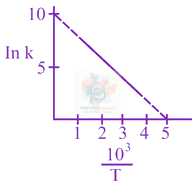
The correct statement about probability density (except at infinite distance from nucleus) is :
A $20.0\mathrm{mL}$ solution containing $0.2g$ impure ${H}_{2}{O}_{2}$ reacts completely with $0.316g$ of ${\mathrm{KMnO}}_{4}$ in acid solution. The purity of ${H}_{2}{O}_{2}$ (in $%$) is______ (mol. wt. of ${H}_{2}{O}_{2}=34$; mol. wt. of ${\mathrm{KMnO}}_{4}=158$)
The ammonia $({NH}_{3})$ released on quantitative reaction of $0.6 g$ urea $({NH}_{2}CON{H}_{2})$ with sodium hydroxide $(NaOH)$ can be neutralized by
The volume, in $\mathrm{mL}$, of $0.02{\mathrm{MK}}_{2}{\mathrm{Cr}}_{2}{O}_{7}$, solution required to react with $0.288g$ of ferrous oxalate in acidic medium is$\ldots \ldots \ldots \ldots$ (Molar mass of $\mathrm{Fe}=56{\mathrm{gmol}}^{-1}$ )
Two open beakers one containing a solvent and the other containing a mixture of that solvent with a non volatile solute are together sealed in a container. Over time:
The standard heat of formation $({\Delta }_{f}{H}_{298}^{0})$ of ethane (in $kJ/mol$ ), if the heat of combustion of ethane, hydrogen and graphite are $-1560,-393.5$ and $-286 kJ/mol$ , respectively is ________
A $100\mathrm{mL}$ solution was made by adding $1.43g$ of ${\mathrm{Na}}_{2}{\mathrm{CO}}_{3}.{\mathrm{xH}}_{2}O.$ The normality of the solution is $0.1N$. The value of $x$ is _______ (The atomic mass of $\mathrm{Na}$ is $23g/\mathrm{mol}$)
An acidic buffer is obtained on mixing:
The ratio of the mass percentages of '$C$ & $H$' and '$C$ & $O$' of a saturated acyclic organic compound '$X$' are $4:1$ and $3:4$ respectively. Then, the moles of oxygen gas required for complete combustion of two moles of organic compound '$X$' is_______
$3 g$ of acetic acid is added to $250 mL$ of $0.1 MHCl$ and the solution made up to $500 mL$. To $20 mL$ of this solution $\frac{1}{2 }mL$ of $5MNaOH$ is added. The $pH$ of the solution is ________ [Given: $pKa$ of acetic acid $=4.75,$ molar mass of acetic acid $60 g/mol,\mathrm{log}3=0.4771$ , Neglect any changes in volume]
The results given in the below table were obtained during kinetic studies of the following reaction: $2A+B\rightarrow C+D$ <table class="pyq-table"><tbody><tr><td>Experiment</td><td>$[A]/{\mathrm{molL}}^{-1}$</td><td>$[B]/{\mathrm{molL}}^{-1}$</td><td>Initial rate/${\mathrm{molL}}^{-1}{\mathrm{min}}^{-1}$</td></tr><tr><td>I</td><td>$0.1$</td><td>$0.1$</td><td>$6.00\times {10}^{-3}$</td></tr><tr><td>II</td><td>$0.1$</td><td>$0.2$</td><td>$2.40\times {10}^{-2}$</td></tr><tr><td>III</td><td>$0.2$</td><td>$0.1$</td><td>$1.20\times {10}^{-2}$</td></tr><tr><td>IV</td><td>X</td><td>$0.2$</td><td>$7.20\times {10}^{-2}$</td></tr><tr><td>V</td><td>$0.3$</td><td>Y</td><td>$2.88\times {10}^{-1}$</td></tr></tbody></table>X and Y in the given table are respectively :
If the solubility product of ${\mathrm{AB}}_{2}$ is $3.20\times {10}^{-11}{M}^{3}$, then the solubility of ${\mathrm{AB}}_{2}$ in pure water is _______ $\times {10}^{-4}\mathrm{mol}{L}^{-1}$ [Assuming that neither kind of ion reacts with water]
Consider the following reactions: $\text{NaCl}+{\text{K}}_{2}{\text{Cr}}_{2}{\text{O}}_{7}+\underset{(\text{Conc.})}{{\text{H}}_{2}{\text{SO}}_{4}}\rightarrow (\text{A})+$ side products $(A)+NaOH\rightarrow (B)+$ side products $(B)+\underset{(\text{dilute})}{{H}_{2}S{O}_{4}}+{H}_{2}{O}_{2}\rightarrow (C)+$ side products The sum of the total number of atoms in one molecule each of $(A),(B)$ and $(C)$ is ________
A set of solutions is prepared using $180g$ of water as a solvent and $10g$ of different non-volatile solutes $A,B$ and $C$. The relative lowering of vapour pressure in the presence of these solutes are in the order [Given, molar mass of $A=100g{\mathrm{mol}}^{-1};B=200g{\mathrm{mol}}^{-1};C=10,000g{\mathrm{mol}}^{-1}$]
At $35{}^{o}C,$ the vapour pressure of $C{S}_{2},$ is $512mm$ Hg and that of acetone is $144mmHg.$ A solution of $C{S}_{2}$ in acetone has a total vapour pressure of $600 mmHg$ . The false statement amongst the following is:
For one mole of an ideal gas, which of these statements must be true? (a) Internal energy $(U)$ and enthalpy $(H)$ each depends on temperature. (b) Compressibility factor $Z$ is not equal to 1 (c) ${C}_{P,m}–{C}_{V,m}=R$ (d) $\mathrm{dU}={C}_{v}\mathrm{dT}$ for any process
The volume $(inmL)$ of $0.125M{AgNO}_{3}$ required to quantitatively precipitate chloride ions in $0.3g$ of $[Co{(N{H}_{3})}_{6}]C{l}_{3}$ is __________. $[Co{(N{H}_{3})}_{6}]MC{l}_{3}=267.46g/mol$ ${AgNOM}_{3}=169.87g/mol$ Report the nearest integer as the answer.
The figure that is not a direct manifestation of the quantum nature of atom is :
It is true that: