JEE Main 2026 — Physical Chemistry
Chemistry Physical Chemistry questions from JEE Main 2026.
Other Years
181 Physical Chemistry Questions from 2026
$19.5$ g of fluoro acetic acid (molar mass $= 78$ g mol$^{-1}$) is dissolved in $500$ g of water at $298$ K. The depression in the freezing point of water was $1°$C. What is $K_a$ of fluoro acetic acid? (For water, $K_f = 1.86$ K kg mol$^{-1}$). Assume molarity and molality to have same values.
80 mL of a hydrocarbon on mixing with 264 mL of oxygen in a closed U-tube undergoes complete combustion. The residual gases after cooling to 273 K occupy 224 mL. When the system is treated with KOH solution, the volume decreases to 64 mL. The formula of the hydrocarbon is :
Arrange the following isothermal processes in order of the magnitude of the work ($p - V$) involved between states $1$ and $2$. A. Expansion in single stage $w_A$ B. Expansion in multi stages $w_B$ C. Compression in single stage $w_C$ D. Compression in multi stages $w_D$ Choose the correct option.
Identify the correct statements from the following: A. Heisenberg uncertainty principle is applicable to electrons. B. The size of $2p_x$ orbital is less than the size of $3p_x$ orbital. C. The energy of $2s$ orbital of H atom is equal to the energy of $2s$ orbital of Li. D. The electronic configuration of Cr is $[\text{Ar}] 3d^5 4s^1$ Choose the correct answer from the options given below:
$M_3 A_2$ is a sparingly soluble salt of molar mass $y$ g mol$^{-1}$ and solubility $x$ g L$^{-1}$. The ratio of the molar concentration of the anion ($A^{3-}$) to the solubility product of the salt is
Solid carbon, CaO and CaCO$_3$ are mixed and allowed to attain equilibrium at T K. $\text{CaCO}_3(s) \rightleftharpoons \text{CaO}(s) + \text{CO}_2(g) \quad K_{p_1} = 0.08$ atm $\text{C}(s) + \text{CO}_2(g) \rightleftharpoons 2\text{CO}(g) \quad K_{p_2} = 2$ atm The partial pressure of CO is ________ $\times 10^{-1}$ atm
Gas 'A' undergoes change from state 'X' to state 'Y'. In this process, the heat absorbed and work done by the gas is $10$ J and $18$ J respectively. Now gas is brought back to state 'X' by another process during which $6$ J of heat is evolved. In the reverse process of 'Y' to 'X',
Consider two radiations of wavelengths 1. $\lambda_1 = 2000$ Å 2. $\lambda_2 = 6000$ Å The ratio of the energies of these two radiations $\left(\dfrac{E_1}{E_2}\right)$ is ________ (Nearest integer).
14.0 g of calcium metal is allowed to react with excess HCl at 1.0 atm pressure and 273 K. Which of the following statements is incorrect? [Given : Molar mass in $\mathrm{g} \mathrm{mol}^{-1}$ of $\mathrm{Ca}-40, \mathrm{Cl}-35.5, \mathrm{H}-1$]
Arrange the following atomic orbitals of multi electron atoms in order of increasing energy. A. $n = 3, l = 2, m = +1$ B. $n = 4, l = 0, m = 0$ C. $n = 6, l = 1, m = 0$ D. $n = 5, l = 1, m = +1$ E. $n = 2, l = 1, m = +1$ Choose the correct answer from the options given below:
' W ' g of a non-volatile electrolyte solid solute of molar mass ' M ' $\mathrm{g} \mathrm{mol}^{-1}$ when dissolved in 100 mL water, decreases vapour pressure of water from 640 mm Hg to 600 mm Hg. If aqueous solution of the electrolyte boils at 375 K and $\mathrm{K}_{\mathrm{b}}$ for water is $0.52 \mathrm{~K} \mathrm{~kg} \mathrm{~mol}^{-1}$, then the mole fraction of the electrolyte solute $\left(x_{2}\right)$ in the solution can be expressed as (Given : density of water $=1 \mathrm{~g} / \mathrm{mL}$ and boiling point of water $=373 \mathrm{~K}$)
Observe the following reactions at $\mathrm{T}(\mathrm{K})$. I. $\mathrm{A} \rightarrow$ products. II. $5 \mathrm{Br}^{-}(\mathrm{aq})+\mathrm{BrO}_{3}{ }^{-}(\mathrm{aq})+6 \mathrm{H}^{+}(\mathrm{aq}) \rightarrow 3 \mathrm{Br}_{2}(\mathrm{aq})+3 \mathrm{H}_{2} \mathrm{O}(\mathrm{l})$ Both the reactions are started at 10.00 am. The rates of these reactions at 10.10 am are same. The value of $-\frac{\Delta\left[\mathrm{Br}^{-}\right]}{\Delta \mathrm{t}}$ at 10.10 am is $2 \times 10^{-4} \mathrm{~mol} \mathrm{~L}^{-1} \mathrm{~min}^{-1}$. The concentration of A at 10.10 am is $10^{-2} \mathrm{~mol} \mathrm{~L}^{-1}$. What is the first order rate constant (in $\mathrm{min}^{-1}$) of reaction $I$ ?
Two positively charged particles $\mathrm{m}_{1}$ and $\mathrm{m}_{2}$ have been accelerated across the same potential difference of 200 keV as shown below. 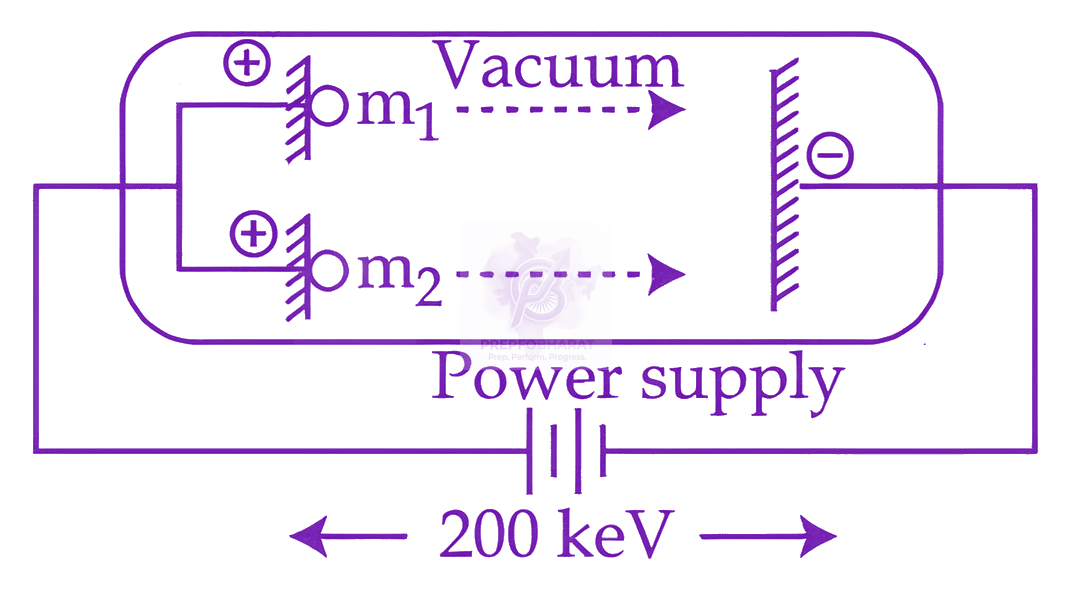 [Given mass of $\mathrm{m}_{1}=1$ amu and $\mathrm{m}_{2}=4$ amu] The deBroglie wavelength of $\mathrm{m}_{1}$ will be $x$ times of $\mathrm{m}_{2}$. The value of $x$ is $\_\_\_\_$ (nearest integer)
Which one of the following graphs accurately represents the plot of partial pressure of $\mathrm{CS}_{2}$ vs its mole fraction in a mixture of acetone and $\mathrm{CS}_{2}$ at constant temperature?
Which of the following mixture gives a buffer solution with $\mathrm{pH}=9.25$ ? Given : $\mathrm{pK}_{\mathrm{b}}\left(\mathrm{NH}_{4} \mathrm{OH}\right)=4.75$
Aqueous HCl reacts with $\mathrm{MnO}_{2}(\mathrm{~s})$ to form $\mathrm{MnCl}_{2}(\mathrm{aq}), \mathrm{Cl}_{2}(\mathrm{~g})$ and $\mathrm{H}_{2} \mathrm{O}(l)$. What is the weight (in g) of $\mathrm{Cl}_{2}$ liberated when 8.7 g of $\mathrm{MnO}_{2}(\mathrm{~s})$ is reacted with excess aqueous HCl solution? (Given Molar mass in $\mathrm{g} \mathrm{mol}^{-1} \mathrm{Mn}=55, \mathrm{Cl}=35.5, \mathrm{O}=16, \mathrm{H}=1$)
The energy of first (lowest) Balmer line of H atom is $x \mathrm{~J}$. The energy (in J) of second Balmer line of H atom is :
For the reaction, $\mathrm{N}_{2} \mathrm{O}_{4} \rightleftharpoons 2 \mathrm{NO}_{2}$, graph is plotted as shown below. Identify correct statements. A. Standard free energy change for the reaction is $-5.40 \mathrm{~kJ} \mathrm{~mol}^{-1}$. B. As $\Delta \mathrm{G}^{\ominus}$ in graph is positive, $\mathrm{N}_{2} \mathrm{O}_{4}$ will not dissociate into $\mathrm{NO}_{2}$ at all. C. Reverse reaction will go to completion. D. When 1 mole of $\mathrm{N}_{2} \mathrm{O}_{4}$ changes into equilibrium mixture, value of $\Delta \mathrm{G}^{\ominus}=-0.84 \mathrm{~kJ} \mathrm{~mol}^{-1}$ E. When 2 mole of $\mathrm{NO}_{2}$ changes into equilibrium mixture, $\Delta \mathrm{G}^{\ominus}$ for equilibrium mixture is $-6.24 \mathrm{~kJ} \mathrm{~mol}^{-1}$. 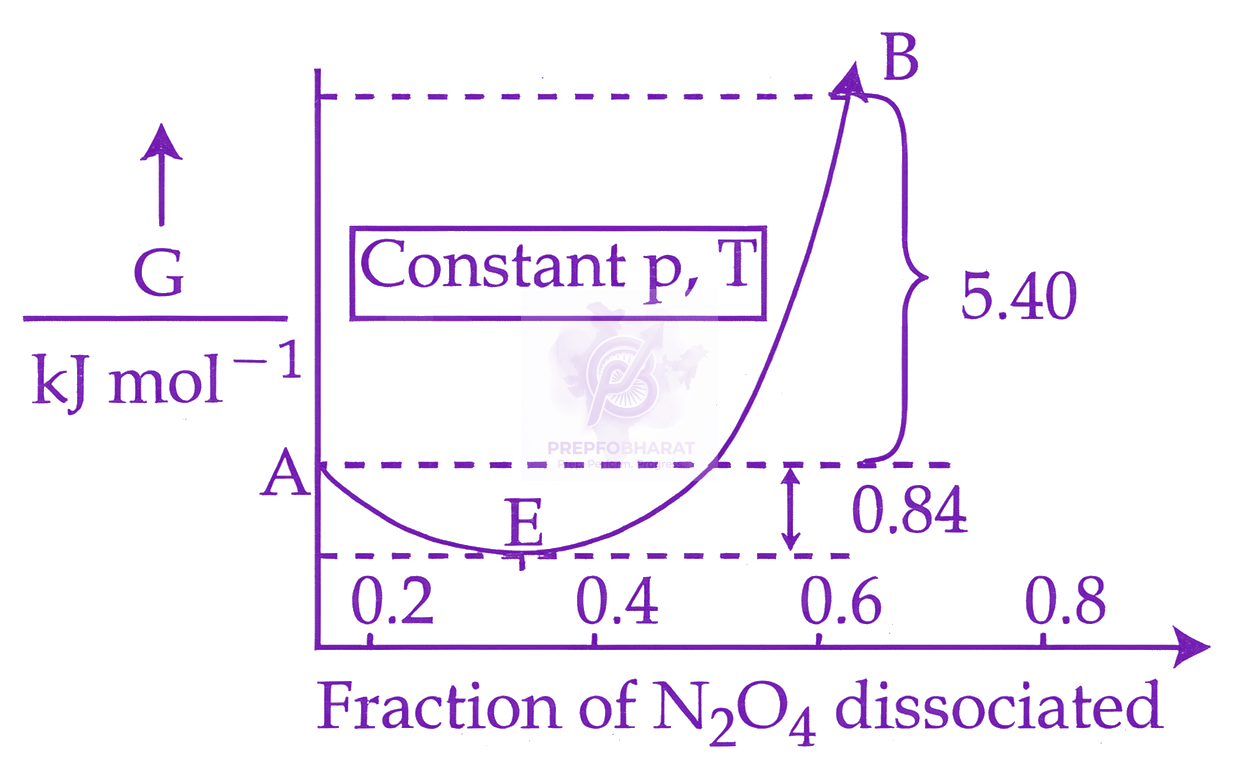 Choose the correct answer from the options given below :
For the following reaction at $50°$C and at $2$ atm pressure, $2N_2O_5(g) \rightleftharpoons 2N_2O_4(g)+O_2(g)$ $N_2O_5$ is $50\%$ dissociated. The magnitude of standard free energy change at this temperature is $x$. $x=$ ______ J mol$^{-1}$ [Nearest integer]. Given: $R=8.314$ J mol$^{-1}$ K$^{-1}$, $\log 2=0.30$, $\log 3=0.48$, $\ln 10=2.303$, $°C+273=K$
Consider the general reaction given below at 400 K $x \mathrm{~A}(\mathrm{~g}) \rightleftharpoons y \mathrm{~B}(\mathrm{~g})$ The values of $\mathrm{K}_{\mathrm{p}}$ and $\mathrm{K}_{\mathrm{c}}$ are studied under the same condition of temperature but variation in $x$ and $y$. (i) $\mathrm{K}_{\mathrm{p}}=85.87$ and $\mathrm{K}_{\mathrm{c}}=2.586$ appropriate units (ii) $\mathrm{K}_{\mathrm{p}}=0.862$ and $\mathrm{K}_{\mathrm{c}}=28.62$ appropriate units. The values of $x$ and $y$ in (i) and (ii) respectively are:
Consider a weak base ' B ' of $\mathrm{pK}_{\mathrm{b}}=5.699$. ' $x$ ' mL of 0.02 M HCl and ' y ' mL of 0.02 M weak base ' B ' are mixed to make 100 mL of a buffer of pH 9 at $25^{\circ} \mathrm{C}$. The values of ' $x$ ' and ' $y$ ' respectively are: [Given: $\log 2=0.3010, \log 3=0.4771, \log 5=0.699$]
Which of the following is correct set of $4$ quantum numbers of $19^{th}$ electron in Chromium (Atomic number $= 24$) in accordance with Aufbau principle?
Consider the reaction $X \rightleftharpoons Y$ at $300$ K. If $\Delta H^{\theta}$ and $K$ are $28.40$ kJ mol$^{-1}$ and $1.8 \times 10^{-7}$ at the same temperature, then the magnitude of $\Delta S^{\theta}$ for the reaction in J K$^{-1}$ mol$^{-1}$ is _______. (Nearest integer) (Given: $R = 8.3$ J K$^{-1}$ mol$^{-1}$, $\ln 10 = 2.3$, $\log 3 = 0.48$, $\log 2 = 0.30$)
X and Y are the number of electrons involved, respectively during the oxidation of $\mathrm{I}^{-}$to $\mathrm{I}_{2}$ and $\mathrm{S}^{2-}$ to S by acidified $\mathrm{K}_{2} \mathrm{Cr}_{2} \mathrm{O}_{7}$. The value of $\mathrm{X}+\mathrm{Y}$ is $\_\_\_\_$.
If the enthalpy of sublimation of Li is $155 \mathrm{~kJ} \mathrm{~mol}^{-1}$, enthalpy of dissociation of $\mathrm{F}_{2}$ is $150 \mathrm{~kJ} \mathrm{~mol}^{-1}$, ionization enthalpy of Li is $520 \mathrm{~kJ} \mathrm{~mol}^{-1}$, electron gain enthalpy of F is $-313 \mathrm{~kJ} \mathrm{~mol}^{-1}$, standard enthalpy of formation of LiF is $-594 \mathrm{~kJ} \mathrm{~mol}^{-1}$. The magnitude of lattice enthalpy of LiF is $\_\_\_\_$ $\mathrm{kJ} \mathrm{mol}^{-1}$. (Nearest Integer)
Use the following data : \(\begin{array}{|c|c|c|} \hline \text {Substance } & \frac{\Delta_f \mathrm{H}^{\ominus}(500 \mathrm{~K})}{\mathrm{kJmol}^{-1}} & \frac{\mathrm{~S}^{\ominus}(500 \mathrm{~K})}{\mathrm{JK}^{-1} \mathrm{~mol}^{-1}} \\ \hline \mathrm{AB}(\mathrm{~g}) & 32 & 222 \\ \hline \mathrm{~A}_2(\mathrm{g}) & 6 & 146 \\ \hline \mathrm{~B}_2(\mathrm{g}) & x & 280 \\ \hline \end{array}\) One mole each of $\mathrm{A}_{2}(\mathrm{~g})$ and $\mathrm{B}_{2}(\mathrm{~g})$ are taken in a 1 L closed flask and allowed to establish the equilibrium at 500 K. $\mathrm{A}_{2}(\mathrm{~g})+\mathrm{B}_{2}(\mathrm{~g}) \rightleftharpoons 2 \mathrm{AB}(\mathrm{~g})$ The value of $x\left(\mathrm{in} \mathrm{kJ} \mathrm{mol}^{-1}\right)$ is $\_\_\_\_$. (Nearest integer) (Given : $\log \mathrm{K}=2.2 \quad \mathrm{R}=8.3 \mathrm{~J} \mathrm{~K}^{-1} \mathrm{~mol}^{-1}$)
200 cc of $x \times 10^{-3} \mathrm{M}$ potassium dichromate is required to oxidise 750 cc of 0.6 M Mohr's salt solution in acidic medium. Here $x=$ $\_\_\_\_$.
Dissociation of a gas $\mathrm{A}_{2}$ takes place according to the following chemical reaction. At equilibrium, the total pressure is 1 bar at 300 K. $\mathrm{A}_{2}(\mathrm{~g}) \rightleftharpoons 2 \mathrm{~A}(\mathrm{~g})$ The standard Gibbs energy of formation of the involved substances has been provided below: \(\begin{array}{|c|c|} \hline \text { Substance } & \Delta \mathrm{G}_{\mathrm{f}}^{\circ} / \mathrm{kJ} \mathrm{~mol}^{-1} \\ \hline \mathrm{~A}_2 & -100.00 \\ \hline \mathrm{~A} & -50.832 \\ \hline \end{array}\) The degree of dissociation of $\mathrm{A}_{2}(\mathrm{~g})$ is given by $\left(x \times 10^{-2}\right)^{1 / 2}$ where $x=$ $\_\_\_\_$. (Nearest integer). [Given: $\mathrm{R}=8 \mathrm{~J} \mathrm{~mol}^{-1} \mathrm{~K}^{-1}, \log 2=0.3010, \log 3=0.48$ ] Assume degree of dissociation is not negligible.
500 mL of 1.2 M KI solution is mixed with 500 mL of $0.2 \mathrm{M} \mathrm{KMnO}_{4}$ solution in basic medium. The liberated iodine was titrated with standard $0.1 \mathrm{M} \mathrm{Na}_{2} \mathrm{~S}_{2} \mathrm{O}_{3}$ solution in the presence of starch indicator till the blue color disappeared. The volume (in L) of $\mathrm{Na}_{2} \mathrm{~S}_{2} \mathrm{O}_{3}$ consumed is $\_\_\_\_$. (Nearest integer)
Match List-I with List-II.<table class="pyq-table"><tbody><tr><th>List-I Mass of substance</th><th>List-II Number of atoms</th></tr><tr><td>A. $1.8$ mg water</td><td>I. $2\times 10^{-4}\times N_A$</td></tr><tr><td>B. $9.8$ mg sulphuric acid</td><td>II. $1.5\times 10^{-4}\times N_A$</td></tr><tr><td>C. $1.8$ mg carbon</td><td>III. $3\times 10^{-4}\times N_A$</td></tr><tr><td>D. $5.85$ mg salt (NaCl)</td><td>IV. $7\times 10^{-4}\times N_A$</td></tr></tbody></table>Choose the correct answer from the options given below:
Given below are two statements : 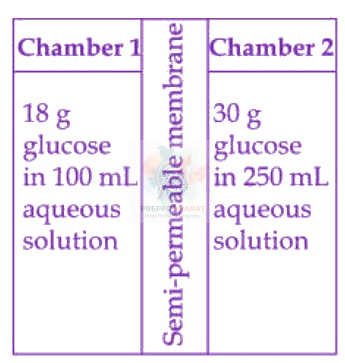 Statement I : H$_2$O molecules move from the chamber $1$ to chamber $2$. Statement II : The osmotic pressure of a solution prepared by dissolving $50$ mg of potassium sulphate (molar mass $= 174$ g/mol) in $2$ L of water (at $27°$C) is $0.0107$ bar. (Given : R $= 0.083$ dm$^3$ bar K$^{-1}$ mol$^{-1}$ and assume complete dissociation of electrolyte) In the light of the above statements, choose the correct answer from the options given below :
The osmotic pressure of a living cell is 12 atm at 300 K. The strength of sodium chloride solution that is isotonic with the living cell at this temperature is $\_\_\_\_$ $\mathrm{g} \mathrm{L}^{-1}$. (Nearest integer) Given : $\mathrm{R}=0.08 \mathrm{~L} \mathrm{~atm} \mathrm{~K}^{-1} \mathrm{~mol}^{-1}$ Assume complete dissociation of NaCl (Given : Molar mass of Na and Cl are 23 and $35.5 \mathrm{~g} \mathrm{~mol}^{-1}$ respectively.)
Consider the reaction $2\text{H}_2\text{S}(g) + 3\text{O}_2(g) \rightarrow 2\text{H}_2\text{O}(l) + 2\text{SO}_2(g)$ The magnitude of enthalpy change for the reaction in kJ mol$^{-1}$ is ________. (Nearest integer) Given: $\Delta_fH^{\ominus}(\text{H}_2\text{S}) = -20.1$ kJ mol$^{-1}$ $\Delta_fH^{\ominus}(\text{H}_2\text{O}) = -286.0$ kJ mol$^{-1}$ $\Delta_fH^{\ominus}(\text{SO}_2) = -297.0$ kJ mol$^{-1}$
Given below are two statements: Statement I: The Henry's law constant $\mathrm{K}_{\mathrm{H}}$ is constant with respect to variations in solution's concentration over the range for which the solution is ideally dilute. Statement II: $\mathrm{K}_{\mathrm{H}}$ does not differ for the same solute in different solvents. In the light of the above statements, choose the correct answer from the options given below
Consider the following spectral lines for atomic hydrogen : A. First line of Paschen series B. Second line of Balmer series C. Third line of Paschen series D. Fourth line of Bracket series. The correct arrangement of the above lines in ascending order of energy is :
For a closed circuit Daniell cell, which of the following plots is the accurate one at a given temperature?
For a reaction $A \rightarrow P$ at $T\text{ K}$, the half life $(t_{1/2})$ is plotted as a function of initial concentration $[A]_0$ of $A$ as given below. 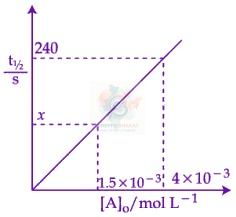 The value of $x$ in the given figure is _______ s (Nearest integer)
Which of the following statement(s) is/are true ? A. If two orbitals have the same value of $(n + l)$, the orbital with lower value of $n$ will have lower energy. B. Energies of the orbitals in the same subshell increase with increase in atomic number. C. The size of $2p_x$ orbital is less than the size of $3p_x$ orbital. D. Among $5f$, $6s$, $4d$, $5p$ and $5d$ orbitals, none of the orbitals have $2$ radial nodes. Choose the correct answer from the options given below :
The reaction $A(g) \rightleftharpoons B(g) + C(g)$ was initiated with the amount '$a$' of $A(g)$. At equilibrium it is found that the amount of $A(g)$ remaining is $(a - x)$ at a total pressure of $p$. The equilibrium constant $K_p$ of the reaction can be calculated from the expression :
Two liquids A and B form an ideal solution at temperature T K. At T K, the vapour pressures of pure A and B are 55 and $15 \mathrm{kN} \mathrm{m}^{-2}$ respectively. What is the mole fraction of $A$ in solution of $A$ and $B$ in equilibrium with a vapour in which the mole fraction of A is 0.8 ?
An electrochemical cell is constructed using half cells in the direction of spontaneous change $Fe(OH)_2(s) + 2e^- \rightarrow Fe(s) + 2OH^-(aq) \quad E^\theta = -0.88$ V and $AgBr(s) + e^- \rightarrow Ag(s) + Br^-(aq) \quad E^\theta = +0.07$ V Which of the following option is correct?
Given below are two statements: $R=8.314$ J K$^{-1}$ mol$^{-1}$ and $1$ cal $=4.2$ J Statement I: When $E_a=12.6$ kcal/mol, the room temperature rate constant is doubled by a $10\,^\circ$C increase in temperature ($298$ K to $308$ K) Statement II: For a first order reactions A $\rightarrow$ B, 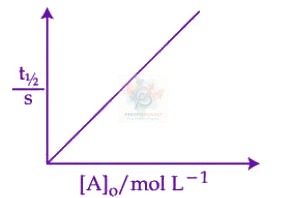 Here $[A]_o$ is the initial concentration of A and $t_{1/2}$ is half life of reaction. In the light of the above statements, choose the correct answer from the options given below:
$\mathrm{A} \rightarrow$ product (First order reaction). Three sets of experiment were performed for a reaction under similar experimental conditions: Run $1 \Rightarrow 100 \mathrm{~mL}$ of 10 M solution of reactant A Run $2 \Rightarrow 200 \mathrm{~mL}$ of 10 M solution of reactant A Run $3 \Rightarrow 100 \mathrm{~mL}$ of 10 M solution of reactant $\mathrm{A}+100 \mathrm{~mL}$ of $\mathrm{H}_{2} \mathrm{O}$ added. The correct variation of rate of reaction is
First order gas phase reaction $A \rightarrow B + C$ $p_i =$ initial pressure of gas A, $p_t =$ total pressure of the reaction mixture at time $t$ Expression of rate constant ($k$) is
At $\mathrm{T}(\mathrm{K}), 100 \mathrm{~g}$ of $98 \% \mathrm{H}_{2} \mathrm{SO}_{4}(\mathrm{w} / \mathrm{w})$ aqueous solution is mixed with 100 g of $49 \% \mathrm{H}_{2} \mathrm{SO}_{4}(\mathrm{w} / \mathrm{w})$ aqueous solution. What is the mole fraction of $\mathrm{H}_{2} \mathrm{SO}_{4}$ in the resultant solution? (Given : Atomic mass $\mathrm{H}=1 \mathrm{u} ; \mathrm{S}=32 \mathrm{u} ; \mathrm{O}=16 \mathrm{u}$). (Assume that temperature after mixing remains constant)
Given below are two statements : Statement I: When an electric discharge is passed through gaseous hydrogen, the hydrogen molecules dissociate and the energetically excited hydrogen atoms produce electromagnetic radiation of discrete frequencies. Statement II: The frequency of second line of Balmer series obtained from $\mathrm{He}^{+}$is equal to that of first line of Lyman series obtained from hydrogen atom. In the light of the above statements, choose the correct answer from the options given below :
Consider the following redox reaction taking place in acidic medium $\mathrm{BH}_{4}^{-}(a q)+\mathrm{ClO}_{3}^{-}(a q) \longrightarrow \mathrm{H}_{2} \mathrm{BO}_{3}^{-}(a q)+\mathrm{Cl}^{-}(a q)$ If the Nernst equation for the above balanced reaction is $\mathrm{E}_{\text {cell }}=\mathrm{E}_{\text {cell }}^{\circ}-\frac{\mathrm{RT}}{\mathrm{nF}} \ln \mathrm{Q}$, then the value of $n$ is $\_\_\_\_$. (Nearest integer)
For the given reaction: $\mathrm{CaCO}_{3}+2 \mathrm{HCl} \longrightarrow \mathrm{CaCl}_{2}+\mathrm{H}_{2} \mathrm{O}+\mathrm{CO}_{2}$ If $90 \mathrm{~g} \mathrm{CaCO}_{3}$ is added to 300 mL of HCl which contains $38.55 \% \mathrm{HCl}$ by mass and has density $1.13 \mathrm{~g} \mathrm{~mL}^{-1}$, then which of the following option is correct ? Given molar mass of $\mathrm{H}, \mathrm{Cl}, \mathrm{Ca}$ and O are 1, 35.5, 40 and $16 \mathrm{~g} \mathrm{~mol}^{-1}$ respectively.
A substance ' X ' (1.5 g) dissolved in 150 g of a solvent ' Y ' (molar mass $=300 \mathrm{~g} \mathrm{~mol}^{-1}$) led to an elevation of the boiling point by 0.5 K. The relative lowering in the vapour pressure of the solvent ' Y ' is $\_\_\_\_$ $\times 10^{-2}$. (nearest integer) [Given : $\mathrm{K}_{\mathrm{b}}$ of the solvent $=5.0 \mathrm{~K} \mathrm{~kg} \mathrm{~mol}^{-1}$ ] Assume the solution to be dilute and no association or dissociation of $X$ takes place in solution.
Match List-I with List-II.<table class="pyq-table"><tbody><tr><th>List-I Mass of substance</th><th>List-II Number of atoms</th></tr><tr><td>A. $1.8$ mg water</td><td>I. $2\times 10^{-4}\times N_A$</td></tr><tr><td>B. $9.8$ mg sulphuric acid</td><td>II. $1.5\times 10^{-4}\times N_A$</td></tr><tr><td>C. $1.8$ mg carbon</td><td>III. $3\times 10^{-4}\times N_A$</td></tr><tr><td>D. $5.85$ mg salt (NaCl)</td><td>IV. $7\times 10^{-4}\times N_A$</td></tr></tbody></table>Choose the correct answer from the options given below:
At $T(K)$, the equilibrium constant of $A_2(g) + B_2(g) \rightleftharpoons C(g)$ is $2.7 \times 10^{-5}$. What is the equilibrium constant for $\dfrac{1}{3}A_2(g) + \dfrac{1}{3}B_2(g) \rightleftharpoons \dfrac{1}{3}C(g)$ at the same temperature?
Which of the following contain the same number of atoms ? (Given : Molar mass in g mol$^{-1}$ of H, He, O and S are $1, 4, 16$ and $32$ respectively)<br>A. $2$ g of O$_2$ gas<br>B. $4$ g of SO$_2$ gas<br>C. $1400$ mL of O$_2$ at STP<br>D. $0.05$ L of He at STP<br>E. $0.0625$ mol of H$_2$ gas<br>Choose the correct answer from the options given below :
The first and second ionization constants of $\mathrm{H}_{2} \mathrm{X}$ are $2.5 \times 10^{-8}$ and $1.0 \times 10^{-13}$ respectively. The concentration of $\mathrm{X}^{2-}$ in $0.1 \mathrm{M} \mathrm{H}_{2} \mathrm{X}$ solution is $\_\_\_\_$ $\times 10^{-15} \mathrm{M}$. (Nearest Integer)
Consider the following gas phase reaction being carried out in a closed vessel at $25°C$. $2A(g) \rightarrow 4B(g) + C(g)$ <table class="pyq-table"><tbody><tr><th>time (min)</th><th>total pressure of the system (mm Hg)</th></tr><tr><td>$30$</td><td>$300$</td></tr><tr><td>$\infty$</td><td>$600$</td></tr></tbody></table>The pressure of $C(g)$ at $30$ minutes time interval would be _______ mm Hg. (nearest integer)
$t_{100\%}$ is the time required for the $100\%$ completion of the reaction while $t_{1/2}$ is the time required for $50\%$ of the reaction to be completed. Which of the following option correctly represents the relation between $t_{100\%}$ and $t_{1/2}$ for zero and first order reactions respectively?
Decomposition of A is a first order reaction at $\mathrm{T}(\mathrm{K})$ and is given by $\mathrm{A}(\mathrm{g}) \longrightarrow \mathrm{B}(\mathrm{g})+\mathrm{C}(\mathrm{g})$. In a closed 1 L vessel, 1 bar $\mathrm{A}(\mathrm{g})$ is allowed to decompose at $\mathrm{T}(\mathrm{K})$. After 100 minutes, the total pressure was 1.5 bar. What is the rate constant $\left(\mathrm{in} \mathrm{min}^{-1}\right)$ of the reaction ? $(\log 2=0.3)$
Pre-exponential factors of two different reactions of same order are identical. Let activation energy of first reaction exceeds the activation energy of second reaction by $20 \mathrm{~kJ} \mathrm{~mol}^{-1}$. If $\mathrm{k}_{1}$ and $\mathrm{k}_{2}$ are the rate constants of first and second reaction respectively at 300 K, then $\ln \frac{\mathrm{k}_{2}}{\mathrm{k}_{1}}$ will be $\_\_\_\_$. (nearest integer) $\left[\mathrm{R}=8.3 \mathrm{~J} \mathrm{~K}^{-1} \mathrm{~mol}^{-1}\right]$
Consider the dissociation equilibrium of the following weak acid $\mathrm{HA} \rightleftharpoons \mathrm{H}^{+}(\mathrm{aq})+\mathrm{A}^{-}(\mathrm{aq})$ If the pKa of the acid is 4, then the pH of 10 mMHA solution is $\_\_\_\_$.(Nearest integer) [Given: The degree of dissociation can be neglected with respect to unity]
Consider the following electrochemical cell at 298 K $\mathrm{Pt}\left|\mathrm{HSnO}_{2}{ }^{-}(\mathrm{aq})\right| \mathrm{Sn}(\mathrm{OH})_{6}{ }^{2-}(\mathrm{aq})\left|\mathrm{OH}^{-}(\mathrm{aq})\right| \mathrm{Bi}_{2} \mathrm{O}_{3}(\mathrm{~s}) \mid \mathrm{Bi}(\mathrm{s})$. If the reaction quotient at a given time is $10^{6}$, then the cell EMF ($\mathrm{E}_{\text {cell }}$) is $\_\_\_\_$ $\times 10^{-1} \mathrm{~V}$ (Nearest integer). Given the standard half-cell reduction potential as $\mathrm{E}_{\mathrm{Bi}_{2} \mathrm{O}_{3} / \mathrm{Bi}, \mathrm{OH}^{-}}^{\circ}=-0.44 \mathrm{~V} \text { and } \mathrm{E}_{\mathrm{Sn}(\mathrm{OH})_{6}^{2-} / \mathrm{HSnO}_{2}^{-}, \mathrm{OH}^{-}}^{\circ}=-0.90 \mathrm{~V}$
The ratio of mass percentage (w/w) of C : H in a hydrocarbon is $12 : 1$. It has two carbon atoms. The weight (in g) of $CO_2(g)$ formed when $3.38$ g of this hydrocarbon is completely burnt in oxygen is : (Given : Molar mass in g mol$^{-1}$ C : 12, H : 1, O : 16)
Consider two Group IV metal ions $\mathrm{X}^{2+}$ and $\mathrm{Y}^{2+}$. A solution containing $0.01 \mathrm{M} \mathrm{X}^{2+}$ and $0.01 \mathrm{M} \mathrm{Y}^{2+}$ is saturated with $\mathrm{H}_{2} \mathrm{~S}$. The pH at which the metal sulphide YS will form as a precipitate is $\_\_\_\_$. (Nearest integer) (Given: $\mathrm{K}_{\mathrm{sp}}(\mathrm{XS})=1 \times 10^{-22}$ at $25^{\circ} \mathrm{C}, \mathrm{K}_{\mathrm{sp}}(\mathrm{YS})=4 \times 10^{-16}$ at $25^{\circ} \mathrm{C}$, $\left[\mathrm{H}_{2} \mathrm{~S}\right]=0.1 \mathrm{M}$ in solution, $\mathrm{K}_{a 1} \times \mathrm{K}_{a 2}\left(\mathrm{H}_{2} \mathrm{~S}\right)=1.0 \times 10^{-21}, \log 2=0.30$, $\log 3=0.48, \log 5=0.70$)
Match the LIST-I with LIST-II \(\begin{array}{|l|l|c|l|} \hline \text{List-I} & \text{Isothermal process} \\ & \text{for ideal gas system} & \text{List-II} & \text{Work done } (V_f > V_i) \\ \hline \text{A.} & \text{Reversible expansion} & \text{I.} & w = 0 \\ \hline \text{B.} & \text{Free expansion} & \text{II.} & w = -nRT \ln \dfrac{V_f}{V_i} \\ \hline \text{C.} & \text{Irreversible expansion} & \text{III.} & w = -p_{\text{ex}}(V_f - V_i) \\ \hline \text{D.} & \text{Irreversible compression} & \text{IV.} & w = -p_{\text{ex}}(V_i - V_f) \\ \hline \end{array}\) Choose the correct answer from the options given below:
The first and second ionization constants of a weak dibasic acid $H_2 A$ are $8.1 \times 10^{-8}$ and $1.0 \times 10^{-13}$ respectively. $0.1$ mol of $H_2 A$ was dissolved in $1$ L of $0.1$ M HCl solution. The concentration of $HA^-$ in the resultant solution is:
Solution A is prepared by dissolving $1$ g of a protein (molar mass $= 50000$ g mol$^{-1}$) in $0.5$ L of water at $300$ K. Its osmotic pressure is $x$ bar. Solution B is made by dissolving $2$ g of same protein in $1$ L of water at $300$ K. Osmotic pressure of solution B is $y$ bar. Entire solution of A is mixed with entire solution of B at same temperature. The osmotic pressure of resultant solution is $z$ bar. $x, y$ and $z$ respectively are: $(R = 0.083$ L bar mol$^{-1}$ K$^{-1})$
An oxide of iron contains $69.9\%$ iron, its empirical formula, is: (Given: Molar mass of Fe and O are $56$ and $16$ g mol$^{-1}$ respectively.)
An organic compound undergoes first order decomposition. The time taken for decomposition to $\left(\frac{1}{8}\right)^{\text {th }}$ and $\left(\frac{1}{10}\right)^{\text {th }}$ of its initial concentration are $\mathrm{t}_{1 / 8}$ and $\mathrm{t}_{1 / 10}$ respectively. What is the value of $\frac{\mathrm{t}_{1 / 8}}{\mathrm{t}_{1 / 10}} \times 10$ ? ($\log 2=0.3$)
Match the LIST-I with LIST-II \(\begin{array}{|c|l|c|c|} \hline & \textbf{List-I (Thermodynamic Process)} & & \textbf{List-II} \\ & & & \textbf{(Magnitude in kJ)} \\ \hline A. & \begin{array}{l} \text{Work done in reversible,} \\ \text{isothermal expansion of }\\ \text{2 mol ideal gas from } 2\,\mathrm{dm}^3 \\ \text{ to } 20\,\mathrm{dm}^3 \text{ at } 300\,\mathrm{K} \end{array} & I. & 4 \\ \hline B. & \begin{array}{l} \text{Work done in irreversible} \\ \text{isothermal expansion of }\\ 1 \text{ mol ideal gas from } 1\,\mathrm{m}^3 \text{ to } 3\,\mathrm{m}^3 \\ \text{at } 300\,\mathrm{K} \text{ against} \\ \text{constant pressure } 3\,\mathrm{kPa} \end{array} & II. & 11.5 \\ \hline C. & \begin{array}{l} \text{Change in internal energy} \\ \text{for adiabatic expansion of }\\ 1 \text{ mol ideal gas, } \Delta T = 320\,\mathrm{K}, \; \\ \overline{C}_V=\dfrac{3}{2}R \end{array} & III. & 6 \\ \hline D. & \begin{array}{l} \text{Change in enthalpy at constant} \\ \text{pressure of }\\ 1 \text{ mol ideal gas, } \Delta T = 337\,\mathrm{K}, \; \\ \overline{C}_p=\dfrac{5}{2}R \end{array} & IV. & 7 \\ \hline \end{array}\) Choose the correct answer from the options given below:
The values of pressure equilibrium constant recorded at different temperatures for the following equilibrium reaction have been given below $A(g) \rightleftharpoons B(g) + C(g)$ <table class="pyq-table"><tbody><tr><td>$\dfrac{1}{T}(\text{K}^{-1})$</td><td>$\log_{10} K_p$</td></tr><tr><td>$0.05$</td><td>$3.5$</td></tr><tr><td>$0.06$</td><td>$2.5$</td></tr><tr><td>$0.07$</td><td>$1.5$</td></tr></tbody></table> The magnitude of $\dfrac{\Delta H°}{R}$ calculated from the above data is _____. (Nearest integer)
How many grams of residue is obtained by heating $2.76$ g of silver carbonate?<br>(Given: Molar mass of C, O and Ag are $12$, $16$ and $108$ g mol$^{-1}$ respectively)
Consider the following two half-cell reactions along with the standard reduction potential given: $CO_2 + 6H^+ + 6e^- \rightarrow CH_3 OH + H_2 O \quad E°_{red} = 0.02$ V $\dfrac{1}{2} O_2 + 2H^+ + 2e^- \rightarrow H_2 O \quad E°_{red} = 1.23$ V A fuel cell was set up using the above two reactions such that the cell operates under the standard condition of $1$ bar pressure and $298$ K temperature. The fuel cell works with $80\%$ efficiency. If the work derived from the cell using $1$ mol of $CH_3 OH$ is used to compress an ideal gas isothermally against a constant pressure of $1$ kPa, then the change in the volume of the gas, $\Delta V = $ _____ m$^3$. (nearest integer) Given: $F = 96500$ C mol$^{-1}$
The wavelength of spectral line obtained in the spectrum of $\mathrm{Li}^{2+}$ ion, when the transition takes place between two levels whose sum is 4 and difference is 2, is
The pH of a solution obtained by mixing $5$ mL of $0.1$ M $NH_4OH$ solution with $250$ mL of $0.1$ M $NH_4Cl$ solution is _____ $\times 10^{-2}$. (Nearest integer) Given: $pK_b(NH_4OH) = 4.74$ $\log 2 = 0.30$ $\log 3 = 0.48$ $\log 5 = 0.70$
$\mathrm{A}+2 \mathrm{~B} \longrightarrow \mathrm{AB}_{2}$<br>36.0 g of 'A' (Molar mass: $60 \mathrm{~g} \mathrm{~mol}^{-1}$) and 56.0 g of ' $\mathrm{B}^{\prime}$ (Molar mass: $80 \mathrm{~g} \mathrm{~mol}^{-1}$) are allowed to react. Which of the following statements are correct ?<br>A. 'A' is the limiting reagent.<br>B. $77.0 \mathrm{~g}$ of $\mathrm{AB}_{2}$ is formed.<br>C. Molar mass of $A B_{2}$ is $140 \mathrm{~g} \mathrm{~mol}^{-1}$.<br>D. $15.0 \mathrm{~g}$ of A is left unreacted after the completion of reaction.<br>Choose the correct answer from the options given below :
MX is a sparingly soluble salt that follows the given solubility equilibrium at 298 K. $\mathrm{MX}(\mathrm{s}) \rightleftharpoons \mathrm{M}^{+}(\mathrm{aq})+\mathrm{X}^{-}(\mathrm{aq}) ; \mathrm{K}_{\mathrm{sp}}=10^{-10}$ If the standard reduction potential for $\mathrm{M}^{+}(\mathrm{aq}) \xrightarrow{+\mathrm{e}^{-}} \mathrm{M}(\mathrm{s})$ is $\left(\mathrm{E}_{\mathrm{M}^{+} / \mathrm{M}}^{\ominus}\right)=0.79 \mathrm{~V}$, then the value of the standard reduction potential for the metal/metal insoluble salt electrode $\mathrm{E}_{\mathrm{X}^{-} / \mathrm{MX}(\mathrm{s}) / \mathrm{M}}^{\ominus}$ is $\_\_\_\_$ mV. (nearest integer) [Given : $\frac{2.303 \mathrm{RT}}{\mathrm{F}}=0.059 \mathrm{~V}$ ]
Which of the following graphs between pressure ' p ' versus volume ' V ' represents the maximum work done?
Match the LIST-I with LIST-II <table class="pyq-table"><tbody><tr><th>List-I Orbital</th><th>List-II Radial nodes and nodal plane</th></tr><tr><td>A. $2s$</td><td>I. $1$ Radial node + two nodal planes</td></tr><tr><td>B. $3s$</td><td>II. $1$ Radial node + one nodal plane</td></tr><tr><td>C. $3p$</td><td>III. $2$ Radial nodes + No nodal plane</td></tr><tr><td>D. $4d$</td><td>IV. $1$ Radial node + No nodal plane</td></tr></tbody></table> Choose the correct answer from the options given below:
The correct order of total number of atoms present in (A) $2$ moles of cyclohexane (B) $684$ g of sucrose (C) $90.8$ L of dihydrogen at STP is:
Two liquids A and B form an ideal solution. At 320 K, the vapour pressure of the solution, containing 3 mol of A and 1 mol of B is 500 mm Hg. At the same temperature, if 1 mol of A is further added to this solution, vapour pressure of the solution increases by 20 mm Hg. Vapour pressure (in mm Hg) of B in pure state is $\_\_\_\_$. (Nearest integer)
Given below are two statements : Statement (I) : 1,2,3-Trihydroxypropane can be separated from water by simple distillation. Statement (II) : An azeotropic mixture cannot be separated by fractional distillation. In the light of the above statements, choose the correct answer from the options given below :
Match List - I with List - II. Given $V_1$ and $V_2$ are initial and final volumes respectively.<table class="pyq-table"><tbody><tr><th>List - I (Isothermal process)</th><th>List - II (Expression)</th></tr><tr><td>A. Reversible expansion</td><td>I. $q = 0$</td></tr><tr><td>B. Free expansion</td><td>II. $q = nRT \ln\dfrac{V_2}{V_1}$</td></tr><tr><td>C. Irreversible Compression</td><td>III. $w = -p_{ext}(V_1 - V_2)$</td></tr><tr><td>D. Cyclic reversible</td><td>IV. $\dfrac{q_{rev}}{T} = 0$</td></tr></tbody></table>Choose the correct answer from the options given below :
In the reaction, $2 \mathrm{Al}(\mathrm{s})+6 \mathrm{HCl}(\mathrm{aq}) \rightarrow 2 \mathrm{Al}^{3+}(\mathrm{aq})+6 \mathrm{Cl}^{-}(\mathrm{aq})+3 \mathrm{H}_{2}(\mathrm{~g})$
At $27^{\circ} \mathrm{C}$ in presence of a catalyst, activation energy of a reaction is lowered by $10 \mathrm{~kJ} \mathrm{~mol}^{-1}$. The logarithm of ratio of $\frac{\mathrm{k} \text { (catalysed) }}{\mathrm{k} \text { (uncatalysed) }}$ is.... (Consider that the frequency factor for both the reactions is same)
What volume of hydrogen gas at STP would be liberated by action of $50\text{ mL}$ of $H_2SO_4$ of $50\%$ purity (density $= 1.3\text{ g mL}^{-1}$) on $20\text{ g}$ of zinc ? Given : Molar mass of H, O, S, Zn are $1, 16, 32, 65\text{ g mol}^{-1}$ respectively.
One mole each of He and $A(g)$ are taken in a $10$ L closed flask and heated to $400$ K to establish the following equilibrium. $A(g) \rightleftharpoons B(g)$. $K_c$ for this reaction at $400$ K is $4.0$. The partial pressures (in atm) of He and $B(g)$ are respectively (at equilibrium) (Assume He, $A(g)$ and $B(g)$ behave as ideal gases) (Given: $R = 0.082$ L atm K$^{-1}$ mol$^{-1}$)
A volume of $x\,\mathrm{mL}$ of $5\,\mathrm{M}\,\mathrm{NaHCO_3}$ solution was mixed with $10\,\mathrm{mL}$ of $2\,\mathrm{M}\,\mathrm{H_2CO_3}$ solution to make an electrolytic buffer. If the same buffer was used in the following electrochemical cell to record a cell potential of $235.3\,\mathrm{mV}$, then the value of $x = \_\_\_\_$ mL (nearest integer). $\mathrm{Sn(s)} \; \big| \; \mathrm{Sn(OH)_6^{2-}}(0.5\,\mathrm{M}) \; \big| \; \mathrm{HSnO_2^-}(0.05\,\mathrm{M}) \; \big| \; \mathrm{OH^-} \; \big| \; \mathrm{Bi_2O_3(s)} \; \big| \; \mathrm{Bi(s)}$ Consider up to one place of decimal for intermediate calculations. $\begin{array}{ll}\text{Given:} & E^\circ_{\mathrm{[Sn(OH)_6]^{2-}/HSnO_2^-}} = -0.90\,\mathrm{V} \\[4pt]& E^\circ_{\mathrm{Bi_2O_3/Bi}} = -0.44\,\mathrm{V} \\[4pt]& \mathrm{p}K_a(\mathrm{H_2CO_3}) = 6.11 \\[4pt]& \dfrac{2.303\,RT}{F} = 0.059\,\mathrm{V} \\[6pt]& \text{Antilog}(1.29) = 19.5\end{array}$
Observe the following equilibrium in a 1 L flask. $\mathrm{A}(\mathrm{~g}) \rightleftharpoons \mathrm{B}(\mathrm{~g})$ At $\mathrm{T}(\mathrm{K})$, the equilibrium concentrations of A and B are 0.5 M and 0.375 M respectively. 0.1 moles of A is added into the flask and heated to $\mathrm{T}(\mathrm{K})$ to establish the equilibrium again. The new equilibrium concentrations (in M) of A and B are respectively
Which of the following contain the same number of atoms ? (Given : Molar mass in g mol$^{-1}$ of H, He, O and S are $1, 4, 16$ and $32$ respectively) A. $2$ g of O$_2$ gas B. $4$ g of SO$_2$ gas C. $1400$ mL of O$_2$ at STP D. $0.05$ L of He at STP E. $0.0625$ mol of H$_2$ gas Choose the correct answer from the options given below :
Decomposition of a hydrocarbon follows the equation $k = (5.5 \times 10^{11}\,\text{s}^{-1})\,e^{\frac{-28000\,\text{K}}{T}}$. The activation energy of reaction is __________ kJ mol$^{-1}$. (Nearest Integer) Given : R $= 8.3$ J K$^{-1}$ mol$^{-1}$
Identify the correct statements : A. Hydrated salts can be used as primary standard. B. Primary standard should not undergo any reaction with air. C. Reactions of primary standard with another substance should be instantaneous and stoichiometric. D. Primary standard should not be soluble in water. E. Primary standard should have low relative molar mass. Choose the correct answer from the options given below :
The energy required by electrons, present in the first Bohr orbit of hydrogen atom to be excited to second Bohr orbit is $\_\_\_\_$ $\mathrm{J} \mathrm{mol}^{-1}$. Given: $R_{H}=2.18 \times 10^{-11} \mathrm{ergs}$.
When $0.25$ moles of a non-volatile, non-ionizable solute was dissolved in $1$ mole of a solvent the vapor pressure of solution was $x\%$ of vapor pressure of pure solvent. What is $x\%$?
A monoatomic anion $(A^-)$ has $45$ neutrons and $36$ electrons. Atomic mass, group in the periodic table and physical state at room temperature of the element $(A)$ respectively are
At $\mathrm{T}(\mathrm{K}), 2$ moles of liquid A and 3 moles of liquid B are mixed. The vapour pressure of ideal solution formed is 320 mm Hg. At this stage, one mole of A and one mole of B are added to the solution. The vapour pressure is now measured as 328.6 mm Hg. The vapour pressure (in mm Hg) of A and B are respectively:
What is the mole fraction of water in $10$% by weight (w/w) of aqueous urea solution? [Given: Molar mass of H, O, C and N are $1$, $16$, $12$ and $14$ g mol$^{-1}$ respectively.]
Consider the following reactions in which all the reactants and products are present in gaseous state $2xy \rightleftharpoons x_2 + y_2 \quad K_1 = 2.5\times 10^5$ $xy + \dfrac{1}{2}z_2 \rightleftharpoons xyz \quad K_2 = 5\times 10^{-3}$ The value of $K_3$ for the equilibrium $\dfrac{1}{2}x_2 + \dfrac{1}{2}y_2 + \dfrac{1}{2}z_2 \rightleftharpoons xyz$ is:
One half cell in a voltaic cell is constructed by dipping silver rod in $AgNO_3$ solution of unknown concentration, other half cell is $Zn$ rod dipped in $1$ molar solution of $ZnSO_4$. A voltage of $1.60\text{ V}$ is measured at $298\text{ K}$ for this cell. What is the concentration of $Ag^+$ ions used in terms of $\log x$ ($x = [Ag^+]$) ? $E^\circ_{Zn^{2+}/Zn} = -0.76\text{ V}$, $E^\circ_{Ag^+/Ag} = +0.80\text{ V}$, $\dfrac{2.303 RT}{F} = 0.059\text{ V}$
Consider the following data. (i) $2Al(s) + 6HCl(aq) \rightarrow Al_2Cl_6(aq) + 3H_2(g) + 1200$ kJ/mol (ii) $H_2(g) + Cl_2(g) \rightarrow 2HCl(g) + 164$ kJ/mol (iii) $HCl(g) + aq \rightarrow HCl(aq) + 83$ kJ/mol (iv) $Al_2Cl_6(s) + aq \rightarrow Al_2Cl_6(aq) + 663$ kJ/mol The enthalpy of formation of anhydrous solid $Al_2Cl_6$ is :
Which of the following statements are not correct? A. For water, magnitude of $K_b$ is more than the magnitude of $K_f$. B. The elevation in boiling point of water when a non-volatile solute is added to it is larger in magnitude than its depression in freezing point. C. Osmotic pressure measurement is preferred over any other colligative property to determine molar mass of proteins and polymers. D. The dimerised form of benzoic acid in benzene is $C_6H_5-\underset{O}{\overset{O}{\|}}C-OH \cdots\cdots O=\underset{OH}{\overset{|}{C}}-C_6H_5$ Choose the correct answer from the options given below:
The wavelength of photon ' A ' is 400 nm. The frequency of photon ' B ' is $10^{16} \mathrm{~s}^{-1}$. The wave number of photon ' $C^{\prime}$ is $10^{4} \mathrm{~cm}^{-1}$. The correct order of energy of these photons is :
An oxide of iron contains $69.9\%$ iron, its empirical formula, is: (Given: Molar mass of Fe and O are $56$ and $16$ g mol$^{-1}$ respectively.)
For the given reaction:<br>$\mathrm{CaCO}_{3}+2 \mathrm{HCl} \longrightarrow \mathrm{CaCl}_{2}+\mathrm{H}_{2} \mathrm{O}+\mathrm{CO}_{2}$<br>If $90 \mathrm{~g} \mathrm{CaCO}_{3}$ is added to 300 mL of HCl which contains $38.55 \% \mathrm{HCl}$ by mass and has density $1.13 \mathrm{~g} \mathrm{~mL}^{-1}$, then which of the following option is correct ?<br>Given molar mass of $\mathrm{H}, \mathrm{Cl}, \mathrm{Ca}$ and O are 1, 35.5, 40 and $16 \mathrm{~g} \mathrm{~mol}^{-1}$ respectively.
Consider the following gaseous equilibrium in a closed container of volume ' V ' at $\mathrm{T}(\mathrm{K})$. $\mathrm{P}_{2}(\mathrm{~g})+\mathrm{Q}_{2}(\mathrm{~g}) \rightleftharpoons 2 \mathrm{PQ}(\mathrm{g})$ 2 moles each of $\mathrm{P}_{2}(\mathrm{~g}), \mathrm{Q}_{2}(\mathrm{~g})$ and $\mathrm{PQ}(\mathrm{g})$ are present at equilibrium. Now one mole each of ' $\mathrm{P}_{2}$ ' and ' $\mathrm{Q}_{2}$ ' are added to the equilibrium keeping the temperature at $\mathrm{T}(\mathrm{K})$. The number of moles of $P_{2}, Q_{2}$ and $P Q$ at the new equilibrium, respectively, are
$\mathrm{A}+2 \mathrm{~B} \longrightarrow \mathrm{AB}_{2}$ 36.0 g of 'A' (Molar mass: $60 \mathrm{~g} \mathrm{~mol}^{-1}$) and 56.0 g of ' $\mathrm{B}^{\prime}$ (Molar mass: $80 \mathrm{~g} \mathrm{~mol}^{-1}$) are allowed to react. Which of the following statements are correct ? A. 'A' is the limiting reagent. B. $77.0 \mathrm{~g}$ of $\mathrm{AB}_{2}$ is formed. C. Molar mass of $A B_{2}$ is $140 \mathrm{~g} \mathrm{~mol}^{-1}$. D. $15.0 \mathrm{~g}$ of A is left unreacted after the completion of reaction. Choose the correct answer from the options given below :
What volume of hydrogen gas at STP would be liberated by action of $50\text{ mL}$ of $H_2SO_4$ of $50\%$ purity (density $= 1.3\text{ g mL}^{-1}$) on $20\text{ g}$ of zinc ?<br>Given : Molar mass of H, O, S, Zn are $1, 16, 32, 65\text{ g mol}^{-1}$ respectively.
How many grams of residue is obtained by heating $2.76$ g of silver carbonate? (Given: Molar mass of C, O and Ag are $12$, $16$ and $108$ g mol$^{-1}$ respectively)
For a general redox reaction Anode : $\text{Red}_1 \rightarrow \text{Ox}_1^{n_1^+} + n_1 e^-$ Cathode : $\text{Ox}_2 + n_2 e^- \rightarrow \text{Red}_2^{n_2^-}$ Which of the following statement is incorrect ?
Number of moles and number of molecules in $1.4187$ L of $SO_2$ at STP respectively are:
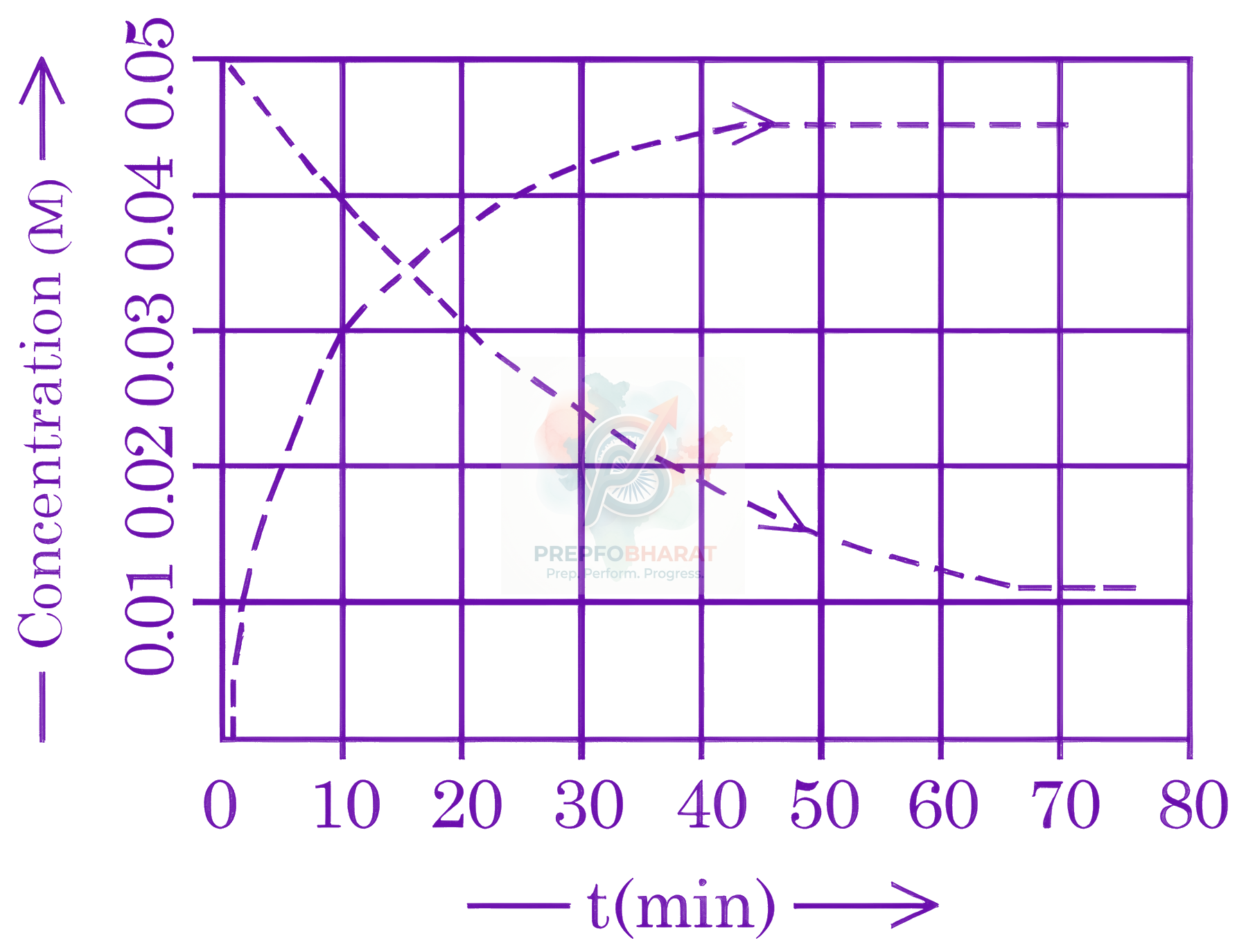 Given above is the concentration vs time plot for a dissociation reaction : $\mathrm{A} \rightarrow \mathrm{nB}$. Based on the data of the initial phase of the reaction (initial 10 min), the value of n is $\_\_\_\_$.
At the transition temperature $T$, $A \rightleftharpoons B$ and $\Delta G^0 = 105 - 35\log T$ where $A$ and $B$ are two states of substance $X$. The transition temperature in $°$C when pressure is $1$ atm is _______. (Nearest integer)
$20.0 \mathrm{dm}^{3}$ of an ideal gas ' X ' at 600 K and 0.5 MPa undergoes isothermal reversible expansion until pressure of the gas is 0.2 MPa. Which of the following option is correct? (Given: $\log 2=0.3010$ and $\log 5=0.6989$)
Consider the following data for the reaction $X_2(g) + Y_2(g) \rightleftharpoons 2XY(g)$ at $600\text{ K}$. The $\Delta_r G^\circ$ (in kJ mol$^{-1}$) for the reaction is : <table class="pyq-table"><tbody><tr><th>Compound</th><th>$\Delta_f H^\circ_{600K}$ (kJ mol$^{-1}$)</th><th>$S^\circ_{600K}$ (J mol$^{-1}$ K$^{-1}$)</th></tr><tr><td>$XY(g)$</td><td>$42$</td><td>$200$</td></tr><tr><td>$X_2(g)$</td><td>$8$</td><td>$140$</td></tr><tr><td>$Y_2(g)$</td><td>$80$</td><td>$250$</td></tr></tbody></table>
Elements P and Q form two types of non-volatile, non-ionizable compounds PQ and $\mathrm{PQ}_{2}$. When 1 g of PQ is dissolved in 50 g of solvent ${ }^{\prime} \mathrm{A}^{\prime}, \Delta \mathrm{T}_{\mathrm{b}}$ was 1.176 K while when 1 g of $\mathrm{PQ}_{2}$ is dissolved in 50 g of solvent ${ }^{\prime} \mathrm{A}^{\prime}, \Delta \mathrm{T}_{\mathrm{b}}$ was 0.689 K. ($\mathrm{K}_{\mathrm{b}}$ of ' $\mathrm{A}^{\prime}=5 \mathrm{~K} \mathrm{~kg} \mathrm{~mol}^{-1}$). The molar masses of elements P and Q (in $\mathrm{g} \mathrm{mol}^{-1}$) respectively, are :
One mole of $\mathrm{Cl}_{2}(\mathrm{~g})$ was passed into 2 L of cold 2 M KOH solution. After the reaction, the concentrations of $\mathrm{Cl}^{-}, \mathrm{ClO}^{-}$and $\mathrm{OH}^{-}$are respectively (assume volume remains constant)
The pH and conductance of a weak acid (HX) was found to be 5 and $4 \times 10^{-5} \mathrm{~S}$, respectively. The conductance was measured under standard condition using a cell where the electrode plates having a surface area of $1 \mathrm{~cm}^{2}$ were at a distance of 15 cm apart. The value of the limiting molar conductivity is $\_\_\_\_$ $\mathrm{S} \mathrm{m}^{2} \mathrm{~mol}^{-1}$. (nearest integer) (Given : degree of dissociation of the weak acid $(\alpha) \ll 1$)
For reaction $A \rightarrow P$, rate constant $k = 1.5 \times 10^3$ s$^{-1}$ at $27°$C. If activation energy for the above reaction is $60$ kJ mol$^{-1}$, then the temperature (in $°$C) at which rate constant, $k = 4.5 \times 10^3$ s$^{-1}$ is _______. (Nearest integer) Given : $\log 2 = 0.30$, $\log 3 = 0.48$, $R = 8.3$ J K$^{-1}$ mol$^{-1}$, $\ln 10 = 2.3$
Consider the following reduction processes : $\mathrm{Al}^{3+}+3 \mathrm{e}^{-} \longrightarrow \mathrm{Al}(\mathrm{s}), \mathrm{E}^{0}=-1.66 \mathrm{~V}$ $\mathrm{Fe}^{3+}+\mathrm{e}^{-} \longrightarrow \mathrm{Fe}^{2+}, \mathrm{E}^{0}=+0.77 \mathrm{~V}$ $\mathrm{Co}^{3+}+\mathrm{e}^{-} \longrightarrow \mathrm{Co}^{2+}, \mathrm{E}^{0}=+1.81 \mathrm{~V}$ $\mathrm{Cr}^{3+}+3 \mathrm{e}^{-} \longrightarrow \mathrm{Cr}(\mathrm{s}), \mathrm{E}^{\circ}=-0.74 \mathrm{~V}$ The tendency to act as reducing agent decreases in the order :
For a first order reaction $A \rightarrow B$ <table class="pyq-table"><tbody><tr><th>$t/\text{min}$</th><th>$[A]/M$</th></tr><tr><td>$0$</td><td>$0.6500$</td></tr><tr><td>$x$</td><td>$0.0650$</td></tr><tr><td>$20$</td><td>$0.00065$</td></tr></tbody></table> $x=$ ______ min. (Nearest integer)
What is the energy (in J atom$^{-1}$) required for the following process? $Li^{2+}(g) \rightarrow Li^{3+}(g) + e^-$ (Take the ionization energy for the H atom in the ground state as $2.18 \times 10^{-18}$ J atom$^{-1}$)
$20$ mL of a solution of acetic acid required $28.4$ mL of $0.1$ M NaOH for its neutralization. A solution (X) was prepared by mixing $20$ mL of the above acetic acid and $14.2$ mL of $0.1$ M NaOH solution. What is the pH of the solution (X)? ($pK_a$ value of acetic acid is $4.75$).
For the thermal decomposition of reactant $\mathrm{AB}(\mathrm{g})$, the following plot is constructed. 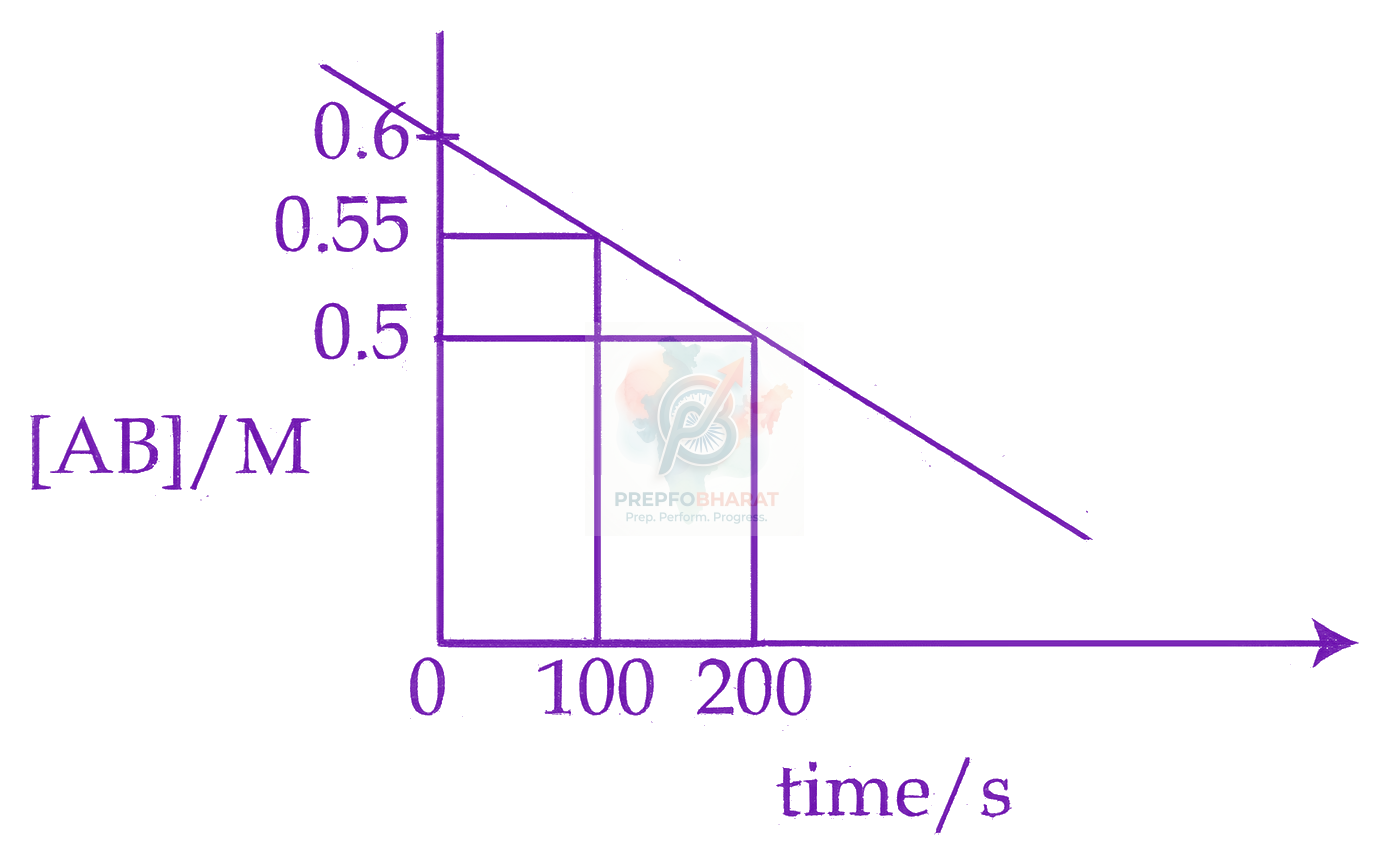 The half life of the reaction is ' $x^{\prime} \min$. $x=$ $\_\_\_\_$ min. (Nearest integer)
Given, (A) $\mathrm{n}=5, \mathrm{~m}_{1}=-1$ (B) $\mathrm{n}=3, \mathrm{l}=2, \mathrm{~m}_{1}=-1, \mathrm{~m}_{\mathrm{s}}=+\frac{1}{2}$ The maximum number of electron(s) in an atom that can have the quantum numbers as given in (A) and (B) respectively are :
Given below are two statements: Statement I: For an ideal gas, heat capacity at constant volume is always greater than the heat capacity at constant pressure. Statement II: In a constant volume process, no work is produced and all the heat withdrawn goes into the chaotic motion and is reflected by a temperature increase of the ideal gas. In the light of the above statements, choose the correct answer from the options given below
The pH of a 0.01 M NaOH solution at 25°C is:
Consider the given graph showing variation of reactant concentration with time. Three different reactions were started with identical initial concentration of reactants. Which of the following statement is correct? 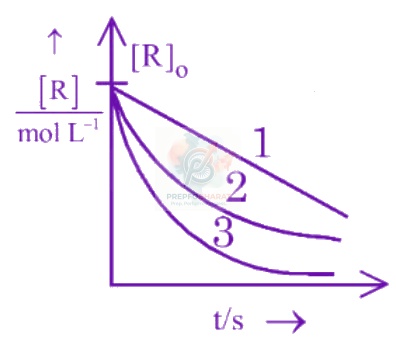
The work functions of two metals $\left(M_{A}\right.$ and $\left.M_{B}\right)$ are in the $1: 2$ ratio. When these metals are exposed to photons of energy 6 eV, the kinetic energy of liberated electrons of $M_{A}: M_{B}$ is in the ratio of $2.642: 1$. The work functions (in eV) of $M_{A}$ and $M_{B}$ are respectively.
The solubility product constants of $Ag_2CrO_4$ and $AgBr$ are $32x$ and $4y$ respectively at $298$ K. The value of $\left(\dfrac{\text{molarity of } Ag_2CrO_4}{\text{molarity of } AgBr}\right)$ can be expressed as :
$20\text{ g}$ hemoglobin in a $1\text{ L}$ aqueous solution (A) at $300\text{ K}$ is separated from pure water by semi permeable membrane. At equilibrium the height of solution in a tube dipped in a solution (A) is found to be $80.0\text{ mm}$ higher than the tube dipped in water. The molar mass of hemoglobin is _______ $\text{kg mol}^{-1}$. (Nearest integer) (Given : $g = 10\text{ m s}^{-2}$, $R = 8.3\text{ kPa dm}^3\text{ K}^{-1}\text{mol}^{-1}$, density of solution $= 1000\text{ kg m}^{-3}$)
In the given electrochemical cell, $\mathrm{Ag}(\mathrm{s})|\mathrm{AgCl}(\mathrm{s})| \mathrm{FeCl}_{2}(\mathrm{aq}), \mathrm{FeCl}_{3}(\mathrm{aq}) \mid \mathrm{Pt}(\mathrm{s})$ at 298 K, the cell potential $\left(\mathrm{E}_{\text {cell }}\right)$ will increase when : A. Concentration of $\mathrm{Fe}^{2+}$ is increased. B. Concentration of $\mathrm{Fe}^{3+}$ is decreased. C. Concentration of $\mathrm{Fe}^{2+}$ is decreased. D. Concentration of $\mathrm{Fe}^{3+}$ is increased. E. Concentration of $\mathrm{Cl}^{-}$is increased. Choose the correct answer from the options given below :
The temperature at which the rate constants of the given below two gaseous reactions become equal is $\_\_\_\_$ K. (Nearest integer) $\mathrm{X} \longrightarrow \mathrm{Y} \quad \mathrm{k}_{1}=10^{6} e^{\frac{-30000}{\mathrm{~T}}}$ $\mathrm{P} \longrightarrow \mathrm{Q} \quad \mathrm{k}_{2}=10^{4} e^{\frac{-24000}{\mathrm{~T}}}$ Given: $\ln 10=2.303$
An electrochemical cell, consist of the following two redox couples, $M^{x+}(aq)/M(s)$ $[E_{red}^\ominus=+0.15\text{ V}]$ and $Fe^{3+}(aq)/Fe(s)$ $[E_{red}^\ominus=-0.036\text{ V}]$. The cell EMF $(E_{cell})$ is recorded to be $0.2057$ V. If the reaction quotient of the electrochemical reaction is found to be $10^{-2}$, then the value of $x$ is ______. (Nearest integer) [Given: M is a p-block metal and $\dfrac{2.303RT}{F}=0.059$ V]
Consider the following data. <table class="pyq-table"><tbody><tr><th>Electrolyte</th><th>$\Lambda^{\circ}_m$ (S cm$^2$ mol$^{-1}$)</th></tr><tr><td>$\text{BaCl}_2$</td><td>$x_1$</td></tr><tr><td>$\text{H}_2\text{SO}_4$</td><td>$x_2$</td></tr><tr><td>HCl</td><td>$x_3$</td></tr></tbody></table> $\text{BaSO}_4$ is sparingly soluble in water. If the conductivity of the saturated $\text{BaSO}_4$ solution is $x$ S cm$^{-1}$ then the solubility product of $\text{BaSO}_4$ can be given as (Here $\Lambda_m = \Lambda^{\circ}_m$)
The half-life of ${ }^{65} \mathrm{Zn}$ is 245 days. After $x$ days, $75 \%$ of original activity remained. The value of $x$ in days is $\_\_\_\_$. (Nearest integer) (Given: $\log 3=0.4771$ and $\log 2=0.3010$)
At $27°$C, $0.1$ M, $1$ L $K_4[Fe(CN)_6]$ aqueous solution and $0.1$ M, $1$ L $FeCl_3$ aqueous solution are placed in a container separated by a semi permeable membrane AB. Assume complete dissociation of both the solutes. Which of the following statement is correct? 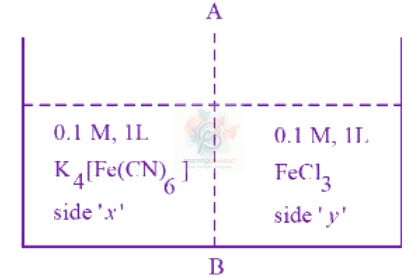
In order to oxidise a mixture of $1$ mole each of $FeC_2O_4$, $Fe_2(C_2O_4)_3$, $FeSO_4$ and $Fe_2(SO_4)_3$ in acidic medium, the number of moles of $KMnO_4$ required is
For strong electrolyte $\Lambda_{\mathrm{m}}$ increases slowly with dilution and can be represented by the equation $\Lambda_{\mathrm{m}}=\Lambda_{\mathrm{m}}^{\circ}-\mathrm{Ac}^{1 / 2}$ Molar conductivity values of the solutions of strong electrolyte AB at $18^{\circ} \mathrm{C}$ are given below : \(\begin{array}{|l|c|c|c|c|} \hline \mathrm{c}\;[\mathrm{mol\,L^{-1}}] & 0.04 & 0.09 & 0.16 & 0.25 \\ \hline \Lambda_{\mathrm{m}}\;[\mathrm{S\,cm^{2}\,mol^{-1}}] & 96.1 & 95.7 & 95.3 & 94.9 \\ \hline \end{array}\) The value of constant A based on the above data $\left[\right.$ in $\left.\mathrm{S} \mathrm{cm}^{2} \mathrm{~mol}^{-1} /(\mathrm{mol} / \mathrm{L})^{1 / 2}\right]$ unit is $\_\_\_\_$.
Molar conductivity of a weak acid HQ of concentration 0.18 M was found to be $1 / 30$ of the molar conductivity of another weak acid HZ with concentration of 0.02 M. If $\lambda^{\circ} \mathrm{Q}^{-}$happened to be equal with $\lambda^{\circ} \mathrm{Z}^{-}$, then the difference of the $\mathrm{pK}_{\mathrm{a}}$ values of the two weak acids $\left(\mathrm{pK}_{\mathrm{a}}(\mathrm{HQ})-\mathrm{pK}_{\mathrm{a}}(\mathrm{HZ})\right)$ is $\_\_\_\_$ (Nearest integer). [Given: degree of dissociation $(\alpha) \ll 1$ for both weak acids, $\lambda^{\circ}$ : limiting molar conductivity of ions]
The heat of atomisation of methane and ethane are ' x ' $\mathrm{kJ} \mathrm{mol}^{-1}$ and ' y ' $\mathrm{kJ} \mathrm{mol}^{-1}$ respectively. The longest wavelength $(\lambda)$ of light capable of breaking the $\mathrm{C}-\mathrm{C}$ bond can be expressed in SI unit as:
The species having identical radii according to the Bohr's theory are: A. $H$ (first orbit) B. $He^+$ (first orbit) C. $He^+$ (Second orbit) D. $Li^{2+}$ (first orbit) E. $Be^{3+}$ (Second orbit) Choose the correct answer from the options given below:
If shortest wavelength of hydrogen atom in Lyman series is $x$, then longest wavelength in Balmer series of $\text{He}^+$ is:
Given below are two statements: Statement I: Sodium dichromate and potassium dichromate are classified as primary standards in titrimetric analysis. Statement II: Phenolphthalein is a weak base, therefore it dissociates in acidic medium. In the light of the above statements, choose the correct answer from the options given below
Identify the INCORRECT statements from the following: A. Notation ${ }_{12}^{24} \mathrm{Mg}$ represents 24 protons and 12 neutrons. B. Wavelength of a radiation of frequency $4.5 \times 10^{15} \mathrm{~s}^{-1}$ is $6.7 \times 10^{-8} \mathrm{~m}$. C. One radiation has wavelength $=\lambda_{1}(900 \mathrm{~nm})$ and energy $=\mathrm{E}_{1}$. Other radiation has wavelength $=\lambda_{2}(300 \mathrm{~nm})$ and energy $=\mathrm{E}_{2}. \mathrm{E}_{1}: \mathrm{E}_{2}=3: 1$. D. Number of photons of light of wavelength 2000 pm that provides 1 J of energy is $1.006 \times 10^{16}$. Choose the correct answer from the options given below:
The plot of $\log _{10} \mathrm{~K}$ vs $\frac{1}{\mathrm{~T}}$ gives a straight line. The intercept and slope respectively are (where K is equilibrium constant).
$\mathrm{A} \longrightarrow \mathrm{B}$ (first reaction) $\mathrm{C} \longrightarrow \mathrm{D}$ (second reaction) Consider the above two first-order reactions. The rate constant for first reaction at 500 K is double of the same at 300 K. At $500 \mathrm{~K}, 50 \%$ of the reaction becomes complete in 2 hour. The activation energy of the second reaction is half of that of first reaction. If the rate constant at 500 K of the second reaction becomes double of the rate constant of first reaction at the same temperature; then rate constant for the second reaction at 300 K is $\_\_\_\_$ $\times 10^{-1}$ hour $^{-1}$ (nearest integer).
A non-volatile, non-electrolyte solid solute when dissolved in $40$ g of a solvent, the vapour pressure of the solvent decreased from $760$ mm Hg to $750$ mm Hg. If the same solution boils at $320$ K, then the number of moles of the solvent present in the solution is _____. (Nearest integer) [Given: boiling point of the pure solvent $= 319.5$ K, $K_b$ of the solvent $= 0.3$ K kg mol$^{-1}$]
In a closed flask at $600$ K, one mole of X$_2$Y$_4$(g) attains equilibrium as given below : $\text{X}_2\text{Y}_4(g) \rightleftharpoons 2\text{XY}_2(g)$ At equilibrium, $75\%$ X$_2$Y$_4$(g) was dissociated and the total pressure is $1$ atm. The magnitude of $\Delta_r G^{\ominus}$ (in kJ mol$^{-1}$) at this temperature is __________. (Nearest Integer) (Given : R $= 8.3$ J mol$^{-1}$ K$^{-1}$; $\ln 10 = 2.3$, $\log 2 = 0.3$, $\log 3 = 0.48$, $\log 5 = 0.69$, $\log 7 = 0.84$)
At $25°C$, $20.0$ mL of $0.2$ M weak monoprotic acid HX is titrated against $0.2$ M NaOH. The pH of the solution (a) at the start of the titration (when NaOH has not been added) and (b) when $10$ mL of NaOH is added respectively, are: Given: $K_a = 5 \times 10^{-4}$, $pK_a = 3.3$, $\alpha << 1$ <table class="pyq-table"><tbody><tr><th>(a)</th><th>(b)</th></tr></tbody></table>
Consider the first order reaction $R \rightarrow P$. The fraction of molecules decomposed in the given first order reaction can be expressed as
Given below are two statements: Given: Molar mass of C, H, O, Cl are $12, 1, 16$ and $35.5$ g mol$^{-1}$, respectively. Statement I: In $30\%$ (w/w) solution of methanol in CCl$_4$ (at T K), the mole fraction of CCl$_4$ is equal to $0.33$. Statement II: Mixture of methanol and CCl$_4$ shows positive deviation from Raoult's law. In the light of the above statements, choose the correct answer from the options given below:
If the half life of a first order reaction is $6.93$ minutes then the time required for completion of $99$% of the reaction will be _____ minutes. (Given : $\log 2 = 0.3010$)
Consider a solution of $\mathrm{CO}_{2}(\mathrm{~g})$ dissolved in water in a closed container. Which one of the following plots correctly represents variation of log (partial pressure of $\mathrm{CO}_{2}$ in vapour phase above water) $[y$-axis] with $\log$ (mole fraction of $\mathrm{CO}_{2}$ in water) $[x$-axis $]$ at $25^{\circ} \mathrm{C}$ ?
Given is a concentrated solution of a weak electrolyte $A_xB_y$ of concentration 'c' and dissociation constant 'K'. The degree of dissociation is given by :
The correct order of molar heat capacities measured at $298\text{ K}$ and $1\text{ bar}$ is :
$500$ mL of $0.2$ M MnO$_4^-$ solution in basic medium when mixed with $500$ mL of $1.5$ M KI solution, oxidises iodide ions to liberate molecular iodine. This liberated iodine is then titrated with a standard $x$ M thiosulphate solution in presence of starch till the end point. If $300$ mL of thiosulphate was consumed, then the value of $x$ is __________.
Consider $\mathrm{A} \xrightarrow{\mathrm{k}_{1}} \mathrm{~B}$ and $\mathrm{C} \xrightarrow{\mathrm{k}_{2}} \mathrm{D}$ are two reactions. If the rate constant $\left(\mathrm{k}_{1}\right)$ of the $\mathrm{A} \longrightarrow \mathrm{B}$ reaction can be expressed by the following equation $\log _{10} \mathrm{k}=14.34-\frac{1.5 \times 10^{4}}{\mathrm{~T} / \mathrm{K}}$ and activation energy of $C \longrightarrow D$ reaction $\left(E a_{2}\right)$ is $\frac{1}{5}$ th of the $A \longrightarrow B$ reaction $\left(E a_{1}\right)$, then the value of $\left(E a_{2}\right)$ is $\_\_\_\_$ $\mathrm{kJ} \mathrm{mol}^{-1}$. (Nearest Integer)
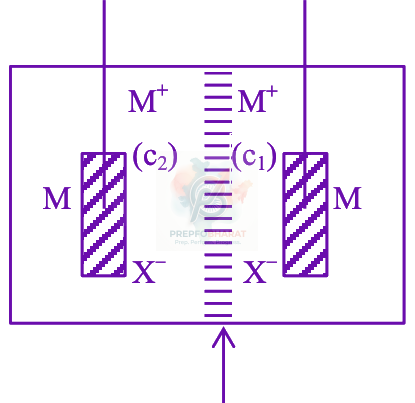 Consider the above electrochemical cell where a metal electrode (M) is undergoing redox reaction by forming $\mathrm{M}^{+}\left(\mathrm{M} \rightarrow \mathrm{M}^{+}+\mathrm{e}^{-}\right)$. The cation $\mathrm{M}^{+}$is present in two different concentrations $c_{1}$ and $c_{2}$ as shown above. Which of the following statement is correct for generating a positive cell potential?
The correct order of total number of atoms present in<br>(A) $2$ moles of cyclohexane<br>(B) $684$ g of sucrose<br>(C) $90.8$ L of dihydrogen at STP<br>is:
A cup of water at $5^{\circ} \mathrm{C}$ (system) is placed in a microwave oven and the oven is turned on for one minute during which the water begins to boil. Which of the following option is true ?
The Bohr radius of a hydrogen like species is $70.53$ pm. The species and the stationary state $(n)$ are respectively (Given : Hydrogen atom Bohr radius is $52.9$ pm)
For the following gas phase equilibrium reaction at constant temperature, $\mathrm{NH}_{3}(\mathrm{~g}) \rightleftharpoons 1 / 2 \mathrm{~N}_{2}(\mathrm{~g})+3 / 2 \mathrm{H}_{2}(\mathrm{~g})$ if the total pressure is $\sqrt{3} \mathrm{~atm}$ and the pressure equilibrium constant $\left(\mathrm{K}_{\mathrm{p}}\right)$ is 9 atm, then the degree of dissociation is given as $\left(x \times 10^{-2}\right)^{-1 / 2}$. The value of $x$ is $\_\_\_\_$. (nearest integer)
Consider the following electrochemical cell : $\mathrm{Pt}\left|\mathrm{O}_{2}(\mathrm{~g})(1 \mathrm{bar})\right| \mathrm{HCl}(\mathrm{aq}) \| \mathrm{M}^{2+}(\mathrm{aq}, 1.0 \mathrm{M}) \mid \mathrm{M}(\mathrm{~s})$ The pH above which, oxygen gas would start to evolve at anode is $\_\_\_\_$ (nearest integer). $\left[\begin{array}{ll}\text { Given: } & \mathrm{E}^{\mathrm{o}}{ }_{\mathrm{M}^{2+} / \mathrm{M}}=0.994 \mathrm{~V} \\ & \mathrm{E}^{\mathrm{o}}{ }_{\mathrm{O}_{2} / \mathrm{H}_{2} \mathrm{O}}=1.23 \mathrm{~V}\end{array}\right\}$ standard reduction potential $]$
Given at $298$ K: $E^{\ominus}_{Fe^{2+}/Fe} = X$ Volt; $E^{\ominus}_{Fe^{3+}/Fe} = Y$ Volt. The $E^{\ominus}_{Fe^{3+}/Fe^{2+}}$ in Volt at $298$ K is given by:
Consider the following data: $\Delta_{f} \mathrm{H}^{\ominus}$ (methane, g$)=-\mathrm{X} \mathrm{kJ} \mathrm{mol}{ }^{-1}$ Enthalpy of sublimation of graphite $=\mathrm{Y} \mathrm{kJ} \mathrm{mol}^{-1}$ Dissociation enthalpy of $\mathrm{H}_{2}=\mathrm{Z} \mathrm{kJ} \mathrm{mol}{ }^{-1}$ The bond enthalpy of $\mathrm{C}-\mathrm{H}$ bond is given by :
$\mathrm{X}_{2}(\mathrm{~g})+\mathrm{Y}_{2}(\mathrm{~g}) \rightleftharpoons 2 \mathrm{Z}(\mathrm{g})$ $\mathrm{X}_{2}(\mathrm{~g})$ and $\mathrm{Y}_{2}(\mathrm{~g})$ are added to a 1 L flask and it is found that the system attains the above equilibrium at $\mathrm{T}(\mathrm{K})$ with the number of moles of $\mathrm{X}_{2}(\mathrm{~g}), \mathrm{Y}_{2}(\mathrm{~g})$ and $\mathrm{Z}(\mathrm{g})$ being 3,3 and 9 mol respectively (equilibrium moles). Under this condition of equilibrium, 10 mol of $\mathrm{Z}(\mathrm{g})$ is added to the flask and the temperature is maintained at $\mathrm{T}(\mathrm{K})$. Then the number of moles of $\mathrm{Z}(\mathrm{g})$ in the flask when the new equilibrium is established is $\_\_\_\_$. (Nearest integer)
The ratio of mass percentage (w/w) of C : H in a hydrocarbon is $12 : 1$. It has two carbon atoms. The weight (in g) of $CO_2(g)$ formed when $3.38$ g of this hydrocarbon is completely burnt in oxygen is : (Given : Molar mass in g mol$^{-1}$ C : 12, H : 1, O : 16)
$x \mathrm{mg}$ of pure HCl was used to make an aqueous solution. 25.0 mL of $0.1 \mathrm{M} \mathrm{Ba}(\mathrm{OH})_{2}$ solution is used when the HCl solution was titrated against it. The numerical value of $x$ is $\_\_\_\_$ $\times 10^{-1}$. (Nearest integer) Given : Molar mass of HCl and $\mathrm{Ba}(\mathrm{OH})_{2}$ are 36.5 and $171.0 \mathrm{~g} \mathrm{~mol}^{-1}$ respectively.
Which of the following statements regarding the energy of the stationary state is true in the following one - electron systems ?
$\mathrm{A} \rightarrow \mathrm{D}$ is an endothermic reaction occurring in three steps (elementary). (i) $\mathrm{A} \rightarrow \mathrm{B} \Delta \mathrm{H}_{i}=+\mathrm{ve}$ (ii) $\mathrm{B} \rightarrow \mathrm{C} \Delta \mathrm{H}_{i i}=-\mathrm{ve}$ (iii) $\mathrm{C} \rightarrow \mathrm{D} \Delta \mathrm{H}_{i i i}=-\mathrm{ve}$ Which of the following graphs between potential energy ($y$-axis) vs reaction coordinate (x -axis) correctly represents the reaction profile of $\mathrm{A} \rightarrow \mathrm{D}$ ?
At $298\text{ K}$, the molar conductivity of $x\%$ (w/w) $MX$ solution (aqueous) is $123.5\text{ S cm}^2\text{ mol}^{-1}$. The conductance of same solution is $1.9 \times 10^{-3}\text{ S}$. The value of $x$ is _______ $\times 10^{-2}$. (Given : cell constant $= 1.3\text{ cm}^{-1}$; molar mass of $MX$ is $75\text{ g mol}^{-1}$, density of aqueous solution of $MX$ at $298\text{ K}$ is $1.0\text{ g mL}^{-1}$)
The surface of sodium metal is irradiated with radiation of wavelength $x$ nm. The kinetic energy of ejected electrons is $2.8 \times 10^{-20}$ J. The work function of sodium is $2.3$ eV. The value of $x$ is _____ $\times 10^2$ nm. (Nearest integer) (Given: $h = 6.6 \times 10^{-34}$ J s; $1$ eV $= 1.6 \times 10^{-19}$ J; $c = 3.0 \times 10^8$ m s$^{-1}$)
The wave numbers of three spectral lines of H atom are considered. Identify the set of spectral lines belonging to Balmer series. ($\mathrm{R}=$ Rydberg constant)
What is the ratio of wave number of first line (lowest energy line) of Balmer series of H atomic spectrum to first line of its Brackett series?
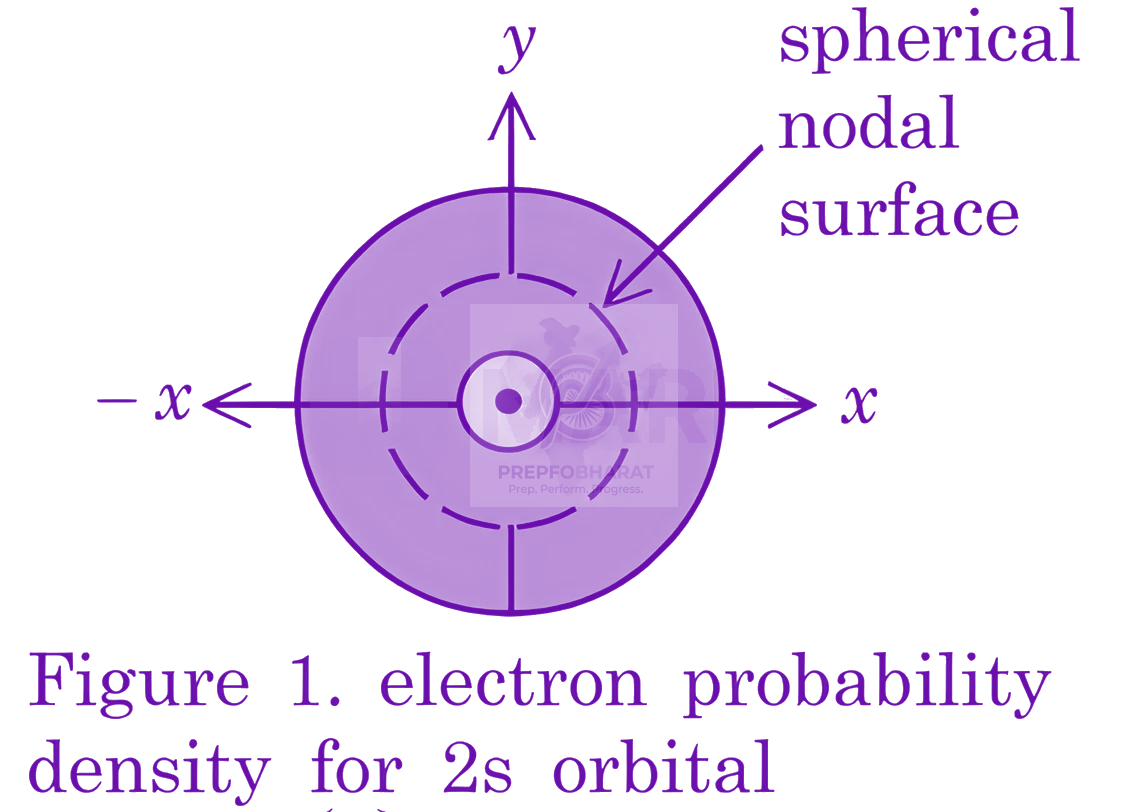 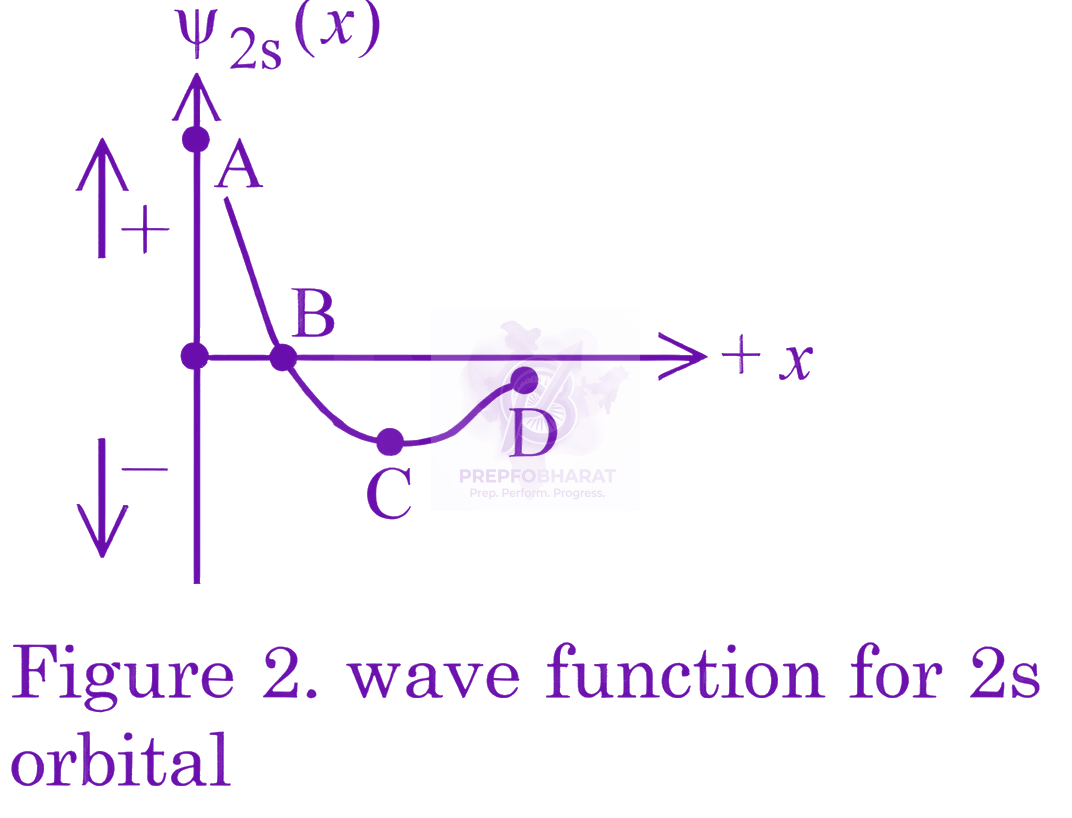 Which of the following point in Figure 2 most accurately represents the nodal surface as shown in Figure 1?
At 298 K, the mole percentage of $\mathrm{N}_{2}(\mathrm{~g})$ in air is $80 \%$. Water is in equilibrium with air at a pressure of 10 atm. What is the mole fraction of $\mathrm{N}_{2}(\mathrm{~g})$ in water at 298 K ? ($\mathrm{K}_{\mathrm{H}}$ for $\mathrm{N}_{2}$ is $6.5 \times 10^{7} \mathrm{~mm} \mathrm{Hg}$)
Electricity is passed through an acidic solution of $\mathrm{Cu}^{2+}$ till all the $\mathrm{Cu}^{2+}$ was exhausted, leading to the deposition of 300 mg of Cu metal. However, a current of 600 mA was continued to pass through the same solution for another 28 minutes by keeping the total volume of the solution fixed at 200 mL. The total volume of oxygen evolved at STP during the entire process is $\_\_\_\_$ mL. (Nearest integer) [Given: $\mathrm{Cu}^{2+}(\mathrm{aq})+2 \mathrm{e}^{-} \rightarrow \mathrm{Cu}(\mathrm{s}) \mathrm{E}_{\text {red }}^{\mathrm{o}}=+0.34 \mathrm{~V}$ $\mathrm{O}_{2}(\mathrm{~g})+4 \mathrm{H}^{+}+4 \mathrm{e}^{-} \rightarrow 2 \mathrm{H}_{2} \mathrm{O} \mathrm{E}_{\text {red }}^{\mathrm{o}}=+1.23 \mathrm{~V}$ Molar mass of $\mathrm{Cu}=63.54 \mathrm{~g} \mathrm{~mol}^{-1}$ Molar mass of $\mathrm{O}_{2}=32 \mathrm{~g} \mathrm{~mol}^{-1}$ Faraday Constant $=96500 \mathrm{C} \mathrm{mol}^{-1}$ Molar volume at $\mathrm{STP}=22.4 \mathrm{~L}$]
Arrange the following resultant mixtures in increasing order of their pH values A. $10$ mL $0.2$ M Ca(OH)$_2$ + $25$ mL $0.1$ M HCl B. $10$ mL $0.01$ M H$_2$SO$_4$ + $10$ mL $0.01$ M Ca(OH)$_2$ C. $10$ mL $0.1$ M H$_2$SO$_4$ + $10$ mL $0.1$ M KOH Choose the correct answer from the options given below:
The hydrogen spectrum consists of several spectral lines in Lyman series ($\mathrm{L}_{1}, \mathrm{~L}_{2}$, $\mathrm{L}_{3} \ldots ; \mathrm{L}_{1}$ has lowest energy among Lyman series). Similarly it consists of several spectral lines in Balmer series $\left(\mathrm{B}_{1}, \mathrm{~B}_{2}, \mathrm{~B}_{3} \ldots ; \mathrm{B}_{1}\right.$ has lowest energy among Balmer lines). The energy of $L_{1}$ is $x$ times the energy of $B_{1}$. The value of $x$ is $\_\_\_\_$ $\times 10^{-1}$ . (Nearest integer)
Consider the reaction $aX \rightarrow bY$, for which the rate constant at $30°C$ is $1 \times 10^{-3}$ mol$^{-1}$ L s$^{-1}$. Which of the following statements are true? A. When concentration of 'X' is increased to four times, the rate of reaction becomes $16$ times. B. The reaction is a second order reaction. C. The half-life period is independent of the concentration of X. D. Decomposition of $N_2 O_5$ is an example of the above reaction. E. $\ln\dfrac{[R_o]}{[R]}$ vs time is valid for the above reaction. Choose the correct answer from the options given below:
Correct statements regarding Arrhenius equation among the following are : A. Factor $e^{-E a / R T}$ corresponds to fraction of molecules having kinetic energy less than Ea. B. At a given temperature, lower the Ea, faster is the reaction. C. Increase in temperature by about $10^{\circ} \mathrm{C}$ doubles the rate of reaction. D. Plot of $\log \mathrm{k}$ vs $\frac{1}{\mathrm{~T}}$ gives a straight line with slope $=-\frac{E a}{R}$. Choose the correct answer from the options given below :
If $3.365$ g of ethanol $(l)$ is burnt completely in a bomb calorimeter at $298.15$ K, the heat produced is $99.472$ kJ. The $|\Delta H_f°|$ of ethanol at $298.15$ K is ______ $\times 10^2$ kJ mol$^{-1}$. (Nearest integer) Given: Standard enthalpy for combustion of graphite $=-393.5$ kJ mol$^{-1}$ Standard enthalpy of formation of water $(l)=-285.8$ kJ mol$^{-1}$ Molar mass in g mol$^{-1}$ of C, H, O are $12$, $1$ and $16$ respectively
A solution is prepared by dissolving 0.3 g of a non-volatile non-electrolyte solute 'A' of molar mass $60 \mathrm{~g} \mathrm{~mol}^{-1}$ and 0.9 g of a non-volatile non-electrolyte solute ' $B$ ' of molar mass $180 \mathrm{~g} \mathrm{~mol}^{-1}$ in $100 \mathrm{~mL} \mathrm{H}_{2} \mathrm{O}$ at $27^{\circ} \mathrm{C}$. Osmotic pressure of the solution will be [Given: $\mathrm{R}=0.082 \mathrm{~L} \mathrm{~atm} \mathrm{~K}^{-1} \mathrm{~mol}^{-1}$]
Consider the following aqueous solutions. I. 2.2 g Glucose in 125 mL of solution. II. 1.9 g Calcium chloride in 250 mL of solution. III. 9.0 g Urea in 500 mL of solution. IV. 20.5 g Aluminium sulphate in 750 mL of solution. The correct increasing order of boiling point of these solutions will be : [Given : Molar mass in $\mathrm{g} \mathrm{mol}^{-1}: \mathrm{H}=1, \mathrm{C}=12, \mathrm{~N}=14, \mathrm{O}=16, \mathrm{Cl}=35.5, \mathrm{Ca}=40, \mathrm{Al}=27$ and $\mathrm{S}=32$]