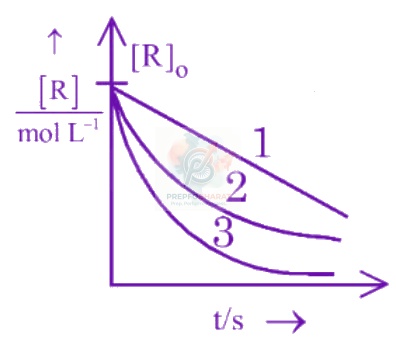
Analysis of the graph:
The graph shows reactant concentration [R] vs time t for three reactions starting from the same initial concentration.
Curve 1 is a straight line with negative slope. For a zero-order reaction, the integrated rate law is [R]=[R]0−kt, which is a straight line in [R] vs t. Hence, reaction 1 is a zero-order reaction.
Curves 2 and 3 are non-linear (exponential-type decays), so they correspond to reactions of order greater than zero (e.g., first or second order).
Evaluating the options:
(1) The order of all three reactions is the same.
Reaction 1 is zero order while reactions 2 and 3 are of higher order, so this statement is incorrect.
(2) The rate constant of reaction 3 is larger than that of reaction 2, assuming both have the same order.
Assuming both curves 2 and 3 correspond to the same order (say first order), the integrated rate law is [R]=[R]0e−kt. At any given time t, the curve for reaction 3 lies below that of reaction 2, i.e., [R]3<[R]2. Since both start from the same [R]0, reaction 3 is decaying faster, which implies a larger rate constant. Hence k3>k2, and this statement is correct.
(3) The SI unit of the rate constant of reaction 1 is s−1.
For a zero-order reaction, Rate=k[R]0=k, so the unit of k is that of rate, i.e., mol L−1s−1. The unit s−1 corresponds to a first-order reaction, so this statement is incorrect.
(4) Thermal decomposition of HI on a gold surface is an example of reaction 2.
The thermal decomposition of HI on a gold surface is a well-known zero-order reaction, which corresponds to curve 1, not curve 2. Hence this statement is incorrect.
Therefore, the correct option is (2).