JEE Main 2021 — Physical Chemistry
Chemistry Physical Chemistry questions from JEE Main 2021.
Other Years
208 Physical Chemistry Questions from 2021
Which of the following is an intensive property?
The elevation in boiling point of a solution depends on:
The molar solubility of $\mathrm{Zn}(\mathrm{OH}{)}_{2}$ in $0.1\mathrm{MNaOH}$ solution is $x\times {10}^{-18}M.$ The value of $x$ is _____ . (Nearest integer) $(\text{Given : The solubility product of }\mathrm{Zn}(\mathrm{OH}{)}_{2}\text{is}2\times {10}^{-20})$
Consider the following cell reaction ${\mathrm{Cd}}_{(s)}+{\mathrm{Hg}}_{2}{\mathrm{SO}}_{4(s)}+\frac{9}{5}{H}_{2}{O}_{(l)}\rightleftharpoons {\mathrm{CdSO}}_{4}\cdot \frac{9}{5}{H}_{2}{O}_{(s)}+2{\mathrm{Hg}}_{(l)}.$ The value of ${E}_{\mathrm{cell}}^{0}$ is $4.315V$ at $25^{\circ}C.$ If $\Delta H^{\circ}=-825.2\mathrm{kJ}{\mathrm{mol}}^{-1},$ the standard entropy change $\Delta S^{\circ}$ in $J{K}^{-1}$ is _________ . (Nearest integer) [Given : Faraday constant $=96487C{\mathrm{mol}}^{-1}$]
The inactivation rate of a viral preparation is proportional to the amount of virus. In the first minute after preparation, $10%$ of the virus is inactivated. The rate constant for viral inactivation is $___\times {10}^{-3}{\mathrm{min}}^{-1}.$ (Nearest integer) [Use : $\mathrm{ln}10=2.303;{\mathrm{log}}_{10}3=0.477$ property of logarithm$:\mathrm{log}{x}^{y}=y\mathrm{log}x]$
$0.01$ moles of a weak acid $\mathrm{HA}({K}_{a}=2.0\times {10}^{-6})$ is dissolved in $1.0L$ of $0.1M\mathrm{HCl}$ solution. The degree of dissociation of $\mathrm{HA}$ is __________ $\times {10}^{-5}$ (Round off to the Nearest Integer). [Neglect volume change on adding $\mathrm{HA}$ and assume degree of dissociation $<<1$]
The $\mathrm{pH}$ of a solution obtained by mixing $50\mathrm{mL}$ of $1M\mathrm{HCl}$ and $30\mathrm{mL}$ of $1M\mathrm{NaOH}$ is $x\times {10}^{-4}.$ The value of $x$ is (Nearest integer) $[\mathrm{log}2.5=0.3979]$
The equilibrium constant for the reaction $A(s)\rightleftharpoons M(s)+\frac{1}{2}{O}_{2}(g)$ is ${K}_{p}=4.$ At equilibrium, the partial pressure of ${O}_{2}$ is _____ atm. (Round off to the nearest integer)
$100\mathrm{mL}$ of ${\mathrm{Na}}_{3}{\mathrm{PO}}_{4}$ solution contains $3.45g$ of sodium. The molarity of the solution is .....$\times {10}^{-2}\mathrm{mol}{L}^{-1}$. (Nearest integer) [Atomic Masses - $\mathrm{Na}:23.0u,O:16.0u,P:31.0u]$
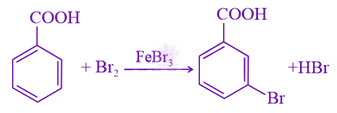 Consider the above reaction where $6.1g$ of benzoic acid is used to get $7.8g$ of m-bromo benzoic acid. The percentage yield of the product is ___ . (Round off to the Nearest integer) [Given : Atomic masses : $C=12.0u,H:1.0u,O:16.0u,\mathrm{Br}=80.0u$]
Number of electrons that Vanadium $(Z=23)$ has in p-orbitals is equal to:
The species given below that does $\mathrm{NOT}$ show disproportionation reaction is:
For water ${\Delta }_{\mathrm{vap}}H=41\mathrm{kJ}{\mathrm{mol}}^{-1}$ at $373K$ and 1 bar pressure. Assuming that water vapour is an ideal gas that occupies a much larger volume than liquid water, the internal energy change during evaporation of water is $({\mathrm{kJmol}}^{-1})$: [ Use $:R=8.3J{\mathrm{mol}}^{-1}{K}^{-1}]$
If the concentration of glucose $({C}_{6}{H}_{12}{O}_{6})$ in blood is $0.72g{L}^{-1},$ the molarity of glucose in blood is $-\times {10}^{-3}M$ (Nearest integer): $[$Given : Atomic mass of $C=12,H=1,O=16u]$
At $298K$, the enthalpy of fusion of a solid $(X)$ is $2.8\mathrm{kJ}{\mathrm{mol}}^{-1}$ and the enthalpy of vaporisation of the liquid $(X)$ is $98.2\mathrm{kJ}{\mathrm{mol}}^{-1}$. The enthalpy of sublimation of the substance $(X)$ in $\mathrm{kJ}{\mathrm{mol}}^{-1}$ is ______. (in nearest integer)
For the reaction ${C}_{2}{H}_{6}\rightarrow {C}_{2}{H}_{4}+{H}_{2}$ the reaction enthalpy ${\Delta }_{r}H\mathrm{in}$ ${\mathrm{kJmol}}^{-1}$ is (Round off to the Nearest Integer). [Given : Bond enthalpies in ${\mathrm{kJmol}}^{-1}:C-C:$ $347,C=C:611;C-H:414,H-H:436]$
The molarity of the solution prepared by dissolving $6.3g$ of oxalic acid $({H}_{2}{C}_{2}{O}_{4}\cdot 2{H}_{2}O)$ in $250\mathrm{mL}$ of water in $\mathrm{mol}{L}^{-1}$ is $x\times {10}^{-2}.$ The value of $x$ is _________ . (Nearest integer) [Atomic mass : $H:1.0,C:12.0,0:16.0J$]
The solubility of ${\mathrm{CdSO}}_{4}$ in water is $8.0\times {10}^{-4}\mathrm{mol}{L}^{-1}$. Its solubility in $0.01M{H}_{2}{\mathrm{SO}}_{4}$ solution is ___ $\times {10}^{-6}\mathrm{mol}{L}^{-1}$ (Round off to the Nearest integer) (Assume that solubility is much less than $0.01M$ )
The Born-Haber cycle for $\mathrm{KCl}$ is evaluated with the following data: ${\Delta }_{f}{H}^{\Theta }\text{ for }\mathrm{KCl}=-436.7{\mathrm{kJmol}}^{-1};{\Delta }_{\mathrm{sub}}{H}^{\Theta }\text{ for }K=89.2{\mathrm{kJmol}}^{-1};$ ${\Delta }_{\text{ionization }}{H}^{\Theta }\text{ for }K=419.0\mathrm{kJ}{\text{ mol }}^{-1};{\Delta }_{\text{electron gain }}{H}^{\Theta }\text{ for }{\mathrm{Cl}}_{(g)}=-348.6{\mathrm{kJmol}}^{-1}$ ${\Delta }_{\text{bond }}{H}^{\Theta }\text{ for }{\mathrm{Cl}}_{2}=243.0{\mathrm{kJmol}}^{-1}$ The magnitude of lattice enthalpy of $\mathrm{KCl}$ in ${\mathrm{kJmol}}^{-1}$ is (Nearest integer)
$1.86g$ of aniline completely reacts to form acetanilide. $10%$ of the product is lost during purification. Amount of acetanilide obtained after purification (in $g$) is ___________ $\times {10}^{-2}.$
$\mathrm{Ge}(Z=32)$ in its ground state electronic configuration has $x$ completely filled orbitals with ${m}_{l}=0.$ The value of $x$ is __________ .
Consider the reaction ${N}_{2}{O}_{4}(g)\rightleftharpoons 2{\mathrm{NO}}_{2}(g)$ The temperature at which ${K}_{C}=20.4$ and ${K}_{P}=600.1,$ is ______ $K$. (Round off to the Nearest Integer). [Assume all gases are ideal and $R=0.0831L$ bar ${K}^{-1}{\mathrm{mol}}^{-1}]$
The number of photons emitted by a monochromatic (single frequency) infrared range finder of power $1\mathrm{mW}$ and wavelength of $1000\mathrm{nm}$, in $0.1$ second is $x\times {10}^{13}$. The value of $x$ is (Nearest integer) $(h=6.63\times {10}^{-34}\mathrm{Js},c=3.00\times {10}^{8}{\mathrm{ms}}^{-1})$:
Dichromate ion is treated with base, the oxidation number of $\mathrm{Cr}$ in the product formed is
A homogeneous ideal gaseous reaction ${\mathrm{AB}}_{2(g)}\rightleftharpoons {A}_{(g)}+2{B}_{(g)}$ is carried out in a $25\mathrm{litre}$ flask at $27^{\circ}C$. The initial amount of ${\mathrm{AB}}_{2}$ was $1$ mole and the equilibrium pressure was $1.9\mathrm{atm}$. The value of ${K}_{p}$ is $x\times {10}^{-2}$. The value of $x$ is (Integer answer) $[R=0.08206{\mathrm{dm}}^{3}\mathrm{atm}{K}^{-1}{\mathrm{mol}}^{-1}]$
Two salts ${A}_{2}X$ and $\mathrm{MX}$ have the same value of solubility product of $4.0\times {10}^{-12}$. The ratio of their molar solubilizes i.e. $\frac{S({A}_{2}X)}{S(\mathrm{MX})}=$ ________. (Round off to the Nearest Integer).
(A) $\mathrm{HOCl}+{H}_{2}{O}_{2}\rightarrow {H}_{3}{O}^{+}+{\mathrm{Cl}}^{-}+{O}_{2}$ (B) ${I}_{2}+{H}_{2}{O}_{2}+2{\mathrm{OH}}^{-}\rightarrow 2{I}^{-}+2{H}_{2}O+{O}_{2}$ Choose the correct option.
An average person needs about $10000\mathrm{kJ}$ energy per day. The amount of glucose (molar mass $=180.0g{\mathrm{mol}}^{-1}$) needed to meet this energy requirement is ______$g.$ (Use : ${\Delta }_{C}H$ (glucose)$=-2700\mathrm{kJ}{\mathrm{mol}}^{-1}$)
For a certain first order reaction $32%$ of the reactant is left after $570s.$ The rate constant of this reaction is $\times {10}^{-3}{s}^{-1}.$ (Round off to the Nearest Integer). [Given: ${\mathrm{log}}_{10}2=0.301,\mathrm{ln}10=2.303$]
The equilibrium constant ${K}_{c}$ at $298K$ for the reaction $A+B\rightleftharpoons C+D$ is $100.$ Starting with an equimolar solution with concentrations of $A,B,C$ and $D$ all equal to $1M$, the equilibrium concentration of $D$ is _____$\times {10}^{-2}M$. (Nearest integer)
Sucrose hydrolyses in acid solution into glucose and fructose following first order rate law with a half-life of $3.33h$ at $25^{\circ}C.$ After $9h,$ the fraction of sucrose remaining is $f.$ The value of ${\mathrm{log}}_{10}(\frac{1}{f})$ is ________ $\times {10}^{-2}.$ (Rounded off to the nearest integer) [Assume: In$10=2.303,\mathrm{ln}2=0.693$]
${\mathrm{PCl}}_{5}\rightleftharpoons {\mathrm{PCl}}_{3}+{\mathrm{Cl}}_{2}{K}_{c}=1.844$ $3.0$ moles of ${\mathrm{PCl}}_{5}$ is introduced in a $1L$ closed reaction vessel at $380K.$ The number of moles of ${\mathrm{PCl}}_{5}$ at equilibrium is $—\times {10}^{-3}$ (Round off to the Nearest Integer)
The oxidation states of nitrogen in $\mathrm{NO},{\mathrm{NO}}_{2},{N}_{2}O$ and ${\mathrm{NO}}_{3}^{-}$ are in the order of :
Sodium oxide reacts with water to produce sodium hydroxide. $20.0g$ of sodium oxide is dissolved in $500\mathrm{mL}$ of water. Neglecting the change in volume, the concentration of the resulting $\mathrm{NaOH}$ solution is _________ $\times {10}^{-1}M.$ (Nearest integer) [Atomic mass : $\mathrm{Na}=23.0,O=16.0,H=1.0$]
Which one of the following $0.10M$ aqueous solutions will exhibit the largest freezing point depression?
If $80g$ of copper sulphate ${\mathrm{CuSO}}_{4}\cdot 5{H}_{2}O$ is dissolved in deionised water to make $5L$ of solution. The concentration of the copper sulphate solution is $x\times {10}^{-3}\text{ mol }{L}^{-1}.$ The value of $x$ is _____. $[\text{Atomic masses }\mathrm{Cu}:63.54u,S:32u,O:16u,H:1u]$
$40g$ of glucose (Molar mass $=180)$ is mixed with $200\mathrm{mL}$ of water. The freezing point of solution is $__K$. (Nearest integer) [Given : ${K}_{f}=1.86K\mathrm{kg}{\mathrm{mol}}^{-1};$ Density of water $=1.00g{\mathrm{cm}}^{-3};$ Freezing point of water $=273.15K]$
A solute $A$ dimerizes in water. The boiling point of a $2$ molal solution of $A$ is $100.52C\circ$. The percentage association of $A$ is ___ . (Round off to the Nearest integer) Use : ${K}_{b}$ for water $=0.52K\mathrm{kg}{\mathrm{mol}}^{-1}$ Boiling point of water $=100^{\circ}C$
If a compound $\mathrm{AB}$ dissociates to the extent of $75%$ in an aqueous solution, the molality of the solution which shows a $2.5K$ rise in the boiling point of the solution is ___ molal. (Rounded-off to the nearest integer) $[{K}_{b}=0.52K\mathrm{kg}{\mathrm{mol}}^{-1}]$.
${\mathrm{AB}}_{2}$ is $10%$ dissociated in water to ${A}^{2+}$ and ${B}^{-}$. The boiling point of $10.0$ molal aqueous solution of ${\mathrm{AB}}_{2}$ is-- $C\circ$. (Round off to the Nearest Integer). [Given : Molal elevation constant of water ${K}_{b}=0.5K\mathrm{kg}{\mathrm{mol}}^{-1}$ boiling point of pure water$=100^{\circ}C$]
A solution is $0.1M$ in ${\mathrm{Cl}}^{-}$ and $0.001M$ in ${\mathrm{CrO}}_{4}^{2-}.$ Solid ${\mathrm{AgNO}}_{3}$ is gradually added to it Assuming that the addition does not change in volume and ${K}_{\mathrm{sp}}(\mathrm{AgCl})=1.7\times {10}^{-10}{M}^{2}$ and ${K}_{\mathrm{sp}}({\mathrm{Ag}}_{2}{\mathrm{CrO}}_{4})=1.9\times {10}^{-12}{M}^{3}.$ Select correct statement from the following:
For the galvanic cell, $\mathrm{Zn}(s)+{\mathrm{Cu}}^{2+}(0.02M)\rightarrow {\mathrm{Zn}}^{2+}(0.04M)+\mathrm{Cu}(s)$ ${E}_{\mathrm{cell}}=\ldots \times {10}^{-2}V$ (Nearest integer) $[\mathrm{Use}:{E}^{0}\mathrm{Cu}/{\mathrm{Cu}}^{2+}=-0.34V,{E}_{\mathrm{Zn}/{\mathrm{Zn}}^{2}+}=+0.76V,\frac{2.303\mathrm{RT}}{F}=0.059V]$
A $\mathrm{KCl}$ solution of conductivity $0.14S{m}^{-1}$ shows a resistance of $4.19\Omega$ in a conductivity cell. If the same cell is filled with an $\mathrm{HCl}$ solution, the resistance drops to $1.03\Omega$. The conductivity of the HCl solution is ____$\times {10}^{-2}S{m}^{-1}$. (Round off to the Nearest Integer).
The magnitude of the change in oxidising power of the ${\mathrm{MnO}}_{4}^{-}/{\mathrm{Mn}}^{2+}$ couple is $x\times {10}^{-4}V$ if the ${H}^{+}$ concentration is decreased from $1M$ to ${10}^{-4}M$ at $25^{\circ}C.$ (Assume concentration of ${\mathrm{MnO}}_{4}^{-}$ and ${\mathrm{Mn}}^{2+}$ to be same on change in ${H}^{+}$ concentration). The value of $x$ is __________. (Rounded off to the nearest integer) [Given: $\frac{2.303\mathrm{RT}}{F}=0.059$]
The Azimuthal quantum number for the valence electrons of ${\mathrm{Ga}}^{+}$ ion is (Atomic number of $\mathrm{Ga}=31$)
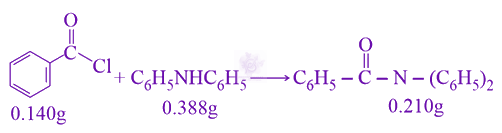 Consider the above reaction. The percentage yield of amide product is (Round off to the Nearest Integer). (Given : Atomic mass : $C:12.0u,H:1.0u$ $N:14.0u,O:16.0u,\mathrm{Cl}:35.5u)$
An accelerated electron has a speed of $5\times {10}^{6}{\mathrm{ms}}^{-1}$ with an uncertainty of $0.02%$. The uncertainty in finding its location while in motion is $x\times {10}^{-9}m$. The value of $x$ is __________. (Nearest integer) [Use mass of electron$=9.1\times {10}^{-31}\mathrm{kg}$, $h=6.63\times {10}^{-34}\mathrm{Js},\pi =3.14]$
At $298.2K$ the relationship between enthalpy of bond dissociation (in $\mathrm{kJ}{\mathrm{mol}}^{-1}$) for hydrogen $({E}_{H})$ and its isotope, deuterium $({E}_{D})$, is best described by:
The vapour pressures of $A$ and $B$ at $25^{\circ}C$ are $90\mathrm{mmHg}$ and $15\mathrm{mm}\mathrm{Hg}$ respectively. If $A$ and $B$ are mixed such that the mole fraction of $A$ in the mixture is $0.6,$ then the mole fraction of $B$ in the vapour phase is $x\times {10}^{-1}.$ The value of $x$ is (Nearest integer)
Given below are two statements : Statement I : The $E^{\circ}$ value of ${\mathrm{Ce}}^{4+}/{\mathrm{Ce}}^{3+}$ is $+1.74V$ Statement II : Ce is more stable in ${\mathrm{Ce}}^{4+}$ state than ${\mathrm{Ce}}^{3+}$ state. In the light of the above statements, choose the most appropriate answer from the options given below:
The rate constant of a reaction increases by five times on increase in temperature from $27^{\circ}C$ to $52^{\circ}C$. The value of activation energy in ${\mathrm{kJmol}}^{-1}$ is ___ .(Rounded-off to the nearest integer) $[R=8.314J{K}^{-1}{\mathrm{mol}}^{-1}]$
$10.0\mathrm{mL}$ of $0.05M{\mathrm{KMnO}}_{4}$ solution was consumed in a titration with $10.0\mathrm{mL}$ of given oxalic acid dihydrate solution. The strength of given oxalic acid solution is ........ $\times {10}^{-2}g/L$. (Round off to the nearest integer)
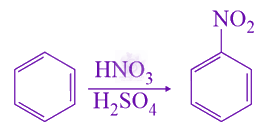 In the above reaction, $3.9g$ of benzene on nitration gives $4.92g$ of nitrobenzene. The percentage yield of nitrobenzene in the above reaction is _________ $%$. (Round off to the Nearest Integer). (Given atomic mass : $C:12.0u,H:1.0u$$O:16.0u,N:14.0u$)
The solubility of $\mathrm{Ca}{(\mathrm{OH})}_{2}$ in water is : [Given : The solubility product of $\mathrm{Ca}{(\mathrm{OH})}_{2}$ in water $=5.5\times {10}^{-6}$]
Copper reduces ${\mathrm{NO}}_{3}^{-}$ into $\mathrm{NO}$ and ${\mathrm{NO}}_{2}$ depending upon the concentration of ${\mathrm{HNO}}_{3}$ in solution. (Assuming fixed $[{\mathrm{Cu}}^{2+}]$ and ${P}_{\mathrm{NO}}={P}_{{\mathrm{NO}}_{2}}$), the ${\mathrm{HNO}}_{3}$ concentration at which the thermodynamic tendency for reduction of ${\mathrm{NO}}_{3}^{-}$ into $\mathrm{NO}$ and ${\mathrm{NO}}_{2}$ by copper is same is ${10}^{x}M$. The value of $2x$ is ___. (Rounded-off to the nearest integer) [Given, ${E}_{{\mathrm{Cu}}^{2+}/\mathrm{Cu}}^{o}=0.34V,{E}_{{\mathrm{NO}}_{3}^{-}/\mathrm{NO}}^{o}=0.96V,{E}_{{\mathrm{NO}}_{3}^{-}/{\mathrm{NO}}_{2}}^{o}=0.79V$ and at $298K$, $\frac{\mathrm{RT}}{F}(2.303)=0.059$]
The gas phase reaction $2A(g)\rightleftharpoons {A}_{2}(g)$ at $400K$ has $\Delta {G}^{o}=+25.2\mathrm{kJ}{\mathrm{mol}}^{-1}$. The equilibrium constant ${K}_{C}$ for this reaction is ___ $\times {10}^{-2}$. (Round off to the Nearest integer) Use : $R=8.3J{\mathrm{mol}}^{-1}{K}^{-1},\mathrm{ln}10=2.3 {\mathrm{log}}_{10}2=0.30,1\mathrm{atm}=1\mathrm{bar}$ antilog $(-0.3)=0.501$
For water at $100^{\circ}C$ and $1$ bar, ${\Delta }_{vap}H-{\Delta }_{vap}U=\underset{¯}{}\times {10}^{2}J{\mathrm{mol}}^{-1}$ (Round off to the Nearest Integer) [Use : $R=8.31J{\mathrm{mol}}^{-1}{K}^{-1}]$ [Assume volume of ${H}_{2}O(l)$ is much smaller than volume of ${H}_{2}O(g)$. Assume ${H}_{2}O(g)$ treated as an ideal gas]
During which of the following processes, does entropy decrease ? (A) Freezing of water to ice at $0^{\circ}C$ (B) Freezing of water to ice at $-10^{\circ}C$ (C) ${N}_{2}(g)+3{H}_{2}(g)\rightarrow 2{\mathrm{NH}}_{3}(g)$ (D) Adsorption of $\mathrm{CO}(g)$ and lead surface (E) Dissolution of $\mathrm{NaCl}$ in water
The standard enthalpies of formation of ${\mathrm{Al}}_{2}{O}_{3}$ and $\mathrm{CaO}$ are $-1675\mathrm{kJ}{\mathrm{mol}}^{-1}$ and $-635\mathrm{kJ}{\mathrm{mol}}^{-1}$ respectively. For the reaction $3\mathrm{CaO}+2\mathrm{Al}\rightarrow 3\mathrm{Ca}+{\mathrm{Al}}_{2}{O}_{3}$ the standard reaction enthalpy ${\Delta }_{r}{H}^{0}=$ ________ $\mathrm{kJ}.$ (Round off to the Nearest Integer).
At $25^{\circ}C,50g$ of iron reacts with $\mathrm{HCl}$ to form ${\mathrm{FeCl}}_{2}$. The evolved hydrogen gas expands against a constant pressure of $1\mathrm{bar}$. The work done by the gas during this expansion is -_______ $J$. (Round off to the Nearest Integer) [Given : $R=8.314J{\mathrm{mol}}^{-1}{K}^{-1}$. Assume, hydrogen is an ideal gas] [Atomic mass off Fe is $55.85u$]
Five moles of an ideal gas at $293K$ is expanded isothermally from an initial pressure of $2.1\mathrm{MPa}$ to $1.3\mathrm{MPa}$ against at constant external pressure $4.3\mathrm{MPa}$. The heat transferred in this process is ___ ${\mathrm{kJmol}}^{-1}$. (Rounded-off to the nearest integer)[ Use $R=8.314J{\mathrm{mol}}^{-1}{K}^{-1}$]
The reaction of sulphur in alkaline medium is given below: ${S}_{8(s)}+a{\mathrm{OH}}_{(\mathrm{aq})}^{-}\rightarrow b{S}_{(\mathrm{aq})}^{2-}+c{S}_{2}{O}_{3(\mathrm{aq})}^{2-}+d{H}_{2}{O}_{(l)}$ The values of '$a$' is______ (Integer answer)
The ${\mathrm{OH}}^{-}$ concentration in a mixture of $5.0\mathrm{mL}$ of $0.0504M{\mathrm{NH}}_{4}\mathrm{Cl}$ and $2\mathrm{mL}$ of $0.0210M{\mathrm{NH}}_{3}$ solution is $x\times {10}^{-6}M$. The value of $x$ is (Nearest integer) [Given ${K}_{w}=1\times {10}^{-14}$ and ${K}_{b}=1.8\times {10}^{-5}]$
The number of moles of ${\mathrm{NH}}_{3},$ that must be added to $2L$ of $0.80{\mathrm{MAgNO}}_{3}$ in order to reduce the concentration of ${\mathrm{Ag}}^{+}$ ions to $5.0\times {10}^{-8}M({K}_{\text{formation }}$ for ${[\mathrm{Ag}{({\mathrm{NH}}_{3})}_{2}]}^{+}=1.0\times {10}^{8})$ is __________. (Nearest integer) [Assume no volume change on adding ${\mathrm{NH}}_{3}$]
$2{\mathrm{SO}}_{2}(g)+{O}_{2}(g)\rightleftharpoons 2{\mathrm{SO}}_{3}(g)$ In an equilibrium mixture, the partial pressures are ${P}_{{\mathrm{SO}}_{3}}=43\mathrm{kPa};{P}_{{O}_{2}}=530\mathrm{Pa}$ and ${P}_{{\mathrm{SO}}_{2}}=45\mathrm{kPa}.$ The equilibrium constant ${K}_{P}=_____\times {10}^{-2}.$ (Nearest integer)
Which one of the following species doesn't have a magnetic moment of $1.73\mathrm{BM},$ (spin only value)?
A system does $200J$ of work and at the same time absorbs $150J$ of heat. The magnitude of the change in internal energy is ______$J$. (Nearest integer)
The decomposition of formic acid on gold surface follows first order kinetics. If the rate constant at $300K$ is $1.0\times {10}^{-3}{s}^{-1}$ and the activation energy ${E}_{a}=11.488\mathrm{kJ}{\mathrm{mol}}^{-1}$, the rate constant at $200K$ is _________ $\times {10}^{-5}{s}^{-1}$. (Round of to the Nearest Integer). (Given $R=8.314J{\mathrm{mol}}^{-1}{K}^{-1}$)
In the sulphur estimation, $0.471g$ of an organic compound gave $1.44g$ of barium sulfate. The percentage of sulphur in the compound is. (Nearest integer) (Atomic Mass of $\mathrm{Ba}=137u$ )
An exothermic reaction $X\rightarrow Y$ has an activation energy $30\mathrm{kJ}{\mathrm{mol}}^{-1}$. If energy change $\Delta E$ during the reaction is $-20\mathrm{kJ}$, then the activation energy for the reverse reaction in $\mathrm{kJ}$ is (Integer answer)
The incorrect expression among the following is :
For the reaction $2{\mathrm{NO}}_{2}(g)\rightleftharpoons {N}_{2}{O}_{4}(g),$ when $\Delta S=-176.0J{K}^{-1}$ and $\Delta H=-57.8\mathrm{kJ}{\mathrm{mol}}^{-1}$ the magnitude of $\Delta G$ at $298K$ for the reaction is _____ ${\mathrm{kJmol}}^{-1}$. (Nearest integer)
The molar conductivity at infinite dilution of barium chloride, sulphuric arid and hydrochloric acid are $280,860$ $426{\mathrm{Scm}}^{2}{\mathrm{mol}}^{-1}$ respectively. The molar conductivity at infinite dilution of barium sulphate is ___ ${\mathrm{Scm}}^{2}{\mathrm{mol}}^{-1}$ ( Round off to the Nearest Integer).
$2$ molal solution of a weak acid $\mathrm{HA}$ has a freezing point of $3.885^{\circ}C.$ The degree of dissociation of this acid is ______$\times {10}^{-3}.$ (Round off to the Nearest Integer). $[$Given : Molal depression constant of water $=1.85K\mathrm{kg}{\mathrm{mol}}^{-1}$ Freezing point of pure water$=0^{\circ}C]$
The resistance of conductivity cell with cell constant $1.14{\mathrm{cm}}^{-1}$, containing $0.001M\mathrm{KCl}$ at $298K$ is $1500\Omega$. The molar conductivity of $0.001M\mathrm{KCl}$ solution at $298K$ in $S{\mathrm{cm}}^{2}{\mathrm{mol}}^{-1}$ is (Integer answer)
$1\mathrm{kg}$ of $0.75$ molal aqueous solution of sucrose can be cooled up to $-4^{\circ}C$ before freezing. The amount of ice (in $g$) that will be separated out is ___________. (Nearest integer) [Given : ${K}_{f}({H}_{2}O)=1.86K\mathrm{kg}{\mathrm{mol}}^{-1}$]
$10.0\mathrm{ml}$ of ${\mathrm{Na}}_{2}{\mathrm{CO}}_{3}$ solution is titrated against $0.2M\mathrm{HCl}$ solution. The following values were obtained in $5$ readings. $4.8\mathrm{ml},4.9\mathrm{ml},5.0\mathrm{ml},5.0\mathrm{ml}$ and $5.0\mathrm{ml}$ Based on these readings, and convention of titrimetric estimation of concentration of ${\mathrm{Na}}_{2}{\mathrm{CO}}_{3}$ solution is ___ $\mathrm{mM}$. (Round off to the Nearest integer)
Assuming ideal behaviour, the magnitude of $\mathrm{log}K$ for the following reaction at $25^{\circ}C$ is $x\times {10}^{-1}.$ The value of $x$ is __________. (Integer answer)$3\mathrm{HC}\equiv {\mathrm{CH}}_{(g)}\rightleftharpoons {C}_{6}{H}_{6(l)}$ [Given: ${\Delta }_{f}G^{\circ}(\mathrm{HC}\equiv \mathrm{CH})=-2.04\times {10}^{5}J{\mathrm{mol}}^{-1};{\Delta }_{f}G^{\circ}({C}_{6}{H}_{6})=-1.24\times {10}^{5}J{\mathrm{mol}}^{-1};R=8.314J{K}^{-1}{\mathrm{mol}}^{-1}$]
$15\mathrm{mL}$ of aqueous solution of ${\mathrm{Fe}}^{2+}$ in acidic medium completely reacted with $20\mathrm{mL}$ of $0.03M$ aqueous ${\mathrm{Cr}}_{2}{{O}_{7}}^{2-}.$ The molarity of the ${\mathrm{Fe}}^{2+}$ solution is _______ $\times {10}^{-2}M$ (Round off to the Nearest Integer).
When $10\mathrm{mL}$ of an aqueous solution of ${\mathrm{Fe}}^{2+}$ ions was titrated in the presence of dil ${H}_{2}{\mathrm{SO}}_{4}$ using diphenylamine indicator, $15\mathrm{mL}$ of $0.02M$ solution of ${K}_{2}{\mathrm{Cr}}_{2}{O}_{7}$ was required to get the end point. The molarity of the solution containing ${\mathrm{Fe}}^{2+}$ ions is $x\times {10}^{-2}M$. The value of $x$ is ______. (Nearest integer)
Given below are two statements: Statement I : Bohr's theory accounts for the stability and line spectrum of ${\mathrm{Li}}^{+}$ ion. Statement II : Bohr's theory was unable to explain the splitting of spectral lines in the presence of a magnetic field. In the light of the above statements, choose the most appropriate answer from the options given below:
Complete combustion of $1.80g$ of an oxygen containing compound $({C}_{x}{H}_{y}{O}_{z})$ gave $2.64g$ of ${\mathrm{CO}}_{2}$ and $1.08g$ of ${H}_{2}O.$ The percentage of oxygen in the organic compound is :
The reaction $2A+{B}_{2}\rightarrow 2\mathrm{AB}$ is an elementary reaction. For a certain quantity of reactants, if the volume of the reaction vessel is reduced by a factor of $3,$ the rate of the reaction increases by a factor of _____ . (Round off to the Nearest Integer).
Sulphurous acid $({H}_{2}{\mathrm{SO}}_{3})$ has ${\mathrm{Ka}}_{1}=1.7\times {10}^{-2}$ and ${\mathrm{Ka}}_{2}=6.4\times {10}^{-8}.$ The $\mathrm{pH}$ of $0.588M{H}_{2}{\mathrm{SO}}_{3}$ is____________ $($Round off to the Nearest Integer$)$.
A source of monochromatic radiation wavelength $400\mathrm{nm}$ provides $1000J$ of energy in $10$ seconds. When this radiation falls on the surface of sodium, $x\times {10}^{20}$ electrons are ejected per second. Assume that wavelength $400\mathrm{nm}$ is sufficient for ejection of electron from the surface of sodium metal. The value of $x$ is ______. (Nearest integer) $(h=6.626\times {10}^{-34}\mathrm{Js})$
An aqueous $\mathrm{KCl}$ solution of density $1.20g{\mathrm{mL}}^{-1}$ has a molality of $3.30\mathrm{mol}{\mathrm{kg}}^{-1}$. The molarity of the solution in ${\mathrm{molL}}^{-1}$ is____.(The Nearest integer) $[$Molar mass of $\mathrm{KCl}=74.5g]$
Data given for the following reaction is as follows : ${\mathrm{FeO}}_{(s)}+{C}_{(\mathrm{graphite})}\longrightarrow {\mathrm{Fe}}_{(s)}+{\mathrm{CO}}_{(g)}$ <table class="pyq-table"><tbody><tr><td>Substance</td><td>${\Delta }_{f}H^{\circ}({\mathrm{kJmol}}^{-1})$</td><td>$\Delta S^{\circ}({\mathrm{Jmol}}^{-1}{K}^{-1})$</td></tr><tr><td>${\mathrm{FeO}}_{(s)}$</td><td>$-266.3$</td><td>$57.49$</td></tr><tr><td>${C}_{(\mathrm{graphite})}$</td><td>$0$</td><td>$5.74$</td></tr><tr><td>${\mathrm{Fe}}_{(s)}$</td><td>$0$</td><td>$27.28$</td></tr><tr><td>${\mathrm{CO}}_{(g)}$</td><td>$-110.5$</td><td>$197.6$</td></tr></tbody></table>The minimum temperature in $K$ at which the reaction becomes spontaneous is_____.(Integer answer)
If the activation energy of a reaction is $80.9\mathrm{kJ}{\mathrm{mol}}^{-1}$, the fraction of molecules at $700K$, having enough energy to react to form products is ${e}^{-x}$. The value of $x$ is (Rounded off to the nearest integer) [Use $R=8.31J{K}^{-1}{\mathrm{mol}}^{-1}$]
For the reaction $A(g)\rightleftharpoons B(g)$ at $495K$, ${\Delta }_{r}{G}^{^{\circ}}=-9.478\mathrm{kJ}{\mathrm{mol}}^{-1}$ If we start the reaction in a closed container at $495K$ with $22$ millimoles of $A$, the amount of $B$ is the equilibrium mixture is ________ millimoles. (Round off to the Nearest Integer). $[R=8.314J{\mathrm{mol}}^{-1}{K}^{-1};\ell n10=2.303]$
The formula of a gaseous hydrocarbon which requires 6 times of its own volume of ${O}_{2}$ for complete oxidation and produces $4$ times its own volume of ${\mathrm{CO}}_{2}$ is ${C}_{x}{H}_{y}.$ The value of $y$ is ________.
The reaction of cyanamide, ${\mathrm{NH}}_{2}{\mathrm{CN}}_{(s)}$ with oxygen was run in a bomb calorimeter and $\Delta U$ was found to be $-742.24\mathrm{kJ}{\mathrm{mol}}^{-1}$ . The magnitude of ${\Delta H}_{298}$ for the reaction ${\mathrm{NH}}_{2}{\mathrm{CN}}_{(s)}+\frac{3}{2}{O}_{2(g)}\rightarrow {N}_{2(g)}+{O}_{2(g)}+{H}_{2}{O}_{(l)}$ is $\mathrm{kJ}$. (Rounded off to the nearest integer) [Assume ideal gases and $R=8.314J{\mathrm{mol}}^{-1}{K}^{-1}$]
When $9.45g$ of ${\mathrm{ClCH}}_{2}\mathrm{COOH}$ is added to $500\mathrm{mL}$ of water, its freezing point drops by $0.5^{\circ}C.$ The dissociation constant of ${\mathrm{ClCH}}_{2}\mathrm{COOH}$ is $x\times {10}^{-3}.$ The value of $x$ is off to the nearest integer) $[{K}_{f({H}_{2}O)}=1.86K\mathrm{kg}{\mathrm{mol}}^{-1}]$
At $1990K$ and $1\mathrm{atm}$ pressure, there are equal number of ${\mathrm{Cl}}_{2}$ molecules and $\mathrm{Cl}$ atoms in the reaction mixture. The value of ${K}_{p}$ for the reaction ${\mathrm{Cl}}_{2(g)}=2{\mathrm{Cl}}_{(g)}$ under the above conditions is $x\times {10}^{-1}.$ The value of $x$ is______(Rounded off to the nearest integer)
When $400\mathrm{mL}$ of $0.2M{H}_{2}{\mathrm{SO}}_{4}$ solution is mixed with $600\mathrm{mL}$ of $0.1\mathrm{MNaOH}$ solution, the increase in temperature of the final solution is $—\times {10}^{-2}K$. (Round off to the nearest integer). [Use :${H}^{+}(\mathrm{aq})+{\mathrm{OH}}^{-}(\mathrm{aq})\rightarrow {H}_{2}O:$${\Delta }_{\gamma }H=-57.1\mathrm{kJ}{\mathrm{mol}}^{-1}]$ Specific heat of ${H}_{2}O=4.18J{K}^{-1}{g}^{-1}$ , density of ${H}_{2}O=1.0g{\mathrm{cm}}^{-3}$ Assume no change in volume of solution on mixing.
For a given chemical reaction $A\rightarrow B$ at $300K$ the free energy change is $-49.4\mathrm{kJ}{\mathrm{mol}}^{-1}$ and the enthalpy of reaction is $51.4\mathrm{kJ}{\mathrm{mol}}^{-1}.$ The entropy change of the reaction is _________${\mathrm{JK}}^{-1}{\mathrm{mol}}^{-1}.$
For the reaction, $\mathrm{aA}+\mathrm{bB}\rightarrow \mathrm{cC}+\mathrm{dD},$ the plot of $\mathrm{log}k$ v/s $\frac{1}{T}$ is given below: 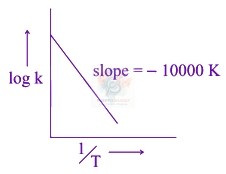 The temperature at which the rate constant of the reaction is ${10}^{-4}{s}^{-1}$ is _____ $K.$ (Rounded-off to the nearest integer) [Given : The rat5e constant of the reaction is ${10}^{-5}{s}^{-1}$ at $500K$.]
${C}_{6}{H}_{6}$ freezes at $5.5^{\circ}C.$ The temperature at which a solution of $10g$ of ${C}_{4}{H}_{10}$ in $200g$ of ${C}_{6}{H}_{6}$ freeze is _______$C\circ .$ (nearest integer value), (The molal freezing point depression constant of ${C}_{6}{H}_{6}$ is $5.12^{\circ}C/m.$)
The solubility product of ${\mathrm{PbI}}_{2}$ is $8.0\times {10}^{-9}.$ The solubility of lead iodide in $0.1$ molar solution of lead nitrate is $x\times {10}^{-6}\mathrm{mol}/L.$ The value of $x$ is _________ (Rounded off to the nearest integer)[Given $\sqrt{2}=1.41$]
$100g$ of propane is completely reacted with $1000g$ of oxygen. The mole fraction of carbon dioxide in the resulting mixture is $x\times {10}^{-2}$. The value of $x$ is (Nearest integer)
In mildly alkaline medium, thiosulphate ion is oxidized by ${\mathrm{MnO}}_{4}^{-}$ to $"A"$. The oxidation state of sulphur in $"A"$ is_
The number of orbitals with $n=5,{m}_{1}=+2$ is ________. (Round off to the Nearest Integer).
$2{\mathrm{SO}}_{2}(g)+{O}_{2}(g)\rightarrow 2{\mathrm{SO}}_{3}(g)$ The above reaction is carried out in a vessel starting with partial pressure ${P}_{{\mathrm{SO}}_{2}}=250m\mathrm{bar}$, ${P}_{{O}_{2}}=750m\mathrm{bar}$ and ${P}_{{\mathrm{SO}}_{3}}=0\mathrm{bar}$. When the reaction is complete, the total pressure in the reaction vessel is _____ $m\mathrm{bar}$. (Round off of the nearest integer).
A $6.50$ molal solution of $\mathrm{KOH}(\mathrm{aq}.)$ has a density of $1.89g{\mathrm{cm}}^{-3}$. The molarity of the solution is $\mathrm{mol}{\mathrm{dm}}^{-3}$. (Round off to the Nearest Integer). [Atomic masses: $K:39.0u;O:16.0u;H:1.0u$]
According to the following figure, the magnitude of the enthalpy change of the reaction $A+B\rightarrow M+N$ in $\mathrm{kJ}{\mathrm{mol}}^{-1}$ is equal to __________ . (Integer answer) 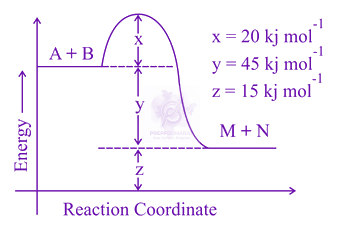
When $3.00g$ of a substance $X$' is dissolved in $100g$ of ${\mathrm{CCl}}_{4}$, it raises the boiling point by $0.60K$. The molar mass of the substance ' ${X}^{'}$ is ___ g ${\mathrm{mol}}^{-1}$. (Nearest integer). [Given ${K}_{b}$ for ${\mathrm{CCl}}_{4}$ is $5.0K\mathrm{kg}{\mathrm{mol}}^{-1}]$
The conductivity of a weak acid$\mathrm{HA}$ of concentration $0.001\mathrm{mol}{L}^{-1}$ is $2.0\times {10}^{-5}S{\mathrm{cm}}^{-1}$. If ${\Lambda }_{m}^{0}(\mathrm{HA})=190S{\mathrm{cm}}^{2}{\mathrm{mol}}^{-1},$ the ionization constant $({K}_{a})$ of HA is equal to $____$ $\times {10}^{-6}$ (Round off to the Nearest Integer)
The stepwise formation of ${[\mathrm{Cu}{({\mathrm{NH}}_{3})}_{4}]}^{2+}$ is given below: ${\mathrm{Cu}}^{2+}+{\mathrm{NH}}_{3}\overset{{K}_{1}}{\rightleftharpoons }{[\mathrm{Cu}({\mathrm{NH}}_{3})]}^{2+}$ ${[\mathrm{Cu}({\mathrm{NH}}_{3})]}^{2+}+{\mathrm{NH}}_{3}\overset{{K}_{2}}{\rightleftharpoons }{[\mathrm{Cu}{({\mathrm{NH}}_{3})}_{2}]}^{2+}$ ${[\mathrm{Cu}{({\mathrm{NH}}_{3})}_{2}]}^{2+}+{\mathrm{NH}}_{3}\overset{{K}_{3}}{\rightleftharpoons }{[\mathrm{Cu}{({\mathrm{NH}}_{3})}_{3}]}^{2+}$ ${[\mathrm{Cu}{({\mathrm{NH}}_{3})}_{3}]}^{2+}+{\mathrm{NH}}_{3}\overset{{K}_{4}}{\rightleftharpoons }{[\mathrm{Cu}{({\mathrm{NH}}_{3})}_{4}]}^{2+}$ The value of stability constants ${K}_{1},{K}_{2},{K}_{3}$ and ${K}_{4}$ are ${10}^{4},1.58\times {10}^{3},5\times {10}^{2}$ and ${10}^{2}$ respectively. The overall equilibrium constants for dissociation of ${[\mathrm{Cu}{({\mathrm{NH}}_{3})}_{4}]}^{2+}$ is $x\times {10}^{-12}.$ The value of $x$ is _____ (Rounded off to the nearest integer)
${\mathrm{PCl}}_{5}(g)\rightarrow {\mathrm{PCl}}_{3}(g)+{\mathrm{Cl}}_{2}(g)$ In the above first order reaction the concentration of ${\mathrm{PCl}}_{5}$ reduces from initial concentration $50\mathrm{mol}{L}^{-1}$ to $10\mathrm{mol}{L}^{-1}$ in $120$ minutes at $300K.$ The rate constant for the reaction at $300K$ is $x\times {10}^{-2}{\mathrm{min}}^{-1}.$ The value of $x$ is __________. [Given $\mathrm{log}5=0.6989$]
The reaction rate for the reaction ${[{\mathrm{PtCl}}_{4}]}^{2-}+{H}_{2}O\rightleftharpoons {[\mathrm{Pt}({H}_{2}O){\mathrm{Cl}}_{3}]}^{-}+{\mathrm{Cl}}^{-}$ was measured as a function of concentrations of different species. It was observed that $\frac{-d[{[{\mathrm{PtCl}}_{4}]}^{2-}]}{\mathrm{dt}}=4.8\times {10}^{-5}[{[{\mathrm{PtCl}}_{4}]}^{2-}]-2.4\times {10}^{-3}[{[\mathrm{Pt}({H}_{2}O){\mathrm{Cl}}_{3}]}^{-}][{\mathrm{Cl}}^{-}]$ where square brackets are used to denote molar concentrations. The equilibrium constant ${K}_{c}=X$(Nearest integer) Value of $\frac{1}{X}is$ (question is modified.)
${\mathrm{Cu}}^{2+}$ salt reacts with potassium iodide to give
The plots of radial distribution functions for various orbitals of hydrogen atom against ' $r'$ are given below.The correct plot for $3s$ orbital is :
An inorganic Compound $'X'$ on treatment with concentrated ${H}_{2}{\mathrm{SO}}_{4}$ produces brown fumes and gives dark brown ring with ${\mathrm{FeSO}}_{4}$ in presence of concentrated ${H}_{2}{\mathrm{SO}}_{4}$. Also Compound $'X'$ gives precipitate $'Y'$, when its solution in dilute $\mathrm{HCl}$ is treated with ${H}_{2}S$ gas. The precipitate $'Y'$ on treatment with concentrated ${\mathrm{HNO}}_{3}$ followed by excess of ${\mathrm{NH}}_{4}\mathrm{OH}$ further gives deep blue coloured solution, Compound $'X'$ is:
Consider the following reaction ${\mathrm{MnO}}_{4}^{-}+8{H}^{+}+5{e}^{-}\rightarrow {\mathrm{Mn}}^{+2}+4{H}_{2}O,E^{\circ}=1.51V$ The quantity of electricity required in Faraday to reduce five moles of ${\mathrm{MnO}}_{4}^{-}$ is
$250\mathrm{mL}$ of $0.5M\mathrm{NaOH}$ was added to $500\mathrm{mL}$ of $1M$ $\mathrm{HCl}$. The number of unreacted $\mathrm{HCl}$ molecules in the solution after the complete reaction is p$\times {10}^{21}$. Find out p (Nearest integer) $({N}_{A}=6.022\times {10}^{23})$
At $363K$, the vapour pressure of $A$ is $21\mathrm{kPa}$ and that of $B$ is $18\mathrm{kPa}$. One mole of $A$ and $2$ moles of $B$ are mixed. Assuming that this solution is ideal, the vapour pressure of the mixture is___________ $\mathrm{kPa}$. $($Round of to the Nearest Integer$)$.
Which one of the following $0.06M$ aqueous solutions has lowest freezing point ?
For a reaction of order $n,$ the unit of the rate constant is :
The $\mathrm{pH}$ of ammonium phosphate solution, if ${\mathrm{pk}}_{a}$ of phosphoric acid and ${\mathrm{pk}}_{b}$ of ammonium hydroxide are $5.23$ and $4.75$ respectively, is
Methylation of $10g$ of benzene gave $9.2g$ of toluene. Calculate the percentage yield of toluene (Nearest integer)
The number of $f$ electrons in the ground state electronic configuration of $\mathrm{Np}(Z=93)$ is ______ .(Integer answer)
At $20^{\circ}C$, the vapour pressure of benzene is $70$ torr and that of methyl benzene is $20$ torr. The mole fraction of benzene in the vapour phase at $20^{\circ}C$ above an equimolar mixture of benzene and methyl benzene is $__\times {10}^{-2}.$ (Nearest integer)
If the conductivity of mercury at $0^{\circ}C$ is $1.07\times {10}^{6}S{m}^{-1}$ and the resistance of a cell containing mercury is $0.243\Omega ,$ then the cell constant of the cell is $x\times {10}^{4}{m}^{-1}.$ The value of $x$ is ______ . (Nearest integer)
The spin only magnetic moments (in BM) for free ${\mathrm{Ti}}^{3+},{V}^{2+}$ and ${\mathrm{Sc}}^{3+}$ ions respectively are (At.No. $\mathrm{Sc}$ : $21,\mathrm{Ti}:22,V:23$ )
For the reaction $A\rightarrow B,$ the rate constant $k$ (in ${s}^{-1}$) is given by ${\mathrm{log}}_{10}k=20.35-\frac{(2.47\times {10}^{3})}{T}$ The energy of activation in $\mathrm{kJ}{\mathrm{mol}}^{-1}$ is ________ . (Nearest integer) [Given : $R=8.314J{K}^{-1}{\mathrm{mol}}^{-1}$]
A certain orbital has no angular nodes and two radial nodes. The orbital is:
For a chemical reaction $A+B=C+D$ $({\Delta }_{r}{H}^{\Theta }=80\mathrm{kJ}{\mathrm{mol}}^{-1})$ the entropy change ${\Delta }_{r}{S}^{\Theta }$ depends on the temperature $T$ (in $K$) as ${\Delta }_{r}{S}^{\Theta }=2T({\mathrm{JK}}^{-1}{\mathrm{mol}}^{-1})$. Minimum temperature at which it will become spontaneous is $K$. (Integer)
A $50$ watt bulb emits monochromatic red light of wavelength of $795\mathrm{nm}$. The number of photons emitted per second by the bulb is $x\times {10}^{20}.$ The value of $x$ is _____ . (Nearest integer) $\text{ [Given : }h=6.63\times {10}^{-34}\mathrm{Js}\text{ and}c=3.0\times {10}^{8}{\mathrm{ms}}^{-1}]$
${A}_{3}{B}_{2}$ is a sparingly soluble salt of molar mass $M(g{\mathrm{mol}}^{-1})$ and solubility $xg{L}^{-1}.$ The solubility product satisfies ${K}_{\mathrm{sp}}=a{(\frac{x}{M})}^{5}.$ The value of $a$ is __________ . (Integer answer)
When $35\mathrm{mL}$ of $0.15M$ lead nitrate solution is mixed with $20\mathrm{mL}$ of $0.12M$ chromic sulphate solution, ____________$\times {10}^{-5}$ moles of lead sulphate precipitate out. (Round off to the Nearest Integer).
$1$ molal aqueous solution of an electrolyte ${A}_{2}{B}_{3}$ is $60%$ ionised. The boiling point of the solution at $1\mathrm{atm}$ is _____ $K$. (Rounded-off to the nearest integer) [Given ${K}_{b}$ for $({H}_{2}O)=0.52K\mathrm{kg}{\mathrm{mol}}^{-1}$]
These are physical properties of an element (A) Sublimation enthalpy (B) Ionisation enthalpy (C) Hydration enthalpy (D) Electron gain enthalpy The total number of above properties that affect the reduction potential is (Integer answer)
The ionization enthalpy of ${\mathrm{Na}}^{+}$ formation from ${\mathrm{Na}}_{(g)}$ is $495.8\mathrm{kJ}{\mathrm{mol}}^{-1},$ while the electron gain enthalpy of $\mathrm{Br}$ is $-325.0\mathrm{kJ}{\mathrm{mol}}^{-1}$. Given the lattice enthalpy of $\mathrm{NaBr}$ is $-728.4\mathrm{kJ}{\mathrm{mol}}^{-1}$ . The energy for the formation of $\mathrm{NaBr}$ ionic solid is $(-)_____{10}^{-1}\mathrm{kJ}{\mathrm{mol}}^{-1}$
Complete combustion of $750g$ of an organic compound provides $420g$ of ${\mathrm{CO}}_{2}$ and $210g$ of ${H}_{2}O$. The percentage composition of carbon and hydrogen in organic compound is $15.3$ and ______ respectively. (Round off to the Nearest Integer)
Isotope(s) of hydrogen which emits low energy ${\beta }^{-}$ particles with ${t}_{1/2}$ value $>12$ years is/are
Assume a cell with the following reaction ${\mathrm{Cu}}_{(s)}+2{\mathrm{Ag}}^{+}(1\times {10}^{-3}M)\rightarrow {\mathrm{Cu}}^{2+}(0.250M)+2{\mathrm{Ag}}_{(s)}$ ${E}_{\mathrm{cell}}^{\circ }=2.97V$ ${E}_{\mathrm{cell}}$ for the above reaction is $V.$ (Nearest integer) $[$ Given : $\mathrm{log}2.5=0.3979,T=298K]$
A ball weighing $10g$ is moving with a velocity of $90m{s}^{-1}.$ If the uncertainty in its velocity is $5%$, then the uncertainty in its position is _ $\times {10}^{-33}m.$ (Rounded off to the nearest integer) [Given: $h=6.63\times {10}^{-34}\mathrm{Js}$]
When $5.1g$ of solid ${\mathrm{NH}}_{4}\mathrm{HS}$ is introduced into a two litre evacuated flask at $27^{\circ}C,20%$ of the solid decomposes into gaseous ammonia and hydrogen sulphide. The ${K}_{p}$ for the reaction at $27^{\circ}C$ is $x\times {10}^{-2}$. The value of $x$ is (Integer answer) [Given $1R=0.082L\mathrm{atm}{K}^{-1}{\mathrm{mol}}^{-1}]$
$2\mathrm{NO}(g)+{\mathrm{Cl}}_{2}(g)\rightleftharpoons 2\mathrm{NOCl}(s)$ This reaction was studied at $-10^{\circ}C$ and the following data was obtained $\begin{matrix}\mathrm{run} & [\mathrm{NO}{]}_{0} & {[{\mathrm{Cl}}_{2}]}_{0} & {r}_{0} \\ 1 & 0.10 & 0.10 & 0.18 \\ 2 & 0.10 & 0.20 & 0.35 \\ 3 & 0.20 & 0.20 & 1.40\end{matrix}$ $[\mathrm{NO}{]}_{0}$ and ${[{\mathrm{Cl}}_{2}]}_{0}$ are the initial concentrations and ${r}_{0}$ is the initial reaction rate. The overall order of the reaction is (Round off to the Nearest Integer).
According to Bohr's atomic theory: (A) Kinetic energy of electron is $\propto \frac{{Z}^{2}}{{n}^{2}}.$ (B) The product of velocity (v) of electron and principal quantum number $(n),'vn'\propto {Z}^{2}.$ (C) Frequency of revolution of electron in an orbit is $\propto \frac{{Z}^{3}}{{n}^{3}}.$ (D) Coulombic force of attraction on the electron is $\propto \frac{{Z}^{3}}{{n}^{4}}.$ Choose the most appropriate answer from the options given below:
$4g$ equimolar mixture of $\mathrm{NaOH}$ and ${\mathrm{Na}}_{2}{\mathrm{CO}}_{3}$ contains $\mathrm{xg}$ of $\mathrm{NaOH}$ and $\mathrm{yg}$ of ${\mathrm{Na}}_{2}{\mathrm{CO}}_{3}.$ The value of $x$ is $g.$ (Nearest integer)
The following data was obtained for chemical reaction given below at $975K$. $2{\mathrm{NO}}_{(g)}+2{H}_{2(g)}\rightarrow {N}_{2(g)}+2{H}_{2}{O}_{(g)}$ $\begin{matrix} & [\mathrm{NO}] & [{H}_{2}] & \mathrm{Rate} \\ & \text{ mol }{L}^{-1} & \text{ mol }{L}^{-1} & {\mathrm{molL}}^{-1}{s}^{-1} \\ (A) & 8\times {10}^{-5} & 8\times {10}^{-5} & 7\times {10}^{-9} \\ (B) & 24\times {10}^{-5} & 8\times {10}^{-5} & 2.1\times {10}^{-8} \\ (C) & 24\times {10}^{-5} & 32\times {10}^{-5} & 8.4\times {10}^{-8}\end{matrix}$ The order of the reaction with respect to $\mathrm{NO}$_____ is [Integer answer]
For a chemical reaction $A\rightarrow B$, it was found that concentration of $B$ is increased by $0.2\mathrm{mol}{L}^{-1}$ in 30 min. The average rate of the reaction is ________ $\times {10}^{-1}\mathrm{mol}{L}^{-1}{h}^{-1}$. (in nearest integer)
In basic medium ${\mathrm{CrO}}_{4}^{2-}$ oxidises ${S}_{2}{O}_{3}^{2-}$ to form ${{\mathrm{SO}}_{4}}^{2-}$ and itself changes into $\mathrm{Cr}{(\mathrm{OH})}_{4}^{-}$.The volume of $0.154{\mathrm{MCrO}}_{4}^{2-}$ required to react with $40\mathrm{mL}$ of $0.25{\mathrm{MS}}_{2}{{O}_{3}}^{2-}$ is _____ $\mathrm{mL}.$ (Rounded-off to the nearest integer)
The reaction that occurs in a breath analyser, a device used to determine the alcohol level in a person's blood stream is $2{K}_{2}{\mathrm{Cr}}_{2}{O}_{7}+8{H}_{2}{\mathrm{SO}}_{4}+3{C}_{2}{H}_{6}O\rightarrow 2{\mathrm{Cr}}_{2}{({\mathrm{SO}}_{4})}_{3}+3{C}_{2}{H}_{4}{O}_{2}+2{K}_{2}{\mathrm{SO}}_{4}+11{H}_{2}O$ If the rate of appearance of ${\mathrm{Cr}}_{2}{({\mathrm{SO}}_{4})}_{3}$ is $2.67\mathrm{mol}{\mathrm{min}}^{-1}$ at a particular time, the rate of disappearance of ${C}_{2}{H}_{6}O$ at the same time is mol ${\mathrm{min}}^{-1}.$ (Nearest integer)
The ${\mathrm{NaNO}}_{3}$ weighed out to make $50\mathrm{mL}$ of an aqueous solution containing $70.0\mathrm{mg}{\mathrm{Na}}^{+}$ per $\mathrm{mL}$ is_ $g$. (Rounded off to the nearest integer) [Given : Atomic weight in ${\mathrm{gmol}}^{-1}-\mathrm{Na}:23;N:14;O:16$]
$224\mathrm{mL}$ of ${\mathrm{SO}}_{2(g)}$ at $298K$ and $1\mathrm{atm}$ is passed through $100\mathrm{mL}$ of $0.1M\mathrm{NaOH}$ solution. The non-volatile solute produced is dissolved in $36g$ of water. The lowering of vapour pressure of solution (assuming the solution is dilute) ($P{^{\circ}}_{({H}_{2}O)}=24\mathrm{mm}$ of $\mathrm{Hg}$) is $x\times {10}^{-2}\mathrm{mm}$ of $\mathrm{Hg}$ the value of $x$ is (Integer answer)
The kinetic energy of an electron in the second Bohr orbit of a hydrogen atom is equal to $\frac{{h}^{2}}{x{\mathrm{ma}}_{0}^{2}}.$ The value of $10x$ is (${a}_{0}$ is radius of Bohr's orbit) (Nearest integer) [Given: $\pi =3.14$]
In order to prepare a buffer solution of $\mathrm{pH}5.74$, sodium acetate is added to acetic acid. If the concentration of acetic acid in the buffer is $1.0M,$ the concentration of sodium acetate in the buffer is ______$M.$ (Round off to the Nearest Integer). $[\mathrm{Given}:\mathrm{pKa}(\text{acetic acid})=4.74]$
The density of $\mathrm{NaOH}$ solution is $1.2g{\mathrm{cm}}^{-3}.$ The molality of this solution is $m$ (Round off to the Nearest Integer): [Use : Atomic masses : $\mathrm{Na}:23.0uO:16.0u$ $H:1.0u$ Density of ${H}_{2}O:1.0g{\mathrm{cm}}^{-3}]$
Identify the process in which change in the oxidation state is five :
For the following graphs, 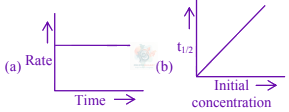 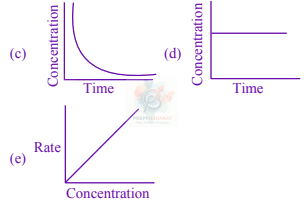 Choose from the options given below, the correct one regarding order of reaction is :
Potassium chlorate is prepared by electrolysis of $\mathrm{KCl}$ in basic solution as shown by following equation. $6{\mathrm{OH}}^{-}+{\mathrm{Cl}}^{-}\rightarrow {\mathrm{ClO}}_{3}^{-}+3{H}_{2}O+6{e}^{-}$ A current of $\mathrm{xA}$ has to be passed for $10h$ to produce $10.0g$ of potassium chlorate. the value of $x$ is __________. (Nearest integer) (Molar mass of ${\mathrm{KClO}}_{3}=122.6g{\mathrm{mol}}^{-1}F=96500C$)
Which of the following compound CANNOT act as a Lewis base?
For the cell $\mathrm{Cu}(s)|{\mathrm{Cu}}^{2+}(\mathrm{aq})(0.1M)\|{\mathrm{Ag}}^{+}(\mathrm{aq})(0.01M)|\mathrm{Ag}(s)$ the cell potential ${E}_{1}=0.3095V$. For the cell $\mathrm{Cu}(s)|{\mathrm{Cu}}^{2+}(\mathrm{aq})(0.01M)\|{\mathrm{Ag}}^{+}(\mathrm{aq})(0.001M)|\mathrm{Ag}(s)$ the cell potential $=x\times {10}^{-2}V.$ Find value of x (Round off the Nearest Integer). [ Use $:\frac{2.303\mathrm{RT}}{F}=0.059J$ ]
${N}_{2}{O}_{5(g)}\rightarrow 2{\mathrm{NO}}_{2(g)}+\frac{1}{2}{O}_{2(g)}$ In the above first order reaction the initial concentration of ${N}_{2}{O}_{5}$ is $2.40\times {10}^{-2}\mathrm{mol}{L}^{-1}$ at $318K.$ The concentration of ${N}_{2}{O}_{5}$ after $1$ hour was $1.60$$\times {10}^{-2}\mathrm{mol}{L}^{-1}.$ The rate constant of the reaction at $318K$ is $\times {10}^{-3}{\mathrm{min}}^{-1}$ (Nearest integer): $[$ Given $:\mathrm{log}3=0.477,\mathrm{log}5=0.699]$
Outermost electronic configuration of a group $13$ element, $E,$ is $4{s}^{2},4{p}^{1}.$ The electronic configuration of an element of p-block period-five placed diagonally to element, $E$ is:
$0.4g$ mixture of $\mathrm{NaOH},{\mathrm{Na}}_{2}{\mathrm{CO}}_{3}$ and some inert impurities was first titrated with $\frac{N}{10}\mathrm{HCl}$ using phenolphthalein as an indicator, $17.5\mathrm{mL}$ of $\mathrm{HCl}$ was required at the end point. After this methyl orange was added and titrated. $1.5\mathrm{mL}$ of same $\mathrm{HCl}$ was required for the next end point. The weight percentage of ${\mathrm{Na}}_{2}{\mathrm{CO}}_{3}$ in the mixture is (Rounded-off to the nearest integer)
Given below are two statements: Statement I : The limiting molar conductivity of $\mathrm{KCl}$ (strong electrolyte) is higher compared to that of $\mathrm{CH}_{3} \mathrm{COOH}$ (weak electrolyte). Statement II : Molar conductivity decreases with decrease in concentration of electrolyte. In the light of the above statements, choose the most appropriate answer from the options given below:
When $12.2g$ of benzoic acid is dissolved in $100g$ of water, the freezing point of solution was found to be $-0.93^{\circ}C({K}_{f}({H}_{2}O)=1.86K\mathrm{kg}{\mathrm{mol}}^{-1})$. The number $(n)$ of benzoic acid molecules associated (assuming $100%$ association) is _.
______grams of $3-$Hydroxy propanal $(\mathrm{MW}=74)$ must be dehydrated to produce $7.8g$ of acrolein $(\mathrm{MW}=56)({C}_{3}{H}_{4}O)$ if the percentage yield is $64.$ (Round off to the Nearest Integer). $[\text{Given: Atomic masses}:C:12.0u,H:1.0u,O:16.0u]$
If the standard molar enthalpy change for combustion of graphite powder is $-2.48\times {10}^{2}\mathrm{kJ}{\mathrm{mol}}^{-1}$, the amount of heat generated on combustion of $1g$ of graphite powder in $\mathrm{kJ}$ (Nearest integer):
$4.5g$ of compound $A(M.W.=90)$ was used to make $250\mathrm{mL}$ of its aqueous solution. The molarity of the solution in $M$ is $x\times {10}^{-1}.$ The value of $x$ is_____ (Rounded off to the nearest integer)
The number of atoms in $8g$ of sodium is $x\times {10}^{23}.$ The value of $x$ is _____ . (Nearest integer) $[\text{ Given : }{N}_{A}=6.02\times {10}^{23}{\mathrm{mol}}^{-1}\text{ Atomic mass of }\mathrm{Na}=23.0u]$
Of the following four aqueous solutions, the total number of those solutions whose freezing point is lower than that of $0.10{\mathrm{MC}}_{2}{H}_{5}\mathrm{OH}$ is (Integer answer) (i) $0.10M{\mathrm{Ba}}_{3}{({\mathrm{PO}}_{4})}_{2}$ (ii) $0.10M{\mathrm{Na}}_{2}{\mathrm{SO}}_{4}$ (iii) $0.10M\mathrm{KCl}$ (iv) $0.10M{\mathrm{Li}}_{3}{\mathrm{PO}}_{4}$
Which one of the following given graphs represents the variation of rate constant $(k)$ with temperature $(T)$ for an endothermic reaction?
Given below are two statements : Statement I : According to Bohr's model of an atom, qualitatively the magnitude of velocity of electron increases with decrease in positive charges on the nucleus as there is no strong hold on the electron by the nucleus. Statement II : According to Bohr's model of an atom, qualitatively the magnitude of velocity of electron increases with decrease in principle quantum number. In the light of the above statements, choose the most appropriate answer from the options given below:
In polythionic acid, ${H}_{2}{S}_{x}{O}_{6}(x=3$ to $5$) the oxidation state(s) of sulphur is/are:
The average $S-F$ bond energy in $\mathrm{kJ}{\mathrm{mol}}^{-1}$ of ${\mathrm{SF}}_{6}$ is _. (Rounded off to the nearest integer) [Given : The values of standard enthalpy of formation of ${\mathrm{SF}}_{6}(g),S(g)$ and $F(g)$ are $-1100,275$ and $80\mathrm{kJ}{\mathrm{mol}}^{-1}$ respectively.]
In which one of the following sets all species show disproportionation reaction?
A proton and a ${\mathrm{Li}}^{3+}$ nucleus are accelerated by the same potential. If ${\lambda }_{\mathrm{Li}}$ and ${\lambda }_{p}$ denote the de Broglie wavelengths of ${\mathrm{Li}}^{3+}$ and proton respectively, then the value of $\frac{{\lambda }_{\mathrm{Li}}}{{\lambda }_{p}}$ is $x\times {10}^{-1}$. The value of $x$ is _____ (Rounded off to the nearest integer) [Mass of ${\mathrm{Li}}^{3+}=8.3$ mass of proton]
When light of wavelength $248\mathrm{nm}$ falls on a metal of threshold energy $3.0\mathrm{eV}$, the de-Broglie wavelength of emitted electrons is ________ $\overset{o}{A}$. (Round off to the Nearest Integer). [Use : $\sqrt{3}=1.73,h=6.63\times {10}^{-34}\mathrm{Js};{m}_{e}=9.1\times {10}^{-31}\mathrm{kg};c=3.0\times {10}^{8}{\mathrm{ms}}^{-1};1\mathrm{eV}=1.6\times {10}^{-19}J]$
The oxidation states of $'P'$ in ${H}_{4}{P}_{2}{O}_{7},{H}_{4}{P}_{2}{O}_{5}$ and ${H}_{4}{P}_{2}{O}_{6},$ respectively, are :
For a first order reaction, the ratio of the time for $75%$ completion of a reaction to the time for $50%$ completion is ___________ . (Integer answer)
Electromagnetic radiation of wavelength $663\mathrm{nm}$ is just sufficient to ionise the atom of metal $A$. The ionization energy of metal $A$ in $\mathrm{kJ}{\mathrm{mol}}^{-1}$ is ___. (Rounded-off to the nearest integer) $[h=6.63\times {10}^{-34}\mathrm{Js},c=3.00\times {10}^{8}{\mathrm{ms}}^{-1},{N}_{A}=6.02\times {10}^{23}{\mathrm{mol}}^{-1}]$
In a solvent $50%$ of an acid HA dimerizes and the rest dissociates. The van't Hoff factor of the acid is _____$\times {10}^{-2}$ (Round off to the nearest integer)
A reaction has a half life of $1\mathrm{min}$. The time required for $99.9%$ completion of the reaction is ___ min. (Round off to the Nearest integer) [Use : $\mathrm{ln}2=0.69,\mathrm{ln}10=2.3$]
For the reaction ${A}_{(g)}\rightarrow {B}_{(g)}$, the value of the equilibrium constant at $300K$ and $1\mathrm{atm}$ is equal to $100.0.$ The value of ${\Delta G}^{o}$ for the reaction at $300K$ and $1\mathrm{atm}$ in ${\mathrm{Jmol}}^{-1}$ is $-xR,$ where $x$ is (Rounded off to the nearest integer) $(R=8.31J{\mathrm{mol}}^{-1}{K}^{-1}\mathrm{and}\mathrm{ln}10=2.3)$
$1.46g$ of a biopolymer dissolved in a $100\mathrm{mL}$ water at $300K$ exerted an osmotic pressure of $2.42\times {10}^{-3}\mathrm{bar}$ The molar mass of the biopolymer is $-\times {10}^{4}g$ ${\mathrm{mol}}^{-1}.$ (Round off to the Nearest Integer) [Use: $R=0.083L$ bar ${\mathrm{mol}}^{-1}{K}^{-1}]$
The oxygen dissolved in water exerts a partial pressure of $20\mathrm{kPa}$ in the vapour above water. The molar solubility of oxygen in water is ______ $\times {10}^{-5}\mathrm{mol}{\mathrm{dm}}^{-3}.$ (Round off to the Nearest Integer). [Given : Henry's law constant $={K}_{H}=8.0\times {10}^{4}\mathrm{kPa}$ for ${O}_{2}.$ Density of water with dissolved oxygen$=1.0\mathrm{kg}{\mathrm{dm}}^{-3}$]
The mole fraction of a solute in a $100$ molal aqueous solution ________ $\times {10}^{-2}.$ (Round off to the Nearest Integer). [Given : Atomic masses: $H:1.0u,O:16.0u$]
A $5.0m\mathrm{mol}{\mathrm{dm}}^{-3}$ aqueous solution of $\mathrm{KCl}$ has a conductance of $0.55\mathrm{mS}$ when measured in a cell constant $1.3{\mathrm{cm}}^{-1}$. The molar conductivity of this solution is _______ ${\mathrm{mSm}}^{2}{\mathrm{mol}}^{-1}$. (Round off to the Nearest Integer)
The first order rate constant for the decomposition of ${\mathrm{CaCO}}_{3}$ at $700K$ is $6.36\times {10}^{-3}{s}^{-1}$ and activation energy is $209\mathrm{kJ}{\mathrm{mol}}^{-1}$. Its rate constant (in ${s}^{-1})$ at $600K$ is $x\times {10}^{-6}$. The value of $x$ is (Nearest integer) [Given $R=8.31J{K}^{-1}{\mathrm{mol}}^{-1};\mathrm{log}6.36\times {10}^{-3}=-2.19,{10}^{-4.79}=1.62\times {10}^{-5}]$
Assuming that $\mathrm{Ba}(\mathrm{OH}{)}_{2}$ is completely ionised in aqueous solution under the given conditions the concentration of ${H}_{3}{O}^{+}$ ions in $0.005M$ aqueous solution of $\mathrm{Ba}(\mathrm{OH}{)}_{2}$ at $298K$ is _________ $\times {10}^{-12}\mathrm{mol}{L}^{-1}.$ (Nearest integer)
$83g$ of ethylene glycol dissolved in $625g$ of water. The freezing point of the solution is ..... K. (Nearest integer) [Use : Molal Freezing point depression constant of water $=1.86K\mathrm{kg}{\mathrm{mol}}^{-1}$ Freezing point of water $=273K$ Atomic masses : $C:12.0u,O:16.0u,H:1.0u]$
$\mathrm{Emf}$ of the following cell at $298K$ in $V$ is $x\times {10}^{-2}$ $\mathrm{Zn}|{\mathrm{Zn}}^{2+}(0.1M)\|{\mathrm{Ag}}^{+}(0.01M)|\mathrm{Ag}$ The value of $x$ is ________________ (Rounded off to the nearest integer) $[\mathrm{Given}:{E}_{{\mathrm{Zn}}^{2+}/\mathrm{Zn}}^{\theta }=-0.76V;{E}_{{\mathrm{Ag}}^{+}/\mathrm{Ag}}^{\theta }=+0.80V;\frac{2.303\mathrm{RT}}{F}=0.059]$
For the first order reaction $A\rightarrow 2B,1$ mole of reactant A gives $0.2$ moles of $B$ after $100$ minutes. The half life of the reaction is ...... min. (Round off to the nearest integer). [Use $:\mathrm{ln}2=0.69,\mathrm{ln}10=2.3$ Properties of logarithms $:\mathrm{ln}{x}^{y}=y\mathrm{ln}x$ $\mathrm{ln}(\frac{x}{y})=\mathrm{ln}x-\mathrm{ln}y]$ (Round off to the nearest integer)
Given below are two statements: Statement I : In the titration between strong acid and weak base methyl orange is suitable as an indicator. Statement II : For titration of acetic acid with $\mathrm{NaOH}$ phenolphthalein is not a suitable indicator. In the light of the above statements, choose the most appropriate answer from the options given below:
$1.22g$ of an organic acid is separately dissolved in $100g$ of benzene $({K}_{b}=2.6K\mathrm{kg}{\mathrm{mol}}^{-1})$ and $100g$ of acetone $({K}_{b}=1.7K\mathrm{kg}{\mathrm{mol}}^{-1}).$ The acid is known to dimerize in benzene but remain as a monomer in acetone. The boiling point of the solution in acetone increases by $0.17^{\circ}C.$ The increase in boiling point of solution in benzene in$C\circ$ is $x\times {10}^{-2}.$ The value of $x$ is (Nearest integer) [Atomic mass : $C=12.0,H=1.0,O=16.0$]
For the reaction $A+B\rightleftharpoons 2C$ the value of equilibrium constant is $100$ at $298K$. If the initial concentration of all the three species is $1M$ each, then the equilibrium concentration of $C$ is $x\times {10}^{-1}M$. The value of $x$ is _______. (Nearest integer)
The exact volumes of $1M\mathrm{NaOH}$ solution required to neutralise $50\mathrm{mL}$ of $1M{H}_{3}{\mathrm{PO}}_{3}$ solution and $100\mathrm{mL}$ of $2M{H}_{3}{\mathrm{PO}}_{2}$ solution, respectively, are :
Match List - I with List - II : <table class="pyq-table"><tbody><tr><td></td><td>List - I (Parameter)</td><td></td><td>List - II (Unit)</td></tr><tr><td>(a)</td><td>Cell constant</td><td>(i)</td><td>$S{\mathrm{cm}}^{2}{\mathrm{mol}}^{-1}$</td></tr><tr><td>(b)</td><td>Molar conductivity</td><td>(ii)</td><td>Dimensionless</td></tr><tr><td>(c)</td><td>Conductivity</td><td>(iii)</td><td>${m}^{-1}$</td></tr><tr><td>(d)</td><td>Degree of dissociation of electrolyte</td><td>(iv)</td><td>${\Omega }^{-1}{m}^{-1}$</td></tr></tbody></table>
$200\mathrm{mL}$ of $0.2M\mathrm{HCl}$ is mixed with $300\mathrm{mL}$ of $0.1M\mathrm{NaOH}.$ The molar heat of neutralization of this reaction is $-57.1\mathrm{kJ}.$ The increase in temperature in $C\circ$ of the system on mixing is $x\times {10}^{-2}.$ The value of $x$ is (Nearest integer) [Given: Specific heat of water $=4.18J{g}^{-1}{K}^{-1}$ Density of water$=1.00g{\mathrm{cm}}^{-3}$] (Assume no volume change on mixing)
A certain orbital has $n=4$ and ${m}_{l}=-3.$ The number of radial nodes in this orbital is _______. (Round off to the Nearest Integer).
The value of magnetic quantum number of the outermost electron of ${\mathrm{Zn}}^{+}$ ion is _________ . (Integer answer)
A $1$ molal ${K}_{4}\mathrm{Fe}(\mathrm{CN}{)}_{6}$ solution has a degree of dissociation of $0.4.$ Its boiling point is equal to that of another solution which contains $18.1$ weight percent of a non electrolytic solute $A$. The molar mass of $A$ is _____ u. (Round off to the Nearest Integer). [Density of water $=1.0g{\mathrm{cm}}^{-3}]$
The solubility of $\mathrm{AgCN}$ in a buffer solution of $\mathrm{pH}=3$ is $x$. The value of $x$ is: [Assume : No cyano complex is formed ; ${K}_{\mathrm{sp}}(\mathrm{AgCN})=2.2\times {10}^{-16}$ and ${K}_{a}(\mathrm{HCN})=6.2\times {10}^{-10}$]
Value of ${K}_{P}$ for the equilibrium reaction ${N}_{2}{O}_{4}(g)\rightleftharpoons 2{\mathrm{NO}}_{2(g)}$ at $288K$ is $47.9.$ The ${K}_{C}$ for this reaction at same temperature is (Nearest integer) $(R=0.083L\mathrm{bar}{K}^{-1}{\mathrm{mol}}^{-1})$
$2{\mathrm{MnO}}_{4}^{-}+{\mathrm{bC}}_{2}{O}_{4}^{2-}+{\mathrm{cH}}^{+}\rightarrow {\mathrm{xMn}}^{2+}+{\mathrm{yCO}}_{2}+{\mathrm{zH}}_{2}O$ If the above equation is balanced with integer coefficients, the value of $c$ is _______ . (Round off to the Nearest Integer).
$A$ and $B$ decompose via first order kinetics with half-lives $54.0\mathrm{min}$ and $18.0\mathrm{min}$ respectively. Starting from an equimolar non-reactive mixture of $A$ and $B$, the time taken for the concentration of $A$ to become $16$ times that of $B$ is ______ $\mathrm{min}$. (Round off to the Nearest Integer).
For the reaction $2{\mathrm{Fe}}^{3+}(\mathrm{aq})+2{I}^{-}(\mathrm{aq})\rightarrow 2{\mathrm{Fe}}^{2+}(\mathrm{aq})+{I}_{2}(s)$ the magnitude of the standard molar free energy change, ${\Delta }_{r}{G}_{m}^{\circ }=-$______$\mathrm{kJ}$ (Round off to the Nearest Integer). 
Consider the complete combustion of butane, the amount of butane utilized to produce $72.0g$ of water is ______ $\times {10}^{-1}g$. (in nearest integer)
Consider titration of $\mathrm{NaOH}$ solution versus $1.25M$ oxalic acid solution. At the end point following burette readings were obtained. (i) $4.5\mathrm{mL}$ (ii) $4.5\mathrm{mL}$ (iii) $4.4\mathrm{mL}$ (iv) $4.4\mathrm{mL}$ (v) $4.4\mathrm{mL}$ If the volume of oxalic acid taken was $10.0\mathrm{mL}$ then the molarity of the $\mathrm{NaOH}$ solution is ___$M$. (Rounded-off to the nearest integer)
The orbital having two radial as well as two angular nodes is:
Complete combustion of $3g$ of ethane gives $x\times {10}^{22}\text{molecules}$ of water. The value of $x$ is ______ (Round off to the Nearest Integer). $[\text{Use}:{N}_{A}=6.023\times {10}^{23};\text{Atomic masses in}u:C:12.0;O:16.0;H:1.0]$
The wavelength of electrons accelerated from rest through a potential difference of $40\mathrm{kV}$ is $X\times {10}^{-12}m.$ The value of $x$ is. (Nearest integer) Given: Mass of electron $=9.1\times {10}^{-31}\mathrm{kg}$ Charge on an electron $=1.6\times {10}^{-19}C$ Planck's constant $=6.63\times {10}^{-34}\mathrm{Js}$
Gaseous cyclobutene isomerizes to butadiene in a first order process which has a '$K$' value of $3.3\times {10}^{-4}{s}^{-1}$ at $153^{\circ}C.$ The time in minutes it takes for the isomerization to proceed $40%$ to completion at this temperature is_____. (Rounded off to the nearest integer)
${\mathrm{CO}}_{2}$ gas is bubbled through water during a soft drink manufacturing process at $298K$. If ${\mathrm{CO}}_{2}$ exerts a partial pressure of $0.835\mathrm{bar}$ then $xm\mathrm{mol}$ of ${\mathrm{CO}}_{2}$ would dissolve in $0.9L$ of water. The value of $x$ is _______. (Nearest integer) (Henry's law constant for ${\mathrm{CO}}_{2}$ at $298K$ is $1.67\times {10}^{3}\mathrm{bar}$)
Consider the cell at $25^{\circ}C$ $\mathrm{Zn}|{\mathrm{Zn}}^{2+}(\mathrm{aq}),(1M)\|{\mathrm{Fe}}^{3+}(\mathrm{aq}),{\mathrm{Fe}}^{2+}(\mathrm{aq})|\mathrm{Pt}(s)$ The fraction of total iron present as ${\mathrm{Fe}}^{3+}$ ion at the cell potential of $1.500V$ is $x\times {10}^{-2}$. The value of $x$ is ______. (Nearest integer) $\mathrm{Given}:{{E}^{\circ }}_{{\mathrm{Fe}}^{3+}|{\mathrm{Fe}}^{2+}}=0.77V,{{E}^{\circ }}_{{\mathrm{Zn}}^{2+}|\mathrm{Zn}}=-0.76V$