JEE Main 2025 — Physical Chemistry
Chemistry Physical Chemistry questions from JEE Main 2025.
Other Years
187 Physical Chemistry Questions from 2025
Given below are two statements : Statement (I) : For a given shell, the total number of allowed orbitals is given by $\mathrm{n}^2$. Statement (II) : For any subshell, the spatial orientation of the orbitals is given by $-l$ to $+l$ values including zero. In the light of the above statements, choose the correct answer from the options given below :
The pH of a 0.001 M HCl solution is:
An aqueous solution of HCl with pH 1.0 is diluted by adding equal volume of water (ignoring dissociation of water). The pH of HCl solution would (Given $\log 2=0.30)$
Density of 3 M NaCl solution is $1.25 \mathrm{~g} / \mathrm{mL}$. The molality of the solution is :
For the given cell $\mathrm{Fe}^{2+}{ }_{(\mathrm{aq})}+\mathrm{Ag}^{+}{ }_{(\mathrm{aq})} \rightarrow \mathrm{Fe}_{(\mathrm{aq})}^{3+}+\mathrm{Ag}_{(\mathrm{s})}$ The standard cell potential of the above reaction is Given: $\begin{array}{lr} \mathrm{Ag}^{+}+\mathrm{e}^{-} \rightarrow \mathrm{Ag} & \mathrm{E}^\theta=\mathrm{xV} \\ \mathrm{Fe}^{2+}+2 \mathrm{e}^{-} \rightarrow \mathrm{Fe} & \mathrm{E}^\theta=\mathrm{yV} \\ \mathrm{Fe}^{3+}+3 \mathrm{e}^{-} \rightarrow \mathrm{Fe} & \mathrm{E}^\theta=\mathrm{zV} \end{array}$
Rate law for a reaction between A and B is given by $\mathrm{R}=\mathrm{k}[\mathrm{~A}]^{\mathrm{n}}[\mathrm{~B}]^{\mathrm{m}}$ If concentration of A is doubled and concentration of $B$ is halved from their initial value, the ratio of new rate of reaction to the initial rate of reaction $\left(\frac{r_2}{r_1}\right)$ is
Total number of non bonded electrons present in $\mathrm{NO}_2{ }^{-}$ion based on Lewis theory is
$2.8 \times 10^{-3} \mathrm{~mol}$ of $\mathrm{CO}_2$ is left after removing $10^{21}$ molecules from its ' $x$ ' mg sample. The mass of $\mathrm{CO}_2$ taken initially is Given: $\mathrm{N}_{\mathrm{A}}=6.02 \times 10^{23} \mathrm{~mol}^{-1}$
Based on the data given below : $\begin{array}{ll}\mathrm{E}_{\mathrm{Cr}_2 \mathrm{O}_7^{2-} / \mathrm{Cr}^{3+}}^{\circ}=1.33 \mathrm{~V} & \mathrm{E}_{\mathrm{Cl}_2 / \mathrm{Cl}^{(-)}}^{\circ}=1.36 \mathrm{~V} \\ \mathrm{E}_{\mathrm{MnO}_4^{-} / \mathrm{Mn}^{2+}}^{\circ}=1.51 \mathrm{~V} & \mathrm{E}_{\mathrm{Cr}^{3+} / \mathrm{Cr}}^{\circ}=-0.74 \mathrm{~V}\end{array}$ the strongest reducing agent is :
Given below are two statements : Statement (I) : It is impossible to specify simultaneously with arbitrary precision, both the linear momentum and the position of a particle. Statement (II) : If the uncertainty in the measurement of position and uncertainty in measurement of momentum are equal for an electron, then the uncertainty in the measurement of velocity is $\geqslant \sqrt{\frac{\mathrm{h}}{\pi}} \times \frac{1}{2 \mathrm{~m}}$. In the light of the above statements, choose the correct answer from the options given below :
Given below are two statements : Statement (\(\mathbf{I}\)): The radii of isoelectronic species increases in the order. \(\mathrm{Mg}^{2+} \lt \mathrm{Na}^{+} \lt \mathrm{F}^{-} \lt \mathrm{O}^{2-}\) Statement (II): The magnitude of electron gain enthalpy of halogen decreases in the order. \(\mathrm{Cl}\gt\mathrm{F}\gt\mathrm{Br}\gt\mathrm{I}\) In the light of the above statements, choose the most appropriate answer from the options given below :
Which of the following postulate of Bohr's model of hydrogen atom in not in agreement with quantum mechanical model of an atom ?
For a reaction, $\mathrm{N}_2 \mathrm{O}_{5(\mathrm{~g})} \rightarrow 2 \mathrm{NO}_{2(\mathrm{~g})}+\frac{1}{2} \mathrm{O}_{2(\mathrm{~g})}$ in a constant volume container, no products were present initially. The final pressure of the system when $50 \%$ of reaction gets completed is
A person's wound was exposed to some bacteria and then bacteria growth started to happen at the same place. The wound was later treated with some antibacterial medicine and the rate of bacterial decay (r) was found to be proportional with the square of the existing number of bacteria at any instance. Which of the following set of graphs correctly represents the 'before' and 'after' situation of the application of the medicine? [Given : $\mathrm{N}=$ No. of bacteria, $\mathrm{t}=$ time, bacterial growth follows $I^{\text {st }}$ order kinetics.]
The correct statement amongst the following is :
\(\mathrm{CaCO}_3(\mathrm{~s})+2 \mathrm{HCl}(\mathrm{aq}) \rightarrow \mathrm{CaCl}_2(\mathrm{aq})+\mathrm{CO}_2(\mathrm{~g}) \mathrm{H}_2 \mathrm{O}(\mathrm{l})\) Consider the above reaction, what mass of \(\mathrm{CaCl}_2\) will be formed if 250 mL of 0.76 M HCl reacts with 1000 g of \(\mathrm{CaCO}_3\) ? (Given : Molar mass of \(\mathrm{Ca}, \mathrm{C}, \mathrm{O}, \mathrm{H}\) and Cl are 40, \(12,16,1\) and \(35.5 \mathrm{~g} \mathrm{~mol}^{-1}\), respectively)
Correct order of limiting molar conductivity for cations in water at 298 K is :
A vessel at 1000 K contains $\mathrm{CO}_2$ with a pressure of 0.5 atm . Some of $\mathrm{CO}_2$ is converted into CO on addition of graphite. If total pressure at equilibrium is 0.8 atm , then Kp is :
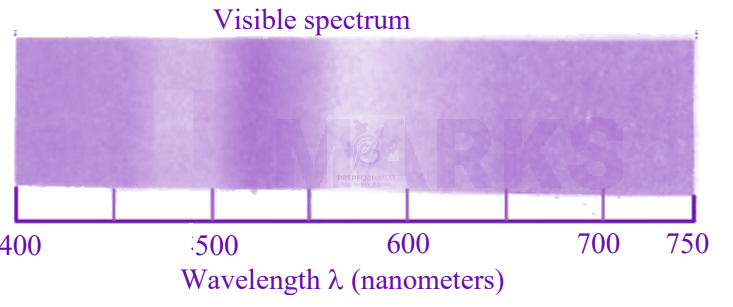 Which of the following statements are correct, if the threshold frequency of caesium is $5.16 \times 10^{14} \mathrm{~Hz}$ ? A. When Cs is placed inside a vacuum chamber with an ammeter connected to it and yellow light is focused on Cs the ammeter shows the presence of current. B. When the brightness of the yellow light is dimmed, the value of the current in the ammeter is reduced. C. When a red light is used instead to the yellow light, the current produced is higher with respect to the yellow light. D. When a blue light is used, the ammeter shows the formation of current. E. When a white light is used, the ammeter shows formation of current. Choose the correct answer from the options given below :
The hydration energies of $\mathrm{K}^{+}$and $\mathrm{Cl}^{-}$are -x and -y $\mathrm{kJ} / \mathrm{mol}$ respectively. If lattice energy of KCl is -z $\mathrm{kJ} / \mathrm{mol}$, then the heat of solution of KCl is :
A weak acid HA has degree of dissociation x . Which option gives the correct expression of ( pH $\mathrm{pK}_{\mathrm{a}}$ )?
Consider the given figure and choose the correct option : 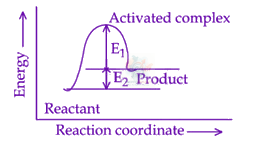
The molar solubility(s) of zirconium phosphate with molecular formula $\left(\mathrm{Zr}^{4+}\right)_3\left(\mathrm{PO}_4^{3-}\right)_4$ is given by relation :
Match List - I with List - II. 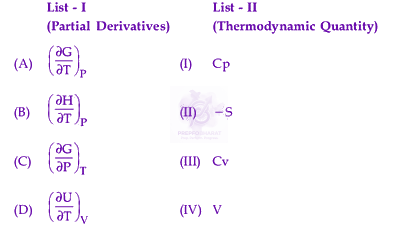 Choose the correct answer from the options given below :
The amount of calcium oxide produced on heating 150 kg limestone ( $75 \%$ pure) is ______ kg. (Nearest integer) Given : Molar mass (in $\mathrm{g} \mathrm{mol}^{-1}$) of Ca-40, O-16, C-12
Total enthalpy change for freezing of 1 mol of water at $10^{\circ} \mathrm{C}$ to ice at $-10^{\circ} \mathrm{C}$ is ____ (Given : $\Delta_{\text {fus }} H=x \mathrm{~kJ} / \mathrm{mol}$) $\begin{aligned} & \mathrm{C}_{\mathrm{p}}\left[\mathrm{H}_2 \mathrm{O}(\mathrm{l})\right]=\mathrm{y} \mathrm{J} \mathrm{mol}^{-1} \mathrm{~K}^{-1} \\ & \mathrm{C}_{\mathrm{p}}\left[\mathrm{H}_2 \mathrm{O}(\mathrm{s})\right]=\mathrm{z} \mathrm{J} \mathrm{mol}^{-1} \mathrm{~K}^{-1}\end{aligned}$
Standard entropies of $\mathrm{X}_2, \mathrm{Y}_2$ and $\mathrm{XY}_5$ are 70,50 and $110 \mathrm{~J} \mathrm{~K}^{-1} \mathrm{~mol}^{-1}$ respectively. The temperature in Kelvin at which the reaction $\frac{1}{2} \mathrm{X}_2+\frac{5}{2} \mathrm{Y}_2 \rightleftharpoons \mathrm{XY}_5 \Delta \mathrm{H}^{\Theta}=-35 \mathrm{~kJ} \mathrm{~mol}^{-1}$ will be at equilibrium is_______. (Nearest integer)
Match List - I with List - II : \(\begin{array}{llll} & \text { List - I } & \text { List - II } \\ & \text { Applications } & \text { Batteries } / \text { Cell } \\ \text { (A) } & \text { Transistors } & \text { (I) } \text { Anode }-\mathrm{Zn} / \mathrm{Hg} \text {; Cathode }-\mathrm{HgO}+\mathrm{C} \\ \text { (B) } & \text { Hearing aids } & \text { (II) } \text { Hydrogen fuel cell } \\ \text { (C) } & \text { Invertors } & \text { (III) Anode }-\mathrm{Zn} \text {; Cathode }- \text { Carbon } \\ \text { (D) } & \text { Apollo space ship } & \text { (IV) Anode }-\mathrm{Pb} \text {; Cathode }-\mathrm{Pb} \mid \mathrm{PbO}_2 \end{array}\) Choose the correct answer from the options given below :
Concentrated nitric acid is labelled as $75 \%$ by mass. The volume in mL of the solution which contains 30 g of nitric acid is ____. Given : Density of nitric acid solution is $1.25 \mathrm{~g} / \mathrm{mL}$.
Which of the following statements are true? (A) The subsidiary quantum number $l$ describes the shape of the orbital occupied by the electron. (B) 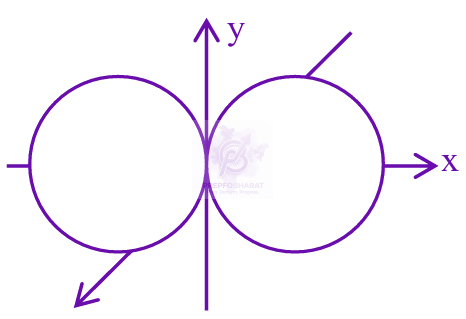 is the boundary surface diagram of the $2 p_x$ orbital. (C) The + and - signs in the wave function of the $2 \mathrm{p}_{\mathrm{x}}$ orbital refer to charge. (D) The wave function of $2 p_x$ orbital is zero everywhere in the xy plane.
Which of the following is/are not correct with respect to energy of atomic orbitals of hydrogen atom? (A)$1 \mathrm{~s} \lt 2 \mathrm{p} \lt 3 \mathrm{~d} \lt 4 \mathrm{~s}$ (B) $1 \mathrm{~s} \lt 2 \mathrm{~s}=2 \mathrm{p} \lt 3 \mathrm{~s}=3 \mathrm{p}$ (C) $1 \mathrm{~s} \lt 2 \mathrm{~s} \lt 2 \mathrm{p} \lt 3 \mathrm{~s} \lt 3 \mathrm{p}$ (D) $1 \mathrm{~s} \lt 2 \mathrm{~s} \lt 4 \mathrm{~s} \lt 3 \mathrm{~d}$ Choose the correct answer from the options given below :
The extra stability of half-filled subshell is due to (A) Symmetrical distribution of electrons (B) Smaller coulombic repulsion energy (C) The presence of electrons with the same spin in non-degenerate orbitals (D) Larger exchange energy (E) Relatively smaller shielding of electrons by one another Identify the correct statements
Given : $\begin{aligned}<br />& \Delta \mathrm{H}_{\text {sub }}^{\ominus}[\mathrm{C}(\text { graphite })]=710 \mathrm{~kJ} \mathrm{~mol}^{-1} \\ & \Delta_{\mathrm{C}-\mathrm{H}} \mathrm{H}^{\ominus}=414 \mathrm{~kJ} \mathrm{~mol}^{-1} \\ & \Delta_{\mathrm{H}-\mathrm{H}} \mathrm{H}^{\Theta}=436 \mathrm{~kJ} \mathrm{~mol}^{-1} \\ & \Delta_{\mathrm{C}=\mathrm{C}} \mathrm{H}^{\Theta}=611 \mathrm{~kJ} \mathrm{~mol}^{-1}<br />\end{aligned}$ The $\Delta \mathrm{H}_{\mathrm{f}}^{\ominus}$ for $\mathrm{CH}_2=\mathrm{CH}_2$ is _____ $\mathrm{kJ} \mathrm{mol}^{-1}$ (nearest integer value)
Consider the following reaction occurring in the blast furnace: $\mathrm{Fe}_3 \mathrm{O}_{4(\mathrm{~s})}+4 \mathrm{CO}_{(\mathrm{g})} \rightarrow 3 \mathrm{Fe}_{(\mathrm{l})}+4 \mathrm{CO}_{2(\mathrm{~g})}$ ' $x$ ' kg of iron is produced when $2.32 \times 10^3 \mathrm{~kg} \mathrm{Fe}_3 \mathrm{O}_4$ and $2.8 \times 10^2 \mathrm{~kg} \mathrm{CO}$ are brought together in the furnace. The value of ' $x$ ' is _____. (nearest integer) Given: molar mass of $\mathrm{Fe}_3 \mathrm{O}_4=232 \mathrm{~g} \mathrm{~mol}^{-1}$ molar mass of $\mathrm{CO}=28 \mathrm{~g} \mathrm{~mol}^{-1}$ molar mass of $\left.\mathrm{Fe}=56 \mathrm{~g} \mathrm{~mol}^{-1}\right\}$
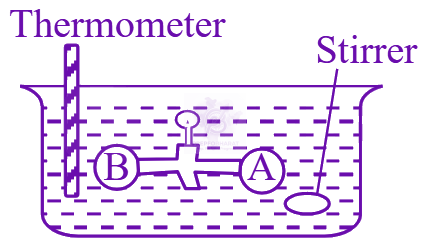 Two vessels A and B are connected via stopcock. The vessel A is filled with a gas at a certain pressure. The entire assembly is immersed in water and is allowed to come to thermal equilibrium with water. After opening the stopcock the gas from vessel A expands into vessel B and no change in temperature is observed in the thermometer. Which of the following statement is true?
Which of the following statement is not true for radioactive decay?
Reactant A converts to product D through the given mechanism (with the net evolution of heat) : $\mathrm{A} \rightarrow \mathrm{B} \quad$ slow $; \Delta \mathrm{H}=+\mathrm{ve}$ $\mathrm{B} \rightarrow \mathrm{C}$ fast; $\Delta \mathrm{H}=-\mathrm{ve}$ $\mathrm{C} \rightarrow \mathrm{D} \quad$ fast ; $\Delta \mathrm{H}=-\mathrm{ve}$ Which of the following represents the above reaction mechanism?
$\mathrm{K}_{\text {sp }}$ for $\mathrm{Cr}(\mathrm{OH})_3$ is $1.6 \times 10^{-30}$. What is the molar solubility of this salt in water?
Among $10^{-9} \mathrm{~g}$ (each) of the following elements, which one will have the highest number of atoms? Element : $\mathrm{Pb}, \mathrm{Po}, \mathrm{Pr}$ and Pt
Given below are two statements : Statement (I) : Corrosion is an electrochemical phenomenon in which pure metal acts as an anode and impure metal as a cathode. Statement (II) : The rate of corrosion is more in alkaline medium than in acidic medium. In the light of the above statements, choose the correct answer from the options given below :
A liquid when kept inside a thermally insulated closed vessel at $25^{\circ} \mathrm{C}$ was mechanically stirred from outside. What will be the correct option for the following thermodynamic parameters ?
$X Y$ is the membrane / partition between two chambers 1 and 2 containing sugar solutions of concentration $c_1$ and $c_2\left(c_1 \gt c_2\right) \mathrm{mol} \mathrm{L}^{-1}$. For the reverse osmosis to take place identify the correct condition (Here $p_1$ and $p_2$ are pressures applied on chamber 1 and 2) 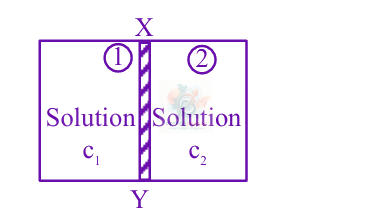 (A) Membrane/Partition; Cellophane, $\mathrm{p}_1 \gt \pi$ (B) Membrane/Partition ; Porous. $\mathrm{p}_2 \gt \pi$ (C) Membrane/Partition ; Parchment paper, $\mathrm{p}_1 \gt \pi$ (D) Membrane/Partition : Cellophane, $\mathrm{p}_2 \gt \pi$ Choose the correct answer from the option given below :
Given below are two statements : Statement (I) : NaCl is added to the ice at $0^{\circ} \mathrm{C}$, present in the ice cream box to prevent the melting of ice cream. Statement (II) : On addition of NaCl to ice at $0^{\circ} \mathrm{C}$, there is a depression in freezing point. In the light of the above statements, choose the correct answer from the options given below :
Assume a living cell with $0.9 \%(\omega / \omega)$ of glucose solution (aqueous). This cell is immersed in another solution having equal mole fraction of glucose and water. (Consider the data upto first decimal place only) The cell will :
Which of the following graph correctly represents the plots of \(\mathrm{K}_{\mathrm{H}}\) at 1 bar gases in water versus temperature?
The observed and normal molar masses of compound $\mathrm{MX}_2$ are 65.6 and 164 respectively. The percent degree of ionisation of $\mathrm{MX}_2$ is $\ldots\ldots$ %. (Nearest integer)
The standard reduction potential values of some of the p-block ions are given below. Predict the one with the strongest oxidising capacity.
Consider the given data : (a) $\mathrm{HCl}(\mathrm{g})+10 \mathrm{H}_2 \mathrm{O}(\mathrm{l}) \rightarrow \mathrm{HCl}.10 \mathrm{H}_2 \mathrm{O}$ $\Delta \mathrm{H}=-69.01 \mathrm{~kJ} \mathrm{~mol}^{-1}$ (b) $\mathrm{HCl}(\mathrm{g})+40 \mathrm{H}_2 \mathrm{O}(\mathrm{l}) \rightarrow \mathrm{HCl}.40 \mathrm{H}_2 \mathrm{O}$ $\Delta \mathrm{H}=-72.79 \mathrm{~kJ} \mathrm{~mol}^{-1}$ Choose the correct statement :
In a multielectron atom, which of the following orbitals described by three quantum numbers will have same energy in absence of electric and magnetic fields? A. $\mathrm{n}=1, \mathrm{l}=0, \mathrm{~m}_1=0$ B. $\mathrm{n}=2, \mathrm{l}=0, \mathrm{~m}_1=0$ C. $\mathrm{n}=2, \mathrm{l}=1, \mathrm{~m}_1=1$ D. $\mathrm{n}=3, \mathrm{l}=2, \mathrm{~m}_1=1$ E. $\mathrm{n}=3, \mathrm{l}=2, \mathrm{~m}_1=0$ Choose the correct answer from the options given below:
When 81.0 g of aluminium is allowed to react with 128.0 g of oxygen gas, the mass of aluminium oxide produced in grams is_______ - (Nearest integer) Given : Molar mass of Al is $27.0 \mathrm{~g} \mathrm{~mol}^{-1}$ Molar mass of O is $16.0 \mathrm{~g} \mathrm{~mol}^{-1}$
Given below are two statements : Statement I : When a system containing ice in equilibrium with water (liquid) is heated, heat is absorbed by the system and there is no change in the temperature of the system until whole ice gets melted. Statement II : At melting point of ice, there is absorption of heat in order to overcome intermolecular forces of attraction within the molecules of water in ice and kinetic energy of molecules is not increased at melting point. In the light of the above statements, choose the correct answer from the options given below:
Which one of the following about an electron occupying the 1 s orbital in a hydrogen atom is incorrect ? (Bohr's radius is represented by a $a_0$)
10 mL of 2 M NaOH solution is added to 20 mL of 1 M HCl solution kept in a beaker. Now, 10 mL of this mixture is poured into a volumetric flask of 100 mL containing 2 moles of HCl and made the volume upto the mark with distilled water. The solution in this flask is :
$0.2 \%(\mathrm{w} / \mathrm{v})$ solution of NaOH is measured to have resistivity $870.0 \mathrm{~m} \Omega \mathrm{~m}$. The molar conductivity of the solution will be ______ $\times 10^2 \mathrm{mS} \mathrm{dm}{ }^2 \mathrm{~mol}^{-1}$. (Nearest integer)
When 1 g each of compounds AB and $\mathrm{AB}_2$ are dissolved in 15 g of water separately, they increased the boiling point of water by 2.7 K and 1.5 K respectively. The atomic mass of A (in amu) is ____ $\times 10^{-1}$ (Nearest integer) (Given : Molal boiling point elevation constant is $\left.0.5 \mathrm{~K} \mathrm{~kg} \mathrm{~mol}^{-1}\right)$
In a reaction $A+B \rightarrow C$, initial concentrations of $A$ and $B$ are related as $[A]_0=8[B]_0$. The half lives of $A$ and $B$ are 10 min and 40 min. respectively. If they start to disappear at the same time, both following first order kinetics, after how much time will the concentration of both the reactants be same?
The elemental composition of a compound is $54.2 \% \mathrm{C}, 9.2 \% \mathrm{H}$ and $36.6 \% \mathrm{O}$. If the molar mass of the compound is $132 \mathrm{~g} \mathrm{~mol}^{-1}$, the molecular formula of the compound is : [Given : The relative atomic mass of $\mathrm{C}: \mathrm{H}: \mathrm{O}=12: 1: 16$ ]
Some $\mathrm{CO}_2$ gas was kept in a sealed container at a pressure of 1 atm and at 273 K . This entire amount of $\mathrm{CO}_2$ gas was later passed through an aqueous solution of $\mathrm{Ca}(\mathrm{OH})_2$. The excess unreacted $\mathrm{Ca}(\mathrm{OH})_2$ was later neutralized with 0.1 M of 40 mL HCl . If the volume of the sealed container of $\mathrm{CO}_2$ was $x$, then $x$ is ________ $\mathrm{cm}^3$ (nearest integer). [Given : The entire amount of $\mathrm{CO}_2(\mathrm{~g})$ reacted with exactly half the initial amount of $\mathrm{Ca}(\mathrm{OH})_2$ present in the aqueous solution.]
${ }^1$ The standard enthalpy and standard entropy of decomposition of $\mathrm{N}_2 \mathrm{O}_4$ to $\mathrm{NO}_2$ are $55.0 \mathrm{~kJ} \mathrm{~mol}^{-1}$ and $175.0 \mathrm{~J} / \mathrm{K} / \mathrm{mol}$ respectively. The standard free energy change for this reaction at $25^{\circ} \mathrm{C}$ in J $\mathrm{mol}^{-1}$ is ______ (Nearest integer)
At temperature T, compound \(\mathrm{AB}_{2(\mathrm{~g})}\) dissociates as \(\mathrm{AB}_{2(\mathrm{~g})} \rightleftharpoons \mathrm{AB}_{(\mathrm{g})}+\frac{1}{2} \mathrm{~B}_{2(\mathrm{~g})}\) having degree of dissociation \(x\) (small compared to unity). The correct expression for \(x\) in terms of \(\mathrm{K}_{\mathrm{p}}\) and p is
The equilibrium constant for decomposition of $\mathrm{H}_2 \mathrm{O}(\mathrm{g})$ $\mathrm{H}_2 \mathrm{O}(\mathrm{~g}) \rightleftharpoons \mathrm{H}_2(\mathrm{~g})+\frac{1}{2} \mathrm{O}_2(\mathrm{~g})\left(\Delta \mathrm{G}^{\circ}=92.34 \mathrm{~kJ} \mathrm{~mol}^{-1}\right)$ is $8.0 \times 10^{-3}$ at 2300 K and total pressure at equilibrium is 1 bar. Under this condition, the degree of dissociation $(\alpha)$ of water is ________ $\times 10^{-2}$ (nearest integer value). [Assume $\alpha$ is negligible with respect to 1 ]
The pH of a 0.01 M weak acid $\mathrm{HX}\left(\mathrm{K}_{\mathrm{a}}=4 \times 10^{-10}\right)$ is found to be 5. Now the acid solution is diluted with excess of water so that the pH of the solution changes to 6. The new concentration of the diluted weak acid is given as $x \times 10^{-4} \mathrm{M}$. The value of x is ________ (nearest integer)
$\begin{aligned} & \mathrm{S}(\mathrm{~g})+\frac{3}{2} \mathrm{O}_2(\mathrm{~g}) \rightarrow \mathrm{SO}_3(\mathrm{~g})+2 x \mathrm{kcal} \\ & \mathrm{SO}_2(\mathrm{~g})+\frac{1}{2} \mathrm{O}_2(\mathrm{~g}) \rightarrow \mathrm{SO}_3(\mathrm{~g})+y \mathrm{kcal} \end{aligned}$ The heat of formation of $\mathrm{SO}_2(\mathrm{~g})$ is given by :
Consider the following plots of log of rate constant $\mathrm{k}(\log \mathrm{k})$ vs $\frac{1}{\mathrm{~T}}$ for three different reactions. The correct order of activation energies of these reactions is 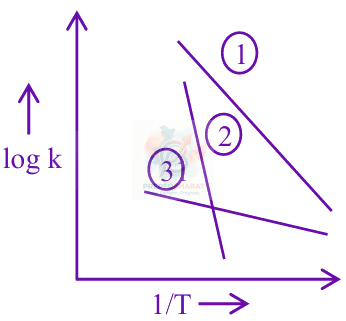
$\mathrm{A} \rightarrow \mathrm{~B}$ The molecule A changes into its isomeric form B by following a first order kinetics at a temperature of 1000 K . If the energy barrier with respect to reactant energy for such isomeric transformation is $191.48 \mathrm{~kJ} \mathrm{~mol}^{-1}$ and the frequency factor is $10^{20}$, the time required for $50 \%$ molecules of A to become $B$ is _________ picoseconds (nearest integer). $\left[\mathrm{R}=8.314 \mathrm{~J} \mathrm{~K}^{-1} \mathrm{~mol}^{-1}\right]$
Consider the following equilibrium, \(\mathrm{CO}(\mathrm{g})+2 \mathrm{H}_2(\mathrm{g}) \rightleftharpoons \mathrm{CH}_3 \mathrm{OH}(\mathrm{g})\) 0.1 mol of CO along with a catalyst is present in a \(2 \mathrm{dm}^3\) flask maintained at 500 K. Hydrogen is introduced into the flask until the pressure is 5 bar and 0.04 mol of \(\mathrm{CH}_3 \mathrm{OH}\) is formed. The \(\mathrm{K}_{\mathrm{p}}^0\) is ______ \(\times 10^{-3}\) (nearest integer). Given : \(\mathrm{R}=0.08 \mathrm{dm}^3\) bar \(\mathrm{K}^{-1} \mathrm{~mol}^{-1}\) Assume only methanol is formed as the product and the system follows ideal gas behaviour.
Match the LIST-I with LIST-II 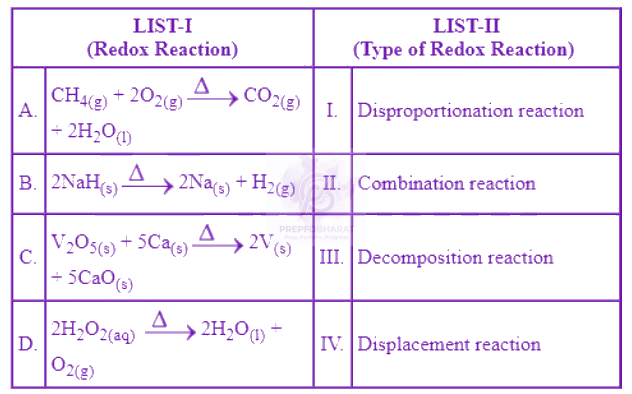 Choose the correct answer from the options given below:
The species which does not undergo disproportionation reaction is :
2 moles each of ethylene glycol and glucose are dissolved in 500 g of water. The boiling point of the resulting solution is : (Given : Ebullioscopic constant of water $\left.=0.52 \mathrm{~K} \mathrm{~kg} \mathrm{~mol}^{-1}\right)$
x mg of $\mathrm{Mg}(\mathrm{OH})_2($ molar mass $=58)$ is required to be dissolved in 1.0 L of water to produce a pH of 10.0 at 298 K. The value of x is ________ mg. (Nearest integer) (Given : $\mathrm{Mg}(\mathrm{OH})_2$ is assumed to dissociate completely in $\mathrm{H}_2 \mathrm{O}$)
If $\quad C$ (diamond $) \rightarrow C$ (graphite $)+\mathrm{X} \mathrm{kJ} \mathrm{mol}^{-1}$ $\mathrm{C}($ diamond $)+\mathrm{O}_2(\mathrm{~g}) \rightarrow \mathrm{CO}_2(\mathrm{~g})+\mathrm{Y} \mathrm{kJ} \mathrm{mol}^{-1}$ C (graphite) $+\mathrm{O}_2(\mathrm{~g}) \rightarrow \mathrm{CO}_2(\mathrm{~g})+\mathrm{Z} \mathrm{kJ} \mathrm{mol}^{-1}$ at constant temperature. Then
The energy of an electron in first Bohr orbit of H -atom is -13.6 eV. The magnitude of energy value of electron in the first excited state of $\mathrm{Be}^{3+}$ is ________ eV. (nearest integer value)
At the sea level, the dry air mass percentage composition is given as nitrogen gas : 70.0, oxygen gas : 27.0 and argon gas : 3.0. If total pressure is 1.15 atm , then calculate the ratio of followings respectively : (i) partial pressure of nitrogen gas to partial pressure of oxygen gas (ii) partial pressure of oxygen gas to partial pressure of argon gas (Given : Molar mass of $\mathrm{N}, \mathrm{O}$ and Ar are 14, 16, and $40 \mathrm{~g} \mathrm{~mol}^{-1}$ respectively)
Consider the following data : Heat of formation of $\mathrm{CO}_2(\mathrm{~g})=-393.5 \mathrm{~kJ} \mathrm{~mol}^{-1}$ Heat of formation of $\mathrm{H}_2 \mathrm{O}(\mathrm{l})=-286.0 \mathrm{~kJ} \mathrm{~mol}^{-1}$ Heat of combustion of benzene $=-3267.0 \mathrm{~kJ} \mathrm{~mol}^{-1}$ The heat of formation of benzene is _ $\mathrm{kJ} \mathrm{mol}{ }^{-1}$. (Nearest integer)
Consider the ground state of chromium atom $(\mathrm{Z}=24)$. How many electrons are with Azimuthal quantum number $l=1$ and $l=2$ respectively ?
40 mL of a mixture of $\mathrm{CH}_3 \mathrm{COOH}$ and HCl (aqueous solution) is titrated against 0.1 M NaOH solution conductometrically. Which of the following statement is correct? 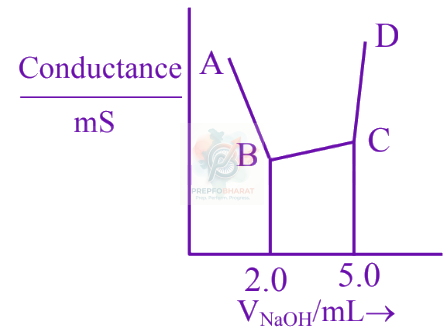
In the following system, $\mathrm{PCl}_5(\mathrm{~g}) \rightleftharpoons \mathrm{PCl}_3(\mathrm{~g})+\mathrm{Cl}_2(\mathrm{~g})$ at equilibrium, upon addition of xenon gas at constant $\mathrm{T} \& \mathrm{p}$, the concentration of
Electrolysis of 600 mL aqueous solution of NaCl for 5 min changes the pH of the solution to 12 . The current in Amperes used for the given electrolysis is ____. (Nearest integer).
Given below are two statements : Statement (I) : A spectral line will be observed for a $2 \mathrm{p}_x \rightarrow 2 \mathrm{p}_y$ transition. Statement (II) : $2 P_x$ and $2 p_y$ are degenerate orbitals. In the light of the above statements, choose the correct answer from the options given below :
Butane reacts with oxygen to produce carbon dioxide and water following the equation given below $\mathrm{C}_4 \mathrm{H}_{10}(\mathrm{~g})+\frac{13}{2} \mathrm{O}_2(\mathrm{~g}) \rightarrow 4 \mathrm{CO}_2(\mathrm{~g})+5 \mathrm{H}_2 \mathrm{O}(\mathrm{l})$ If 174.0 kg of butane is mixed with 320.0 kg of $\mathrm{O}_2$, the volume of water formed in litres is ________.(Nearest integer) [Given : (a) Molar mass of $\mathrm{C}, \mathrm{H}, \mathrm{O}$ are 12, 1, $16 \mathrm{~g} \mathrm{~mol}^{-1}$ respectively, (b) Density of water $\left.=1 \mathrm{~g} \mathrm{~mL}^{-1}\right]$
According to Bohr's model of hydrogen atom, which of the following statement is incorrect?
$37.8 \mathrm{~g} \mathrm{~N}_2 \mathrm{O}_5$ was taken in a 1 L reaction vessel and allowed to undergo the following reaction at 500 K $2 \mathrm{~N}_2 \mathrm{O}_{5(\mathrm{~g})} \rightleftharpoons 2 \mathrm{~N}_2 \mathrm{O}_{4(\mathrm{~g})}+\mathrm{O}_{2(\mathrm{~g})}$ The total pressure at equilibrium was found to be 18.65 bar. Then, $\mathrm{Kp}=$ ______ $\times 10^{-2}$ [nearest integer] Assume $\mathrm{N}_2 \mathrm{O}_5$ to behave ideally under these conditions. Given: $\mathrm{R}=0.082$ bar $\mathrm{L} \mathrm{mol}^{-1} \mathrm{~K}^{-1}$
The reaction \(\mathrm{A}_2+\mathrm{B}_2 \rightarrow 2 \mathrm{AB}\) follows the mechanism 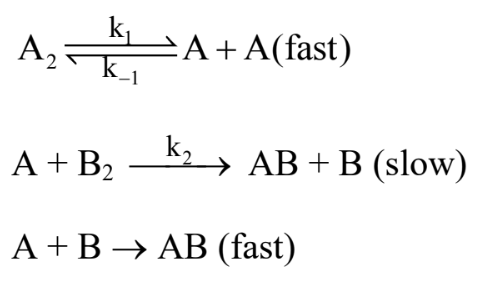 The overall order of the reaction is :
$\mathrm{FeO}_4^{2-} \xrightarrow{+2.0 \mathrm{v}} \mathrm{Fe}^{3+} \xrightarrow{0.8 \mathrm{v}} \mathrm{Fe}^{2+} \xrightarrow{-0.5 \mathrm{v}} \mathrm{Fe}^0$ In the above diagram, the standard electrode potentials are given in volts (over the arrow). The value of $\mathrm{E}_{\mathrm{FeO}_4^{2-} / \mathrm{Fe}^{2+}}^{\mathrm{O}}$ is
Choose the correct statements. (A) Weight of a substance is the amount of matter present in it. (B) Mass is the force exerted by gravity on an object. (C) Volume is the amount of space occupied by a substance. (D) Temperatures below \(0^{\circ} \mathrm{C}\) are possible in Celsius scale, but in Kelvin scale negative temperature is not possible. (E) Precision refers to the closeness of various measurements for the same quantity. Choose the correct answer from the options given below :
Fortification of food with iron is done using $\mathrm{FeSO}_4 \cdot 7 \mathrm{H}_2 \mathrm{O}$. The mass in grams of the $\mathrm{FeSO}_4 \cdot 7 \mathrm{H}_2 \mathrm{O}$ required to achieve 12 ppm of iron in 150 kg of wheat is ____ (Nearest integer) [Given : Molar mass of $\mathrm{Fe}, \mathrm{S}$ and O respectively are 56,32 and $16 \mathrm{~g} \mathrm{~mol}^{-1}$ ]
Consider the following statements related to temperature dependence of rate constants. Identify the correct statements, A. The Arrhenius equation holds true only for an elementary homogenous reaction. B. The unit of A is same as that of k in Arrhenius equation. C. At a given temperature, a low activation energy means a fast reaction. D. A and Ea as used in Arrhenius equation depend on temperature. E. When $\mathrm{Ea} \gg \mathrm{RT}$. A and Ea become interdependent. Choose the correct answer from the options given below :
Which of the following mixing of 1 M base and 1 M acid leads to the largest increase in temperature?
Drug $X$ becomes ineffective after $50 \%$ decomposition. The original concentration of drug in a bottle was $16 \mathrm{mg} / \mathrm{mL}$ which becomes $4 \mathrm{mg} / \mathrm{mL}$ in 12 months. The expiry time of the drug in months is __________$\qquad$ Assume that the decomposition of the drug follows first order kinetics.
Given below are two statements Statement I : A catalyst cannot alter the equilibrium constant $\left(\mathrm{K}_{\mathrm{c}}\right)$ of the reaction, temperature remaining constant Statement II : A homogenous catalyst can change the equilibrium composition of a system temperature remaining constant In the light of the above statements, choose the correct answer from the options given below
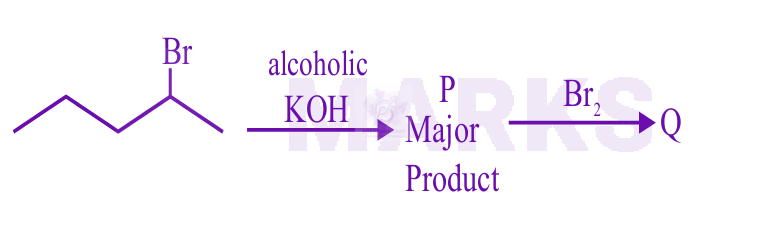 Consider the above sequence of reactions. 151 g of 2-bromopentane is made to react. Yield of major product P is $80 \%$ whereas Q is $100 \%$. Mass of product Q obtained is ____ g. (Given molar mass in $\mathrm{g} \mathrm{mol}^{-1} \mathrm{H}: 1, \mathrm{C}: 12, \mathrm{O}: 16$, $\mathrm{Br}: 80)$
$\mathrm{O}_2$ gas will be evolved as a product of electrolysis of : (A) an aqueous solution of $\mathrm{AgNO}_3$ using silver electrodes. (B) an aqueous solution of $\mathrm{AgNO}_3$ using platinum electrodes. (C) a dilute solution of $\mathrm{H}_2 \mathrm{SO}_4$ using platinum electrodes. (D) a high concentration solution of $\mathrm{H}_2 \mathrm{SO}_4$ using platinum electrodes. Choose the correct answer from the options given below :
Which of the following happens when $\mathrm{NH}_4 \mathrm{OH}$ is added gradually to the solution containing 1 M $\mathrm{A}^{2+}$ and $1 \mathrm{MB}^{3+}$ ions? Given : $\mathrm{K}_{\mathrm{sp}}\left[\mathrm{A}(\mathrm{OH})_2\right]=9 \times 10^{-10}$ and $\mathrm{K}_{\mathrm{sp}}\left[\mathrm{B}(\mathrm{OH})_3\right]=27 \times 10^{-18}$ at 298 K .
For electron in ' 2 s ' and ' 2 p ' orbitals, the orbital angular momentum values, respectively are :
For bacterial growth in a cell culture, growth law is very similar to the law of radioactive decay. Which of the following graphs is most suitable to represent bacterial colony growth ? Where N - Number of Bacteria at any time, $\mathrm{N}_0$ - Initial number of Bacteria.
Consider the given plots of vapour pressure (VP) vs temperature(T/K). Which amongst the following options is correct graphical representation showing $\Delta \mathrm{T}_{\mathrm{f}}$, depression in the freezing point of a solvent in a solution?
Consider a complex reaction taking place in three steps with rate constants $k_1, k_2$ and $k_3$ respectively. The overall rate constant $k$ is given by the expression $k=\sqrt{\frac{k_1 k_3}{k_2}}$. If the activation energies of the three steps are 60,30 and $10 \mathrm{~kJ} \mathrm{~mol}{ }^{-1}$ respectively, then the overall energy of activation in $\mathrm{kJ} \mathrm{mol}^{-1}$ is $\ldots\ldots$ . (Nearest integer)
On charging the lead storage battery, the oxidation state of lead changes from $x_1$ to $y_1$ at the anode and from $x_2$ to $y_2$ at the cathode. The values of $x_1, y_1, x_2, y_2$ are respectively :
If equal volumes of \(\mathrm{AB}_2\) and XY (both are salts) aqueous solutions are mixed, which of the following combination will give a precipitate of \(\mathrm{AY}_2\) at 300 K ? (Given \(\mathrm{K}_{\mathrm{sp}}\) (at 300 K) for \(\mathrm{AY}_2=5.2 \times 10^{-7}\))
Given below are two statements :  In the light of the above statements, choose the correct answer from the options given below :
The molar conductivity of a weak electrolyte when plotted against the square root of its concentration, which of the following is expected to be observed ?
Which of the following binary mixture does not show the behaviour of minimum boiling azeotropes?
pH of water is 7 at $25^{\circ} \mathrm{C}$. If water is heated to $80^{\circ} \mathrm{C}$., it's pH will :
The hydrocarbon $(X)$ with molar mass $80 \mathrm{~g} \mathrm{~mol}^{-1}$ and $90 \%$ carbon has $\ldots\ldots$ degree of unsaturation.
Given below are two statements : Statement (I) : Molal depression constant $\mathrm{K}_{\mathrm{f}}$ is given by $\frac{M_1 R T_f}{\Delta S_{f u s}}$, where symbols have their usual meaning. Statement (II) : $\mathrm{K}_{\mathrm{f}}$ for benzene is less than the $\mathrm{K}_{\mathrm{f}}$ for water. In the light of the above statements, choose the most appropriate answer from the options given below :
The formation enthalpies, $\Delta \mathrm{H}_{\mathrm{f}} \ominus$ for $\mathrm{H}_{(\mathrm{g})}$ and $\mathrm{O}_{(\mathrm{g})}$ are 220.0 and $250.0 \mathrm{~kJ} \mathrm{~mol}^{-1}$, respectively, at 298.15 K , and $\Delta \mathrm{H}_{\mathrm{f}}{ }^{\ominus}$ for $\mathrm{H}_2 \mathrm{O}_{(\mathrm{g})}$ is $-242.0 \mathrm{~kJ} \mathrm{~mol}^{-1}$ at the same temperature. The average bond enthalpy of the $\mathrm{O}-\mathrm{H}$ bond in water at 298.15 K is __________ $\mathrm{kJ} \mathrm{mol}^{-1}$ (nearest integer).
500 J of energy is transferred as heat to 0.5 mol of Argon gas at 298 K and 1.00 atm. The final temperature and the change in internal energy respectively are: Given : \(\mathrm{R}=8.3 \mathrm{~J} \mathrm{~K}^{-1} \mathrm{~mol}^{-1}\)
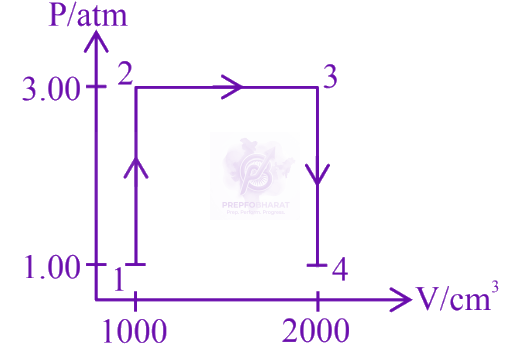 A perfect gas $(0.1 \mathrm{~mol})$ having $\overline{\mathrm{C}}_{\mathrm{v}}=1.50 \mathrm{R}$ (independent of temperature) undergoes the above transformation from point 1 to point 4. If each step is reversible, the total work done (w) while going from point 1 to point 4 is $(-)$ ________ J (nearest integer) $\left[\right.$ Given : $\left.\mathrm{R}=0.082 \mathrm{~L} \mathrm{~atm} \mathrm{~K}^{-1} \mathrm{~mol}^{-1}\right]$
Consider the reaction $\mathrm{X}_2 \mathrm{Y}(\mathrm{~g})=\mathrm{X}_2(\mathrm{~g})+\frac{1}{2} \mathrm{Y}_2(\mathrm{~g})$ The equation representing correct relationship between the degree of dissociation (x) of $\mathrm{X}_2 \mathrm{Y}(\mathrm{g})$ with its equilibrium constant Kp is ______ . Assume $x$ to be very very small.
The molarity of a $70 \%$ (mass $/$ mass) aqueous solution of a monobasic acid $(\mathrm{X})$ is __________ $\times 10^{-1}$ M(Nearest integer) [Given: Density of aqueous solution of (X) is $1.25 \mathrm{~g} \mathrm{~mL}^{-1}$ Molar mass of the acid is $70 \mathrm{~g} \mathrm{~mol}^{-1}$ ]
An organic compound weighing 500 mg , produced 220 mg of $\mathrm{CO}_2$. on complete combustion. The percentage composition of carbon in the compound is _____ \%. (nearest integer) (Given molar mass in $\mathrm{g} \mathrm{mol}^{-1}$ of $\mathrm{C}: 12, \mathrm{O}: 16$)
Correct statements for an element with atomic number 9 are A. There can be 5 electrons for which $\mathrm{m}_{\mathrm{s}}=+\frac{1}{2}$ and 4 electrons for which $\mathrm{m}_{\mathrm{s}}=-\frac{1}{2}$ B. There is only one electron in $p_z$ orbital C. The last electron goes to orbital with $\mathrm{n}=2$ and $l=1$ 4. The sum of angular nodes of all the atomic orbitals is 1. Choose the correct answer from the options given below:
Heat treatment of muscular pain involves radiation of wavelength of about 900 nm . Which spectral line of H atom is suitable for this? Given : Rydberg constant $\mathrm{R}_{\mathrm{H}}=10^5 \mathrm{~cm}^{-1}, \mathrm{~h}=6.6 \times 10^{-34} \mathrm{~J} \mathrm{~s}, \mathrm{c}=3 \times 10^8 \mathrm{~m} / \mathrm{s}$ )
Given below are two statements : 1 M aqueous solution of each of $\mathrm{Cu}\left(\mathrm{NO}_3\right)_2, \mathrm{AgNO}_3$, $\mathrm{Hg}_2\left(\mathrm{NO}_3\right)_2 ; \mathrm{Mg}\left(\mathrm{NO}_3\right)_2$ are electrolysed using inert electrodes, $\begin{aligned} & \text { Given : } \mathrm{E}_{\mathrm{Ag}^{+} / \mathrm{Ag}}^\theta=0.80 \mathrm{~V}, \mathrm{E}_{\mathrm{Hg}_2^{2+} / \mathrm{Hg}}^\theta=0.79 \mathrm{~V}, \\ & \mathrm{E}_{\mathrm{Cu}^{2+} / \mathrm{Cu}}^\theta=0.24 \mathrm{~V} \text { and } \mathrm{E}_{\mathrm{Mg}^{2+} / \mathrm{Mg}}^\theta=-2.37 \mathrm{~V}\end{aligned}$ Statement (I) : With increasing voltage, the sequence of deposition of metals on the cathode will be $\mathrm{Ag}, \mathrm{Hg}$ and Cu Statement (II) : Magnesium will not be deposited at cathode instead oxygen gas will be evolved at the cathode. In the light of the above statement, choose the most appropriate answer from the options given below
Liquid A and B form an ideal solution. The vapour pressure of pure liquids A and B are 350 and 750 mm Hg respectively at the same temperature. If $\mathrm{x}_{\mathrm{A}}$ and $x_B$ are the mole fraction of $A$ and $B$ in solution while $y_A$ and $y_B$ are the mole fraction of A and B in vapour phase then :
Let us consider a reversible reaction at temperature, T. In this reaction, both $\Delta \mathrm{H}$ and $\Delta \mathrm{S}$ were observed to have positive values. If the equilibrium temperature is Te , then the reaction becomes spontaneous at :
Radius of the first excited state of Helium ion is given as : $\mathrm{a}_0 \rightarrow$ radius of first stationary state of hydrogen atom.
Only litre buffer solution was prepared by adding 0.10 mol each of $\mathrm{NH}_3$ and $\mathrm{NH}_4 \mathrm{Cl}$ in deionised water. The change in pH on addition of 0.05 mol of HCl to the above solution is ________ $\times 10^{-2}$, (Nearest integer) (Given : $\mathrm{pK}_{\mathrm{b}}$ of $\mathrm{NH}_3=4.745$ and $\log _{10} 3=0.477$)
Which of the following graphs correctly represents the variation of thermodynamic properties of Haber's process?
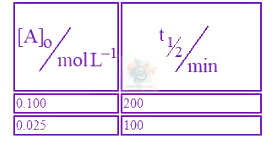 For a given reaction $\mathrm{R} \rightarrow \mathrm{P}, \mathrm{t}_{1 / 2}$ is related to $[\mathrm{A}]_0$ as given in table. Given: $\log 2=0.30$ Which of the following is true? A. The order of the reaction is $1 / 2$. B. If $[\mathrm{A}]_0$ is 1 M , then $\mathrm{t}_{1 / 2}$ is $200 \sqrt{10} \mathrm{~min}$ C. The order of the reaction changes to 1 if the concentration of reactant changes from 0.100 M to 0.500 M . D. $\mathrm{t}_{1 / 2}$ is 800 min for $[\mathrm{A}]_0=1.6 \mathrm{M}$ Choose the correct answer from the options given below: Options
20 mL of 2 M NaOH solution is added to 400 mL of 0.5 M NaOH solution. The final concentration of the solution is _______ $\times 10^{-2} \mathrm{M}$. (Nearest integer)
Sea water, which can be considered as a 6 molar $(6 \mathrm{M})$ solution of NaCl , has a density of $2 \mathrm{~g} \mathrm{~mL}^{-1}$. The concentration of dissolved oxygen $\left(\mathrm{O}_2\right)$ in sea water is 5.8 ppm. Then the concentration of dissolved oxygen $\left(\mathrm{O}_2\right)$ in sea water, is $\mathrm{x} \times 10^{-4} \mathrm{~m}$. $\mathrm{x}=$ _______. (Nearest integer) Given: Molar mass of NaCl is $58.5 \mathrm{~g} \mathrm{~mol}^{-1}$ Molar mass of $\mathrm{O}_2$ is $32 \mathrm{~g} \mathrm{~mol}^{-1}$
Given below are two statements: Statement I: In the oxalic acid vs $\mathrm{KMnO}_4$ (in the presence of dil $\mathrm{H}_2 \mathrm{SO}_4$ ) titration the solution needs to be heated initially to $60^{\circ} \mathrm{C}$, but no heating is required in Ferrous ammonium sulphate (FAS) vs $\mathrm{KMnO}_4$ titration (in the presence of dil $\mathrm{H}_2 \mathrm{SO}_4$ ) Statement II: In oxalic acid vs $\mathrm{KMnO}_4$ titration, the initial formation of $\mathrm{MnSO}_4$ takes place at high temperature, which then acts as catalyst for further reaction. In the case of FAS vs $\mathrm{KMnO}_4$, heating oxidizes $\mathrm{Fe}^{2+}$ into $\mathrm{Fe}^{3+}$ by oxygen of air and error may be introduced in the experiment. In the light of the above statements, choose the correct answer from the options given below
The effect of temperature on spontaneity of reactions are represented as : 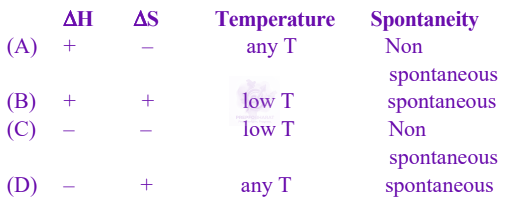
' x ' g of NaCl is added to water in a beaker with a lid. The temperature of the system is raised from $1^{\circ} \mathrm{C}$ to $25^{\circ} \mathrm{C}$. Which out of the following plots, is best suited for the change in the molarity (M) of the solution with respect to temperature? [Consider the solubility of NaCl remains unchanged over the temperature range]
The standard cell potential $\left(\mathrm{E}_{\text {cell }}^{\ominus}\right)$ of a fuel cell based on the oxidation of methanol in air that has been used to power television relay station is measured as 1.21 V. The standard half cell reduction potential for $\mathrm{O}_2\left(\mathrm{E}_{\mathrm{O}_2 / \mathrm{H}_2 \mathrm{O}}^{\mathrm{O}}\right)$ is 1.229 V. Choose the correct statement:
Let us consider an endothermic reaction which is non-spontaneous at the freezing point of water. However, the reaction is spontaneous at boiling point of water. Choose the correct option.
For the reaction \(\mathrm{A} \rightarrow\) products. 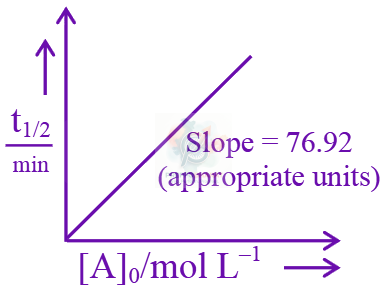 The concentration of A at 10 minutes is _______ \(\times 10^{-3} \mathrm{~mol} \mathrm{~L}^{-1}\) (nearest integer). The reaction was started with \(2.5 \mathrm{~mol} \mathrm{~L}^{-1}\) of A.
For a \(\mathrm{Mg}\left|\mathrm{Mg}^{2+}(\mathrm{aq})\right|\left|\mathrm{Ag}^{+}(\mathrm{aq})\right| \mathrm{Ag}\) the correct Nernst Equation is :
Given below is the plot of the molar conductivity vs $\sqrt{\text { concentration }}$ for KCl in aqueous solution. 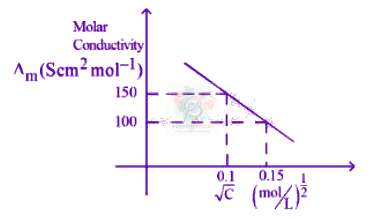 If, for the higher concentration of KCl solution, the resistance of the conductivity cell is $100 \Omega$, then the resistance of the same cell with the dilute solution is ' $x$ ' $\Omega$ The value of $x$ is __________ (Nearest integer)
Given below are two statements : Statement I : Mohr's salt is composed of only three types of ions-ferrous, ammonium and sulphate. Statement II : If the molar conductance at infinite dilution of ferrous, ammonium and sulphate ions are $\mathrm{x}_1, \mathrm{x}_2$ and $\mathrm{x}_3 \mathrm{~S} \mathrm{~cm}^2 \mathrm{~mol}^{-1}$, respectively then the molar conductance for Mohr's salt solution at infinite dilution would be given by $\mathrm{x}_1+\mathrm{x}_2+2 \mathrm{x}_3$ In the light of the given statements, choose the correct answer from the options given below :
For hydrogen like species, which of the following graphs provides the most appropriate representation of E vs Z plot for a constant n ? [E: Energy of the stationary state, Z : atomic number, $\mathrm{n}=$ principal quantum number]
$\mathrm{A}(\mathrm{g}) \rightarrow \mathrm{B}(\mathrm{g})+\mathrm{C}(\mathrm{g})$ is a first order reaction. $\begin{array}{|l|l|l|}\hline \text{Time} & T & \infty \\\hline \mathbf{P}_{\text {system }} & \mathrm{P}_{\mathrm{t}} & \mathrm{P}_{\infty} \\\hline\end{array}$ The reaction was started with reactant A only. Which of the following expression is correct for rate constant k ?
Standard electrode potentials for a few half cells are mentioned below : $\begin{aligned} & \mathrm{E}_{\mathrm{Cu}^{2+} / \mathrm{Cu}}^{\circ}=0.34 \mathrm{~V}, \mathrm{E}_{\mathrm{Zn}^{2+} / \mathrm{Zn}}^{\circ}=-0.76 \mathrm{~V} \\ & \mathrm{E}_{\mathrm{Ag}^{+} / \mathrm{Ag}}^{\circ}=0.80 \mathrm{~V}, \mathrm{E}_{\mathrm{Mg}^{2+} / \mathrm{Mg}}^{\circ}=-2.37 \mathrm{~V} \end{aligned}$ Which one of the following cells gives the most negative value of $\Delta \mathrm{G}^{\circ}$ ?
A solution of aluminium chloride is electrolysed for 30 minutes using a current of 2 A . The amount of the aluminium deposited at the cathode is [Given : molar mass of aluminium and chlorine are $27 \mathrm{~g} \mathrm{~mol}^{-1}$ and $35.5 \mathrm{~g} \mathrm{~mol}^{-1}$ respectively. Faraday constant $\left.=96500 \mathrm{C} \mathrm{mol}^{-1}\right]$
Consider a binary solution of two volatile liquid components 1 and $2 . x_1$ and $y_1$ are the mole fractions of component 1 in liquid and vapour phase, respectively. The slope and intercept of the linear plot of $\frac{1}{x_1}$ vs $\frac{1}{y_1}$ are given respectively as:
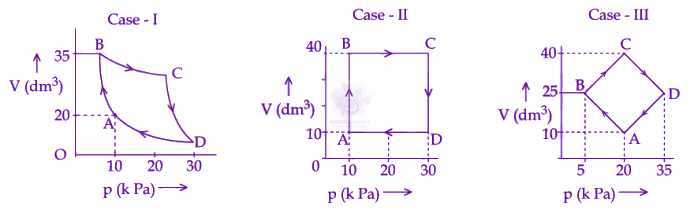 An ideal gas undergoes a cyclic transformation starting from the point $A$ and coming back to the same point by tracing the path $\mathrm{A} \rightarrow \mathrm{B} \rightarrow \mathrm{C} \rightarrow \mathrm{D} \rightarrow \mathrm{A}$ as shown in the three cases above. Choose the correct option regarding $\Delta \mathrm{U}$ :
Mass of magnesium required to produce 220 mL of hydrogen gas at STP on reaction with excess of dil. HCl is Given : Molar mass of Mg is $24 \mathrm{~g} \mathrm{~mol}^{-1}$.
The percentage dissociation of a salt $\left(\mathrm{MX}_3\right)$ solution at given temperature (van't Hoff factor $\mathrm{i}=$ 2) is ______ % (Nearest integer)
Ice at $-5^{\circ} \mathrm{C}$ is heated to become vapor with temperature of $110^{\circ} \mathrm{C}$ at atmospheric pressure. The entropy change associated with this process can be obtained from
Reaction $\mathrm{A}(\mathrm{g}) \rightarrow 2 \mathrm{~B}(\mathrm{~g})+\mathrm{C}(\mathrm{g})$ is a first order reaction. It was started with pure A 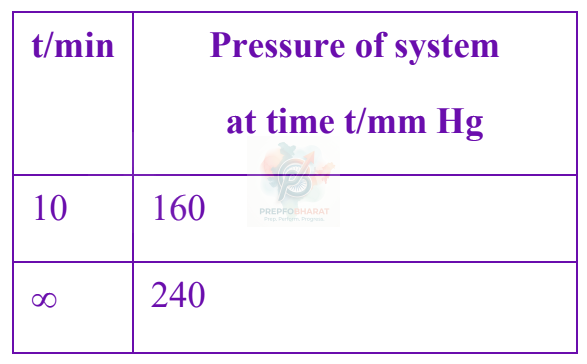 Which of the following option is incorrect?
Arrange the following in order of magnitude of work done by the system / on the system at constant temperature : (a) $\left|\mathrm{w}_{\text {reversible }}\right|$ for expansion in infinite stage. (b) $\left|w_{\text {irreversible }}\right|$ for expansion in single stage. (c) $\left|w_{\text {reversible }}\right|$ for compression in infinite stage. (d) $\left|w_{\text {irreversible }}\right|$ for compression in single stage. Choose the correct answer from the options given below:
Consider the equilibrium $\mathrm{CO}(\mathrm{~g})+3 \mathrm{H}_2(\mathrm{~g}) \rightleftharpoons \mathrm{CH}_4(\mathrm{~g})+\mathrm{H}_2 \mathrm{O}(\mathrm{~g})$ If the pressure applied over the system increases by two fold at constant temperature then (A) Concentration of reactants and products increases. (B) Equilibrium will shift in forward direction. (C) Equilibrium constant increases since concentration of products increases. (D) Equilibrium constant remains unchanged as concentration of reactants and products remain same. Choose the correct answer from the options given below :
The bond dissociation enthalpy of $\mathrm{X}_2 \Delta \mathrm{H}_{\text {bond }}$ calculated from the given data is $\qquad$ $\mathrm{kJ} \mathrm{mol}^{-1}$. (Nearest integer) $\begin{aligned} & \mathrm{M}^{+} \mathrm{X}^{-}(\mathrm{s}) \rightarrow \mathrm{M}^{+}(\mathrm{g})+\mathrm{X}^{-}(\mathrm{g}) \Delta \mathrm{H}_{\text {lattice }}^*=800 \mathrm{~kJ} \mathrm{~mol}^{-1} \\ & \mathrm{M}(\mathrm{~s}) \rightarrow \mathrm{M}(\mathrm{~g}) \Delta \mathrm{H}_{\text {sub }}^{\circ}=100 \mathrm{~kJ} \mathrm{~mol}^{-1} \end{aligned}$ $\mathrm{M}(\mathrm{~g}) \rightarrow \mathrm{M}^{+}(\mathrm{g})+\mathrm{e}^{-}(\mathrm{g}) \Delta \mathrm{H}_{\mathrm{i}}=500 \mathrm{~kJ} \mathrm{~mol}^{-1}$ $\mathrm{X}(\mathrm{~g})+\mathrm{e}^{-}(\mathrm{g}) \rightarrow \mathrm{X}^{-}(\mathrm{g}) \Delta \mathrm{H}_{\mathrm{eg}}^*=-300 \mathrm{~kJ} \mathrm{~mol}^{-1}$ $\mathrm{M}(\mathrm{~s})+\frac{1}{2} \mathrm{X}_2(\mathrm{~g}) \rightarrow \mathrm{M}^{+} \mathrm{X}^{-}(\mathrm{s}) \Delta \mathrm{H}_f^{\circ}=-400 \mathrm{~kJ} \mathrm{~mol}^{-1}$ [Given : $\mathrm{M}^{+} \mathrm{X}^{-}$is a pure ionic compound and X forms a diatomic molecule $\mathrm{X}_2$ in gaseous state]
Given below are two statements about X-ray spectra of elements : Statement (I) : A plot of $\sqrt{v}$ ( $v=$ frequency of $X$-rays emitted) vs atomic mass is a straight line. Statement (II) : A plot of $v(v=$ frequency of $X$-rays emitted) vs atomic number is a straight line. In the light of the above statements, choose the correct answer from the options given below :
If \(\mathrm{a}_0\) is denoted as the Bohr radius of hydrogen atom, then what is the de-Broglie wavelength \((\lambda)\) of the electron present in the second orbit of hydrogen atom? [n : any integer]
Ice and water are placed in a closed container at a pressure of 1 atm and temperature 273.15 K . If pressure of the system is increased 2 times, keeping temperature constant, then identify correct observation from following
For hydrogen atom, the orbital/s with lowest energy is/are : (A) 4 s (B) $3 \mathrm{p}_x$ (C) $3 \mathrm{~d}_{x^2-y^2}$ (D) $3 \mathrm{~d}_{z^2}$ (E) $4 \mathrm{p}_z$ Choose the correct answer from the options given below :
The calculated spin-only magnetic moments of $\mathrm{K}_3\left[\mathrm{Fe}(\mathrm{OH})_6\right]$ and $\mathrm{K}_4\left[\mathrm{Fe}(\mathrm{OH})_6\right]$ respectively are :
0.1 M solution of KI reacts with excess of $\mathrm{H}_2 \mathrm{SO}_4$ and $\mathrm{KIO}_3$ solutions. According to equation $5 \mathrm{I}^{-}+\mathrm{IO}_3^{-}+6 \mathrm{H}^{+} \rightarrow 3 \mathrm{I}_2+3 \mathrm{H}_2 \mathrm{O}$ Identify the correct statements : (A) 200 mL of KI solution reacts with 0.004 mol of $\mathrm{KIO}_3$ (B) 200 mL of KI solution reacts with 0.006 mol of $\mathrm{H}_2 \mathrm{SO}_4$ (C) 0.5 L of KI solution produced 0.005 mol of $\mathrm{I}_2$ (D) Equivalent weight of $\mathrm{KIO}_3$ is equal to ( $\frac{\text { Molecular weight }}{5}$ ) Choose the correct answer from the options given below :
Consider the following cases of standard enthalpy of reaction $\left(\Delta \mathrm{H}_{\mathrm{r}}^{\circ}\right.$ in $\left.\mathrm{kJ} \mathrm{mol}{ }^{-1}\right)$ $\begin{aligned} & \mathrm{C}_2 \mathrm{H}_6(\mathrm{~g})+\frac{7}{2} \mathrm{O}_2(\mathrm{~g}) \rightarrow 2 \mathrm{CO}_2(\mathrm{~g})+3 \mathrm{H}_2 \mathrm{O}(\mathrm{l}) \Delta \mathrm{H}_1^{\circ}=-1550 \\ & \mathrm{C} \text { (graphite) }+\mathrm{O}_2(\mathrm{~g}) \rightarrow \mathrm{CO}_2(\mathrm{~g}) \quad \Delta \mathrm{H}_2^{\circ}=-393.5 \\ & \mathrm{H}_2(\mathrm{~g})+\frac{1}{2} \mathrm{O}_2(\mathrm{~g}) \rightarrow \mathrm{H}_2 \mathrm{O}(\mathrm{l}) \quad \Delta \mathrm{H}_3^{\circ}=-286 \end{aligned}$ The magnitude of $\Delta \mathrm{H}_{f \mathrm{C}_2 \mathrm{H}_6(\mathrm{~g})}^{\circ}$ is _______ $\mathrm{kJ} \mathrm{mol}{ }^{-1}$ (Nearest integer).
Consider the following half cell reaction $\mathrm{Cr}_2 \mathrm{O}_7^{2-}(\mathrm{aq})+6 \mathrm{e}^{-}+14 \mathrm{H}^{+}(\mathrm{aq})$ $\rightarrow 2 \mathrm{Cr}^{3+}(\mathrm{aq})+7 \mathrm{H}_2 \mathrm{O}(\mathrm{l})$ The reaction was conducted with the ratio of $\frac{\left[\mathrm{Cr}^{3+}\right]^2}{\left[\mathrm{Cr}_2 \mathrm{O}_7^{2-}\right]}=10^{-6}$. The pH value at which the EMF of the half cell will become zero is ________. (nearest integer value) [Given : standard half cell reduction potential $\left.\mathrm{E}_{\mathrm{Cr}_2 \mathrm{O}_7^{2-}, \mathrm{H}^{+} / \mathrm{Cr}^{3+}}^{\mathrm{o}}=1.33 \mathrm{~V}, \frac{2.303 \mathrm{RT}}{\mathrm{~F}}=0.059 \mathrm{~V}\right]$
The molar conductance of an infinitely dilute solution of ammonium chloride was found to be $185 \mathrm{~S} \mathrm{~cm}^2 \mathrm{~mol}^{-1}$ and the ionic conductance of hydroxyl and chloride ions are 170 and $70 \mathrm{~S} \mathrm{~cm}^2 \mathrm{~mol}^{-}$ ${ }^1$, respectively. If molar conductance of 0.02 M solution of ammonium hydroxide is $85.5 \mathrm{~S} \mathrm{~cm}^2 \mathrm{~mol}^{-1}$, its degree of dissociation is given by $\mathrm{x} \times 10^{-1}$. The value of $x$ is ________ (Nearest integer)
Which of the following graphs most appropriately represents a zero order reaction ?
The ideal gas equation relating pressure P, volume V, number of moles n, and temperature T is:
Arrange the following solutions in order of their increasing boiling points. (i) $10^{-4} \mathrm{M~} \mathrm{NaCl}$ (ii) $10^{-4} \mathrm{M~}$ Urea (iii) $10^{-3} \mathrm{M~} \mathrm{NaCl}$ (iv) $10^{-2} \mathrm{M~} \mathrm{NaCl}$
Consider the following chemical equilibrium of the gas phase reaction at a constant temperature : $\mathrm{A}(\mathrm{~g}) \rightleftharpoons \mathrm{B}(\mathrm{~g})+\mathrm{C}(\mathrm{~g})$ If $p$ being the total pressure, $K_p$ is the pressure equilibrium constant and $\alpha$ is the degree of dissociation, then which of the following is true at equilibrium?
Consider an elementary reaction $\mathrm{A}(\mathrm{g})+\mathrm{B}(\mathrm{g}) \rightarrow \mathrm{C}(\mathrm{g})+\mathrm{D}(\mathrm{g})$ If the volume of reaction mixture is suddenly reduced to $\frac{1}{3}$ of its initial volume, the reaction rate will become ' $x$ ' times of the original reaction rate. The value of $x$ is :
20 mL of sodium iodide solution gave 4.74 g silver iodide when treated with excess of silver nitrate solution. The molarity of the sodium iodide solution is ________ M. (Nearest Integer value) (Given : $\mathrm{Na}=23, \mathrm{I}=127, \mathrm{Ag}=108, \mathrm{~N}=14$, $\mathrm{O}=16 \mathrm{~g} \mathrm{~mol}^{-1}$)
For the thermal decomposition of $\mathrm{N}_2 \mathrm{O}_5(\mathrm{~g})$ at constant volume, the following table can be formed, for the reaction mentioned below. $2 \mathrm{~N}_2 \mathrm{O}_5(\mathrm{~g}) \rightarrow 2 \mathrm{~N}_2 \mathrm{O}_4(\mathrm{~g})+\mathrm{O}_2(\mathrm{~g})$ 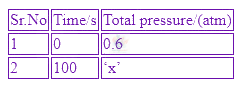 $\mathrm{x}=\ldots \times 10^{-3} \mathrm{~atm} \text { [nearest integer] }$ Given : Rate constant for the reaction is $4.606 \times 10^{-2} \mathrm{~s}^{-1}$.
On complete combustion 1.0 g of an organic compound (X) gave 1.46 g of \(\mathrm{CO}_2\) and 0.567 g of \(\mathrm{H}_2 \mathrm{O}\). The empirical formula mass of compound \((\mathrm{X})\) is ________ g. (Given molar mass in \(\mathrm{g} \mathrm{mol}^{-1} \mathrm{C}: 12, \mathrm{H}: 1, \mathrm{O}: 16\))
1.24 g of \(\mathrm{AX}_2\) (molar mass \(124 \mathrm{~g} \mathrm{~mol}^{-1}\) ) is dissolved in 1 kg of water to form a solution with boiling point of \(100.0156^{\circ} \mathrm{C}\), while \(25.4 \mathrm{~g}^{\circ}\) of \(\mathrm{AY}_2\) (molar mass \(250 \mathrm{~g} \mathrm{~mol}^{-1}\) ) in 2 kg of water constitutes a solution with a boiling point of \(100.0260^{\circ} \mathrm{C}\). \(\mathrm{K}_{\mathrm{b}}\left(\mathrm{H}_2 \mathrm{O}\right)=0.52 \mathrm{~K} \mathrm{~kg} \mathrm{~mol}^{-1}\) Which of the following is correct ?
For $\mathrm{A}_2+\mathrm{B}_2 \rightleftharpoons 2 \mathrm{AB}$ $\mathrm{E}_{\mathrm{a}}$ for forward and backward reaction are 180 and $200 \mathrm{~kJ} \mathrm{~mol}^{-1}$ respectively If catalyst lowers $\mathrm{E}_{\mathrm{a}}$ for both reaction by $100 \mathrm{~kJ} \mathrm{~mol}^{-1}$. Which of the following statement is correct?
One mole of an ideal gas expands isothermally and reversibly from $10 \mathrm{dm}^3$ to $20 \mathrm{dm}^3$ at $300 \mathrm{~K}. \Delta \mathrm{U}$, q and work done in the process respectively are : Given : $\mathrm{R}=8.3 \mathrm{JK}^{-1}$ and $\mathrm{mol}^{-1}$ $\begin{aligned}<br />& \text { In } 10=2.3 \\ & \log 2=0.30 \\ & \log 3=0.48<br />\end{aligned}$
$1$ Faraday electricity was passed through $\mathrm{Cu}^{2+}(1.5$ $\mathrm{M}, 1 \mathrm{~L}) / \mathrm{Cu}$ and $0.1$ Faraday was passed through $\mathrm{Ag}^{+}(0.2 \mathrm{M}, 1 \mathrm{~L}) / \mathrm{Ag}$ electrolytic cells. After this the two cells were connected as shown below to make an electrochemical cell. The emf of the cell thus formed at 298 K is- 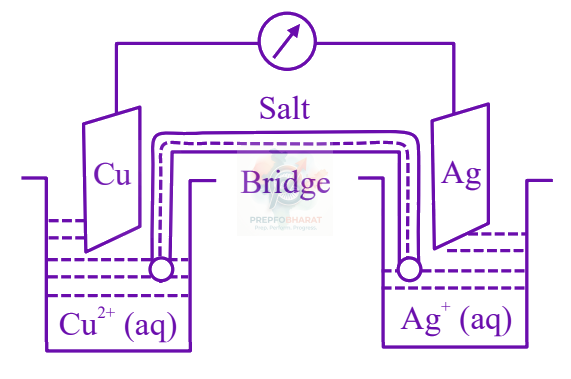 Given: $\mathrm{E}_{\mathrm{Cu}^{2+} / \mathrm{Cu}}^{\mathrm{o}}=0.34 \mathrm{~V}$ $\mathrm{E}_{\mathrm{Ag}^{+} / \mathrm{Ag}}^0=0.8 \mathrm{~V}$ $\frac{2.303 \mathrm{RT}}{\mathrm{F}}=0.06 \mathrm{~V}$
Consider the following electrochemical cell at standard condition. \(\begin{aligned} & \mathrm{Au}(\mathrm{s})\left|\mathrm{QH}_2, \mathrm{Q}\right| \mathrm{NH}_4 \mathrm{X}(0.01 \mathrm{M})| | \mathrm{Ag}^{+}(1 \mathrm{M}) \mid \mathrm{Ag}(\mathrm{s}) \\ & \mathrm{E}_{\text {cell }}=+0.4 \mathrm{~V} \end{aligned}\) The couple \(\mathrm{QH}_2 / \mathrm{Q}\) represents quinhydrone electrode, the half cell reaction is given below 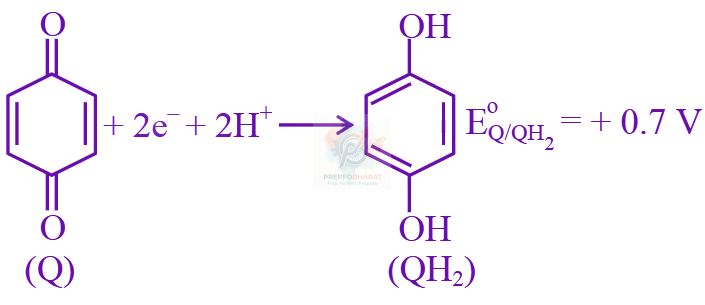 The \(\mathrm{pK}_{\mathrm{b}}\) value of the ammonium halide salt \(\left(\mathrm{NH}_4 \mathrm{X}\right)\) used here is _________. (nearest integer)
If 1 mM solution of ethylamine produces $\mathrm{pH}=9$, then the ionization constant $\left(\mathrm{K}_{\mathrm{b}}\right)$ of ethylamine is $10^{-x}$. The value of $x$ is ______ (nearest integer). [The degree of ionization of ethylamine can be neglected with respect to unity.]
Xg of benzoic acid on reaction with aq $\mathrm{NaHCO}_3$ released $\mathrm{CO}_2$ that occupied 11.2 L volume at STP. X is _____ g.
For the reaction $\mathrm{A} \rightarrow \mathrm{B}$ the following graph was obtained. The time required (in seconds) for the concentration of A to reduce to $2.5 \mathrm{~g} \mathrm{~L}^{-1}$ (if the initial concentration of A was $50 \mathrm{~g} \mathrm{~L}^{-1}$) is _______ (Nearest integer) Given : $\log 2=0.3010$ [We can assume in a hypothetical situation that the graph is correct, assuming its first order reaction, in reality the question is wrong.] 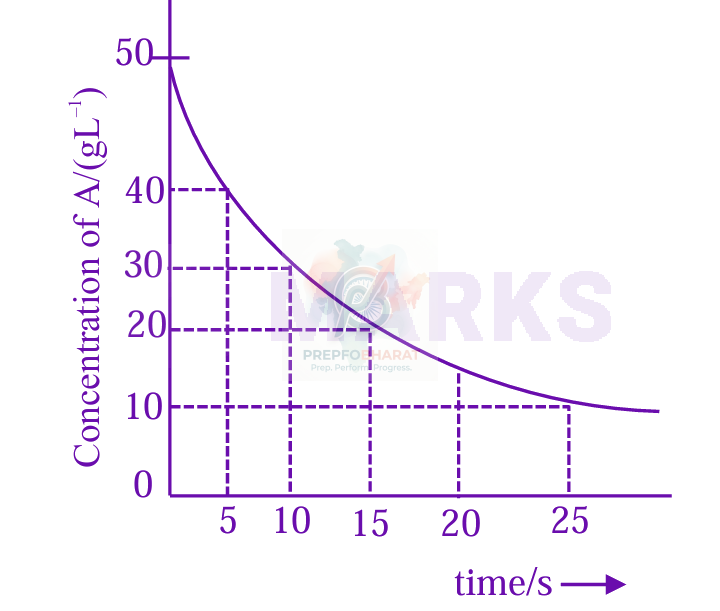
If \(A_2 B\) is \(30 \%\) ionised in an aqueous solution, then the value of van't Hoff factor (i) is ______ \(\times 10^{-1}\).
Half life of zero order reaction $\mathrm{A} \rightarrow$ product is 1 hour, when initial concentration of reaction is $2.0 \mathrm{~mol} \mathrm{~L} \mathrm{~L}^{-1}$. The time required to decrease concentration of A from 0.50 to $0.25 \mathrm{~mol} \mathrm{~L}^{-1}$ is:
Arrange the following in increasing order of solubility product : $\mathrm{Ca}(\mathrm{OH})_2, \mathrm{AgBr}, \mathrm{PbS}, \mathrm{HgS}$
When a non-volatile solute is added to the solvent, the vapour pressure of the solvent decreases by 10 mm of Hg . The mole fraction of the solute in the solution is 0.2 . What would be the mole fraction of the solvent if decrease in vapour pressure is 20 mm of Hg ?
In a first order decomposition reaction, the time taken for the decomposition of reactant to one fourth and one eighth of its initial concentration are $t_1$ and $t_2(s)$, respectively. The ratio $t_1 / t_2$ will :
0.1 mol of the following given antiviral compound \((\mathrm{P})\) will weigh ________ \(\times 10^{-1} \mathrm{~g}\) 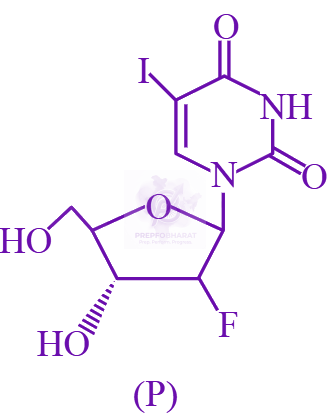 (Given : molar mass in \(\mathrm{g} \mathrm{mol}^{-1} \mathrm{H}: 1, \mathrm{C}: 12, \mathrm{~N}: 14\), \(\mathrm{O}: 16, \mathrm{~F}: 19, \mathrm{I}: 127)\)
Quantitative analysis of an organic compound (X) shows following % composition. C : $14.5 \%$ Cl : 64.46% H: 1.8 % (Empirical formula mass of the compound $(\mathrm{X})$ is __________ $\times 10^{-1}$ (Given molar mass in $\mathrm{g} \mathrm{mol}^{-1}$ of $\mathrm{C}: 12, \mathrm{H}: 1, \mathrm{O}: 16, \mathrm{Cl}: 35.5$)
For the reaction, $\mathrm{H}_2(\mathrm{~g})+\mathrm{I}_2(\mathrm{~g}) \rightleftharpoons 2 \mathrm{HI}(\mathrm{~g})$ Attainment of equillibrium is predicted correctly by :
A solution is made by mixing one mole of volatile liquid \(A\) with 3 moles of volatile liquid \(B\). The vapour pressure of pure A is 200 mm Hg and that of the solution is 500 mm Hg. The vapour pressure of pure \(B\) and the least volatile component of the solution, respectively, are :
0.01 mole of an organic compound $(X)$ containing $10 \%$ hydrogen, on complete combustion produced $0.9 \mathrm{~g} \mathrm{H}_2 \mathrm{O}$. Molar mass of $(\mathrm{X})$ is _____ $\mathrm{g} \mathrm{mol}^{-1}$.
What is the freezing point depression constant of a solvent, 50 g of which contain 1 g non volatile solute (molar mass $256 \mathrm{~g} \mathrm{~mol}^{-1}$ ) and the decrease in freezing point is 0.40 K ?
Match List-I with List-II $\begin{array}{|l|l|l|l|}\hline & \text{List-I} & & \text{List-II} \\ \hline \text{(A)} & \begin{array}{l} \text{Solution of} \\ \text{chloroform and} \\ \text{acetone} \end{array} & \text{(I)} & \begin{array}{l} \text{Minimum} \\ \text{boiling} \\ \text{azeotrope} \end{array} \\ \hline \text{(B)} & \begin{array}{l} \text{Solution of ethanol} \\ \text{and water} \end{array} & \text{(II)} & \text{Dimerizes} \\ \hline \text{(C)} & \begin{array}{l} \text{Solution of benzene} \\ \text{and toluene} \end{array} & \text{(III)} & \begin{array}{l} \text{Maximum} \\ \text{boiling} \\ \text{azeotrope} \end{array} \\ \hline \text{(D)} & \begin{array}{l} \text{Solution of acetic} \\ \text{acid in benzene} \end{array} & \text{(IV)} & \Delta \mathrm{V}_{\text {mix }}=0 \\ \hline \end{array}$ Choose the correct answer from the options given below :
On combustion 0.210 g of an orgainc compound containing $\mathrm{C}, \mathrm{H}$ and O gave $0.127 \mathrm{~g} \mathrm{H}_2 \mathrm{O}$ and 0.307 $\mathrm{g} \mathrm{CO}_2$. The percentages of hydrogen and oxygen in the given organic compound respectively are:
Which of the following properties will change when system containing solution 1 will become solution 2? 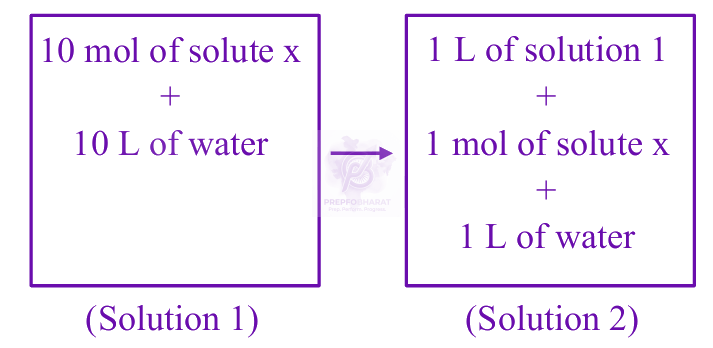
Compounds that should not be used as primary standards in titrimetric analysis are : A. $\mathrm{Na}_2 \mathrm{Cr}_2 \mathrm{O}_7$ B. Oxalic acid C. NaOH D. $\mathrm{FeSO}_4 \cdot 6 \mathrm{H}_2 \mathrm{O}$ E. Sodium tetraborate Choose the most appropriate answer from the options given below:
A sample of n-octane $(1.14 \mathrm{~g})$ was completely burnt in excess of oxygen in a bomb calorimeter, whose heat capacity is $5 \mathrm{~kJ} \mathrm{~K}^{-1}$. As a result of combustion reaction, the temperature of the calorimeter is increased by 5 K. The magnitude of the heat of combustion of octane at constant volume is ______ $\mathrm{kJ} \mathrm{mol}^{-1}$ (nearest integer).