JEE Main 2024 — Physical Chemistry
Chemistry Physical Chemistry questions from JEE Main 2024.
Other Years
177 Physical Chemistry Questions from 2024
What is the EMF of the cell under the given conditions using the Nernst equation?
What is the standard EMF of the cell?
Identify the incorrect statements regarding primary standard of titrimetric analysis. (A) It should be purely available in dry form. (B) It should not undergo chemical change in air. (C) It should be hygroscopic and should react with another chemical instantaneously and stoichiometrically. (D) It should be readily soluble in water. (E) \(\mathrm{KMnO}_4 ~\&~ \mathrm{NaOH}\) can be used as primary standard. Choose the correct answer from the options given below :
The emf of cell Tl \(\left|\underset{(0.001 \mathrm{M})}{\mathrm{Tl}^{+}}\right|\left|\underset{(0.01 \mathrm{M})}{\mathrm{Cu}^{2+}}\right| \mathrm{Cu}\) is \(0.83 \mathrm{~V}\) at \(298 \mathrm{~K}\). It could be increased by :
Two reactions are given below: $2{\mathrm{Fe}}_{(s)}+\frac{3}{2}{O}_{2(g)}\rightarrow {\mathrm{Fe}}_{2}{O}_{3(s)},\Delta {H}^{o}=-822\mathrm{kJ}/\mathrm{mol}$ ${C}_{(s)}+\frac{1}{2}{O}_{2(g)}\rightarrow {\mathrm{CO}}_{(g)},\Delta {H}^{o}=-110\mathrm{kJ}/\mathrm{mol}$ Then enthalpy change for following reaction $3{C}_{(s)}+{\mathrm{Fe}}_{2}{O}_{3(s)}\rightarrow 2{\mathrm{Fe}}_{(s)}+3{\mathrm{CO}}_{(g)}$
\(9.3 \mathrm{~g}\) of pure aniline is treated with bromine water at room temperature to give a white precipitate of the product ' \(\mathrm{P}\) '. The mass of product ' \(\mathrm{P}\) ' obtaind is \(26.4 \mathrm{~g}\). The percentage yield is _______ \(\%\).
For the given reaction, choose the correct expression of ${K}_{C}$ from the following: ${{\mathrm{Fe}}^{3+}}_{(\mathrm{aq})}+{{\mathrm{SCN}}^{-}}_{(\mathrm{aq})}\rightleftharpoons (\mathrm{FeSCN}{{)}^{2+}}_{(\mathrm{aq})}$
$2{\mathrm{MnO}}_{4}^{-}+{\mathrm{bI}}^{-}+{\mathrm{cH}}_{2}O\rightarrow {\mathrm{xI}}_{2}+{\mathrm{yMnO}}_{2}+{\mathrm{zOH}}^{-}$ If the above equation is balanced with integer coefficients, the value of $z$ is ________.
\(\Delta_{\text {vap }} \mathrm{H}^{\ominus}\) for water is \(+40.79 \mathrm{~kJ} \mathrm{~mol}^{-1}\) at 1 bar and \(100{ }^{\circ} \mathrm{C}\). Change in internal energy for this vapourisation under same condition is \(\qquad\) \(\mathrm{kJ} \mathrm{mol}^{-1}\). (Integer answer) (Given \(\mathrm{R}=8.3 \mathrm{JK}^{-1} \mathrm{~mol}^{-1}\))
Total number of species from the following which can undergo disproportionation reaction ___________. ${H}_{2}{O}_{2},{\mathrm{ClO}}_{3}^{-},{P}_{4},{\mathrm{Cl}}_{2},\mathrm{Ag},{\mathrm{Cu}}^{+1},{F}_{2},{\mathrm{NO}}_{2},{K}^{+}$
For the given hypothetical reactions, the equilibrium constants are as follows : \(\begin{aligned} & \mathrm{X} \rightleftharpoons \mathrm{Y} ; \mathrm{K}_1=1.0 \\ & \mathrm{Y} \rightleftharpoons \mathrm{Z} ; \mathrm{K}_2=2.0 \\ & \mathrm{Z} \rightleftharpoons \mathrm{W} ; \mathrm{K}_3=4.0 \end{aligned}\) The equilibrium constant for the reaction \(\mathrm{X} \rightleftharpoons \mathrm{W}\) is
Number of moles of methane required to produce $22g{\mathrm{CO}}_{2(g)}$ after combustion is $x\times {10}^{–2}$ moles. The value of $x$ is
For a certain reaction at $300K,K=10,$ then $\Delta G^{\circ}$ for the same reaction is – ________ $\times {10}^{-1}\mathrm{kJ}{\mathrm{mol}}^{-1}.$ (Given $R=8.314{\mathrm{JK}}^{-1}{\mathrm{mol}}^{-1}$)
Which of the following electronic configuration would be associated with the highest magnetic moment ?
A solution is prepared by adding 1 mole ethyl alcohol in 9 mole water. The mass percent of solute in the solution is ________ (Integer answer) (Given : Molar mass in \(\mathrm{g} \mathrm{mol}^{-1}\) Ethyl alcohol : 46 water: 18)
$10\mathrm{mL}$ of gaseous hydrocarbon on combustion gives $40\mathrm{mL}$ of ${\mathrm{CO}}_{2}(g)$ and $50\mathrm{mL}$ of water vapour. Total number of carbon and hydrogen atoms in the hydrocarbon is _______.
For the reaction ${N}_{2}{O}_{4}(g)\rightleftharpoons 2{\mathrm{NO}}_{2}(g)$, ${K}_{p}=0.492\mathrm{atm}$ at $300K.{K}_{c}$ for the reaction at same temperature is $______\times {10}^{-2}$. (Given :$R=0.082L\mathrm{atm}{\mathrm{mol}}^{-1}{K}^{-1}$)
An artificial cell is made by encapsulating \(0.2 \mathrm{M}\) glucose solution within a semipermeable membrane. The osmotic pressure developed when the artificial cell is placed within a \(0.05 \mathrm{M}\) solution of \(\mathrm{NaCl}\) at \(300 \mathrm{~K}\) is _______ \(\times 10^{-1}\) bar. (nearest integer). [Given : \(\mathrm{R}=0.083 \mathrm{~L} \mathrm{bar} \mathrm{mol}^{-1} \mathrm{~K}^{-1}\)] Assume complete dissociation of \(\mathrm{NaCl}\)
The electronic configuration for Neodymium is: [Atomic Number for Neodymium 60]
The values of conductivity of some materials at $298.15K$ in ${\mathrm{Sm}}^{-1}$ are $2.1\times {10}^{3},1.0\times {10}^{-16},1.2\times 10,3.91,1.5\times {10}^{-2},1\times {10}^{-7},1.0\times {10}^{3}$. The number of conductors among the materials is _____.
The correct set of four quantum numbers for the valence electron of rubidium atom $(Z=37)$ is:
A solution of two miscible liquids showing negative deviation from Raoult's law will have :
$1$ mole of $\mathrm{PbS}$ is oxidised by $X$ moles of ${O}_{3}$ to get $Y$ moles of ${O}_{2}.$ $X+Y=$
The quantity of silver deposited when one coulomb charge is passed through \(\mathrm{AgNO}_3\) solution :
Consider the following reactions \(\mathrm{NiS}+\mathrm{HNO}_3+\mathrm{HCl} \rightarrow \mathrm{A}+\mathrm{NO}+\mathrm{S}+\mathrm{H}_2 \mathrm{O}\) \(\begin{aligned} \mathrm{A}+\mathrm{NH}_4 \mathrm{OH}+\mathrm{H}_3 \mathrm{C}-\mathrm{C} & =\mathrm{N}-\mathrm{OH} \\ | ~\\ \mathrm{H}_3 \mathrm{C}-\mathrm{C} & =\mathrm{N}-\mathrm{OH}\end{aligned} \rightarrow \mathrm{B}+\mathrm{NH}_4 \mathrm{Cl}+\mathrm{H}_2 \mathrm{O}\) The number of protons that do not involve in hydrogen bonding in the product \(B\) is ______.
Choose the correct option for free expansion of an ideal gas under adiabatic condition from the following :
A solution containing \(10 \mathrm{~g}\) of an electrolyte \(\mathrm{AB}_2\) in \(100 \mathrm{~g}\) of water boils at \(100.52^{\circ} \mathrm{C}\). The degree of ionization of the electrolyte \((\alpha)\) is _______ \(\times 10^{-1}\). (nearest integer) [Given : Molar mass of \(\mathrm{AB}_2=200 \mathrm{~g} \mathrm{~mol}^{-1}, \mathrm{~K}_{\mathrm{b}}\) (molal boiling point elevation const. of water) \(=0.52 \mathrm{~K} \mathrm{~kg} \mathrm{~mol}^{-1}\), boiling point of water \(=100^{\circ} \mathrm{C} ; \mathrm{AB}_2\) ionises as \(\left.\mathrm{AB}_2 \rightarrow \mathrm{A}^{2+}+2 \mathrm{~B}^{-}\right]\)
Thiosulphate reacts differently with iodine and bromine in the reactions given below: \(\begin{aligned} & 2 \mathrm{~S}_2 \mathrm{O}_3^{2-}+\mathrm{I}_2 \rightarrow \mathrm{S}_4 \mathrm{O}_6^{2-}+2 \mathrm{I}^{-} \\ & \mathrm{S}_2 \mathrm{O}_3^{2-}+5 \mathrm{Br}_2+5 \mathrm{H}_2 \mathrm{O} \rightarrow 2 \mathrm{SO}_4^{2-}+4 \mathrm{Br}^{-}+10 \mathrm{H}^{+} \end{aligned}\) Which of the following statement justifies the above dual behaviour of thiosulphate?
The rate of first order reaction is $0.04\mathrm{mol}{L}^{-1}{s}^{-1}$ at $10$ minutes and $0.03\mathrm{mol}{L}^{-1}{s}^{-1}$ at $20$ minutes after initiation. Half life of the reaction is ______ minutes. (Given $\mathrm{log}2=0.3010,\mathrm{log}3=0.4771)$ Round off your answer to the nearest integer.
Which of the following statements is not correct about rusting of iron?
Molar ionic conductivities of divalent cation and anion are \(57 \mathrm{~S} \mathrm{~cm}^2 \mathrm{~mol}^{-1}\) and \(73 \mathrm{~S} \mathrm{~cm}^2 \mathrm{~mol}^{-1}\) respectively. The molar conductivity of solution of an electrolyte with the above cation and anion will be :
What pressure (bar) of \(\mathrm{H}_2\) would be required to make emf of hydrogen electrode zero in pure water at \(25^{\circ} \mathrm{C}\) ?
According to the wave-particle duality of matter by de-Broglie, which of the following graph plot presents most appropriate relationship between wavelength of electron $(\lambda )$ and momentum of electron $(p)?$
The Molarity \((\mathrm{M})\) of an aqueous solution containing \(5.85 \mathrm{~g}\) of NaCl in \(500 \mathrm{~mL}\) water is : (Given : Molar Mass \(\mathrm{Na}: 23\) and \(\mathrm{Cl}: 35.5 \mathrm{gmol}^{-1}\) )
Total number of ions from the following with noble gas configuration is ${\mathrm{Sr}}^{2+}(Z=38),{\mathrm{Cs}}^{+}(Z=55),{\mathrm{La}}^{2+}(Z=57){\mathrm{Pb}}^{2+}$$(Z=82),{\mathrm{Yb}}^{2+}(Z=70)\text{ and }{\mathrm{Fe}}^{2+}(Z=26)$
A conductivity cell with two electrodes (dark side) are half filled with infinitely dilute aqueous solution of a weak electrolyte. If volume is doubled by adding more water at constant temperature, the molar conductivity of the cell will - 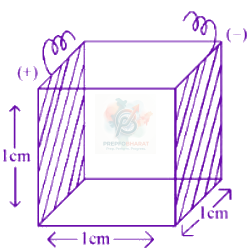
Molality ( \(\mathrm{m}\) ) of \(3 \mathrm{M}\) aqueous solution of \(\mathrm{NaCl}\) is : (Given : Density of solution \(=1.25 \mathrm{~g} \mathrm{~mL}^{-1}\), Molar mass in \(\mathrm{g} \mathrm{mol}^{-1}: \mathrm{Na}-23, \mathrm{Cl}-35.5\))
Match List I with List II \(\begin{array}{|l|l|l|l|} \hline & \text{ List - I (Cell) } & & \text{List - II (Use/Property/Reaction)} \\ \hline \text { A. } & \text { Leclanche cell } & \text { I. } & \begin{array}{l} \text { Converts energy of combustion into electrical } \\ \text { energy } \end{array} \\ \hline \text { B. } & \mathrm{Ni}-\mathrm{Cd} \text { cell } & \text { II. } & \begin{array}{l} \text { Does not involve any ion in solution and is used } \\ \text { in hearing aids } \end{array} \\ \hline \text { C. } & \text { Fuel cell } & \text { III. } & \text { Rechargeable } \\ \hline \text { D. } & \text { Mercury cell } & \text { IV. } & \text { Reaction at anode } \mathrm{Zn} \rightarrow \mathrm{Zn}^{2+}+2 \mathrm{e}^{-} \\ \hline \end{array}\) Choose the correct answer from the options given below:
The ionization energy of sodium in $\mathrm{kJ}{\mathrm{mol}}^{–1}$ . If electromagnetic radiation of wavelength $242\mathrm{nm}$ is just sufficient to ionize sodium atom is ______.(nearest integer)
Consider the two different first order reactions given below \(\mathrm{A}+\mathrm{B} \rightarrow \mathrm{C}\) (Reaction 1\()\) \(P \rightarrow Q\) (Reaction 2) The ratio of the half life of Reaction 1 : Reaction 2 is \(5: 2\). If \(t_1\) and \(t_2\) represent the time taken to complete \(2 / 3^{\text {rd }}\) and \(45^{\text {th }}\) of Reaction 1 and Reaction 2, respectively, then the value of the ratio \(t_1: t_2\) is ______ \(\times 10^{-1}\) (nearest integer). [Given : \(\log _{10}(3)=0.477\) and \(\log _{10}(5)=0.699\)]
The heat of solution of anhydrous \(\mathrm{CuSO}_4\) and \(\mathrm{CuSO}_4 \cdot 5 \mathrm{H}_2 \mathrm{O}\) are \(-70 \mathrm{~kJ} \mathrm{~mol}^{-1}\) and \(+12 \mathrm{~kJ} \mathrm{~mol}^{-1}\) respectively. The heat of hydration of \(\mathrm{CuSO}_4\) to \(\mathrm{CuSO}_4 \cdot 5 \mathrm{H}_2 \mathrm{O}\) is \(-x \mathrm{~kJ}\). The value of \(x\) is ______ (nearest integer).
An ideal gas, \(\overline{\mathrm{C}}_{\mathrm{v}}=\frac{5}{2} \mathrm{R}\), is expanded adiabatically against a constant pressure of 1 atm untill it doubles in volume. If the initial temperature and pressure is \(298 \mathrm{~K}\) and \(5 \mathrm{~atm}\), respectively then the final temperature is _______ \(\mathrm{K}\) (nearest integer). [\(\overline{\mathrm{C}}_{\mathrm{v}}\) is the molar heat capacity at constant volume]
If $5$ moles of an ideal gas expands from $10L$ to a volume of $100L$ at $300K$ under isothermal and reversible condition then work, $w$, is $-xJ$. The value of $x$ is $-$_______. (Given $R=8.314J{K}^{-1}{\mathrm{mol}}^{-1}$)
The enthalpy of formation of ethane \(\left(\mathrm{C}_2 \mathrm{H}_6\right)\) from ethylene by addition of hydrogen where the bond-energies of \(\mathrm{C}-\mathrm{H}, \mathrm{C}-\mathrm{C}, \mathrm{C}=\mathrm{C}, \mathrm{H}-\mathrm{H}\) are \(414 \mathrm{~kJ}, 347 \mathrm{~kJ}, 615 \mathrm{~kJ}\) and \(435 \mathrm{~kJ}\) respectively is \(\qquad\) \(\mathrm{kJ}\)
Given below are two statements : Statement I : On passing \(\mathrm{HCl}_{(\mathrm{g})}\) through a saturated solution of \(\mathrm{BaCl}_2\), at room temperature white turbidity appears. Statement II : When \(\mathrm{HCl}\) gas is passed through a saturated solution of \(\mathrm{NaCl}\), sodium chloride is precipitated due to common ion effect. In the light of the above statements, choose the most appropriate answer from the options given below :
Given below are two statements : Statement (I) : A Buffer solution is the mixture of a salt and an acid or a base mixed in any particular quantities. Statement (II) : Blood is naturally occurring buffer solution whose \(\mathrm{pH}\) is maintained by \(\mathrm{H}_2 \mathrm{CO}_3 / \mathrm{HCO}_3^- \Theta\) concentrations. In the light of the above statements, choose the correct answer from the options given below :
Given below are two statements : Statement (I) : Aqueous solution of ammonium carbonate is basic. Statement (II) : Acidic/basic nature of salt solution of a salt of weak acid and weak base depends on ${K}_{a}$ and ${K}_{b}$ value of acid and the base forming it. In the light of the above statements, choose the most appropriate answer from the options given below :
The $\mathrm{pH}$ at which $\mathrm{Mg}(\mathrm{OH}{)}_{2}[{K}_{\mathrm{sp}}=1\times {10}^{-11}]$ begins to precipitate from a solution containing $0.10M$ ${\mathrm{Mg}}^{2+}$ ions is ______.
What happens to freezing point of benzene when small quantity of napthalene is added to benzene?
Consider the following single step reaction in gas phase at constant temperature. \(2 \mathrm{~A}_{(\mathrm{g})}+\mathrm{B}_{(\mathrm{g})} \rightarrow \mathrm{C}_{(\mathrm{g})}\) The initial rate of the reaction is recorded as \(\mathrm{r}_1\) when the reaction starts with \(1.5 \mathrm{~atm}\) pressure of \(\mathrm{A}\) and \(0.7 \mathrm{~atm}\) pressure of \(\mathrm{B}\). After some time, the rate \(\mathrm{r}_2\) is recorded when the pressure of \(\mathrm{C}\) becomes \(0.5 \mathrm{~atm}\). The ratio \(\mathrm{r}_1: \mathrm{r}_2\) is ______ \(\times 10^{-1}\). (Nearest integer)
Time required for \(99.9 \%\) completion of a first order reaction is _______ times the time required for completion of \(90 \%\) reaction.(nearest integer)
Given below are two statements : Statement I: The rate law for the reaction \(A+B \rightarrow C\) is rate \((r)=k[A]^2[B]\). When the concentration of both A and B is doubled, the reaction rate is increased " \(x\) " times. Statement II : 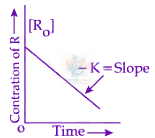 The figure is showing "the variation in concentration against time plot" for a " \(y\) " order reaction. The Value of \(x+y\) is ______
Consider the following reaction, the rate expression of which is given below \[ \begin{aligned} & \mathrm{A}+\mathrm{B} \rightarrow \mathrm{C} \\ & \text { rate }=\mathrm{k}[\mathrm{A}]^{1 / 2}[\mathrm{~B}]^{1 / 2} \end{aligned} \] The reaction is initiated by taking \(1 \mathrm{M}\) concentration of \(\mathrm{A}\) and \(\mathrm{B}\) each. If the rate constant \((\mathrm{k})\) is \(4.6 \times 10^{-2} \mathrm{~s}^{-1}\), then the time taken for \(\mathrm{A}\) to become \(0.1 \mathrm{M}\) is ______ sec. (nearest integer)
For a reaction taking place in three steps at same temperature, overall rate constant $K=\frac{{K}_{1}{K}_{2}}{{K}_{3}}$. If ${\mathrm{Ea}}_{1},{\mathrm{Ea}}_{2}$ and ${\mathrm{Ea}}_{3}$ are $40,50$ and $60\mathrm{kJ}/\mathrm{mol}$ respectively, the overall $\mathrm{Ea}$ is _________ $\mathrm{kJ}/\mathrm{mol}$.
When \(\Delta \mathrm{H}_{\mathrm{vap}}=30 \mathrm{~kJ} / \mathrm{mol}\) and \(\Delta \mathrm{S}_{\mathrm{vap}}=75 \mathrm{~J} \mathrm{~mol}^{-1} \mathrm{~K}^{-1}\), then the temperature of vapour, at one atmosphere is ______ \(\mathrm{K}\).
How can an electrochemical cell be converted into an electrolytic cell?
Match List - I with List - II. \(\begin{array}{ll} \text{List - I} & \text{List - II} \\ \text{Reaction} & \text{Type of redox reaction} \\ \text{(A) } \mathrm{N}_{2(\mathrm{~g})}+\mathrm{O}_{2(\mathrm{~g})} \rightarrow 2 \mathrm{NO}_{(\mathrm{g})} & \text{(I) Decomposition} \\ \text{(B) } 2 \mathrm{~Pb}\left(\mathrm{NO}_3\right)_{2(\mathrm{~s})} \rightarrow 2 \mathrm{PbO}_{(\mathrm{s})}+4 \mathrm{NO}_{2(\mathrm{~g})}+\mathrm{O}_{2(\mathrm{~g})} & \text{(II) Displacement} \\ \text{(C) } 2 \mathrm{Na}_{(\mathrm{s})}+2 \mathrm{H}_2 \mathrm{O}_{\text {(I) }} \rightarrow 2 \mathrm{NaOH}_{(\text {aq. }}+\mathrm{H}_{2(\mathrm{~g})} & \text{(III) Disproportionation} \\ \text{(D) } 2 \mathrm{NO}_{2(\text { g })}+2^{-} \mathrm{OH}( aq. ) \rightarrow \mathrm{NO}_{2(\text { aq. })}^{-}+\mathrm{NO}_{3(\text { aq. })}^{-}+\mathrm{H}_2 \mathrm{O}_{(\mathrm{l})} & \text{(IV) Combination} \end{array}\) Choose the correct answer from the options given below :
The four quantum numbers for the electron in the outer most orbital of potassium (atomic no. $19$) are
$0.05\mathrm{cm}$ thick coating of silver is deposited on a plate of $0.05{m}^{2}$ area. The number of silver atoms deposited on plate are _______$\times {10}^{23}$. (At mass Ag $=108,d=7.9g{\mathrm{cm}}^{-3})$ Round off to the nearest integer.
Match List I with List II \(\begin{array}{|l|l|l|l|} \hline & \text{ List - I (Element) } & & \text{List - II (Electronic configuration)} \\ \hline \text { A. } & \mathrm{N} & \text { I. } & {[\mathrm{Ar}] 3 \mathrm{~d}^{10} 4 \mathrm{~s}^2 4 \mathrm{p}^5 \mathrm{AR}} \\ \hline \text { B. } & \mathrm{S} & \text { II. } & {[\mathrm{Ne}] 3 \mathrm{~s}^2 3 \mathrm{p}^4} \\ \hline \text { C. } & \mathrm{Br} & \text { III. } & {[\mathrm{He}] 2 \mathrm{~s}^2 2 \mathrm{p}^3} \\ \hline \text { D. } & \mathrm{Kr} & \text { IV. } & {[\mathrm{Ar}] 3 \mathrm{~d}^{10} 4 \mathrm{~s}^2 4 \mathrm{p}^6} \\ \hline \end{array}\) Choose the correct answer from the options given below:
Reduction potential of ions are given below: ${\mathrm{ClO}}_{4}^{-}{\mathrm{IO}}_{4}^{-}{\mathrm{BrO}}_{4}^{-}$ $E^{\circ}=1.19V;E^{\circ}=1.65V;E^{\circ}=1.74V$ The correct order of their oxidising power is:
Compare the energies of following sets of quantum numbers for multielectron system. (A) \(\mathrm{n}=4,1=1\) (B) \(\mathrm{n}=4, \mathrm{l}=2\) (C) \(\mathrm{n}=3,1=1\) (D) \(\mathrm{n}=3,1=2\) (E) \(\mathrm{n}=4,1=0\) Choose the correct answer from the options given below :
For a sparingly soluble salt \(\mathrm{AB}_2\), the equilibrium concentrations of \(\mathrm{A}^{2+}\) ions and \(B^{-}\)ions are \(1.2 \times 10^{-4} \mathrm{M}\) and \(0.24 \times 10^{-3} \mathrm{M}\), respectively. The solubility product of \(\mathrm{AB}_2\) is :
The heat of combustion of solid benzoic acid at constant volume is \(-321.30 \mathrm{~kJ}\) at \(27^{\circ} \mathrm{C}\). The heat of combustion at constant pressure is \((-321.30-x \mathrm{R}) \mathrm{kJ}\), the value of \(x\) is _______.
Given below are two statements: Statement I : Gallium is used in the manufacturing of thermometers. Statement II : A thermometer containing gallium is useful for measuring the freezing point \((256 \mathrm{~K})\) of brine solution. In the light of the above statements, choose the correct answer from the options given below :
The density of ' \(x\) ' \(\mathrm{M}\) solution (' \(X\) ' molar) of \(\mathrm{NaOH}\) is \(1.12 \mathrm{~g} \mathrm{~mL}^{-1}\), while in molality, the concentration of the solution is \(3 \mathrm{~m}(3 \mathrm{molal})\). Then \(x\) is (Given : Molar mass of \(\mathrm{NaOH}\) is \(40 \mathrm{~g} / \mathrm{mol}\) )
Given below are two statements : One is labelled as Assertion (A) and the other is labelled as Reason (R) Assertion (A) : Enthalpy of neutralisation of strong monobasic acid with strong monoacidic base is always \(-57 \mathrm{~kJ} \mathrm{~mol}^{-1}\). Reason (R) : Enthalpy of neutralisation is the amount of heat liberated when one mole of \(\mathrm{H}^{+}\) ions furnished by acid combine with one mole of \(\mathrm{OH}^{-}\) ions furnished by base to form one mole of water. In the light of the above statements, choose the correct answer from the options given below.
\(2.5 \mathrm{~g}\) of a non-volatile, non-electrolyte is dissolved in \(100 \mathrm{~g}\) of water at \(25^{\circ} \mathrm{C}\). The solution showed a boiling point elevation by \(2^{\circ} \mathrm{C}\). Assuming the solute concentration is negligible with respect to the solvent concentration, the vapor pressure of the resulting aqueous solution is \(\qquad\) \(\mathrm{mm}\) of \(\mathrm{Hg}\) (nearest integer) [Given : Molal boiling point elevation constant of water \(\left(\mathrm{K}_{\mathrm{b}}\right)=0.52 \mathrm{~K} . \mathrm{kg} \mathrm{mol}^{-1}\), \(1 \mathrm{~atm}\) pressure \(=760 \mathrm{~mm}\) of \(\mathrm{Hg}\), molar mass of water \(=18 \mathrm{~g} \mathrm{~mol}^{-1}\)]
Molarity \((\mathrm{M})\) of an aqueous solution containing \(x \mathrm{~g}\) of anhyd. \(\mathrm{CuSO}_4\) in \(500 \mathrm{~mL}\) solution at \(32{ }^{\circ} \mathrm{C}\) is \(2 \times 10^{-1} \mathrm{M}\). Its molality will be ______ \(\times 10^{-3} \mathrm{~m}\). (nearest integer). [Given density of the solution \(=1.25 \mathrm{~g} / \mathrm{mL}\)]
Time required for completion of $99.9%$ of first order reaction is ________ times of half life $({t}_{1/2})$ of the reaction
The mass of silver (Molar mass of $\mathrm{Ag}:108{\mathrm{gmol}}^{-1}$ ) displaced by a quantity of electricity which displaces $5600\mathrm{mL}$ of ${O}_{2}$ at S.T.P. will be _____ g.
Which of the following reactions are disproportionation reactions? $(1){\mathrm{Cu}}^{+}\rightarrow {\mathrm{Cu}}^{2+}+\mathrm{Cu}$ $(2) 3{\mathrm{MnO}}_{4}^{2-}+4{H}^{+}\rightarrow 2{\mathrm{MnO}}_{4}^{-}+{\mathrm{MnO}}_{2}+2{H}_{2}O$ $(3)2{\mathrm{KMnO}}_{4}\rightarrow {K}_{2}{\mathrm{MnO}}_{4}+{\mathrm{MnO}}_{2}+{O}_{2}$ $(4)2{\mathrm{MnO}}_{4}^{-}+3{\mathrm{Mn}}^{2+}+2{H}_{2}O\rightarrow 5{\mathrm{MnO}}_{2}+4{H}^{+}$ Choose the correct answer from the options given below:
A constant current was passed through a solution of ${\mathrm{AuCl}}_{4}^{-}$ ion between gold electrodes. After a period of $10.0$ minutes, the increase in mass of cathode was $1.314g$. The total charge passed through the solution is ___$\times {10}^{-2}F$. (Given atomic mass of $\mathrm{Au}=197)$
The following data were obtained during the first order thermal decomposition of a gas $A$ at constant volume: $A(g)\rightarrow 2B(g)+C(g)$ S. No Time/s Total pressure/(atm) $1.$ $0$ $0.1$ $2.$ $115$ $0.28$ The rate constant of the reaction is _______ $\times {10}^{-2}{s}^{-1}$ (nearest integer)
If $50\mathrm{mL}$ of $0.5M$ oxalic acid is required to neutralise $25\mathrm{mL}$ of $\mathrm{NaOH}$ solution, the amount of $\mathrm{NaOH}$ in $50\mathrm{mL}$ of given $\mathrm{NaOH}$ solution is_______g.
${A}_{(g)}\rightleftharpoons {B}_{(g)}+\frac{C}{{2}^{(g)}}$. The correct relationship between ${K}_{P},\alpha$ and equilibrium pressure $P$ is
Three moles of an ideal gas are compressed isothermally from \(60 \mathrm{~L}\) to \(20 \mathrm{~L}\) using constant pressure of \(5 \mathrm{~atm}\). Heat exchange \(\mathrm{Q}\) for the compression is - ______ Lit. atm.
${K}_{a}$ for ${\mathrm{CH}}_{3}\mathrm{COOH}$ is $1.8\times {10}^{-5}$ and ${K}_{b}$ for ${\mathrm{NH}}_{4}\mathrm{OH}$ is $1.8\times {10}^{-5}.$ The $\mathrm{pH}$ of ammonium acetate solution will be
The molarity of $1L$ orthophosphoric acid $({H}_{3}{\mathrm{PO}}_{4})$ having $70%$ purity by weight (specific gravity $1.54g{\mathrm{cm}}^{-3}$) is ______ $M$. (Molar mass of ${H}_{3}{\mathrm{PO}}_{4}=98g{\mathrm{mol}}^{-1}$)
The following reaction occurs in the Blast furnance where iron ore is reduced to iron metal \(\mathrm{Fe}_2 \mathrm{O}_{3(\mathrm{~s})}+3 \mathrm{CO}_{(\mathrm{g})} \rightleftharpoons \mathrm{Fe}_{(\mathrm{l})}+3 \mathrm{CO}_{2(\mathrm{~g})}\) Using the Le-chatelier's principle, predict which one of the following will not disturb the equilibrium.
Consider the following data for the given reaction $2{\mathrm{HI}}_{(g)}\rightarrow {H}_{2(g)}+{I}_{2(g)}$ $\begin{matrix}\mathrm{HI}({\mathrm{molL}}^{-1}) & 0.005 & 0.01 & 0.02\end{matrix}$ Rate $({\mathrm{molL}}^{-1}{s}^{-1})7.5\times {10}^{-4}3.0\times {10}^{-3}1.2\times {10}^{-2}$ The order of the reaction is __________.
Among the following halogens \(\mathrm{F}_2, \mathrm{Cl}_2, \mathrm{Br}_2\) and \(\mathrm{I}_2\) Which can undergo disproportionation reactions?
Given below are two statements : Statement (I) : Potassium hydrogen phthalate is a primary standard for standardisation of sodium hydroxide solution. Statement (II) : In this titration phenolphthalein can be used as indicator. In the light of the above statements, choose the most appropriate answer from the options given below:
In acidic medium, ${K}_{2}{\mathrm{Cr}}_{2}{O}_{7}$ shows oxidising action as represented in the half reaction ${\mathrm{Cr}}_{2}{O}_{7}^{2-}+{\mathrm{XH}}^{+}+{\mathrm{Ye}}^{-}\rightarrow 2A+{\mathrm{ZH}}_{2}O$ $X,Y,Z$ and $A$ are respectively are:
Consider the following reaction at $298K$. $\frac{3}{2}{O}_{2(g)}\rightleftharpoons {O}_{3(g)}.{K}_{p}=2.47\times {10}^{-29}$ ${\Delta }_{r}{G}^{0}$ for the reaction is _________ $\mathrm{kJ}$. (Given $R=8.314{\mathrm{JK}}^{–1}{\mathrm{mol}}^{–1}$) Round off your answer to the nearest integer.
Integrated rate law equation for a first order gas phase reaction is given by (where ${P}_{i}$ is initial pressure and ${P}_{t}$ is total pressure at time $t$)
Consider the following transformation involving first order elementary reaction in each step at constant temperature as shown below. \(A+B \underset{\text { Step 3 }}{\text { Step } 1} C \xrightarrow{\text { Step 2 }} P\) Some details of the above reactions are listed below. \(\begin{array}{ccc} \text { Step } & \text { Rate constant }\left(\mathbf{s e c}^{-\mathbf{1}}\right) & \text { Activation energy }\left(\mathbf{k J ~ m o l}^{-\mathbf{1}}\right) \\ 1 & \mathrm{k}_1 & 300 \\ 2 & \mathrm{k}_2 & 200 \\ 3 & \mathrm{k}_3 & \mathrm{Ea}_3 \end{array}\) If the overall rate constant of the above transformation \((k)\) is given as \(k=\frac{k_1 k_2}{k_3}\) and the overall activation energy \(\left(\mathrm{E}_{\mathrm{a}}\right)\) is \(400 \mathrm{~kJ} \mathrm{~mol}^{-1}\), then the value of \(\mathrm{Ea}_3\) is \(\qquad\) \(\mathrm{kJ} \mathrm{mol}^{-1}\) (nearest integer)
The half-life of radioisotopic bromine - $82$ is $36$ hours. The fraction which remains after one day is _________$\times {10}^{-2}$. (Given antilog $0.2006=1.587)$ Round off to the nearest integer
The incorrect postulates of the Dalton's atomic theory are : (A) Atoms of different elements differ in mass. (B) Matter consists of divisible atoms. (C) Compounds are formed when atoms of different element combine in a fixed ratio. (D) All the atoms of given element have different properties including mass. (E) Chemical reactions involve reorganisation of atoms. Choose the correct answer from the options given below :
Molality of $0.8M{H}_{2}{\mathrm{SO}}_{4}$ solution (density $1.06g{\mathrm{cm}}^{-3}$ ) is _______$\times {10}^{-3}m$. Round off your answer to the nearest integer.
The osmotic pressure of a dilute solution is $7\times {10}^{5}\mathrm{Pa}$ at $273K$. Osmotic pressure of the same solution at $283K$ is $_______\times {10}^{4}{\mathrm{Nm}}^{-2}$.(Nearest integer)
Mass of methane required to produce $22g$ of $\mathrm{CO}$ after complete combustion is g. (Given Molar mass in g mol$^{-1}$, $C=12.0$, $H=1.0$, $O=16.0)$
If three moles of an ideal gas at $300K$ expand isothermally from $30{\mathrm{dm}}^{3}$ to $45{\mathrm{dm}}^{3}$ against a constant opposing pressure of $80\mathrm{kPa}$, then the amount of heat transferred is __________J.
${\mathrm{NO}}_{2}$ required for a reaction is produced by decomposition of ${N}_{2}{O}_{5}$ in ${\mathrm{CCl}}_{4}$ as by equation $2{N}_{2}{O}_{5(g)}\rightarrow 4{\mathrm{NO}}_{2(g)}+{O}_{2(g)}$ The initial concentration of ${N}_{2}{O}_{5}$ is $3\mathrm{mol}{L}^{-1}$ and it is $2.75\mathrm{mol}{L}^{-1}$ after $30$ minutes. The rate of formation of ${\mathrm{NO}}_{2}$ is $x\times {10}^{-3}\mathrm{mol}{L}^{-1}$ $\mathrm{min}-1$, value of $x$ is ________.
The value of Rydberg constant \(\left(R_H\right)\) is \(2.18 \times 10^{-18} \mathrm{~J}\). The velocity of electron having mass \(9.1 \times 10^{-31} \mathrm{~kg}\) in Bohr's first orbit of hydrogen atom \(=\) _______ \(\times 10^5 \mathrm{~ms}^{-1}\) (nearest integer).
For the reaction at $298 \mathrm{~K}, 2 \mathrm{~A}+\mathrm{B} \rightarrow \mathrm{C} . \Delta \mathrm{H}$ $=400 \mathrm{~kJ} \mathrm{~mol}^{-1}$ and $\Delta \mathrm{S}=0.2 \mathrm{~kJ} \mathrm{~mol}^{-1} \mathrm{~K}^{-1}$. The reaction will become spontaneous above $\qquad$ K.
Consider the dissociation of the weak acid \(\mathrm{HX}\) as given below \(\mathrm{HX}(\mathrm{aq}) \rightleftharpoons \mathrm{H}^{+}(\mathrm{aq})+\mathrm{X}^{-}(\mathrm{aq}), \mathrm{Ka}=1.2 \times 10^{-5}\) \(\left[\mathrm{K}_{\mathrm{a}}\right.\) : dissociation constant \(]\) The osmotic pressure of \(0.03 \mathrm{M}\) aqueous solution of \(\mathrm{HX}\) at \(300 \mathrm{~K}\) is _______ \(\times 10^{-2}\) bar (nearest integer). [Given : \(\mathrm{R}=0.083 \mathrm{~L} \mathrm{bar} \mathrm{mol}^{-1} \mathrm{~K}^{-1}\)]
Frequency of the de-Broglie wave of electron in Bohr's first orbit of hydrogen atom is _______ \(\times 10^{13} \mathrm{~Hz}\) (nearest integer). \(\begin{aligned} & \text { [Given : } \mathrm{R}_{\mathrm{H}}(\text { Rydberg constant })=2.18 \times 10^{-18} \mathrm{~J}, h \text { (Plank's } \\ & \text { constant })=6.6 \times 10^{-34} \mathrm{~J} \text {.s.] } \end{aligned}\)
${\mathrm{KMnO}}_{4}$ decomposes on heating at $513K$ to form ${O}_{2}$ along with
Combustion of glucose \(\left(\mathrm{C}_6 \mathrm{H}_{12} \mathrm{O}_6\right)\) produces \(\mathrm{CO}_2\) and water. The amount of oxygen (in g) required for the complete combustion of \(900 \mathrm{~g}\) of glucose is : [Molar mass of glucose in \(\mathrm{g} \mathrm{mol}^{-1}=180\) ]
An ideal gas undergoes a cyclic transformation starting from the point $A$ and coming back to the same point by tracing the path $A\rightarrow B\rightarrow C\rightarrow A$ as shown in the diagram. The total work done in the process is _____$J$. 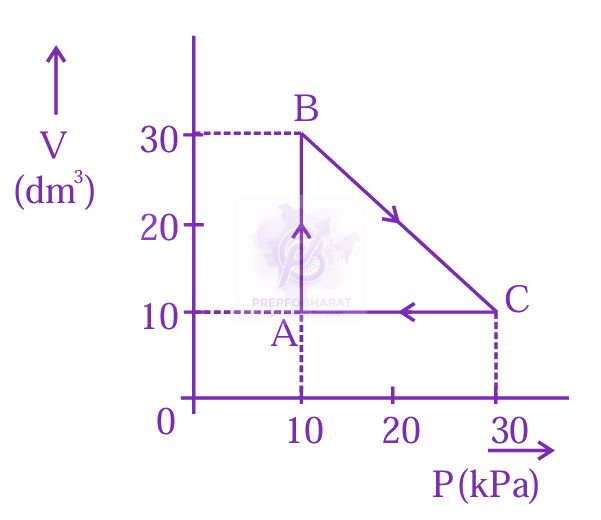
The mass of zinc produced by the electrolysis of zinc sulphate solution with a steady current of $0.015A$ for $15$ minutes is $____\times {10}^{-4}g$. (Atomic mass of zinc $=65.4\mathrm{amu})$
Standard enthalpy of vapourisation for ${\mathrm{CCl}}_{4}$ is $30.5\mathrm{kJ}{\mathrm{mol}}^{-1}$. Heat required for vapourisation of $284g$ of ${\mathrm{CCl}}_{4}$ at constant temperature is __________ $\mathrm{kJ}$. (Given molar mass in ${\mathrm{gmol}}^{-1};C=12,\mathrm{Cl}=35.5$) Round off your answer to the nearest integer.
The standard reduction potentials at \(298 \mathrm{~K}\) for the following half cells are given below : \(\begin{array}{ll} \mathrm{Cr}_2 \mathrm{O}_7^{2-}+14 \mathrm{H}^{+}+6 \mathrm{e}^{-} \rightarrow 2 \mathrm{Cr}^{3+}+7 \mathrm{H}_2 \mathrm{O}, \mathrm{E}^{\circ}=1.33 \mathrm{~V} \\ \mathrm{Fe}^{3+}(\mathrm{aq})+3 \mathrm{e}^{-} \rightarrow \mathrm{Fe} \qquad \mathrm{E}^{\circ}=-0.04 \mathrm{~V} \\ \mathrm{Ni}^{2+}(\mathrm{aq})+2 \mathrm{e}^{-} \rightarrow \mathrm{Ni} \qquad \mathrm{E}^{\circ}=-0.25 \mathrm{~V} \\ \mathrm{Ag}^{+}(\mathrm{aq})+\mathrm{e}^{-} \rightarrow \mathrm{Ag} \quad\qquad \mathrm{E}^{\circ}=0.80 \mathrm{~V} \\ \mathrm{Au}^{3+}(\mathrm{aq})+3 \mathrm{e}^{-} \rightarrow \mathrm{Au} \qquad \mathrm{E}^{\circ}=1.40 \mathrm{~V} \end{array}\) Consider the given electrochemical reactions, The number of metal(s) which will be oxidized be \(\mathrm{Cr}_2 \mathrm{O}_7^{2-}\), in aqueous solution is ______
Molality of an aqueous solution of urea is \(4.44 \mathrm{~m}\). Mole fraction of urea in solution is \(x \times 10^{-3}\). Value of \(x\) is \(\qquad\) - (Integer answer)
The electronic configuration of Einsteinium is : (Given atomic number of Einsteinium \(=99)\)
The hydrogen electrode is dipped in a solution of $\mathrm{pH}=3$ at $25^{\circ}C$. The potential of the electrode will be $-$______$\times {10}^{-2}V$. $(\frac{2.303\mathrm{RT}}{F}=0.059V)$ Round off the answer to the nearest integer.
One Faraday of electricity liberates $x\times {10}^{–1}$ gram atom of copper from copper sulphate, $x$ is______.
For the electro chemical cell \(\begin{gathered} \text { If } \mathrm{E}_{\left(\mathrm{M}^{2+} / \mathrm{M}\right)}^0=0.46 \mathrm{~V} \text { and } \mathrm{E}_{\left(\mathrm{x} / \mathrm{X}^{2-}\right)}^0=0.34 \mathrm{~V} \text {. } \end{gathered}\) Which of the following is correct?
If a substance $'A'$ dissolves in solution of a mixture of ' $B$' and ' $C$ ' with their respective number of moles as ${n}_{A},{n}_{B}$ and ${n}_{C}$, mole fraction of $C$ in the solution is:
The reaction at cathode in the cells commonly used in clocks involves.
Based on Heisenberg's uncertainty principle, the uncertainty in the velocity of the electron to be found within an atomic nucleus of diameter \(10^{-15} \mathrm{~m}\) is ________. \(10^9 \mathrm{~ms}^{-1}\) (nearest integer) [Given : mass of electron \(=9.1 \times 10^{-31} \mathrm{~kg}\), Plank's constant \((h)=6.626 \times 10^{-34} \mathrm{Js}\)] (Value of \(\pi=3.14\))
An organic compound has \(42.1 \%\) carbon, \(6.4 \%\) hydrogen and remainder is oxygen. If its molecular weight is 342, then its molecular formula is :
Consider the following redox reaction: ${\mathrm{MnO}}_{4}^{-}+{H}^{+}+{H}_{2}{C}_{2}{O}_{4}\rightleftharpoons {\mathrm{Mn}}^{2+}+{H}_{2}O+{\mathrm{CO}}_{2}$ The standard reduction potentials are given as below $({E}_{\mathrm{red}}^{\circ})$ ${{E}^{0}}_{{\mathrm{MnO}}_{4}^{-}/{\mathrm{Mn}}^{2+}}=+1.51V$; ${{E}^{0}}_{{\mathrm{CO}}_{2}/{H}_{2}{C}_{2}{O}_{4}}=-0.49V$ If the equilibrium constant of the above reaction is given as ${K}_{\mathrm{eq}}={10}^{x}$, then the value of $x=$ _______ (nearest integer)
Consider the following reaction: $3{\mathrm{PbCl}}_{2}+2{({\mathrm{NH}}_{4})}_{3}{\mathrm{PO}}_{4}\rightarrow {\mathrm{Pb}}_{3}{({\mathrm{PO}}_{4})}_{2}+6{\mathrm{NH}}_{4}\mathrm{Cl}$ If $72\mathrm{mmol}{\mathrm{PbCl}}_{2}$ is mixed with $50\mathrm{mmol}$ of ${({\mathrm{NH}}_{4})}_{3}{\mathrm{PO}}_{4},$ then amount of ${\mathrm{Pb}}_{3}{({\mathrm{PO}}_{4})}_{2}$ formed in $\mathrm{mmol}$. (nearest integer)
Combustion of 1 mole of benzene is expressed at \(\mathrm{C}_6 \mathrm{H}_6(\mathrm{l})+\frac{15}{2} \mathrm{O}_2(\mathrm{~g}) \rightarrow 6 \mathrm{CO}_2(\mathrm{~g})+3 \mathrm{H}_2 \mathrm{O}(\mathrm{l}) \text {. }\) The standard enthalpy of combustion of \(2 \mathrm{~mol}\) of benzene is \(-^{\prime} x^{\prime} \mathrm{kJ}\). \(x=\) ______ Given: 1. standard Enthalpy of formation of \(1 \mathrm{~mol}\) of \(\mathrm{C}_6 \mathrm{H}_6(\mathrm{l})\), for the reaction \(6 \mathrm{C}\) (graphite) \(+3 \mathrm{H}_2(\mathrm{~g}) \rightarrow \mathrm{C}_6 \mathrm{H}_6(\mathrm{l})\) is \(48.5 \mathrm{~kJ} \mathrm{~mol}^{-1}\). 2. Standard Enthalpy of formation of \(1 \mathrm{~mol}\) of \(\mathrm{CO}_2(\mathrm{~g})\), for the reaction \(\mathrm{C}\) (graphite) \(+\mathrm{O}_2(\mathrm{~g}) \rightarrow \mathrm{CO}_2(\mathrm{~g})\) is \(-393.5 \mathrm{~kJ} \mathrm{~mol}^{-1}\). 3. Standard and Enthalpy of formation of \(1 \mathrm{~mol}\) of \(\mathrm{H}_2 \mathrm{O}(\mathrm{l})\), for the reaction \(\mathrm{H}_2(\mathrm{~g})+\frac{1}{2} \mathrm{O}_2(\mathrm{~g}) \rightarrow \mathrm{H}_2 \mathrm{O}(\mathrm{l})\) is \(-286 \mathrm{~kJ} \mathrm{~mol}^{-1}\).
Considering acetic acid dissociates in water, its dissociation constant is \(6.25 \times 10^{-5}\). If \(5 \mathrm{~mL}\) of acetic acid is dissolved in 1 litre water, the solution will freeze at \(-x \times 10^{-2}{ }^{\circ} \mathrm{C}\), provided pure water freezes at \(0^{\circ} \mathrm{C}\). \(x=\) ______ . (Nearest integer) Given : \(\begin{aligned} & \left(\mathrm{K}_f\right)_{\text {water }}=1.86 \mathrm{~K} \mathrm{~kg} \mathrm{~mol}^{-1} \text {. } \\ & \text { density of acetic acid is } 1.2 \mathrm{~g} \mathrm{~mol}^{-1} \text {. } \\ & \text { molar mass of water }=18 \mathrm{~g} \mathrm{~mol}^{-1} \text {. } \\ & \text { molar mass of acetic acid=60 } \mathrm{g} \mathrm{mol}^{-1} \text {. } \\ & \text { density of water }=1 \mathrm{~g} \mathrm{~cm}^{-3} \end{aligned}\) Acetic acid dissociates as \(\mathrm{CH}_3 \mathrm{COOH} \rightleftharpoons \mathrm{CH}_3 \mathrm{COO}^{\ominus}+\mathrm{H}^{\oplus}\)
The $\mathrm{pH}$ of an aqueous solution containing $1M$ benzoic acid $({\mathrm{pK}}_{a}=4.20)$ and $1M$ sodium benzoate is $4.5.$ The volume of benzoic acid solution in $300\mathrm{mL}$ of this buffer solution is __________$\mathrm{mL}$.
Number of spectral lines obtained in ${\mathrm{He}}^{+}$ spectra, when an electron makes transition from fifth excited state to first excited state will be
The molarity of pure water is approximately
We have three aqueous solutions of $\mathrm{NaCl}$ labelled as $‘A’,‘B’$ and $‘C’$ with concentration $0.1M,0.01M$ and $0.001M,$ respectively. The value of van $t’$ Haft factor $(i)$ for these solutions will be in the order.
$9.3g$ of aniline is subjected to reaction with excess of acetic anhydride to prepare acetanilide. The mass of acetanilide produced if the reaction is $100%$ completed is _____$\times {10}^{-1}g$. (Given molar mass in $g{\mathrm{mol}}^{-1}N=14,O=16,C=$$12,H=1)$
The quantity which changes with temperature is:
Choose the Incorrect Statement about Dalton's Atomic Theory
Which out of the following is a correct equation to show change in molar conductivity with respect to concentration for a weak electrolyte, if the symbols carry their usual meaning :
The maximum number of orbitals which can be identified with \(\mathrm{n}=4\) and \(m_l=0\) is ______
In an atom, total number of electrons having quantum numbers \(\mathrm{n}=4,\left|\mathrm{~m}_l\right|=1\) and \(\mathrm{m}_{\mathrm{s}}=-\frac{1}{2}\) is ______
For hydrogen atom, energy of an electron in first excited state is \(-3.4 \mathrm{eV}, \mathrm{K} . \mathrm{E}\). of the same electron of hydrogen atom is \(x \mathrm{eV}\). Value of \(x\) is ______ \(\times 10^{-1} \mathrm{eV}\). (Nearest integer)
The number of moles of methane required to produce \(11 \mathrm{~g} \mathrm{CO}_2(\mathrm{~g})\) after complete combustion is : (Given molar mass of methane in \(\mathrm{g} \mathrm{mol}^{-1}: 16\))
The amount of electricity in Coulomb required for the oxidation of $1\mathrm{mol}$ of ${H}_{2}O$ to ${O}_{2}$ is ______ $\times {10}^{5}C.$
Given below are two statements: Statement-I: The orbitals having same energy are called as degenerate orbitals. Statement-II: In hydrogen atom, $3p$ and $3d$ orbitals are not degenerate orbitals. In the light of the above statements, choose the most appropriate answer from the options given
The number of radial node/s for $3p$ orbital is:
Mass of ethylene glycol (antifreeze) to be added to $18.6\mathrm{kg}$ of water to protect the freezing point at $-24^{\circ}C$ is $\mathrm{kg}$ (Molar mass in ${\mathrm{gmol}}^{-1}$ for ethylene glycol $62,{K}_{f}$ of water $=1.86K\mathrm{kg}{\mathrm{mol}}^{-1}$)
Given below are two statements : Statement I: ${S}_{8}$ solid undergoes disproportionation reaction under alkaline conditions to form ${S}^{2-}$ and ${S}_{2}{O}_{3}^{2-}$ Statement II: ${\mathrm{ClO}}_{4}^{-}$ can undergo disproportionation reaction under acidic condition. In the light of the above statements, choose the most appropriate answer from the options given below:
During Kinetic study of reaction \(2 A+B \rightarrow C+D\), the following results were obtained : \(\begin{array}{llll} & \text { A [M] } & \text { B [M] } & \text { initial rate of formation of D } \\ \text { I } & 0.1 & 0.1 & 6.0 \times 10^{-3} \\ \text { II } & 0.3 & 0.2 & 7.20 \times 10^{-2} \\ \text { III } & 0.3 & 0.4 & 2.88 \times 10^{-1} \\ \text { IV } & 0.4 & 0.1 & 2.40 \times 10^{-2} \\ \end{array}\) Based on above data, overall order of the reaction is ______
For a certain thermochemical reaction $M\rightarrow N$ at $T=400K,{\Delta H}^{o}=77.2\mathrm{kJ}{\mathrm{mol}}^{-1},{\Delta S}^{o}=122{\mathrm{JK}}^{-1}$, $\mathrm{log}$ equilibrium constant $(\mathrm{logK})$ is $-$ _____$\times {10}^{-1}$.
Wavenumber for a radiation having \(5800 Ã…\) wavelength is \(x \times 10 \mathrm{~cm}^{-1}\). The value of \(x\) is ________ (Integer answer)
$r=k[A]$ for a reaction, $50%$ of $A$ is decomposed in $120$ minutes. The time taken for $90%$ decomposition of $A$ is ______ minutes.
Which of the following is strongest Bronsted base?
The reaction; \(\frac{1}{2} \mathrm{H}_{2(\mathrm{~g})}+\mathrm{AgCl}_{(\mathrm{s})} \rightarrow \mathrm{H}_{(\mathrm{aq})}^{+}+\mathrm{Cl}_{(\mathrm{aq})}^{-}+\mathrm{Ag}_{(\mathrm{s})}\) occurs in which of the following galvanic cell :
Which of the following is not correct?
The ratio \(\frac{K_P}{K_C}\) for the reaction : \(\mathrm{CO}_{(\mathrm{g})}+\frac{1}{2} \mathrm{O}_{2(\mathrm{~g})} \rightleftharpoons \mathrm{CO}_{2(\mathrm{~g})}\) is :
The solution from the following with highest depression in freezing point/lowest freezing point is
The number of electrons present in all the completely filled subshells having $n=4$ and $s=+\frac{1}{2}$ is ____ (Where $n=$ principal quantum number and $s=$ spin quantum number)
A sample of ${\mathrm{CaCO}}_{3}$ and ${\mathrm{MgCO}}_{3}$ weighed $2.21g$ is ignited to constant weight of $1.152g$. The composition of the mixture is: (Given molar mass in $g{\mathrm{mol}}^{-1}$, ${\mathrm{CaCO}}_{3}:100,{\mathrm{MgCO}}_{3}:84$)
The equilibrium constant for the reaction \(\mathrm{SO}_3(\mathrm{g}) \rightleftharpoons \mathrm{SO}_2(\mathrm{~g})+\frac{1}{2} \mathrm{O}_2(\mathrm{~g})\) is \(\mathrm{K}_{\mathrm{c}}=4.9 \times 10^{-2}\). The value of \(\mathrm{K}_{\mathrm{c}}\) for the reaction given below is \(2 \mathrm{SO}_2(\mathrm{~g})+\mathrm{O}_2(\mathrm{~g}) \rightleftharpoons 2 \mathrm{SO}_3(\mathrm{~g})\) is :
The candela is the luminous intensity, in a given direction, of a source that emits monochromatic radiation of frequency ' \(\mathrm{A}\) ' \(\times 10^{12}\) hertz and that has a radiant intensity in that direction of \(\frac{1}{'\mathrm{~B}^{\prime}}\) watt per steradian. 'A' and 'B' are respectively
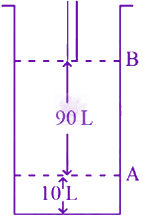 Consider the figure provided. \(1 \mathrm{~mol}\) of an ideal gas is kept in a cylinder, fitted with a piston, at the position A, at \(18^{\circ} \mathrm{C}\). If the piston is moved to position \(\mathrm{B}\), keeping the temperature unchanged, then ' \(x\) ' \(L\) atm work is done in this reversible process. \(x=\) ______ \(\mathrm{L}\) atm. (nearest integer) [Given : Absolute temperature \(={ }^{\circ} \mathrm{C}+273.15, \mathrm{R}=0.08206 \mathrm{~L} \mathrm{~atm} \mathrm{~mol}{ }^{-1} \mathrm{~K}^{-1}\) ]
The mass of sodium acetate $({\mathrm{CH}}_{3}\mathrm{COONa})$ required to prepare $250\mathrm{mL}$ of $0.35M$ aqueous solution is _____ g.$($ Molar mass of ${\mathrm{CH}}_{3}\mathrm{COONa}$ is $82.02g{\mathrm{mol}}^{-1}$) Round off to the nearest integer.
The ratio of $\frac{C14}{C12}$ in a piece of wood is $\frac{1}{8}$ part that of atmosphere. If half life of $C14$ is $5730$ years, the age of wood sample is ..... years.
When ' \(x\) ' \(\times 10^{-2} \mathrm{~mL}\) methanol (molar mass \(=32 \mathrm{~g}\); density \(=0.792 \mathrm{~g} / \mathrm{cm}^3\)) is added to \(100 \mathrm{~mL}\) water (density \(=1 \mathrm{~g} / \mathrm{cm}^3\)), the following diagram is obtained. 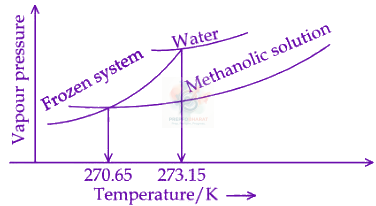 \(x=\) ______ (nearest integer). [Given : Molal freezing point depression constant of water at \(273.15 \mathrm{~K}\) is \(1.86 \mathrm{~K} \mathrm{~kg} \mathrm{~mol}^{-1}\)]
Consider the following reaction \[ \mathrm{A}+\mathrm{B} \rightarrow \mathrm{C} \] The time taken for \(\mathrm{A}\) to become \(1 / 4^{\text {th }}\) of its initial concentration is twice the time taken to become \(1 / 2\) of the same. Also, when the change of concentration of \(B\) is plotted against time, the resulting graph gives a straight line with a negative slope and a positive intercept on the concentration axis. The overall order of the reaction is _______
At \(-20^{\circ} \mathrm{C}\) and \(1 \mathrm{~atm}\) pressure, a cylinder is filled with equal number of \(\mathrm{H}_2, \mathrm{I}_2\) and \(\mathrm{HI}\) molecules for the reaction \(\mathrm{H}_2(\mathrm{~g})+\mathrm{I}_2(\mathrm{~g}) \rightleftharpoons 2 \mathrm{HI}(\mathrm{g})\), the \(\mathrm{K}_{\mathrm{p}}\) for the process is \(x \times 10^{-1}\). \(\mathrm{x}=\) _____ [Given : \(\mathrm{R}=0.082 \mathrm{~L} \mathrm{~atm} \mathrm{~K}^{-1} \mathrm{~mol}^{-1}\)]
One of the commonly used electrode is calomel electrode. Under which of the following categories, calomel electrode comes?
The vapour pressure of pure benzene and methyl benzene at \(27^{\circ} \mathrm{C}\) is given as 80 Torr and 24 Torr, respectively. The mole fraction of methyl benzene in vapour phase, in equilibrium with an equimolar mixture of those two liquids (ideal solution) at the same temperature is _______ \(\times 10^{-2}\) (nearest integer)
Fuel cell, using hydrogen and oxygen as fuels, A. has been used in spaceship B. has as efficiency of \(40 \%\) to produce electricity C. uses aluminum as catalysts D. is eco-friendry E. is actually a type of Galvanic cell only Choose the correct answer from the options given below:
When equal volume of \(1 \mathrm{M} \mathrm{HCl}\) and \(1 \mathrm{M} \mathrm{H}_2 \mathrm{SO}_4\) are separately neutralised by excess volume of \(1 \mathrm{M}\) \(\mathrm{NaOH}\) solution. \(x\) and \(y \mathrm{~kJ}\) of heat is liberated respectively. The value of \(y / x\) is _______
\(2.7 \mathrm{~kg}\) of each of water and acetic acid are mixed. The freezing point of the solution will be \(-x^{\circ} \mathrm{C}\). Consider the acetic acid does not dimerise in water, nor dissociates in water. \(x=\) ______ (nearest integer) [Given: Molar mass of water \(=18 \mathrm{~g} \mathrm{~mol}^{-1}\), acetic acid \(=60 \mathrm{~g} \mathrm{~mol}^{-1}\) \(\mathrm{K}_{\mathrm{f}} \mathrm{H}_2 \mathrm{O}: 1.86 \mathrm{~K} \mathrm{~kg} \mathrm{~mol}^{-1}\) \(\mathrm{K}_{\mathrm{f}}\) acetic acid: \(3.90 \mathrm{~K} \mathrm{~kg} \mathrm{~mol}^{-1}\) freezing point: \(\mathrm{H}_2 \mathrm{O}=273 \mathrm{~K}\), acetic acid \(=290 \mathrm{~K}\)]
A solution of ${H}_{2}{\mathrm{SO}}_{4}$ is $31.4%{H}_{2}{\mathrm{SO}}_{4}$ by mass and has a density of $1.25g/\mathrm{mL}$. The molarity of the ${H}_{2}{\mathrm{SO}}_{4}$ solution is $M$ (nearest integer) [Given molar mass of ${H}_{2}{\mathrm{SO}}_{4}=98g{\mathrm{mol}}^{-1}$]
Volume of $3M\mathrm{NaOH}$ (formula weight $40g{\mathrm{mol}}^{-1}$ ) which can be prepared from $84g$ of $\mathrm{NaOH}$ is ____$\times {10}^{-1}{\mathrm{dm}}^{3}$.
The de-Broglie's wavelength of an electron in the \(4^{\text {th }}\) orbit is \(\qquad\) \(\pi \mathrm{a}_0 \cdot\left(\mathrm{a}_0=\right.\) Bohr's radius \()\)
Which of the following cannot function as an oxidising agent?
Only \(2 \mathrm{~mL}\) of \(\mathrm{KMnO}_4\) solution of unknown molarity is required to reach the end point of a titration of \(20 \mathrm{~mL}\) of oxalic acid \((2 \mathrm{M})\) in acidic medium. The molarity of \(\mathrm{KMnO}_4\) solution should be \(\qquad\) M.
Chlorine undergoes disproportionation in alkaline medium as shown below : ${\mathrm{aCl}}_{2}(g)+{\mathrm{bOH}}^{-}(\mathrm{aq})\rightarrow {\mathrm{cClO}}^{-}(\mathrm{aq})+{\mathrm{dCl}}^{-}(\mathrm{aq})+{\mathrm{eH}}_{2}O(l)$ The values of $a,b,c$ and $d$ in a balanced redox reaction are respectively :
For a reaction \(\mathrm{A} \xrightarrow{\mathrm{K}_1} \mathrm{~B} \xrightarrow{\mathrm{K}_2} \mathrm{C}\) If the rate of formation of \(B\) is set to be zero then the concentration of \(B\) is given by :
Identify the mixture that shows positive deviations from Raoult's Law
The molar conductivity for electrolytes \(A\) and \(B\) are plotted against \(C^{1 / 2}\) as shown below. Electrolytes \(A\) and \(B\) respectively are : 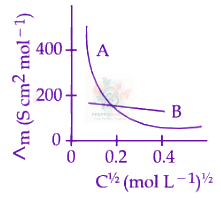
The equilibrium \(\mathrm{Cr}_2 \mathrm{O}_7^{2-} \rightleftharpoons 2 \mathrm{CrO}_4^{2-}\) is shifted to the right in :
Identify the factor from the following that does not affect electrolytic conductance of a solution.
Solubility of calcium phosphate (molecular mass, $M$) in water is ${W}_{g}$ per $100\mathrm{mL}$ at $25^{\circ}C.$ Its solubility product at $25^{\circ}C$ will be approximately.
A hypothetical electromagnetic wave is show below. 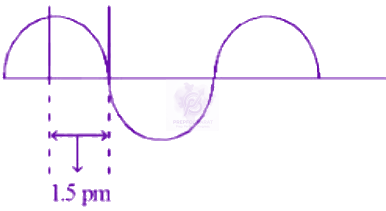 The frequency of the wave is \(x \times 10^{19} \mathrm{~Hz}\). \(x =\) ______ (nearest integer)
For a strong electrolyte, a plot of molar conductivity against (concentration) \({ }^{1 / 2}\) is a straight line, with a negative slope, the correct unit for the slope is
Match List I with List II 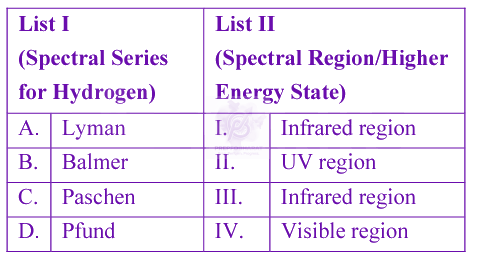 Choose the correct answer from the options given below :-
The potential for the given half cell at $298K$ is $(-)$............ $\times {10}^{-2}V.$ $2{H}_{(\mathrm{aq})}^{+}+2{e}^{-}\rightarrow {H}_{2}(g)$ $[{H}^{+}]=1M,{P}_{{H}_{2}}=2\mathrm{atm}$ (Given$2.303\mathrm{RT}/F=0.06V,\mathrm{log}2=0.3$)
Consider the following first order gas phase reaction at constant temperature \(\mathrm{A}(\mathrm{g}) \rightarrow 2 \mathrm{~B}(\mathrm{~g})+\mathrm{C}(\mathrm{g})\) If the total pressure of the gases is found to be 200 torr after \(23 \mathrm{sec}\). and 300 torr upon the complete decomposition of A after a very long time, then the rate constant of the given reaction is ______ \(\times 10^{-2} \mathrm{~s}^{-1}\) (nearest integer) [Given : \(\log _{10}(2)=0.301\)]
The following concentrations were observed at $500K$ for the formation of ${\mathrm{NH}}_{3}$ from ${N}_{2}$ and ${H}_{2}$. At equilibrium : $[{N}_{2}]=2\times {10}^{-2}M,[{H}_{2}]=3\times {10}^{-2}M$ and $[{\mathrm{NH}}_{3}]=1.5\times {10}^{-2}M$. Equilibrium constant for the reaction is ______.
The metals that are employed in the battery industries are A. Fe, B. Mn, C. Ni, D. Cr, E. Cd Choose the correct answer from the options given below: