JEE Main 2023 — Physical Chemistry
Chemistry Physical Chemistry questions from JEE Main 2023.
Other Years
201 Physical Chemistry Questions from 2023
At $298K$, the solubility of silver chloride in water is $1.434\times {10}^{-3}g{L}^{-1}$. The value of $-{\mathrm{logK}}_{\mathrm{sp}}$ for silver chloride is (Given mass of Ag is $107.9g{\mathrm{mol}}^{-1}$, and mass of $\mathrm{Cl}$ is $35.5g{\mathrm{mol}}^{-1}$ )
The pH of a 0.1 M HCl solution is:
For an isothermal reversible expansion of an ideal gas, which of the following is true?
At what $\mathrm{pH}$, given half cell ${\mathrm{MnO}}_{4}^{-}(0.1M)\mid {\mathrm{Mn}}^{2+}$ $(0.001M)$ will have electrode potential of $1.282V$ ? (Nearest Integer) Given ${E}_{{\mathrm{MnO}}_{4}^{-}/{\mathrm{Mn}}^{2+}}^{o}=1.54V,\frac{2.303\mathrm{RT}}{F}=0.059V$
At $298K$, the standard reduction potential for ${\mathrm{Cu}}^{2+}/\mathrm{Cu}$ electrode is $0.34V$. Given : ${K}_{\mathrm{sp}}\mathrm{Cu}(\mathrm{OH}{)}_{2}=1\times {10}^{-20}$ Take $\frac{2.303\mathrm{RT}}{F}=0.059V$ The reduction potential at $\mathrm{pH}=14$ for the above couple is $(-)x\times {10}^{-2}V$. The value of x is
The number of correct statement/s involving equilibria in physical processes from the following is ________ (A) Equilibrium is possible only in a closed system at a given temperature. (B) Both the opposing processes occur at the same rate. (C) When equilibrium is attained at a given temperature, the value of all its parameters became equal (D) For dissolution of solids in liquids, the solubility is constant at a given temperature.
When ${\mathrm{Fe}}_{0.93}O$ is heated in presence of oxygen, it converts to ${\mathrm{Fe}}_{2}{O}_{3}$. The number of correct statement/s from the following is ______ . A. The equivalent weight of ${\mathrm{Fe}}_{0.93}O$ is $\frac{\mathrm{Molecular}\mathrm{weight}}{0.79}$ B. The number of moles of ${\mathrm{Fe}}^{2+}$ and ${\mathrm{Fe}}^{3+}$ in $1$ mole of ${\mathrm{Fe}}_{0.93}O$ is $0.79$ and $0.14$ respectively. C. ${\mathrm{Fe}}_{0.93}O$ is metal deficient with lattice comprising of cubic closed packed arrangement of ${O}^{2-}$ ions. D. The $%$ composition of ${\mathrm{Fe}}^{2+}$ and ${\mathrm{Fe}}^{3+}$ in ${\mathrm{Fe}}_{0.93}O$ is $85%$ and $15%$ respectively.
$0.5g$ of an organic compound (X) with $60%$ carbon will produce $\times {10}^{-1}g$ of ${\mathrm{CO}}_{2}$ on complete combustion.
The graph which represents the following reaction is: ${({C}_{6}{H}_{5})}_{3}C-\mathrm{Cl}\frac{{\mathrm{OH}}^{-}}{\mathrm{Pyridine}}{({C}_{6}{H}_{5})}_{3}C-\mathrm{OH}$
For independent process at $300K$. <table class="pyq-table"><tbody><tr><td>Process</td><td>$\Delta H/{\mathrm{kJmol}}^{-1}$</td><td>$\Delta S/{\mathrm{JK}}^{-1}$</td></tr><tr><td>$A$</td><td>$-25$</td><td>$-80$</td></tr><tr><td>$B$</td><td>$-22$</td><td>$40$</td></tr><tr><td>$C$</td><td>$25$</td><td>$-50$</td></tr><tr><td>$D$</td><td>$22$</td><td>$20$</td></tr></tbody></table>The number of non-spontaneous process from the following is _____ .
$20\mathrm{mL}$ of $0.1\mathrm{MNaOH}$ is added to $50\mathrm{mL}$ of $0.1M$ acetic acid solution. The $\mathrm{pH}$ of the resulting solution is $\times {10}^{-2}$. (Nearest integer) Given : $\mathrm{pK}a({\mathrm{CH}}_{3}\mathrm{COOH})=4.76$ $\mathrm{log}2=0.30$ $\mathrm{log}3=0.48$
Consider the cell $\mathrm{Pt}(s)|{H}_{2}(s)(\mathrm{latm})|{H}^{+}(\mathrm{aq},[{H}^{+}]=1)||{\mathrm{Fe}}^{3+}(\mathrm{aq}),{\mathrm{Fe}}^{2+}(\mathrm{aq})\mid Pt(s)$ Given: ${E}_{{\mathrm{Fe}}^{3+}/{\mathrm{Fe}}^{2+}}^{\circ}=0.771V$ and ${E}_{{H}^{+}/\frac{1}{2}{H}_{2}}^{\circ}=0V,T=298K$ If the potential of the cell is $0.712V$ the ratio of concentration of ${\mathrm{Fe}}^{2+}$ to ${\mathrm{Fe}}^{3+}$ is (Nearest integer)
Given below are two statements: Statement I: In redox titration, the indicators used are sensitive to change in $\mathrm{pH}$ of the solution. Statement II: In acid-base titration, the indicators used are sensitive to change in oxidation potential. In the light of the above statements, choose the most appropriate answer from the options given below
The electrode potential of the following half cell at $298K$ $X|{X}^{2+}(0.001M)\|{Y}^{2+}(0.01M)|Y$ is _____ $\times {10}^{-2}V$ (Nearest integer) Given : ${E}_{{X}^{2+}\mid X}^{0}=-2.36V$ ${E}_{{Y}^{2+}Y}^{0}=+0.36V$ $\frac{2.303\mathrm{RT}}{F}=0.06V$
Given below are two statements Statement I : According to Bohr’s model of hydrogen atom, the angular momentum of an electron in a given stationary state is quantised. Statement II : The concept of electron in Bohr’s orbit, violates the Heisenberg uncertainty principle. In the light of the above statements, choose the most appropriate answer from the options given below
$30.4\mathrm{kJ}$ of heat is required to melt one mole of sodium chloride and the entropy change at the melting point is $28.4J{K}^{–1}{\mathrm{mol}}^{–1}$ at $1\mathrm{atm}$. The melting point of sodium chloride is _______ $K$ (Nearest Integer)
$A(g)\rightleftharpoons 2B(g)+C(g)$ For the given reaction, if the initial pressure is $450\mathrm{mmHg}$ and the pressure at time $t$ is$720\mathrm{mmHg}$ at a constant temperature$T$ and constant volume $V$. The fraction of $A(g)$ decomposed under these conditions is $x\times {10}^{-1}$. The value of $x$ is (nearest integer)
Match List I with List II. <table class="pyq-table"><tbody><tr><td colspan="2" rowspan="1">List I</td><td colspan="2" rowspan="1">List II</td></tr><tr><td>A.</td><td>van't Hoff factor, i</td><td>I.</td><td>Cryoscopic constant</td></tr><tr><td>B.</td><td>${k}_{f}$</td><td>II.</td><td>Isotonic solutions</td></tr><tr><td>C.</td><td>Solutions with same osmotic pressure</td><td>III.</td><td>$\frac{\text{Normal molar mass}}{\text{Abnormal molar mas}}$</td></tr><tr><td>D.</td><td>Azeotropes</td><td>IV.</td><td>Solutions with same composition of vapour above it</td></tr></tbody></table>Choose the correct answer from the options given below:
A solution of sugar is obtained by mixing $200g$ of its $25%$ solution and $500g$of its $40%$solution (both by mass). The mass percentage of the resulting sugar solution is _______ (Nearest integer)
Given below are two statements: one is labelled as Assertion A and the other is labelled as Reason R. Assertion A: $3.1500g$of hydrated oxalic acid dissolved in water to make $250.0mL$ solution will result in $0.1M$ oxalic acid solution. Reason R: Molar mass of hydrated oxalic acid is $126gmo{l}^{–1}$ . In the light of the above statements, choose the correct answer from the options given below:
The number of following statement/s which is/are incorrect is ______ A) Line emission spectra are used to study the electronic structure B) The emission spectra of atoms in the gas phase show a continuous spread of wavelength from red to violet. C) An absorption spectrum is like the photographic negative of an emission spectrum D) The element helium was discovered in the sun by spectroscopic method
Consider the following data Heat of combustion of ${H}_{2}(g)=–241.8\mathrm{kJ}{\mathrm{mol}}^{–1}$ Heat of combustion of $C(s)=–393.5\mathrm{kJ}{\mathrm{mol}}^{–1}$ Heat of combustion of ${C}_{2}{H}_{5}\mathrm{OH}(l)$$=–1234.7\mathrm{kJ}{\mathrm{mol}}^{–1}$ The heat of formation of ${C}_{2}{H}_{5}\mathrm{OH}(l)$ is $(–)$ _____ $\mathrm{kJ}{\mathrm{mol}}^{–1}$ (Nearest integer).
The number of given orbitals which have electron density along the axis is ${p}_{x},{p}_{y},{p}_{z},{d}_{\mathrm{xy}},{d}_{\mathrm{yz}},{d}_{\mathrm{xz}},{d}_{z}^{2},{d}_{{x}^{2}-{y}^{2}}$
On complete combustion, $0.492g$ of an organic compound gave $0.792g$ of ${\mathrm{CO}}_{2}$. The $%$ of carbon in the organic compound is (Nearest integer)
The total number of isoelectronic species from the given set is ________. ${O}^{2-},{F}^{–},\mathrm{Al},{\mathrm{Mg}}^{2+},{\mathrm{Na}}^{+},{O}^{+},\mathrm{Mg},{\mathrm{Al}}^{3+},F$
Consider the graph of Gibbs free energy G vs extent of reaction. The number of statement/s from the following which are true with respect to points (a), (b) and (c) is $______$ 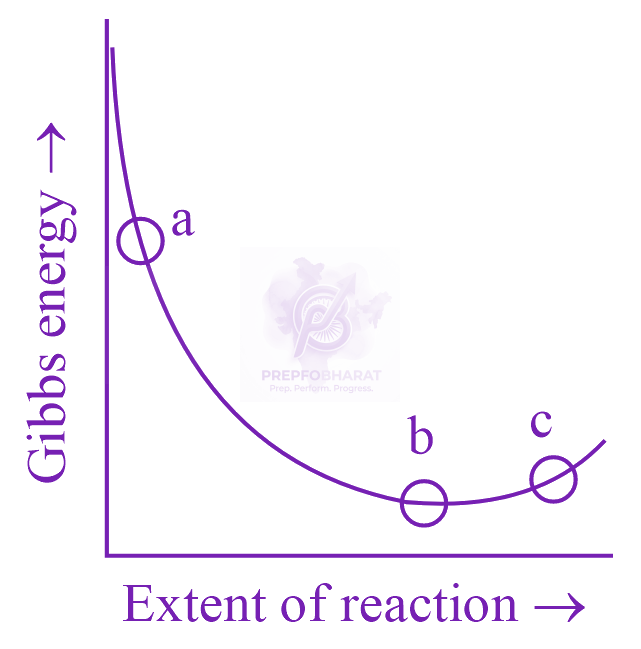 A. Reaction is spontaneous at (a) and (b) B. Reaction is at equilibrium at point (b) and non-spontaneous at point (c) C. Reaction is spontaneous at (a) and non-spontaneous at (c) D. Reaction is non-spontaneous at (a) and (b)
A and B are two substances undergoing radioactive decay in a container. The half life of A is $15\mathrm{min}$ and that of B is $5\mathrm{min}$. If the initial concentration of B is $4$ times that of A and they both start decaying at the same time, how much time will it take for the concentration of both of them to be same? ________min.
For certain chemical reaction $X\rightarrow Y$, the rate of formation of product is plotted against the time as shown in the figure. The number of Correct statement/s from the following is _____ 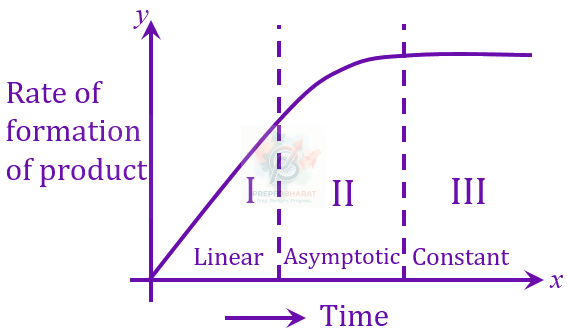 (A) Over all order of this reaction is one (B) Order of this reaction can't be determined (C) In region-I and III, the reaction is of first and zero order respectively (D) In region-II, the reaction is of first order (E) In region-II, the order of reaction is in the range of $0.1$ to $0.9$.
$5g\mathrm{of}\mathrm{NaOH}$ was dissolved in deionized water to prepare a $450\mathrm{mL}$ stock solution. What volume (in mL) of this solution would be required to prepare $500\mathrm{mL}$ of $0.1M$ solution ? Given : Molar Mass of $\mathrm{Na},O\mathrm{and}H\mathrm{is}23,16\mathrm{and}1g{\mathrm{mol}}^{–1}$ respectively
A $300\mathrm{mL}$ bottle of soft drink has $0.2{\mathrm{MCO}}_{2}$ dissolved in it. Assuming ${\mathrm{CO}}_{2}$ behaves as an ideal gas, the volume of the dissolved ${\mathrm{CO}}_{2}$ at STP is _____ $\mathrm{mL}$. (Nearest integer) Given: At STP, molar volume of an ideal gas is $22.7L{\mathrm{mol}}^{-1}$
Millimoles of calcium hydroxyide required to produce $100\mathrm{mL}$ of the aqueous solution of $\mathrm{pH}12$ is $x\times {10}^{-1}$. The value of $x$ is _____ (Nearest integer). Assume complete dissociation.
Given below are two statement : one is labelled as Assertion A and the other is labelled as Reason R Assertion A : $5f$ electron can participate in bonding to a far greater extent than $4f$ electrons Reason R : $5f$ orbitals are not as buried as $4f$ orbitals In the light of the above statements, choose the correct answer from the options given below
The vapour pressure vs. temperature curve for a solution solvent system is shown below. 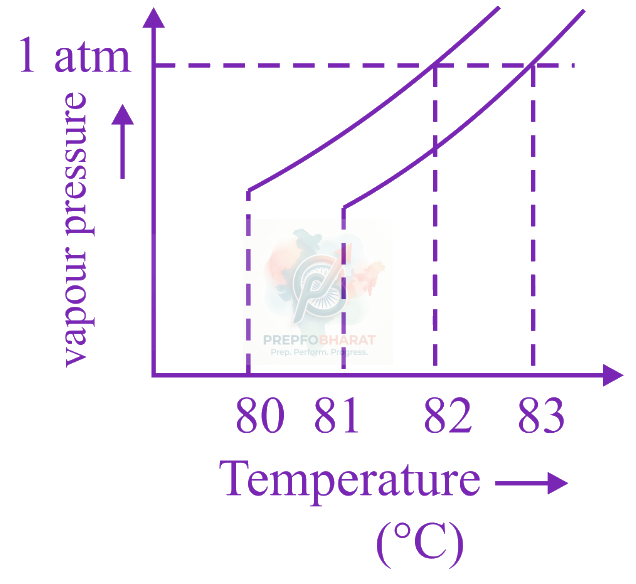 The boiling point of the solvent is _____°C.
The dissociation constant of acetic is $x\times {10}^{–5}$. When $25\mathrm{mL}\mathrm{of}0.2M{\mathrm{CH}}_{3}\mathrm{COONa}$ solution is mixed with $25\mathrm{mL}\mathrm{of}0.02M{\mathrm{CH}}_{3}\mathrm{COOH}$ solution, the $\mathrm{pH}$ of the resultant solution is found to be equal to $5$. The value of $x$ is _______.
The total change in the oxidation state of manganese involved in the reaction of ${\mathrm{KMnO}}_{4}$ and potassium iodide in the acidic medium is ________.
The number of molecules and moles in $2.8375$ litres of ${O}_{2}$ at $\mathrm{STP}$ are respectively
${\mathrm{KMnO}}_{4}$ is titrated with ferrous ammonium sulphate hexahydrate in presence of dilute ${H}_{2}{\mathrm{SO}}_{4}.$ Number of water molecules produced for $2$ molecules of ${\mathrm{KMnO}}_{4}$ is $_______$
The number of correct statement/s from the following is _____ . A.Larger the activation energy, smaller is the value of the rate constant. B. The higher is the activation energy, higher is the value of the temperature coefficient. C. At lower temperatures, increase in temperature causes more change in the value of $k$ than at higher temperature. D. A plot of $\mathrm{ln}k$ vs $\frac{1}{T}$ is a straight line with slope equal to $-\frac{\mathrm{Ea}}{R}$
The logarithm of equilibrium constant for the reaction ${\mathrm{Pd}}^{2+}+4{\mathrm{Cl}}^{-}\rightleftharpoons {\mathrm{PdCl}}_{4}^{2-}$ is (Nearest integer) Given: $\frac{2.303\mathrm{RT}}{F}=0.06V$ ${\mathrm{Pd}}_{(\mathrm{aq})}^{2+}+2{e}^{-}\rightleftharpoons \mathrm{Pd}(s){E}^{o}=0.83V$ ${\mathrm{PdCl}}_{4}^{2-}(\mathrm{aq})+2{e}^{-}\rightleftharpoons \mathrm{Pd}(s)+4{\mathrm{Cl}}^{-}(\mathrm{aq})$ ${E}^{o}=0.65V$
In an electrochemical reaction of lead, at standard temperature, if ${E}_{({\mathrm{Pb}}^{2+}/\mathrm{Pb})}^{o}=m\text{ Volt }$and ${E}_{({\mathrm{Pb}}^{4+}/\mathrm{Pb})}^{o}=n\mathrm{Volt},$then the value of $E^{\circ}({\mathrm{Pb}}^{2+}/{\mathrm{Pb}}^{4+})$ is given by $m–\mathrm{xn}$. The value of x is _______. (Nearest integer)
Zinc reacts with hydrochloric acid to give hydrogen and zinc chloride. The volume of hydrogen gas produced at STP from the reaction of $11.5g$ of zinc with excess $\mathrm{HCl}$ is $L$ (Nearest integer) (Given : Molar mass of $\mathrm{Zn}$ is $65.4g{\mathrm{mol}}^{-1}$ and Molar volume of ${H}_{2}$ at $\mathrm{STP}=22.7L$ )
The enthalpy change for the adsorption process and micelle formation respectively are
A metal chloride contains $55.0%$ of chlorine by weight. $100\mathrm{mL}$ vapours of the metal chloride at STP weigh $0.57g$. The molecular formula of the metal chloride is (Given: Atomic mass of chlorine is $35.5u$)
Electrons in a cathode ray tube have been emitted with a velocity of $1000{\mathrm{ms}}^{-1}$. The number of following statements which is/are true about the emitted radiation is Given : $h=6\times {10}^{-34}\mathrm{Js},{m}_{e}=9\times {10}^{-31}\mathrm{kg}$ (A ) The deBroglie wavelength of the electron emitted is $666.67\mathrm{nm}$ (B ) The characteristic of electrons emitted depend upon the material of the electrodes of the cathode ray tube. (C) The cathode rays start from cathode and move towards anode. (D ) The nature of the emitted electrons depends on the nature of the gas present in cathode ray tube..
The rate constant for a first order reaction is $20{\mathrm{min}}^{-1}$. The time required for the initial concentration of the reactant to reduce to its $\frac{1}{32}$ level is $______\times {10}^{-2}\mathrm{min}$. (Nearest integer)
An organic compound gives $0.220g$ of ${\mathrm{CO}}_{2}$ and $0.126g$ of ${H}_{2}O$ on complete combustion. If the $%$ of carbon is $24$ then the $%$ of hydrogen is $_________\times {10}^{–1}.$ (Nearest integer)
Number of hydrogen atoms per molecule of a hydrocarbon A having $85.8%$ carbon is (Given : Molar mass of $A=84g{\mathrm{mol}}^{-1}$ )
A solution containing $2g$ of a non-volatile solute in $20g$ of water boils at $373.52K$. The molecular mass of the solute is _____ ${\mathrm{gmol}}^{-1}$. (Nearest integer) Given, water boils at $373K,{K}_{b}$ for water $=0.52K\mathrm{kg}{\mathrm{mol}}^{-1}$
The number of correct statements from the following is........... A. ${E}_{\mathrm{cell}}$ is an intensive parameter B. A negative ${E}^{o}$ means that the redox couple is a stronger reducing agent than the ${H}^{+}/{H}_{2}$ couple. C. The amount of electricity required for oxidation or reduction depends on the stoichiometry of the electrode reaction. D. The amount of chemical reaction which occurs at any electrode during electrolysis by a current is proportional to the quantity of electricity passed through the electrolyte.
The reaction occurs in which of the given galvanic cell? $\frac{1}{2}{H}_{2}(g)+\mathrm{AgCl}(s)\rightleftharpoons {H}^{+}(\mathrm{aq})+{\mathrm{Cl}}^{-}(\mathrm{aq})+\mathrm{Ag}(s)$
The standard electrode potential of ${M}^{+}/M$ in aqueous solution does not depend on
Following figure shows dependence of molar conductance of two electrolytes on concentration. ${\Lambda }_{m}^{0}$ is the limiting molar conductivity. 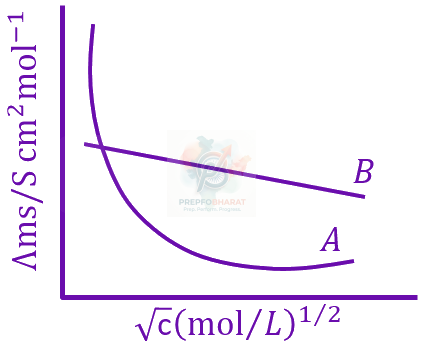 The number of Incorrect statement(s) from the following is _____ (A) ${\Lambda }_{m}^{0}$ for electrolyte $A$ is obtained by extrapolation (B) For electrolyte $B,{\Lambda }_{m}\mathrm{Vs}\sqrt{c}$ graph is a straight line with intercept equal to ${\Lambda }_{m}^{0}$ (C) At infinite dilution, the value of degree of dissociation approach zero for electrolyte $B$. (D) ${\Lambda }_{m}$ for any electrolyte $A$ or $B$ can be calculated using $\lambda ^{\circ}$ for individual ions.
The effect of addition of helium gas to the following reaction in equilibrium state at constant volume, is : ${\mathrm{PCI}}_{5}(g)\rightleftharpoons {\mathrm{PCl}}_{3}(g)+{\mathrm{Cl}}_{2}(g)$
For conversion of compound $A\rightarrow B$, the rate constant of the reaction was found to be $4.6\times {10}^{-5}\mathrm{Lmol}-1{s}^{-1}$. The order of the reaction is _____ .
The number of correct statements from the following is ........... A. For $1s$ orbital, the probability density is maximum at the nucleus B. For $2s$ orbital, the probability density first increases to maximum and then decreases sharply to zero. C. Boundary surface diagrams of the orbitals encloses a region of $100%$ probability of finding the electron. D. $p$ and $d$-orbitals have $1$ and $2$ angular nodes respectively E. probability density of $p$-orbital is zero at the nucleus
Given below are two statements: one is labelled as Assertion (A) and the other is labelled as Reason (R). Assertion (A) : An aqueous solution of $\mathrm{KOH}$ when for volumetric analysis, its concentration should be checked before the use. Reason (R) : On aging,$\mathrm{KOH}$ solution absorbs atmospheric ${\mathrm{CO}}_{2}$. In the light of the above statements, choose the correct answer from the options given below.
The equilibrium constant for the reaction $\mathrm{Zn}(s)+{\mathrm{Sn}}^{2+}(\mathrm{aq})\rightleftharpoons {\mathrm{Zn}}^{2+}(\mathrm{aq})+\mathrm{Sn}(s)$ is $1\times {10}^{20}$ at $298K$. The magnitude of standard electrode potential of $\mathrm{Sn}/{\mathrm{Sn}}^{2+}$ if ${E}_{{\mathrm{Zn}}^{2*}/\mathrm{Zn}}^{0}=-0.76V$ is _____ $\times {10}^{-2}V$. (Nearest integer) Given : $\frac{2.303\mathrm{RT}}{F}=0.059V$
Assume carbon burns according to following equation : $2C(s)+{O}_{2}(g)\rightarrow 2\mathrm{CO}\text{ (s) }$ when $12g$ carbon is burnt in $48g$ of oxygen, the volume of carbon monoxide produced is $______\times {10}^{-1}L$ at STP [nearest integer] [Given : Assume $\mathrm{CO}$ as ideal gas, Mass of $C$ is $12g{\mathrm{mol}}^{-1}$, mass of $O$ is $16g{\mathrm{mol}}^{-1}$ and molar volume of an idal gas at STP is $22.7L{\mathrm{mol}}^{-1}$ ]
The correct reaction profile diagram for a positive catalyst reaction.
The volume of hydrogen liberated at STP by treating $2.4g$ of magnesium with excess of hydrochloric acid is ......$\times {10}^{-2}L$. Given Molar volume of gas is $22.4L$ at STP. Molar mass of magnesium is $24g{\mathrm{mol}}^{-1}$
$80$ mole percent of ${\mathrm{MgCl}}_{2}$ is dissociated in aqueous solution. The vapour pressure of $1.0$ molal aqueous solution of ${\mathrm{MgCl}}_{2}$ at ${38}^{o}C$ is _____ $\mathrm{mm}\mathrm{Hg}$. (Nearest integer) Given: Vapour pressure of water at ${38}^{o}C$ is $50\mathrm{mm}\mathrm{Hg}$
For the first order reaction $A\rightarrow B$ the half life is $30\mathrm{min}$. The time taken for $75%$ completion of the reaction is mm. (Nearest integer) Given : $\mathrm{log}2=0.3010$ $\mathrm{log}3=0.4771$ $\mathrm{log}5=0.6989$
Water decomposes at $2300K$ ${H}_{2}O(g)\rightarrow {H}_{2}(g)+\frac{1}{2}{O}_{2}(g)$ The percent of water decomposing at $2300K$ and 1 bar is _____ (Nearest integer). Equilibrium constant for the reaction is $2\times {10}^{-3}$ at $2300K$
A molecule undergoes two independent first order reactions whose respective half lives are $12\mathrm{min}$ and $3\mathrm{min}$. If both the reactions are occurring then the time taken for the $50%$ consumption of the reactant is ______ $\mathrm{min}$. (Nearest integer)
$A\rightarrow B$ The rate constants of the above reaction at $200K$ and $300K$ are $0.03{\mathrm{min}}^{-1}$ and $0.05{\mathrm{min}}^{-1}$ respectively. The activation energy for the reaction is $J$ (Nearest integer) (Given : In $10=2.3$ $R=8.3J{K}^{-1}{\mathrm{mol}}^{-1}$ $\mathrm{log}5=0.70$ $\mathrm{log}3=0.48$ $\mathrm{log}2=0.30$
Which one of the following sets of ions represents a collection of isoelectronic species? (Given : Atomic Number $:F:9,\mathrm{Cl}:17,\mathrm{Na}=11$ $\mathrm{Mg}=12,\mathrm{Al}=13,K=19,\mathrm{Ca}=20,\mathrm{Sc}=21)$
$0.004M{K}_{2}{\mathrm{SO}}_{4}$ solution is isotonic with $0.01M$ glucose solution. Percentage dissociation of ${K}_{2}{\mathrm{SO}}_{4}$ is _____ (Nearest integer)
A litre of buffer solution contains $0.1$ mole of each of ${\mathrm{NH}}_{3}$ and ${\mathrm{NH}}_{4}\mathrm{Cl}$. On the addition of $0.02$ mole of $\mathrm{HCl}$ by dissolving gaseous $\mathrm{HCl}$, the $\mathrm{pH}$ of the solution is found to be $_____\times {10}^{-3}$ (Nearest integer) Given: ${\mathrm{pK}}_{b}({\mathrm{NH}}_{3})=4.745$ $\mathrm{log}2=0.301$ $\mathrm{log}3=0.477$ $T=298K]$
For the adsorption of hydrogen on platinum, the activation energy is $30\mathrm{kJ}{\mathrm{mol}}^{–1}$ and for the adsorption of hydrogen on nickel, the activation energy is $41.4\mathrm{kJ}{\mathrm{mol}}^{–1}.$ The logarithm of the ratio of the rates of chemisorption on equal areas of the metals at $300K$ is $_______$ (Nearest integer) Given: $\mathrm{In}10=2.3$ $R=8.3J{K}^{-1}{\mathrm{mol}}^{-1}$
For a chemical reaction $A+B\rightarrow$ Product, the order is $1$ with respect to $A$ and $B$.<table class="pyq-table"><tbody><tr><td>Rate $\mathrm{mol}{L}^{-1}{S}^{-1}$</td><td>[A] $\mathrm{mol}{L}^{-1}$</td><td>[B] $\mathrm{mol}{L}^{-1}$</td></tr><tr><td>$0.10$</td><td>$20$</td><td>$0.5$</td></tr><tr><td>$0.40$</td><td>$x$</td><td>$0.5$</td></tr><tr><td>$0.80$</td><td>$40$</td><td>$y$</td></tr></tbody></table>What is the value of $x$ and $y$?
An aqueous solution of volume $300{\mathrm{cm}}^{3}$ contains $0.63g$ of protein. The osmotic pressure of the solution at $300K$ is $1.29\mathrm{mbar}$. The molar mass of the protein is ${\mathrm{gmol}}^{-1}$. Given : $R=0.083{L}_{\mathrm{bar}}{K}^{-1}{\mathrm{mol}}^{-1}$
Evaluate the following statements for their correctness. A. The elevation in boiling point temperature of water will be same for $0.1M$ $\mathrm{NaCl}$ and $0.1M$ urea. B. Azeotropic mixture boil without change in their composition. C. Osmosis always takes place from hypertonic to hypotonic solution. D. The density of $32%$ ${H}_{2}{\mathrm{SO}}_{4}$ solution having molarity $4.09M$ is approximately $1.26g{\mathrm{mL}}^{–1}$. E. A negatively charged sol is obtained when $\mathrm{KI}$ solution is added to silver nitrate solution. Choose the correct answer from the options given below:
Consider the following reaction approaching equilibrium at $27^{\circ}C$ and $1$ atm pressure $A+B\underset{{K}_{r}={10}^{2}}{\overset{{K}_{t}={0}^{3}}{\rightleftharpoons }}C+D$ The standard Gibb's energy change $({\Delta }_{r}G^{\circ})$ at $27^{\circ}C$ is $(-)$ _____ ${\mathrm{kJmol}}^{-1}$ (Nearest integer). (Given : $R=8.3J{K}^{-1}{\mathrm{mol}}^{-1}$ and $\mathrm{ln}10=2.3$)
At equilibrium, the rate of forward reaction is
Mass of Urea $({\mathrm{NH}}_{2}{\mathrm{CONH}}_{2})$ required to be dissolved in $1000g$ of water in order to reduce the vapour pressure of water by $25%$ is $_______g.$ (Nearest integer) Given : Molar mass of $N,C,O$ and $H$ are $14,12,16$ and $1g{\mathrm{mol}}^{-1}$ respectively.
${t}_{87.5}$ is the time required for the reaction to undergo $87.5%$ completion and ${t}_{50}$ is the time required for the reaction to undergo $50%$ completion. The relation between ${t}_{87.5}$ and ${t}_{50}$ for a first order reaction is ${t}_{87.5}=x\times {t}_{50}$ The value of $x$ is $_________.$ (Nearest integer)
A mixture of one mole of ${H}_{2}O$ and 1 mole of $\mathrm{CO}$ is taken in a $10\mathrm{litre}$ container and heated to $725K$. At equilibrium $40%$ of water by mass reacts with carbon monoxide according to the equation: $\mathrm{CO}(g)+{H}_{2}O(g)\overset{}{\rightleftharpoons }{\mathrm{CO}}_{2}(g)+{H}_{2}(g)$. The equilibrium constant ${K}_{C}\times {10}^{2}$ for the reaction is ________ (Nearest integer)
Given below are two statements : one is labelled as Assertion A and the other is labelled as Reason R : Assertion A: In the photoelectric effect, the electrons are ejected from the metal surface as soon as the beam of light of frequency greater than threshold frequency strikes the surface. Reason R : When the photon of any energy strikes an electron in the atom, transfer of energy from the photon to the electron takes place. In the light of the above statements, choose the most appropriate answer from the options given below :
For complete combustion of ethene, ${C}_{2}{H}_{4}(g)+3{O}_{2}(g)\rightarrow 2{\mathrm{CO}}_{2}(g)+2{H}_{2}O(l)$ the amount of heat produced as measured in bomb calorimeter is $1406\mathrm{kJ}{\mathrm{mol}}^{-1}$ at $300K$. The minimum value of $T\Delta S$ needed to reach equilibrium is $(-)$ $\mathrm{kJ}$. (Nearest integer) Given: $R=8.3J{K}^{-1}{\mathrm{mol}}^{-1}$
$20\mathrm{mL}$ of calcium hydroxide was consumed when it was reacted with $10\mathrm{mL}$ of unknown solution of ${H}_{2}{\mathrm{SO}}_{4}.$ Also $20\mathrm{mL}$ standard solution of $0.5M\mathrm{HCl}$ containing $2$ drops of phenolphthalein was titrated with calcium hydroxide, the mixture showed pink colour when burette displayed the value of $35.5\mathrm{mL}$ whereas the burette showed $25.5\mathrm{mL}$ initially. The concentration of ${H}_{2}{\mathrm{SO}}_{4}$ is $_______M.$ (Nearest integer)
Sea water contains $29.25%\mathrm{NaCl}$ and $19%{\mathrm{MgCl}}_{2}$ by weight of solution. The normal boiling point of the sea water is $C\circ$ (Nearest integer) Assume $100%$ ionization for both $\mathrm{NaCl}$ and ${\mathrm{MgCl}}_{2}$ Given: ${K}_{b}({H}_{2}O=0.52K\mathrm{kg}{\mathrm{mol}}^{-1})$ Molar mass of $\mathrm{NaCl}$ and ${\mathrm{MgCl}}_{2}$ is $58.5$ and $95g$ ${\mathrm{mol}}^{-1}$ respectively.
The resistivity of a $0.8M$ solution of an electrolyte is $5\times {10}^{-3}\Omega cm$. Its molar conductivity is ${10}^{4}{\Omega }^{-1}{\mathrm{cm}}^{2}{\mathrm{mol}}^{-1}$. (Nearest integer)
Consider the cell ${\mathrm{Pt}}_{(s)}|{H}_{2}(g,1\mathrm{atm})|{H}^{+}(\mathrm{aq},1M)||{\mathrm{Fe}}^{3+}(\mathrm{aq}),{\mathrm{Fe}}^{2+}(\mathrm{aq})|Pt(s)$ When the potential of the cell is $0.712V$ at $298K$, the ratio $[{\mathrm{Fe}}^{2+}]/[{\mathrm{Fe}}^{3+}]$ is (Nearest integer) Given: ${\mathrm{Fe}}^{3+}+{e}^{-}={\mathrm{Fe}}^{2+},E^{\circ}{\mathrm{Fe}}^{3+},{\mathrm{Fe}}^{2+}\mathrm{Pt}=0.771\frac{2.303\mathrm{RT}}{F}=0.06V$
The reaction $2\mathrm{NO}+{\mathrm{Br}}_{2}\rightarrow 2\mathrm{NOBr}$ takes place through the mechanism given below $\mathrm{NO}+{\mathrm{Br}}_{2}\overset{}{\rightleftharpoons }{\mathrm{NOBr}}_{2}(\mathrm{fast})$ ${\mathrm{NOBr}}_{2}+\mathrm{NO}\rightarrow 2\mathrm{NOBr}(\mathrm{slow})$ The overall order of the reaction is _____.
$25.0\mathrm{mL}$ of $0.050M\mathrm{Ba}{({\mathrm{NO}}_{3})}_{2}$ is mixed with $25.0\mathrm{mL}$ of $0.020M\mathrm{NaF}.{K}_{\mathrm{sp}}$ of ${\mathrm{BaF}}_{2}$ is $0.5\times 10–6$ at $298K.$ The ratio of $[{\mathrm{Ba}}^{2+}]{[{F}^{-}]}^{2}$ and ${K}_{\mathrm{sp}}$ is $______.$
When a $60W$ electric heater is immersed in a gas for $100s$ in a constant volume container with adiabatic walls, the temperature of the gas rises by $5^{\circ}C$. The heat capacity of the given gas is ${\mathrm{JK}}^{-1}$ (Nearest integer)
$A\rightarrow B$ The above reaction is of zero order. Half life of this reaction is $50\mathrm{min}$. The time taken for the concentration of $A$ to reduce to one-fourth of its initial value is min . (Nearest integer)
(i) $X(g)\rightleftharpoons Y(g)+Z(g){K}_{p1}=3$ (ii) $A(g)\rightleftharpoons 2B(g){K}_{p2}=1$ If the degree of dissociation and initial concentration of both the reactants $X(g)$ and $A(g)$ are equal, then the ratio of the total pressure at equilibrium $(\frac{{p}_{1}}{{p}_{2}})$ is equal to $x:1$. The value of $x$ is (Nearest integer)
The vapour pressure of $30%(w/v)$, aqueous solution of glucose is ________ $\mathrm{mm}\mathrm{Hg}$ at ${25}^{\circ }C$. [Given: The density of $30%(w/v)$, aqueous solution of glucose is $1.2g{\mathrm{cm}}^{–3}$ and vapour pressure of pure water is $24\mathrm{mm}\mathrm{Hg}$.] (Molar mass of glucose is $180g{\mathrm{mol}}^{–1}$)
$20%$ of acetic acid is dissociated when its $5g$ is added to $500\mathrm{mL}$ of water. The depression in freezing point of such water is $_____\times {10}^{-3}C\circ$. Atomic mass of $C,H$ and $O$ are $12,1$ and $16$ a.m.u. respectively. [Given : Molal depression constant and density of water are $1.86K\mathrm{kg}{\mathrm{mol}}^{-1}$ and $1g{\mathrm{cm}}^{-3}$ respectively.
$28.0$ L of ${\mathrm{CO}}_{2}$ is produced on complete combustion of $16.8L$ gaseous mixture of ethene and methane at $25^{\circ}C$ and $1$ atm. Heat evolved during the combustion process is $\mathrm{kJ}$ Given$:{\Delta H}_{C}({\mathrm{CH}}_{4})=-900\mathrm{kJ}{\mathrm{mol}}^{-1}$ ${\Delta H}_{C}({C}_{2}{H}_{4})=-1400\mathrm{kJ}{\mathrm{mol}}^{-1}$.
Arrange the following orbitals in decreasing order of energy. A. $n=3,l=0,m=0$ B. $n=4,l=0,m=0$ C. $n=3,l=1,m=0$ D. $n=3,l=2,m=1$ The correct option for the order is:
When a hydrocarbon $A$ undergoes complete combustion it requires $11$ equivalents of oxygen and produces $4$ equivalents of water. What is the molecular formula of $A$?
The number of correct statements from the following is ___________ (A) Conductivity always decreases with decrease in concentration for both strong and weak electrolytes. (B) The number of ions per unit volume that carry current in a solution increases on dilution. (C) Molar conductivity increases with decrease in concentration. (D) The variation in molar conductivity is different for strong and weak electrolytes. (E) For weak electrolytes, the change in molar conductivity with dilution is due to decrease in degree of dissociation.
Which of the following options are correct for the reaction? $2{[\mathrm{Au}(\mathrm{CN}{)}_{2}]}^{-}(\mathrm{aq})+\mathrm{Zn}(s)\rightarrow 2\mathrm{Au}(s)+{[\mathrm{Zn}(\mathrm{CN}{)}_{4}]}^{2-}(\mathrm{aq})$ A. Redox reaction B. Displacement reaction C. Decomposition reaction D. Combination reaction Choose the correct answer from the options given below:
In alkaline medium, the reduction of permanganate anion involves a gain of ____________ electrons.
At $298K$, a $1$ litre solution containing $10\mathrm{mmol}$ of ${\mathrm{Cr}}_{2}{O}_{7}^{2-}$ and $100\mathrm{mmol}$ of ${\mathrm{Cr}}^{3+}$ shows a $\mathrm{pH}$ of $3.0$. Given : ${\mathrm{Cr}}_{2}{O}_{7}\rightarrow 2-{\mathrm{Cr}}^{3+};{E}^{0}=1.330V$ and $\frac{2.303\mathrm{RT}}{F}=0.059V$ The potential for the half cell reaction is $x\times {10}^{-3}V$ . The value of $x$ is _____ .
$1g$ of a carbonate $({M}_{2}{\mathrm{CO}}_{3})$ on treatment with excess $\mathrm{HCl}$ produces $0.01\mathrm{mol}$ of ${\mathrm{CO}}_{2}$. The molar mass of ${M}_{2}{\mathrm{CO}}_{3}$ is ${\mathrm{gmol}}^{-1}$. (Nearest integer)
An organic compound undergoes first order decomposition. If the time taken for the $60%$ decomposition is $540s$, then the time required for $90%$ decomposition will be is _____ s. (Nearest integer). Given : $\mathrm{ln}10=2.3;\mathrm{log}2=0.3$
Consider the following pairs of solution which will be isotonic at the same temperature. The number of pairs of solutions is/ are _____ A. $1M\mathrm{aq}.\mathrm{NaCl}$ and $2M\mathrm{aq}.$ urea B. $1M\mathrm{aq}.{\mathrm{CaCl}}_{2}$ and $1.5M\mathrm{aq}.\mathrm{KCl}$ C. $1.5M\mathrm{aq}.{\mathrm{AlCl}}_{3}$ and $2M\mathrm{aq}.{\mathrm{Na}}_{2}{\mathrm{SO}}_{4}$ D. $2.5M\mathrm{aq}.\mathrm{KCl}$ and $1M\mathrm{aq}.{\mathrm{Al}}_{2}({\mathrm{SO}}_{4}{)}_{3}$
$2{\mathrm{IO}}_{3}^{-}+{\mathrm{xI}}^{-}+12{H}^{+}\rightarrow 6{I}_{2}+6{H}_{2}$ What is the value of $x$?
What happens when methane undergoes combustion in systems A and B respectively? 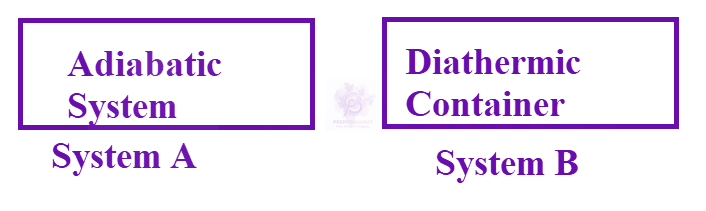
The number of incorrect statement/s from the following is ______________ A. The successive half lives of zero order reactions decreases with time. B. A substance appearing as reactant in the chemical equation may not affect the rate of reaction C. Order and molecularity of a chemical reaction can be a fractional number D. The rate constant units of zero and second order reaction are $\mathrm{molL}-1{s}^{-1}$ and ${\mathrm{mol}}^{-1}L{s}^{-1}$ respectively
Solution of $12g$ of non-electrolyte (A) prepared by dissolving it in $1000\mathrm{mL}$ of water exerts the same osmotic pressure as that of $0.05M$ glucose solution at the same temperature. The empirical formula of $A$ is ${\mathrm{CH}}_{2}O.$ The molecular mass of $A$ is $________g.$ (Nearest integer)
Incorrect statement for the use of indicator in acid-base titration is:
Strong reducing and oxidizing agents among the following , respectively, are
At $27^{\circ}C$, a solution containing $2.5g$ of solute in $250.0\mathrm{mL}$ of solution exerts an osmotic pressure of $400\mathrm{Pa}$. The molar mass of the solute is g ${\mathrm{mol}}^{-1}$ (Nearest integer) (Given : $R=0.083L$ bar $-1{\mathrm{mol}}^{-1}$ )
Gibbs energy vs $T$ plot for the formation of oxides is given below. 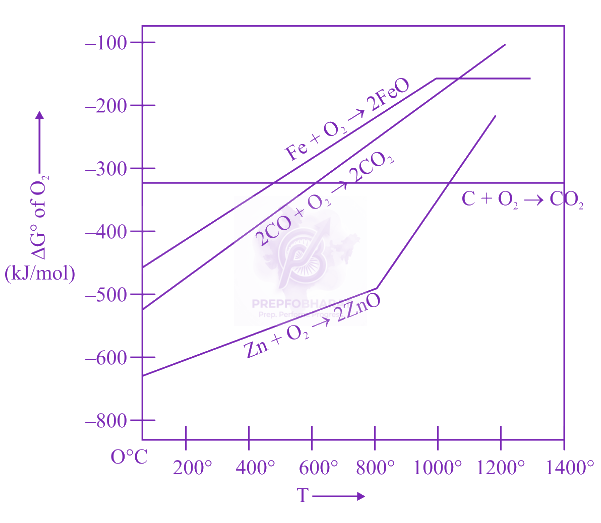 For the given diagram, the correct statement is-
The molality of a $10%(v/V)$ solution of di-bromine solution in ${\mathrm{CCl}}_{4}$ (carbon tetrachloride) is $x$ '. $x=$ $_____\times {10}^{-2}M$. (Nearest integer) [Given : molar mass of ${\mathrm{Br}}_{2}=160g{\mathrm{mol}}^{-1}$ atomic mass of $C=12g{\mathrm{mol}}^{-1}$ atomic mass of $\mathrm{Cl}=35.5g{\mathrm{mol}}^{-1}$ density of dibromine $=3.2g{\mathrm{cm}}^{-3}$ density of ${\mathrm{CCl}}_{4}=1.6g{\mathrm{cm}}^{-3}]$
The standard reduction potentials at $295K$ for the following half cells are given below: <table class="pyq-table"><tbody><tr><td>${{\mathrm{NO}}_{3}}^{-}+4{H}^{+}+3{e}^{-}\rightarrow \mathrm{NO}(g)+2{H}_{2}O$</td><td>${E}^{o}=0.97V$</td></tr><tr><td>${V}^{2+}(\mathrm{aq})+2{e}^{-}\rightarrow V(s)$</td><td>${E}^{o}=-1.19V$</td></tr><tr><td>${\mathrm{Fe}}^{3+}(\mathrm{aq})+3{e}^{-}\rightarrow \mathrm{Fe}(s)$</td><td>${E}^{o}=-0.04V$</td></tr><tr><td>${\mathrm{Ag}}^{+}(\mathrm{aq})+{e}^{-}\rightarrow \mathrm{Ag}(s)$</td><td>${E}^{o}=0.80V$</td></tr><tr><td>${\mathrm{Au}}^{3+}(\mathrm{aq})+3{e}^{-}\rightarrow \mathrm{Au}(s)$</td><td>${E}^{o}=1.40V$</td></tr></tbody></table>The number of metal(s) which will be oxidised by ${{\mathrm{NO}}_{3}}^{-}$ in aqueous solution is _____.
It is observed that characteristic X-ray spectra of elements show regularity. When frequency to the power 'n' i.e. ${v}^{n}$ of X-rays emitted is plotted against atomic number $Z$, the following graph is obtained. 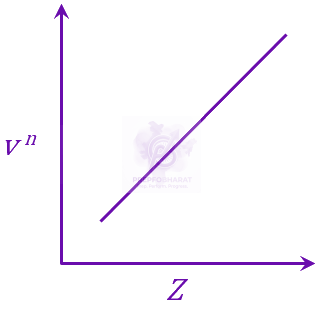 The value of 'n' is
Which one of the following statements is correct for electrolysis of brine solution?
Consider the following reaction that goes from $A$ to $B$ in three steps as shown below: 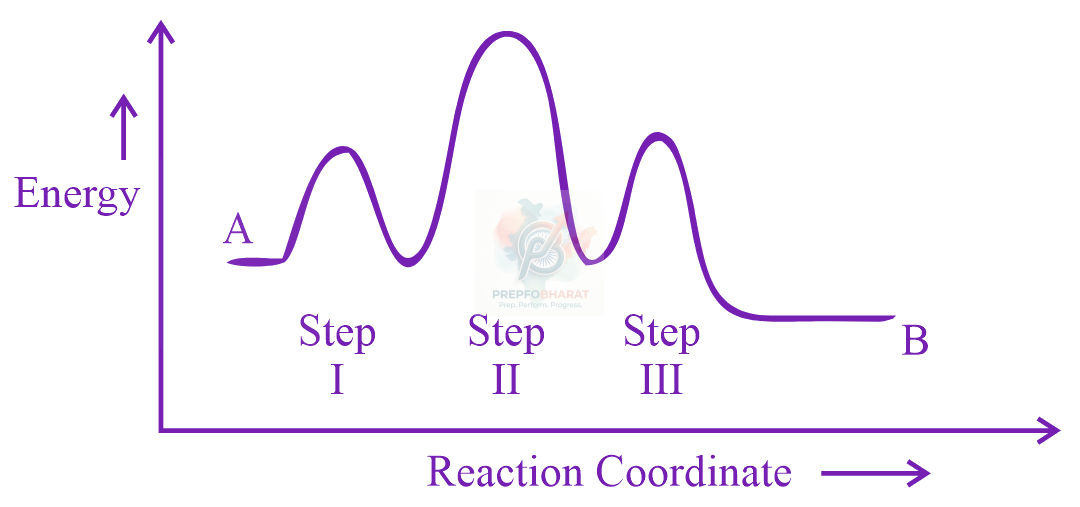 Choose the correct option <table class="pyq-table"><tbody><tr><td></td><td>Number of Intermediates</td><td>Number of Activated Complexes</td><td>Rate determining step</td></tr><tr><td>$(1)$</td><td>$2$</td><td>$3$</td><td>$I$</td></tr><tr><td>$(2)$</td><td>$2$</td><td>$3$</td><td>$\mathrm{III}$</td></tr><tr><td>$(3)$</td><td>$2$</td><td>$3$</td><td>$\mathrm{II}$</td></tr><tr><td>$(4)$</td><td>$3$</td><td>$2$</td><td>$\mathrm{II}$</td></tr></tbody></table>
If $5$ moles of ${\mathrm{BaCl}}_{2}$ is mixed with $2$ moles of ${\mathrm{Na}}_{3}{\mathrm{PO}}_{4},$ the maximum number of moles of ${\mathrm{Ba}}_{3}{({\mathrm{PO}}_{4})}_{2}$formed is $_________$ (Nearest integer)
The radius of the 2$^{nd}$ orbit of ${\mathrm{Li}}^{2+}$ is $x$. The expected radius of the 3$^{rd}$ orbit of ${\mathrm{Be}}^{3+}$ is
$Pt(s){H}_{2}(g)(1\mathrm{bar})|{H}^{+}(\mathrm{aq})(1M)||{M}^{3+}(\mathrm{aq}),{M}^{+}(\mathrm{aq})|\mathrm{Pt}(s)$ The ${E}_{\text{cell }}$ for the given cell is $0.1115V$ at $298K$ When $\frac{[{M}^{+}(\mathrm{aq})]}{[{M}^{3+}(\mathrm{aq})]}={10}^{a}$ The value of a is ___________ Given : ${E}^{\theta }={M}^{3+}/{M}^{+}0.2V$ $\frac{2.303\mathrm{RT}}{F}=0.059V$
A student has studied the decomposition of a gas $A{B}_{3}$ at $25^{\circ}C$. He obtained the following data <table class="pyq-table"><tbody><tr><td>$p(mmHg)$</td><td>$50$</td><td>$100$</td><td>$200$</td><td>$400$</td></tr><tr><td>Relative ${t}_{\frac{1}{2}}(s)$</td><td>$4$</td><td>$2$</td><td>$1$</td><td>$0.5$</td></tr></tbody></table>The order of the reaction is
The orbital angular momentum of an electron in $3s$ orbital is $\frac{\mathrm{xh}}{2\pi }$. The value of $x$ is (nearest integer)
If the $\mathrm{pKa}$ of lactic acid is $5$, then the $\mathrm{pH}$ of $0.005M$ calcium lactate solution at $25^{\circ}C$ is __________ $\times {10}^{–1}$ (Nearest integer)
Solid fuel used in rocket is a mixture of ${\mathrm{Fe}}_{2}{O}_{3}$and $\mathrm{Al}$ (in ratio $1:2$). The heat evolved $(\mathrm{kJ})$ per gram of the mixture is _____ (Nearest integer) Given ${\Delta H}_{f}^{0}({\mathrm{Al}}_{2}{O}_{3})=-1700\mathrm{kJ}{\mathrm{mol}}^{-1}$ ${\Delta H}_{f}^{0}({\mathrm{Fe}}_{2}{O}_{3})=-840\mathrm{kJ}{\mathrm{mol}}^{-1}$ Molar mass of $\mathrm{Fe},\mathrm{AI}$ and $O$ are $56,27$ and $16g{\mathrm{mol}}^{–1}$ respectively
The number of atomic orbitals from the following having $5$ radial nodes is $7s,7p,6s,8p,8d$
Choose the correct representation of conductometric titration of benzoic acid vs sodium hydroxide.
If compound $A$ reacts with $B$ following first order kinetics with rate constant $2.011\times {10}^{-3}{s}^{-1}$. The time taken by A (in seconds) to reduce from $7g$ to $2g$ will be _____ . (Nearest Integer) $[\mathrm{log}5=0.698,\mathrm{log}7=0.845,\mathrm{log}2=0.301]$
The equilibrium composition for the reaction ${\mathrm{PCl}}_{3}+{\mathrm{Cl}}_{2}\underset{}{\rightleftharpoons }{\mathrm{PCl}}_{5}$ at $298K$ is given below: ${[{\mathrm{PCl}}_{3}]}_{\mathrm{eq}}=0.2\mathrm{mol}{L}^{-1},{[{\mathrm{Cl}}_{2}]}_{\mathrm{eq}}=0.1\mathrm{mol}{L}^{-1},{[{\mathrm{PCl}}_{5}]}_{\mathrm{eq}}=0.40\mathrm{mol}{L}^{-1}$ If $0.2\mathrm{mol}$ of ${\mathrm{Cl}}_{2}$ is added at the same temperature, the equilibrium concentrations of ${\mathrm{PCl}}_{5}$ is _____ $\times {10}^{–2}\mathrm{mol}{L}^{–1}$ Given: ${K}_{c}$ for the reaction at $298K$ is $20$
Values of work function $({W}_{0})$ for a few metals are given below <table class="pyq-table"><tbody><tr><td>Metal</td><td>$\mathrm{Li}$</td><td>$\mathrm{Na}$</td><td>$K$</td><td>$\mathrm{Mg}$</td><td>$\mathrm{Cu}$</td><td>$\mathrm{Ag}$</td></tr><tr><td>$\frac{{W}_{0}}{\mathrm{eV}}$</td><td>$2.42$</td><td>$2.3$</td><td>$2.25$</td><td>$3.7$</td><td>$4.8$</td><td>$4.3$</td></tr></tbody></table>The number of metals which will show photoelectric effect when light of wavelength $400\mathrm{nm}$ falls on it is _____ Given: $h=6.6\times {10}^{–34}Js$ $c=3\times {10}^{8}{\mathrm{ms}}^{–1}$ $e=1.6\times {10}^{–19}C$
The energy of an electron in the first Bohr orbit of hydrogen atom is $-2.18\times {10}^{-18}J$ Its energy in the third Bohr orbit is$_______.$
Which of the following statement(s) is/are correct? (A) The $\mathrm{pH}$ of $1\times {10}^{–8}M\mathrm{HCl}$ solution is $8$. (B) The conjugate base of ${H}_{2}{\mathrm{PO}}^{4-}$ is ${\mathrm{HPO}}_{4}^{2-}$. (C) ${K}_{w}$ increases with increase in temperature. (D) When a solution of a weak monoprotic acid is titrated against a strong base at half neutralisation point, $\mathrm{pH}=\frac{1}{2}{\mathrm{pK}}_{a}$. Choose the correct answer from the options given below:
$600\mathrm{mL}$ of $0.01M\mathrm{HCl}$ is mixed with $400\mathrm{mL}$ of $0.01M{H}_{2}{\mathrm{SO}}_{4}$. The $\mathrm{pH}$ of the mixture is _____$\times {10}^{-2}$. (Nearest integer) [Given $\mathrm{log}2=0.30,\mathrm{log}3=0.48,\mathrm{log}5=0.69,\mathrm{log}7=0.84,\mathrm{log}11=1.04$]
Assume that the radius of the first Bohr orbit of hydrogen atom is $0.6Å$. The radius of the third Bohr orbit of ${\mathrm{He}}^{+}$ is _____ picometer. (Nearest Integer)
In the depression of freezing point experiment A. Vapour pressure of the solution is less than that of pure solvent B. Vapour pressure of the solution is more than that of pure solvent C. Only solute molecules solidify at the freezing point D. Only solvent molecules solidify at the freezing point
See the following chemical reaction: ${\mathrm{Cr}}_{2}{O}_{7}^{2-}+{\mathrm{XH}}^{+}+6{\mathrm{Fe}}^{2+}\rightarrow {\mathrm{YCr}}^{3+}+6{\mathrm{Fe}}^{3+}+{\mathrm{ZH}}_{2}O$ The sum of X, Y and Z is
The standard electrode potential (${M}^{3+}/{M}^{2+}$) for $V,\mathrm{Cr},\mathrm{Mn}$ & $\mathrm{Co}$ are $-0.26V,-0.41V,+1.57V$ and $+1.97V$, respectively. The metal ions which can liberate ${H}_{2}$ from a dilute acid are
For a reversible reaction $A\rightleftharpoons B$, the $\Delta H$ forward reaction $=20\mathrm{kJ}{\mathrm{mol}}^{–1}$. The activation energy of the uncatalyzed forward reaction is $300\mathrm{kJ}{\mathrm{mol}}^{–1}$. When the reaction is catalysed keeping the reactant concentration same, the rate of the catalysed forward reaction at ${27}^{\circ }C$ is found to be same as that of the uncatalyzed reaction at ${327}^{\circ }C$. The activation energy of the catalysed backward reaction is _______$\mathrm{kJ}{\mathrm{mol}}^{–1}$.
One mole of an ideal monoatomic gas is subjected to changes as shown in the graph. The magnitude of the work done (by the system or on the system) is _______ J (nearest integer) 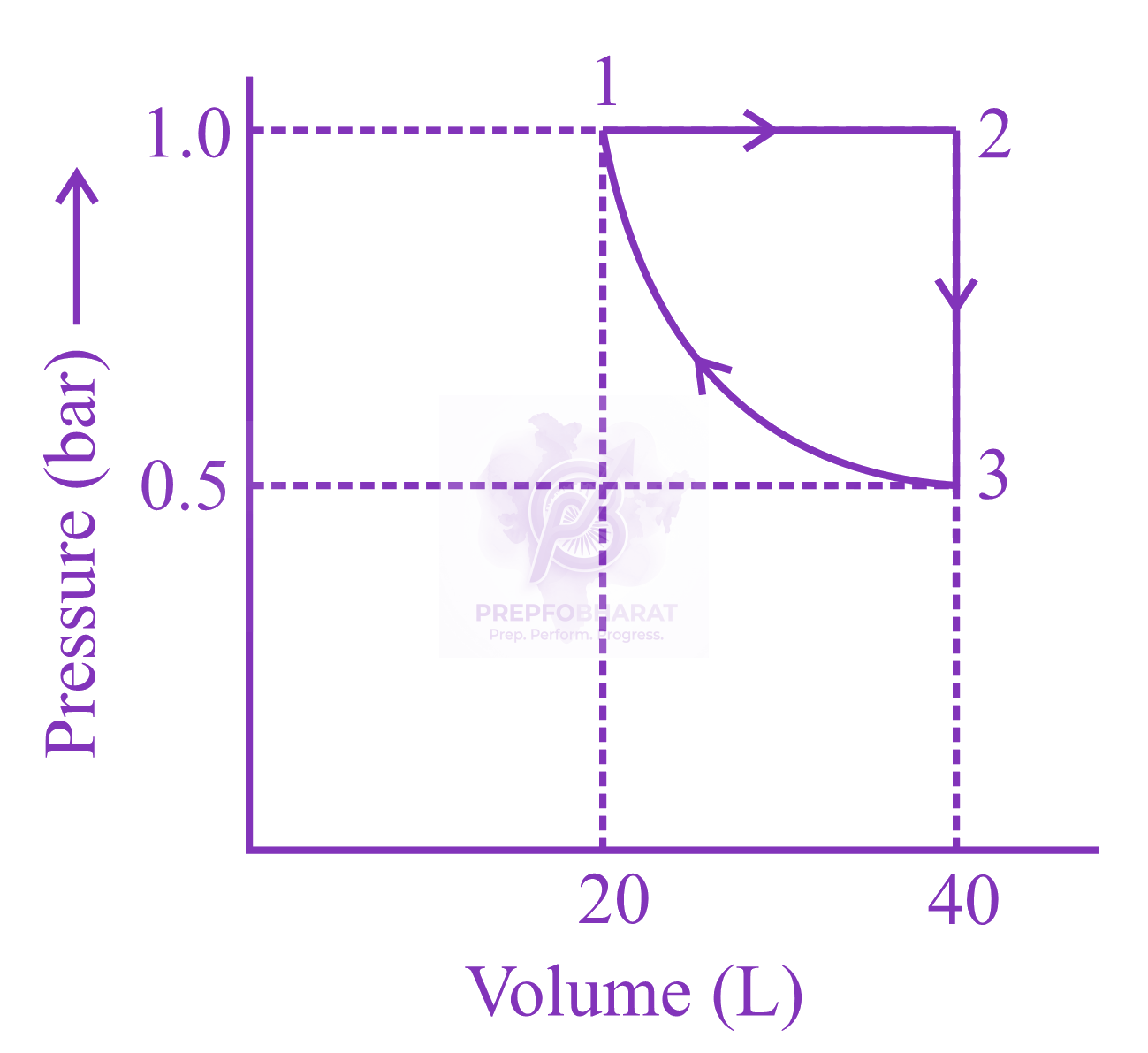 Given : log 2 = 0.3, ln 10 = 2.3
${\mathrm{FeO}}_{4}^{2-}\overset{+2.2V}{\longrightarrow }{\mathrm{Fe}}^{3+}\overset{+0.70V}{\longrightarrow }{\mathrm{Fe}}^{2+}\overset{-0.45V}{\longrightarrow }{\mathrm{Fe}}^{0}$ ${E}_{{\mathrm{FeO}}_{4}^{2-}/{\mathrm{Fe}}^{2+}}^{\theta }$ is $x\times {10}^{-3}V$. The value of $x$ is _______
If the radius of the first orbit of hydrogen atom is ${a}_{0}$, then de Broglie’s wavelength of electron in ${3}^{\mathrm{rd}}$ orbit is
An analyst wants to convert $1L\mathrm{HCl}$ of $\mathrm{pH}=1$ to a solution of $\mathrm{HCl}$ of $\mathrm{pH}=2$. The volume of water needed to do this dilution is _____ $\mathrm{mL}$. (Nearest integer)
At $298K$ ${N}_{2}(g)+3{H}_{2}(g)\rightleftharpoons 2{\mathrm{NH}}_{3}(g),{K}_{1}=4\times {10}^{5}$ ${N}_{2}(g)+{O}_{2}(g)\rightleftharpoons 2\mathrm{NO}(g),{K}_{2}=1.6\times {10}^{12}$ ${H}_{2}(g)+\frac{1}{2}{O}_{2}(g)\rightleftharpoons {H}_{2}O(g),{K}_{3}=1.0\times {10}^{-13}$ Based on above equilibria, the equilibrium constant of the reaction, $2{\mathrm{NH}}_{3}(g)+\frac{5}{2}{O}_{2}(g)\rightleftharpoons 2\mathrm{NO}(g)+3{H}_{2}O(g)$ is _____ $\times {10}^{-33}$ (Nearest integer)
One mole of an ideal gas at $350K$ is in a $2.0L$ vessel of thermally conducting walls, which are in contact with the surroundings. It undergoes isothermal reversible expansion from $2.0L$ to $3.0L$ against a constant pressure of $4\mathrm{atm}$. The change in entropy of the surroundings $(\Delta S)$ is _____ $J{K}^{–1}$ (Nearest integer) Given: $R=8.314J{K}^{-1}{\mathrm{mol}}^{-1}$.
The volume of $0.02M$ aqueous $\mathrm{HBr}$ required to neutralize $10.0\mathrm{mL}$ of $0.01M$ aqueous $\mathrm{Ba}(\mathrm{OH}{)}_{2}$ is (Assume complete neutralization)
Which of the following relations are correct? (A) $\Delta U=q+p\Delta V$ (B) $\Delta G=\Delta H-T\Delta S$ (C) $\Delta S=\frac{{q}_{\mathrm{rev}}}{T}$ (D) $\Delta H=\Delta U-\Delta nRT$ Choose the most appropriate answer from the options given below :
$0.3g$ of ethane undergoes combustion at $27^{\circ}C$ in a bomb calorimeter. The temperature of calorimeter system (including the water) is found to rise by $0.5^{\circ}C$. The heat evolved during combustion of ethane at constant pressure is ${\mathrm{kJmol}}^{-1}$. (Nearest integer) [Given : The heat capacity of the calorimeter system is $20\mathrm{kJ}{K}^{-1},R=8.3{\mathrm{JK}}^{-1}{\mathrm{mol}}^{-1}$. Assume ideal gas behaviour. Assume ideal gas behaviour. Atomic mass of $C$ and $H$ are $12$ and $1g{\mathrm{mol}}^{-1}$ respectively]
Maximum number of electrons that can be accommodated in shell with $n=4$ are:
Consider the following equation: $2{\mathrm{SO}}_{2}(g)+{O}_{2}(g)\rightleftharpoons 2{\mathrm{SO}}_{3}(g),\Delta H=-190\mathrm{kJ}$. The number of factors which will increase the yield of ${\mathrm{SO}}_{3}$ at equilibrium from the following is _____ . A. Increasing temperature B. Increasing pressure C. Adding more ${\mathrm{SO}}_{2}$ D. Adding more ${O}_{2}$ E. Addition of catalyst
Which transition in the hydrogen spectrum would have the same wavelength as the Balmer type transition from $n=4$ to $n=2$ of ${\mathrm{He}}^{+}$spectrum
The number of given statement/s which is/are correct is_____ (A) The stronger the temperature dependence of the rate constant, the higher is the activation energy. (B) If a reaction has zero activation energy, its rate is independent of temperature. (C) The stronger the temperature dependence of the rate constant, the smaller is the activation energy. (D) If there is no correlation between the temperature and the rate constant then it means that the reaction has negative activation energy.
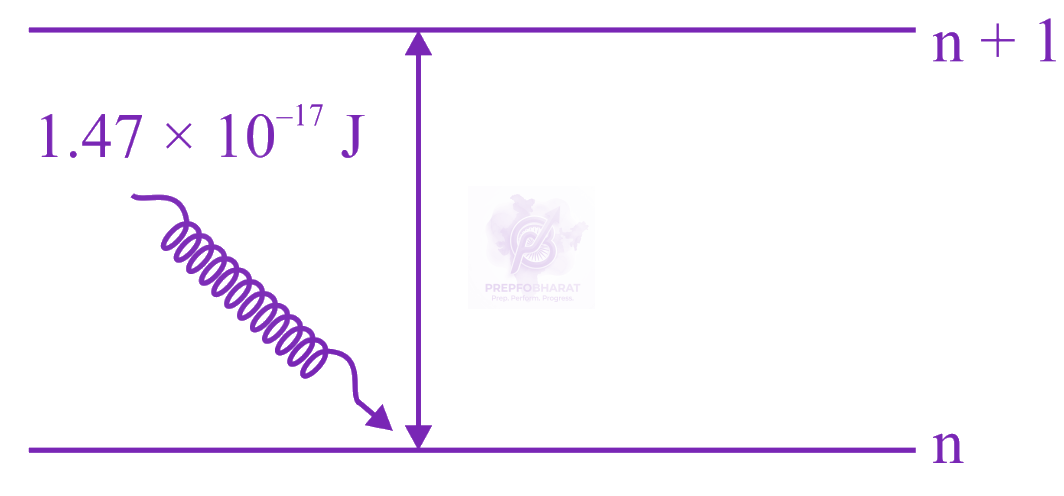 The electron in the ${n}^{\mathrm{th}}$ orbit of ${\mathrm{Li}}^{2+}$ is excited to $(n+1)$ orbit using the radiation of energy $1.47\times {10}^{-17}J$ (as shown in the diagram). The value of $n$ is ___________ Given : ${R}_{H}=2.18\times {10}^{-18}J$
For lead storage battery pick the correct statements A. During charging of battery, ${\mathrm{PbSO}}_{4}$ on anode is converted into ${\mathrm{PbO}}_{2}$ B. During charging of battery, ${\mathrm{PbSO}}_{4}$ on cathode is converted into ${\mathrm{PbO}}_{2}$ C. Lead storage battery consists of grid of lead packed with ${\mathrm{PbO}}_{2}$ as anode D. Lead storage battery has $~38%$ solution of sulphuric acid as an electrolyte Choose the correct answer from the options given below:
For a concentrated solution of a weak electrolyte (${K}_{\mathrm{eq}}=$equilibrium constant) ${A}_{2}{B}_{3}$ of concentration $‘C’,$ the degree of dissociation $‘\alpha ’$ is
The number of pairs of the solution having the same value of the osmotic pressure from the following is (Assume $100%$ ionization) A. $0.500M{C}_{2}{H}_{5}\mathrm{OH}(\mathrm{aq})$ and $0.25M\mathrm{KBr}(\mathrm{aq})$ B. $0.100{M}_{}{K}_{4}[\mathrm{Fe}(\mathrm{CN}{)}_{6}](\mathrm{aq})$ and $0.100M$ ${\mathrm{FeSO}}_{4}{({\mathrm{NH}}_{4})}_{2}{\mathrm{SO}}_{4}(\mathrm{aq})$ C. $0.05M{K}_{4}[\mathrm{Fe}(\mathrm{CN}{)}_{6}]$ (aq) and $0.25M\mathrm{NaCl}$ $(\mathrm{aq})$ D. $0.15M\mathrm{NaCl}(\mathrm{aq})$ and $0.1M{\mathrm{BaCl}}_{2}(\mathrm{aq})$ E. $0.02M\mathrm{KCl}.{\mathrm{MgCl}}_{2}.6{H}_{2}O(\mathrm{aq})$ and $0.05M$ $\mathrm{KCl}(\mathrm{aq})$
A metal surface of $100{\mathrm{cm}}^{2}$ area has to be coated with nickel layer of thickness $0.001\mathrm{mm}.$ A current of $2A$ was passed through a solution of $\mathrm{Ni}{({\mathrm{NO}}_{3})}_{2}$ for $‘x’$ seconds to coat the desired layer. The value of $x$ is _________. (Nearest integer) ($\rho Ni$ (density of Nickel) is $10g{\mathrm{mL}}^{–1},$Molar mass of Nickel is $60g{\mathrm{mol}}^{-1}F=96500{\mathrm{Cmol}}^{-1}$)
$1\times {10}^{-5}M{\mathrm{AgNO}}_{3}$ is added to $1L$ of saturated solution of $\mathrm{AgBr}$. The conductivity of this solution at $298K$ is $_______\times {10}^{-8}S{m}^{-1}$. [Given : ${K}_{\mathrm{sp}}(\mathrm{AgBr})=4.9\times {10}^{-13}$ at $298K$ ${\lambda }_{{\mathrm{Ag}}^{+}}^{0}=6\times {10}^{-3}{\mathrm{Sm}}^{2}{\mathrm{mol}}^{-1}$ ${\lambda }_{{\mathrm{Br}}^{-}}^{0}=8\times {10}^{-3}{\mathrm{Sm}}^{2}{\mathrm{mol}}^{-1}$ ${\lambda }_{{\mathrm{NO}}_{3}^{-}}^{0}=7\times {10}^{-3}{\mathrm{Sm}}^{2}{\mathrm{mol}}^{-1}]$
For reaction: ${\mathrm{SO}}_{2}(g)+\frac{1}{2}{O}_{2}(g)\rightleftharpoons {\mathrm{SO}}_{3}(g)$ ${K}_{P}=2\times {10}^{12}$ at $27^{\circ}C$ and $1\mathrm{atm}$ pressure. The ${K}_{c}$ for the same reaction is $\times {10}^{13}.($ Nearest integer) (Given $R=0.082L\mathrm{atm}{K}^{-1}{\mathrm{mol}}^{-1}$ )
During the reaction of permanganate with thiosulphate, the change in oxidation of manganese occurs by value of $3$. Identify which of the below medium will favour the reaction.
What is the mass ratio of ethylene glycol (${C}_{2}{H}_{6}{O}_{2}$, molar mass $=62g/\mathrm{mol}$) required for making $500g$ of $0.25$ molal aqueous solution and $250\mathrm{mL}$ of $0.25$ molar aqueous solution?
The number of incorrect statement/s about the black body from the following is______ (A) Emit or absorb energy in the form of electromagnetic radiation. (B) Frequency distribution of the emitted radiation depends on temperature. (C) At a given temperature, intensity vs frequency curve passes through a maximum value. (D) The maximum of the intensity vs frequency curve is at a higher frequency at higher temperature compared to that at lower temperature.
Solid Lead nitrate is dissolved in $1$ litre of water. The solution was found to boil at $100.15^{\circ}C$. When $0.2\mathrm{mol}$ of $\mathrm{NaCl}$ is added to the resulting solution, it was observed that the solution froze at $-0.8^{\circ}C$. The solutbility product of ${\mathrm{PbCl}}_{2}$ formed is _____ $\times {10}^{-6}$ at $298K$. (Nearest integer) Given : ${K}_{b}=0.5K\mathrm{kg}{\mathrm{mol}}^{-1}$ and ${K}_{f}=1.8\mathrm{kg}{\mathrm{mol}}^{-1}$. Assume molality to be equal to molarity in all cases.
A first order reaction has the rate constant, $k=4.6\times {10}^{-3}{s}^{-1}$. The number of correct statement/s from the following is/are Given: $\mathrm{log}3=0.48$. A. Reaction completes in $1000s$. B. The reaction has a half-life of $500s$. C. The time required for $10%$ completion is 25 times the time required for 90% completion. D. The degree of dissociation is equal to $(1-{e}^{-\mathrm{kt}})$. E. The rate and the rate constant have the same unit.
The Total pressure observed by mixing two liquid $A\text{and}B$ is $350\mathrm{mm}\mathrm{Hg}$ when their mole fractions are $0.7\text{and}0.3$ respectively. The Total pressure becomes$410\mathrm{mm}\mathrm{Hg}$ if the mole fractions are changed to$0.2\text{and}0.8$ respectively for $A\text{and}B$. The vapour pressure of pure $A$ is ______ $\mathrm{mm}\mathrm{Hg}$. (Nearest integer) Consider the liquids and solutions behave ideally
The shortest wavelength of hydrogen atom in Lyman series is $\lambda$. The longest wavelength in Balmer series of ${\mathrm{He}}^{+}$ is
$1$ mole of ideal gas is allowed to expand reversibly and adiabatically from a temperature of $27^{\circ}C$. The work done is $3\mathrm{kJ}{\mathrm{mol}}^{-1}$. The final temperature of the gas is _____ $K$ (Nearest integer). Given ${C}_{v}=20J{\mathrm{mol}}^{-1}{K}^{-1}$
The total pressure of a mixture of non-reacting gases $X(0.6g)$ and $Y(0.45g)$ in a vessel is $740\mathrm{mm}$ of $\mathrm{Hg}$. The partial pressure of the gas $X$ is $\mathrm{mm}$ of $\mathrm{Hg}.$ (Nearest Integer) (Given : molar mass $X=20$ and $Y=45g{\mathrm{mol}}^{-1}$ )
The volume of $\mathrm{HCl}$, containing $73g{L}^{-1}$, required to completely neutralise $\mathrm{NaOH}$ obtained by reacting $0.69g$ of metallic sodium with water, is _____ $\mathrm{mL}$. (Nearest Integer) (Given : molar Masses of $\mathrm{Na},\mathrm{Cl},O,H$ are $23,35.5,16$ and $1g{\mathrm{mol}}^{-1}$ respectively)
$25\mathrm{mL}$ of an aqueous solution of $\mathrm{KCl}$ was found to require $20\mathrm{mL}$ of $1M{\mathrm{AgNO}}_{3}$ solution when titrated using ${K}_{2}{\mathrm{CrO}}_{4}$ as an indicator. What is the depression in freezing point of $\mathrm{KCl}$ solution of the given concentration? (Nearest integer). (Given : ${K}_{f}=2.0K\mathrm{kg}{\mathrm{mol}}^{-1}$ ) Assume 1) $100%$ ionization and 2) density of the aqueous solution as $1g{\mathrm{mL}}^{-1}$
Lead storage battery contains $38%$ by weight solution of ${H}_{2}{\mathrm{SO}}_{4}$. The van't Hoff factor is $2.67$ at this concentration. The temperature in Kelvin at which the solution in the battery will freeze is _____ (Nearest integer). Given ${K}_{f}=1.8K\mathrm{kg}{\mathrm{mol}}^{-1}$
When 2 litre of ideal gas expands isothermally into vacuum to a total volume of $6$ litre, the change in internal energy is _____ J. (Nearest integer)
The titration curve of weak acid vs. strong base with phenolphthalein as indicator is shown below. The ${K}_{\text{phenolphthalein }}=4\times {10}^{-10}$ Given: $\mathrm{log}2=0.3$ 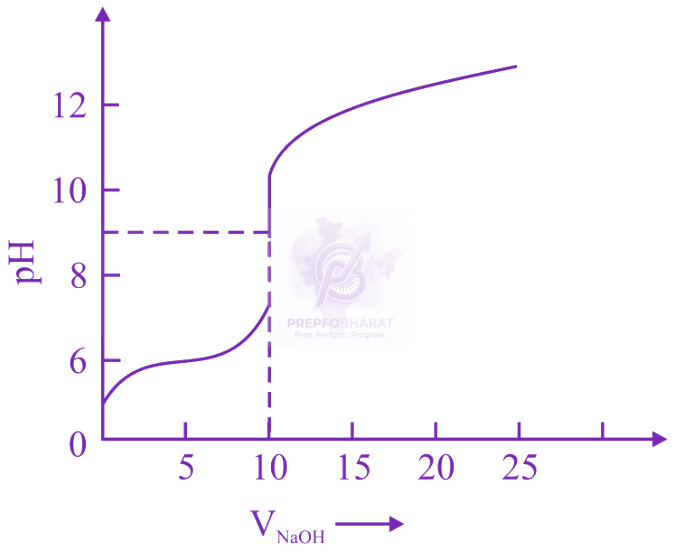 The number of following statement/s which is/are correct about phenolphthalein is _______ A. It can be used as an indicator for the titration of weak acid with weak base. B. It begins to change colour at $\mathrm{pH}=8.4$ C. It is a weak organic base D. It is colourless in acidic medium
If the boiling points of two solvents $X$ and $Y$ (having same molecular weights) are in the ratio $\text{2: 1}$ and their enthalpy of vaporizations are in the ratio $1:2$, then the boiling point elevation constant of $X$ is $m$ times the boiling point elevation constant of $Y$. The value of $m$ is (nearest integer).
$25\mathrm{mL}$ of silver nitrate solution $(1M)$ is added dropwise to $25\mathrm{mL}$ of potassium iodide $(1.05M)$ solution. The ion(s) present in very small quantity in the solution is/are
Match List-I with List-II<table class="pyq-table"><tbody><tr><td></td><td>List-I</td><td></td><td>List-II</td></tr><tr><td>A</td><td>$16g$ of ${\mathrm{CH}}_{4}(g)$</td><td>I</td><td>Weighs $28g$</td></tr><tr><td>B</td><td>$1g$ of ${H}_{2}(g)$</td><td>II</td><td>$60.2\times {10}^{23}$ electrons</td></tr><tr><td>C</td><td>$1\mathrm{mole}$ of ${N}_{2}(g)$</td><td>III</td><td>Weighs $32g$</td></tr><tr><td>D</td><td>$0.5\mathrm{mol}$of ${\mathrm{SO}}_{2}(g)$</td><td>IV</td><td>Occupies$11.4L$ volume at STP</td></tr></tbody></table>Choose the correct answer from the options given below:
The energy of one mole of photons of radiation of frequency $2\times {10}^{12}\mathrm{Hz}$ in ${\mathrm{Jmol}}^{-1}$ is _____ . (Nearest integer) (Given: $h=6.626\times {10}^{-34}\mathrm{Js}$ ${N}_{A}=6.022\times {10}^{23}{\mathrm{mol}}^{-1}$)
The incorrect statements from the following is: A. The electrical work that a reaction can perform at constant pressure and temperature is equal to the reaction Gibbs energy. B. ${E}_{\mathrm{cell}}^{\circ }$ is dependent on the pressure. C. $\frac{{\mathrm{dE}}_{\mathrm{cell}}^{^{\circ}}}{\mathrm{dT}}=\frac{{\Delta }_{r}{S}^{^{\circ}}}{\mathrm{nF}}$ D. A cell is operating reversibly if the cell potential is exactly balanced by an opposing source of potential difference.
The solubility product of ${\mathrm{BaSO}}_{4}$ is $1\times {10}^{-10}$ at $298K$. The solubility of ${\mathrm{BaSO}}_{4}$ in $0.1M{K}_{2}{\mathrm{SO}}_{4}(\mathrm{aq})$ solution is ------$\times {10}^{-9}g{L}^{-1}$(nearest integer). Given: Molar mass of ${\mathrm{BaSO}}_{4}$ is $233g{\mathrm{mol}}^{-1}$
${\mathrm{KClO}}_{3}+6{\mathrm{FeSO}}_{4}+3{H}_{2}{\mathrm{SO}}_{4}\rightarrow \mathrm{KCl}+3{\mathrm{Fe}}_{2}({\mathrm{SO}}_{4}{)}_{3}+3{H}_{2}O$ The above reaction was studied at $300K$ by monitoring the concentration of ${\mathrm{FeSO}}_{4}$ in which initial concentration was $10M$ and after half an hour became $8.8M$. The rate of production of ${\mathrm{Fe}}_{2}({\mathrm{SO}}_{4}{)}_{3}$ is _______ $\times l{0}^{–6}\mathrm{mol}{L}^{–1}s{}^{–1}$ (Nearest integer)
When the hydrogen ion concentration $[{H}^{+}]$changes by a factor of $1000$ , the value of $\mathrm{pH}$ of the solution
The product, which is not obtained during the electrolysis of brine solution is
The value of $\mathrm{log}K$ for the reaction $A\rightleftharpoons B$ at $298K$ is $_______.$ (Nearest integer) Given: $\Delta H^{\circ}=-54.07\mathrm{kJ}{\mathrm{mol}}^{-1}$ $\Delta S^{\circ}=10{\mathrm{JK}}^{-1}{\mathrm{mol}}^{-1}$ (Taken $2.303\times 8.314\times 298=5705$ )
The number of endothermic process/es from the following is _______. A. ${I}_{2}(g)\rightarrow 2I(g)$ B. $\mathrm{HCl}(g)\rightarrow H(g)+\mathrm{Cl}(g)$ C. ${H}_{2}O(l)\rightarrow {H}_{2}O(g)$ D. $C(s)+{O}_{2}(g)\rightarrow {\mathrm{CO}}_{2}(g)$ E. Dissolution of ammonium chloride in water
Given below are two statements: Statement-I : Methyl orange is a weak acid. Statement-II : The benzenoid form of methyl orange is more intense/deeply coloured than the quinonoid form. In the light of the above statement, choose the most appropriate answer from the options given below:
The density of a monobasic strong acid (Molar mass $24.2g\mathrm{mol})$ is $1.21\mathrm{kg}L$. The volume of its solution required for the complete neutralization of $25\mathrm{mL}$ of $0.24M\mathrm{NaOH}$ is ${10}^{-2}\mathrm{mL}$ (Nearest integer)
If the degree of dissociation of aqueous solution of weak monobasic acid is determined to be $0.3$, then the observed freezing point will be _____ $%$ higher than the expected/theoretical freezing point. (Nearest integer).
The density of $3M$ solution of $\mathrm{NaCl}$ is $1.0g{\mathrm{mL}}^{-1}$. Molality of the solution is $______\times {10}^{-2}m$ (Nearest integer). Given: Molar mass of $\mathrm{Na}$ and $\mathrm{Cl}$ is $23$ and $35.5g$ ${\mathrm{mol}}^{-1}$ respectively.
A solution is prepared by adding $2g$ of $''X''$ to $1$ mole of water. Mass percent of $''X''$in solution is
The number of units, which are used to express concentration of solutions from the following is _________. (Mass percent, Mole, Mole fraction, Molarity, ppm, Molality.)
At $25^{\circ}C$, the enthalpy of the following processes are given: ${H}_{2}(g)+{O}_{2}(g)\rightarrow 2\mathrm{OH}(g)\Delta {H}^{o}=78\mathrm{kJ}{\mathrm{mol}}^{-1}$ ${H}_{2}(g)+1/2{O}_{2}(g)\rightarrow {H}_{2}O(g)\Delta {H}^{0}=-242\mathrm{kJ}{\mathrm{mol}}^{-1}$ ${H}_{2}(g)\rightarrow 2H(g)\Delta {H}^{o}=436\mathrm{kJ}{\mathrm{mol}}^{-1}$ $1/2{O}_{2}(g)\rightarrow O(g)\Delta {H}^{0}=249\mathrm{kJ}{\mathrm{mol}}^{-1}$ What would be the value of X for the following reaction? (Nearest integer) ${H}_{2}O(g)\rightarrow H(g)+\mathrm{OH}(g)\Delta {H}^{o}=X{\mathrm{kJmol}}^{-1}$
The wavelength of an electron of kinetic energy $4.50\times {10}^{-29}J$ is $________\times 10–5m.$ (Nearest integer) Given: mass of electron is$9\times 10–31\mathrm{kg},h=6.6\times 10–34\mathrm{Js}$
The osmotic pressure of solutions of PVC in cyclohexanone at $300K$ are plotted on the graph. The molar mass of PVC is $g{\mathrm{mol}}^{-1}$ (Nearest integer) 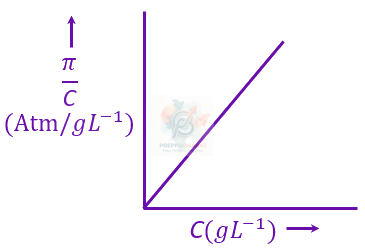 (Given : $R=0.083L\mathrm{atm}{K}^{-1}{\mathrm{mol}}^{-1}$ )
Given (A) $2\mathrm{CO}(g)+{O}_{2}(g)\rightarrow 2{\mathrm{CO}}_{2}(g){\Delta H}_{1}^{o}=-x\mathrm{kJ}{\mathrm{mol}}^{-1}$ (B) $C(\mathrm{graphite})+{O}_{2}(g)\rightarrow {\mathrm{CO}}_{2}(g){\Delta H}_{2}^{o}=-y\mathrm{kJ}{\mathrm{mol}}^{-1}$ The $\Delta {H}^{o}$ for the reaction $C(\mathrm{graphite})+\frac{1}{2}{O}_{2}(g)\rightarrow \mathrm{CO}(g)$ is
The total number of intensive properties from the following is........... Volume, Molar heat capacity, molarity, ${E}_{\mathrm{cell}}^{o}$,Gibbs free energy change, Molar mass, Mole
Henry Moseley studied characteristic $X$-ray spectra of elements. The graph which represents his observation correctly is Given $v=$ Frequency of X-ray emitted $Z=$ Atomic number
$4.5$ moles each of hydrogen and iodine is heated in a sealed ten litre vessel.At equilibrium, $3$ moles of $\mathrm{HI}$ were found. The equilibrium constant for ${H}_{2}(g)+{I}_{2}(g)\rightleftharpoons 2{\mathrm{HI}}_{(g)}$ is ........
The wave function $(\Psi )$ of $2s$ is given by ${\Psi }_{2s}=\frac{1}{2\sqrt{2\pi }}{(\frac{1}{{a}_{0}})}^{1/2}(2-\frac{r}{{a}_{0}}){e}^{-r/2{a}_{0}}$ At $r={r}_{0}$, radial node is formed. Thus, ${r}_{0}$ in terms of ${a}_{0}$
$A(g)\rightarrow 2B(g)+C(g)$ is a first order reaction. The initial pressure of the system was found to be $800\mathrm{mm}\mathrm{Hg}$ which increased to $1600\mathrm{mm}\mathrm{Hg}$ after $10\mathrm{min}$. The total pressure of the system after $30$min will be $\mathrm{mm}\mathrm{Hg}$. (Nearest integer)
Some amount of dichloromethane $({\mathrm{CH}}_{2}{\mathrm{Cl}}_{2})$ is added to $671.141\mathrm{mL}$ of chloroform $({\mathrm{CHCl}}_{3})$ to prepare $2.6\times {10}^{-3}M$ solution of ${\mathrm{CH}}_{2}{\mathrm{Cl}}_{2}(\mathrm{DCM})$. The concentration of $\mathrm{DCM}$ is _____ ppm (by mass). Given: Atomic mass : $C=12;H:1;\mathrm{Cl}=35.5$ density of ${\mathrm{CHCl}}_{3}=1.49g{\mathrm{cm}}^{-3}$
The enthalpy change for the conversion of $\frac{1}{2}{\mathrm{Cl}}_{2}$ (g) to ${\mathrm{Cl}}^{-}(\mathrm{aq})$ is $(-)$ ${\mathrm{kJmol}}^{-1}$ (Nearest integer) Given : ${\Delta }_{\text{dis }}{H}_{{\mathrm{Cl}}_{2(g)}}^{0}=240{\mathrm{kJmol}}^{-1}$. ${\Delta }_{\mathrm{eg}}{H}_{\mathrm{Cl}(g)}^{o}=-350{\mathrm{kJmol}}^{-1}$, ${\Delta }_{\mathrm{hyd}}{H}_{{\mathrm{Cl}}_{(g)}^{-}}^{o}=-380{\mathrm{kJmol}}^{-1}$
What weight of glucose must be dissolved in $100g$ of water to lower the vapour pressure by $0.20\mathrm{mm}\mathrm{Hg}$? (Assume dilute solution is being formed) Given: Vapour pressure of pure water is $54.2\mathrm{mm}\mathrm{Hg}$ at room temperature.Molar mass of glucose is $180g{\mathrm{mol}}^{-1}$
If wavelength of the first line of the Paschen series of hydrogen atom is $720\mathrm{nm}$, then the wavelength of the second line of this series is _______ $\mathrm{nm}$. (Nearest integer)
Enthalpies of formation of ${\mathrm{CCl}}_{4}(g),{H}_{2}O(g),{\mathrm{CO}}_{2}(g)$ and $\mathrm{HCl}$ are $-105,-242,-394$ and $-92\mathrm{kJ}{\mathrm{mol}}^{-1}$ respectively. The magnitude of enthalpy of the reaction given below is ${\mathrm{kJmol}}^{-1}$. (nearest integer) ${\mathrm{CCl}}_{4}(g)+2{H}_{2}O(g)\rightarrow {\mathrm{CO}}_{2}(g)+4\mathrm{HCl}(g)$
The specific conductance of $0.0025M$ acetic acid is $5\times {10}^{-5}S{\mathrm{cm}}^{-1}$ at a certain temperature. The dissociation constant of acetic acid is ___________ $\times {10}^{-7}$.(Nearest integer) Consider limiting molar conductivity of ${\mathrm{CH}}_{3}\mathrm{COOH}$ as $400S{\mathrm{cm}}^{2}{\mathrm{mol}}^{-1}$
${A}_{2}+{B}_{2}\rightarrow 2\mathrm{AB}.\Delta {H}_{f}=-200\mathrm{kJ}{\mathrm{mol}}^{-1}$ $\mathrm{AB},{A}_{2}$ and ${B}_{2}$ are diatomic molecules. If the bond enthalpies of ${A}_{2},{B}_{2}$ and $\mathrm{AB}$ are in the ratio$1:0.5:1,$ then the bond enthalpy of ${A}_{2}$ is$_________kJ{\mathrm{mol}}^{–1}$ (Nearest integer)
For a metal ion, the calculated magnetic moment is $4.90\mathrm{BM}$. This metal ion has _______ number of unpaired electrons