C6H5(WA)COOH+Na(SB)OH→C6H5(Salt)COONa+H2O
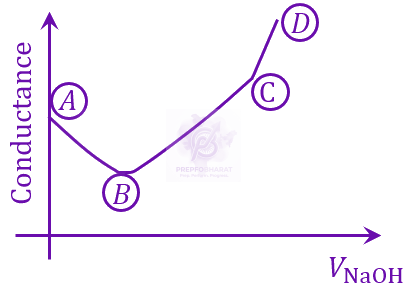
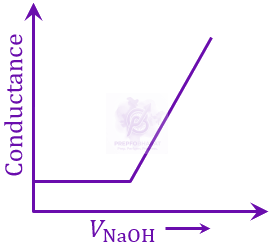
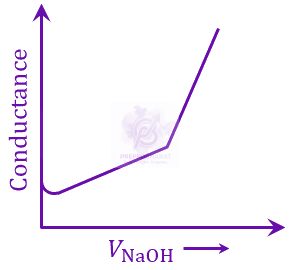
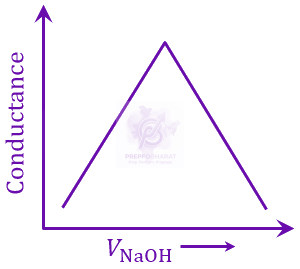
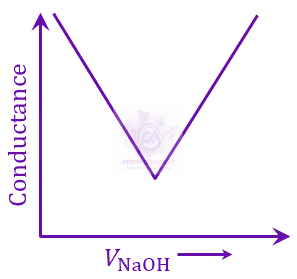
Initially the conductance is low due to the feeble ionisation of acetic acid. On the addition of base, there is decrease in conductance(A→B) not only due to the replacement ofH+ by Na+ but also suppresses the dissociation of benzoic acid due to common ion benzoate. But very soon, the conductance increases(B→C) on adding NaOH as NaOH neutralises the un-dissociated C6H5COOH to C6H5COONa which is the strong electrolyte. This increase in conductance continues raise up to the equivalence point. The graph near the equivalence point is curved due the hydrolysis of salt C6H5COONa. Beyond the equivalence point, conductance increases(C→D) more rapidly with the addition of NaOH due to the highly conducting OH− ions