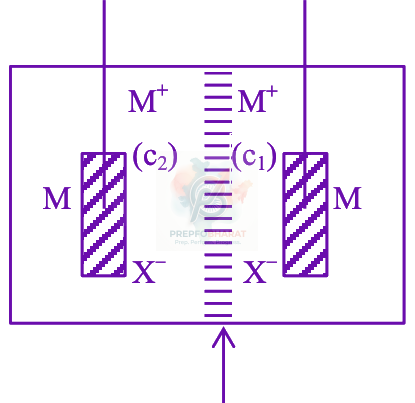
The given setup is a concentration cell with identical electrodes (M) and different electrolyte concentrations (c1 and c2).
For a concentration cell, the standard cell potential Ecell0=0.
The cell reactions are:
Anode: M(s)→M+(canode)+e−
Cathode: M+(ccathode)+e−→M(s)
Net reaction: M+(ccathode)→M+(canode)
Using the Nernst equation at 298 K:
Ecell=Ecell0−n0.0591logccathodecanode
Ecell=0−0.0591logccathodecanode
For a positive cell potential (Ecell>0), the term logccathodecanode must be negative.
This requires ccathodecanode<1, which means ccathode>canode.
If c1 is present at the cathode and c2 is at the anode, then for Ecell>0, we must have c1>c2.
Checking the options:
(1) If c1 is at cathode, c1<c2 (Incorrect)
(2) If c1 is at anode, c1>c2 (Incorrect, would require c2>c1)
(3) If c1 is at cathode, c1>c2 (Correct)
(4) If c1 is at anode, c1=c2 (Incorrect, Ecell would be zero)