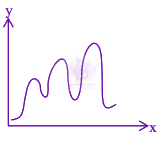
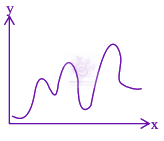
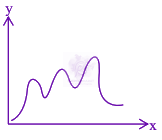
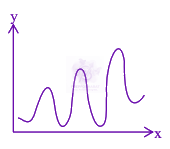
The reaction A → D occurs through three elementary steps with energy changes:
Step (i): A → B is endothermic (ΔHI=+ve), so B has higher energy than A, creating the first peak.
Step (ii): B → C is exothermic (ΔHII=−ve), so C has lower energy than B, creating a lower second peak.
Step (iii): C → D is exothermic (ΔHIII=−ve), so D has lower energy than C, creating an even lower third feature.
Overall reaction: Since step (i) is endothermic and steps (ii) and (iii) are exothermic, the reaction can be endothermic overall depending on the magnitudes. The overall energy change is positive (A → D is endothermic), meaning D must be at higher energy than A.
The reaction profile must show three distinct peaks/steps with the final product D positioned higher than the initial reactant A.
(1) correctly depicts this three-step mechanism with proper energy relationships and overall endothermic character.