For Statement I:
According to the Arrhenius equation:
log(k1k2)=2.303REa(T1T2T2−T1)
Given that the rate constant doubles, k2=2k1. The temperatures are T1=298 K and T2=308 K.
The gas constant R=8.314 J K−1 mol−1=4.28.314 cal K−1 mol−1≈1.98 cal K−1 mol−1.
Substituting the values:
log(2)=2.303×1.98Ea(298×308308−298)
0.301=4.56Ea(9178410)
Ea=100.301×4.56×91784≈12598 cal/mol ≈12.6 kcal/mol.
Thus, Statement I is true.
For Statement II:
For a first order reaction, the half-life is given by:
t1/2=k0.693
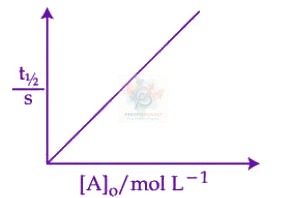
This indicates that the half-life of a first order reaction is independent of the initial concentration [A]o. The graph of t1/2 versus [A]o should be a horizontal line parallel to the concentration axis.
The given graph shows t1/2 directly proportional to [A]o, which corresponds to a zero order reaction (t1/2=2k[A]o).
Thus, Statement II is false.
Therefore, Statement I is true but Statement II is false.
Answer: Statement I is true but Statement II is false