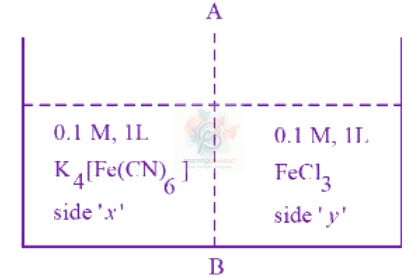
For complete dissociation, the van 't Hoff factor i is equal to the number of ions produced per formula unit.
For side 'x' containing K4[Fe(CN)6]:
K4[Fe(CN)6]→4K++[Fe(CN)6]4−
Number of ions, ix=5
Effective concentration (osmolarity) =ix×C=5×0.1=0.5 M
For side 'y' containing FeCl3:
FeCl3→Fe3++3Cl−
Number of ions, iy=4
Effective concentration (osmolarity) =iy×C=4×0.1=0.4 M
Since the effective concentration of side 'y' (0.4 M) is less than that of side 'x' (0.5 M), the solution on side 'y' has a lower osmotic pressure and is therefore hypotonic with respect to side 'x'.
Evaluating the other options:
A semi-permeable membrane (SPM) only allows solvent molecules to pass, not solute ions. Thus, Fe3+ and [Fe(CN)6]4− cannot mix, and no blue color is formed.
To cause reverse osmosis, the external pressure applied to the hypertonic side (side 'x') must be strictly greater than the osmotic pressure difference (Δπ=πx−πy), not just any value.
Answer: Solution on side 'y' is hypotonic.