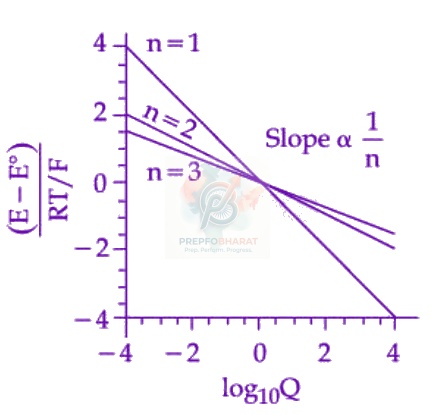
For the given redox reaction, the half-cell reactions are:
Anode: Red1→Ox1n1++n1e−
Cathode: Ox2+n2e−→Red2n2−
To obtain the overall balanced chemical equation, we multiply the anode reaction by n2 and the cathode reaction by n1 so that the number of electrons lost equals the number of electrons gained:
n2Red1→n2Ox1n1++n1n2e−
n1Ox2+n1n2e−→n1Red2n2−
Adding these gives the overall reaction:
n2Red1+n1Ox2⇌n2Ox1n1++n1Red2n2−
Thus, statement (A) is correct.
In the overall reaction, electrons do not appear because the electrons produced at the anode are exactly consumed at the cathode. Thus, statement (B) is correct.
From the Nernst equation:
E=E∘−nFRTlnQ=E∘−nF2.303RTlog10Q
RT/FE−E∘=−n2.303log10Q
The graph of RT/FE−E∘ versus log10Q is a straight line with a slope of −n2.303, where n is the number of electrons transferred in the balanced redox reaction. Thus, statement (C) is correct.
The electrical work done by a galvanic cell is given by the product of the total charge transferred and the cell potential (potential difference), not their ratio.
Welectrical=Charge×Potential difference=nFEcell
Thus, statement (D) is incorrect.
Answer: If the reaction is carried out reversibly, the electrical work done is equal to the ratio of charge and potential difference through which charge is moved.