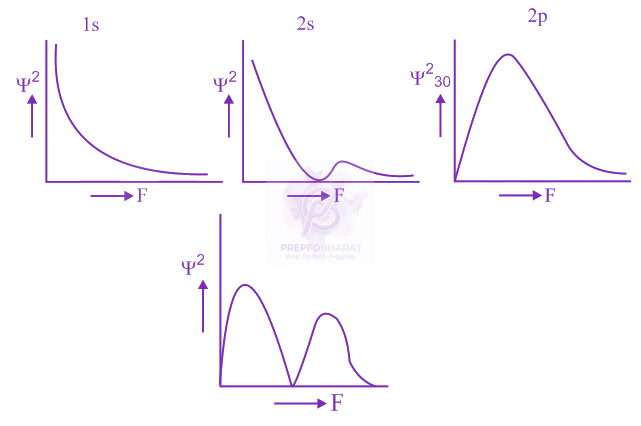
From the following Ψ2 function graph (Ψ2= probability density)
Ψ2 can be zero for 3p orbital other than infinity.
JEE Main 2020 — Chemistry Physical Chemistry
The correct statement about probability density (except at infinite distance from nucleus) is :
Held on 5 Sept 2020 · Verified 6 Jul 2026.
It can be zero for 1s orbital
It can be negative for 2p orbital
It can be zero for 3p orbital
It can never be zero for 2s orbital
Sign in to track your attempts and accuracy.
Sign in to keep a private note on this question. Nothing you write is ever public.
Arrange the following isothermal processes in order of the magnitude of the work ($p - V$) involved between states $1$ and $2$. A. Expansion in single stage $w_A$ B. Expansion in multi stages $w_B$ C. Compression in single stage $w_C$ D. Compression in multi stages $w_D$ Choose the correct option.
Identify the correct statements from the following: A. Heisenberg uncertainty principle is applicable to electrons. B. The size of $2p_x$ orbital is less than the size of $3p_x$ orbital. C. The energy of $2s$ orbital of H atom is equal to the energy of $2s$ orbital of Li. D. The electronic configuration of Cr is $[\text{Ar}] 3d^5 4s^1$ Choose the correct answer from the options given below:
80 mL of a hydrocarbon on mixing with 264 mL of oxygen in a closed U-tube undergoes complete combustion. The residual gases after cooling to 273 K occupy 224 mL. When the system is treated with KOH solution, the volume decreases to 64 mL. The formula of the hydrocarbon is :
$19.5$ g of fluoro acetic acid (molar mass $= 78$ g mol$^{-1}$) is dissolved in $500$ g of water at $298$ K. The depression in the freezing point of water was $1°$C. What is $K_a$ of fluoro acetic acid? (For water, $K_f = 1.86$ K kg mol$^{-1}$). Assume molarity and molality to have same values.
$M_3 A_2$ is a sparingly soluble salt of molar mass $y$ g mol$^{-1}$ and solubility $x$ g L$^{-1}$. The ratio of the molar concentration of the anion ($A^{3-}$) to the solubility product of the salt is
Work through every JEE Main Physical Chemistry PYQ, year by year.