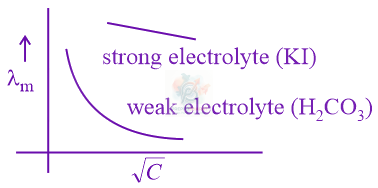
For strong electrolytes, ∧m increases slowly with dilution and can be represented by the equation:
∧m=∧mo−Ac21
It can be seen that if we plot ∧m against c21, We obtain a straight line with intercept equal to ∧m and slope equal to '−A'. The value of the constant 'A' for a given solvent and temperature depends on the type of electrolyte. KI is a strong electrolyte.
Weak electrolytes like carbonic acid and have lower degree of dissociation at higher concentrations and hence for such electrolytes, the change in ∧m with dilution is due to increase in the degree of dissociation and consequently the number of ions in total volume of solution that contains 1mol of electrolyte. In such cases ∧m increases steeply on dilution, especially near lower concentrations. Therefore, ∧mo cannot be obtained by extrapolation of ∧m to zero concentration.