JEE Main 2012 — Physical Chemistry
Chemistry Physical Chemistry questions from JEE Main 2012.
Other Years
45 Physical Chemistry Questions from 2012
An aqueous solution of oxalic acid dihydrate contains its $6.3 \mathrm{~g}$ in $250 \mathrm{ml}$. The volume of $0.1 \mathrm{~N}$ $\mathrm{NaOH}$ required to completely neutralize $10 \mathrm{ml}$ of this solution
Which of the following paramagnetic ions would exhibit a magnetic moment (spin only) of the order of $5 \mathrm{BM}$ ? (At. Nos. $\mathrm{Mn}=25, \mathrm{Cr}=24, \mathrm{~V}=23, \mathrm{Ti}=22$ )
A solution containing $0.85 \mathrm{~g}$ of $\mathrm{ZnCl}_2$ in $125.0 \mathrm{~g}$ of water freezes at $-0.23^{\circ} \mathrm{C}$. The apparent degree of dissociation of the salt is $\left(K_f\right.$ for water $=1.86 \mathrm{~K} \mathrm{~kg} \mathrm{~mol}^{-1}$, atomic mass: $\mathrm{Zn}=65.3$ and $\mathrm{Cl}=35.5)$
A transition metal $M$ forms a volatile chloride which has a vapour density of $94.8$. If it contains $74.75 \%$ of chlorine the formula of the metal chloride will be
If the kinetic energy of an electron is increased four times, the wavelength of the de-Broglie wave associated with it would become
One mole of $\mathrm{O}_{2(\mathrm{~g})}$ and two moles of $\mathrm{SO}_{2(\mathrm{~g})}$ were heated in a closed vessel of one-litre capacity at $1098 \mathrm{~K}$. At equilibrium $1.6$ moles of $\mathrm{SO}_{3(\mathrm{~g})}$ were found. The equilibrium constant $K_c$ of the reaction would be
The solubility (in mol $\mathrm{L}^{-1}$ ) of $\mathrm{AgCl}$ $\left(K_{\mathrm{sp}}=1.0 \times 10^{-10}\right)$ in a $0.1 \mathrm{M} \mathrm{KCl}$ solution will be
The limiting line in Balmer series will have a frequency of (Rydberg constant, $R_{\infty}=3.29 \times 10^{15}$ cycles $/ \mathrm{s}$ )
For a reaction $A \rightarrow$ Products, a plot of $\log t_{1 / 2}$ versus $\log a_0$ is shown in the figure. If the initial concentration of $A$ is represented by $a_0$, the order of the reaction is 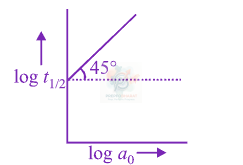
$8 \mathrm{~mol}$ of $A B_3(\mathrm{~g})$ are introduced into a $1.0 \mathrm{dm}^3$ vessel. If it dissociates as $2 \mathrm{AB}_3(g) \rightleftharpoons A_2(g)+3 B_2(g)$. At equilibrium, $2 \mathrm{~mol}$ of $A_2$ are found to be present. The equilibrium constant of this reaction is
The entropy of a sample of a certain substance increases by $0.836 \mathrm{~J} \mathrm{~K}^{-1}$ on adding reversibly $0.3344 \mathrm{~J}$ of heat at constant temperature. The temperature of the sample is:
In the following balanced reaction, 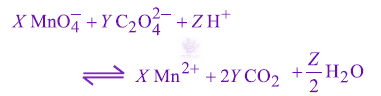 values of $X, Y$ and $Z$ respectively are
Reaction rate between two substance $A$ and $B$ is expressed as following: rate $=k[A]^n[B]^m$ If the concentration of $\mathrm{A}$ is doubled and concentration of $\mathrm{B}$ is made half of initial concentration, the ratio of the new rate to the earlier rate will be:
The electrons identified by quantum numbers $\mathrm{n}$ and $\mathrm{I}$ : (a) $n=4, I=1$ (b) $n=4, l=0$ (c) $n=3, I=2$ (d) $n=3, I=1$ Can be placed in order of increasing energy as:
The pH of a $0.1$ molar solution of the acid $\mathrm{HQ}$ is $3$ . The value of the ionization constant, Ka of this acid is :
The increasing order of the ionic radii of the given isoelectronic species is :
The electron affinity of chlorine is $3.7 \mathrm{eV} .1$ gram of chlorine is completely converted to $\mathrm{Cl}^{-}$ion in a gaseous state. $\left(1 \mathrm{eV}=23.06 \mathrm{kcal} \mathrm{mol}^{-1}\right)$. Energy released in the process is
$5 \mathrm{~g}$ of benzene on nitration gave $6.6 \mathrm{~g}$ of nitrobenzene. The theoretical yield of the nitrobenzene will be
One mole of an ideal gas is expanded isothermally and reversibly to half of its initial pressure. $\Delta S$ for the process in $\mathrm{J} \mathrm{K}^{-1} \mathrm{~mol}^{-1}$ is $[\ln 2=0.693$ and $R=8.314, \mathrm{~J} /(\mathrm{mol} \mathrm{K})]$
In a chemical reaction $A$ is converted into $B$. The rates of reaction, starting with initial concentrations of $A$ as $2 \times 10^{-3} \mathrm{M}$ and $1 \times 10^{-3}$ $\mathrm{M}$, are equal to $2.40 \times 10^{-4} \mathrm{Ms}^{-1}$ and $0.60 \times 10^{-4} \mathrm{Ms}^{-1}$ respectively. The order of reaction with respect to reactant $A$ will be
Given $$ \mathrm{E}_{\mathrm{Cu}^{2+} / \mathrm{Cu}}^{\circ}=0.34 \mathrm{~V}, \mathrm{E}_{\mathrm{Cu}^{2+} / \mathrm{Cu}}^{\circ}=0.15 \mathrm{~V} $$ Standard electrode potential for the half cell $\mathrm{Cu}^{+} / \mathrm{Cu}$ is
For a first order reaction, $(A) \rightarrow$ products, the concentration of $A$ changes from $0.1 \mathrm{~M}$ to $0.025 \mathrm{~M}$ in $40$ minutes. The rate of reaction when the concentration of $A$ is $0.01 \mathrm{~M}$ is :
Liquids A and B form an ideal solution. At $30^{\circ} \mathrm{C}$, the total vapour pressure of a solution containing $1 \mathrm{~mol}$ of A and $2 \mathrm{~mol}$ of B is $250 \mathrm{~mm} \mathrm{Hg}$. The total vapour pressure becomes $300 \mathrm{~mm} \mathrm{Hg}$ when 1 more mol of $\mathrm{A}$ is added to the first solution. The vapour pressures of pure $\mathrm{A}$ and $\mathrm{B}$ at the same temperature are
Given (i) $\operatorname{HCN}(a q)+\mathrm{H}_2 \mathrm{O}(b) \rightleftharpoons \mathrm{H}_3 \mathrm{O}^{+}(a q)+\mathrm{CN}^{-}(a q)$ $K_{\mathrm{a}}=6.2 \times 10^{-10}$ (ii) $\mathrm{CN}^{-}(a q)+\mathrm{H}_2 \mathrm{O}(\mathrm{l}) \rightleftharpoons \mathrm{HCN}(a q)+\mathrm{OH}^{-}(a q)$ $K_{\mathrm{b}}=1.6 \times 10^{-5}$. These equilibria show the following order of the relative base strength,
$K_1, K_2$ and $K_3$ are the equilibrium constants of the following reactions (I), (II) and (III) respectively: (I) $\mathrm{N}_2+2 \mathrm{O}_2 \rightleftharpoons 2 \mathrm{NO}_2$ (II) $2 \mathrm{NO}_2 \rightleftharpoons \mathrm{N}_2+2 \mathrm{O}_2$ (III) $\mathrm{NO}_2 \rightleftharpoons \frac{1}{2} \mathrm{~N}_2+\mathrm{O}_2$ The correct relation from the following is
The activation energy for a reaction which doubles the rate when the temperature is raised from $298 \mathrm{~K}$ to $308 \mathrm{~K}$ is
A battery is constructed of $\mathrm{Cr}$ and $\mathrm{Na}_2 \mathrm{Cr}_2 \mathrm{O}_7$. The unbalanced chemical equation when such a battery discharges is following: $$ \mathrm{Na}_2 \mathrm{Cr}_2 \mathrm{O}_7+\mathrm{Cr}+\mathrm{H}^{+} \rightarrow \mathrm{Cr}^{3+}+\mathrm{H}_2 \mathrm{O}+\mathrm{Na}^{+} $$ If one Faraday of electricity is passed through the battery during the charging, the number of moles of $\mathrm{Cr}^{3+}$ removed from the solution is
The freezing point of a $1.00 \mathrm{~m}$ aqueous solution of $\mathrm{HF}$ is found to be $-1.91^{\circ} \mathrm{C}$. The freezing point constant of water, $K_f$ is $1.86 \mathrm{~K} \mathrm{~kg} \mathrm{~mol}^{-1}$. The percentage dissociation of $\mathrm{HF}$ at this concentration is
The value of $K_p$ for the equilibrium reaction $\mathrm{N}_2 \mathrm{O}_4(g) \rightleftharpoons 2 \mathrm{NO}_2(g)$ is 2 . The percentage dissociation of $\mathrm{N}_2 \mathrm{O}_4(g)$ at a pressure of $0.5 \mathrm{~atm}$ is
The equilibrium constant $\left(\mathrm{K}_{\mathrm{c}}\right)$ for the reaction $\mathrm{N}_2(\mathrm{g})+\mathrm{O}_2(\mathrm{~g}) \rightarrow 2 \mathrm{NO}(\mathrm{g})$ at temperature $\mathrm{T}$ is $4 \times 10^{-4}$. The value of $\mathrm{K}_{\mathrm{c}}$ for the reaction, $\mathrm{NO}(\mathrm{g}) \rightarrow{1 / 2} \mathrm{~N}_2(\mathrm{g})+{1 / 2} \mathrm{~O}_2(\mathrm{g})$ at the same temperature is :
The concentrated sulphuric acid that is peddled commercial is $95 \% \mathrm{H}_2 \mathrm{SO}_4$ by weight. If the density of this commercial acid is $1.834 \mathrm{~g} \mathrm{~cm}^{-3}$, the molarity of this solution is
The enthalpy of neutralisation of $\mathrm{NH}_4 \mathrm{OH}$ with $\mathrm{HCl}$ is $-51.46 \mathrm{~kJ} \mathrm{~mol}^{-1}$ and the enthalpy of neutralisation of $\mathrm{NaOH}$ with $\mathrm{HCl}$ is $-55.90 \mathrm{~kJ} \mathrm{~mol}^{-1}$. The enthalpy of ionisation of $\mathrm{NH}_4 \mathrm{OH}$ is
The standard reduction potentials for $\mathrm{Zn}^{2+} / \mathrm{Zn}, \mathrm{Ni}^{2+} / \mathrm{Ni}$, and $\mathrm{Fe}^{2+} / \mathrm{Fe}$ are $-0.76,-0.23$ and $-0.44 \mathrm{~V}$ respectively. The reaction $\mathrm{X}+\mathrm{Y}^{2+} \rightarrow \mathrm{X}^{2+}+\mathrm{Y}$ will be spontaneous when:
The ppm level of $\mathrm{F}^{-}$in a $500 \mathrm{~g}$ sample of a tooth paste containing $0.2 \mathrm{~g} \mathrm{~F}^{-}$is
$\mathrm{K}_{\mathrm{f}}$ for water is $1.86 \mathrm{~K} \mathrm{~kg} \mathrm{~mol}^{-1}$. If your automobile radiator holds $1.0 \mathrm{~kg}$ of water, how many grams of ethylene glycol $\left(\mathrm{C}_2 \mathrm{H}_6 \mathrm{O}_2\right)$ must you add to get the freezing point of the solution lowered to $-2.8^{\circ} \mathrm{C}$ ?
When $\mathrm{CO}_{2(\mathrm{~g})}$ is passed over red hot coke it partially gets reduced to $\mathrm{CO}(g)$. Upon passing $0.5 \mathrm{~L}$ of $\mathrm{CO}_2(g)$ over red hot coke, the total volume of the gases increased to $700 \mathrm{~mL}$. The composition of the gaseous mixture at STP is
The difference between the reaction enthalpy change $\left(\Delta_{\mathrm{r}} \mathrm{H}\right)$ and reaction internal energy change $\left(\Delta_{\mathrm{r}} \mathrm{U}\right)$ for the reaction: $$ 2 \mathrm{C}_6 \mathrm{H}_6(\mathrm{l})+15 \mathrm{O}_2(\mathrm{~g}) \longrightarrow $$ at $300 \mathrm{~K}$ is $\left(\mathrm{R}=8.314 \mathrm{~J} \mathrm{~mol}^{-1} \mathrm{~K}^{-1}\right)$
The solubility of $\mathrm{PbI}_2$ at $25^{\circ} \mathrm{C}$ is $0.7 \mathrm{~g} \mathrm{~L}^{-1}$. The solubility product of $\mathrm{PbI}_2$ at this temperature is (molar mass of $\mathrm{PbI}_2=461.2 \mathrm{~g} \mathrm{~mol}^{-1}$ )
If $K_{s p}$ of $\mathrm{CaF}_2$ at $25^{\circ} \mathrm{C}$ is $1.7 \times 10^{-10}$, the combination amongst the following which gives a precipitate of $\mathrm{CaF}_2$ is
The standard potentials of $\mathrm{Ag}^{+} / \mathrm{Ag}, \mathrm{Hg}_2{ }^{2+} / 2 \mathrm{Hg}$, $\mathrm{Cu}^{2+} / \mathrm{Cu}$ and $\mathrm{Mg}^{2+} / \mathrm{Mg}$ electrodes are $0.80,0.79$, $0.34$ and $-2.37 \mathrm{~V}$, respectively. An aqueous solution which contains one mole per litre of the salts of each of the four metals is electrolyzed. With increasing voltage, the correct sequence of deposition of the metals at the cathode is
If the radius of first orbit of $\mathrm{H}$ atom is $a_0$, the deBroglie wavelength of an electron in the third orbit is
The density of a solution prepared by dissolving $120 \mathrm{~g}$ of urea (mol. Mass $=60 \mathrm{u}$ ) in $1000 \mathrm{~g}$ of water is $1.15 \mathrm{~g} / \mathrm{mL}$. The molarity of this solution is :
The ratio of number of oxygen atoms $(\mathrm{O})$ in $16.0 \mathrm{~g}$ ozone $\left(\mathrm{O}_3\right), 28.0 \mathrm{~g}$ carbon monoxide $(\mathrm{CO})$ and $16.0$ oxygen $\left(\mathrm{O}_2\right)$ is (Atomic mass : $\mathrm{C}=12, \mathrm{O}=16$ and Avogadro's constant $\mathrm{N}_{\mathrm{A}}=6.0 \times 10^{23} \mathrm{~mol}^{-1}$ )
The following sets of quantum numbers represent four electrons in an atom. (i) $n=4, l=1$ (ii) $n=4, l=0$ (iii) $n=3, l=2$ (iv) $n=3, l=1$ The sequence representing increasing order of energy, is
The incorrect expression among the following is :