JEE Main 2005 — Physical Chemistry
Chemistry Physical Chemistry questions from JEE Main 2005.
Other Years
25 Physical Chemistry Questions from 2005
Of the following sets which one does NOT contain isoelectronic species?
If the bond dissociation energies of $X Y, X_2$ and $Y_2$ (all diatomic molecules) are in the ratio of 1:1:0.5 and $\Delta_t \mathrm{H}$ for the formation of $X Y$ is $-200 \mathrm{~kJ} \mathrm{~mole}^{-1}$. The bond dissociation energy of $\mathrm{X}_2$ will be
An organic compound having molecular mass 60 is found to contain $\mathrm{C}=20 \%, \mathrm{H}=$ $6.67 \%$ and $\mathrm{N}=46.67 \%$ while rest is oxygen. On heating it gives $\mathrm{NH}_3$ alongwith a solid residue. The solid residue give violet colour with alkaline copper sulphate solution. The compound is
$\mathrm{t}_{1 / 4}$ can be taken as the time taken for the concentration of a reactant to drop to $\frac{3}{4}$ of its initial value. If the rate constant for a first order reaction is $\mathrm{K}$, the $\mathrm{t}_{1 / 4}$ can be written as
The exothermic formation of $\mathrm{ClF}_3$ is represented by the equation: $$ \mathrm{Cl}_{2(g)}+3 \mathrm{~F}_{2(g)} \rightleftharpoons 2 \mathrm{ClF}_{3(g)} ; \Delta \mathrm{r} \mathrm{H}=-329 \mathrm{~kJ} $$ Which of the following will increase the quantity of $\mathrm{ClF}_3$ in an equilibrium mixture of $\mathrm{Cl}_2, \mathrm{~F}_2$ and $\mathrm{ClF}_3$ ?
A reaction involving two different reactants can never be
The solubility product of a salt having general formula $M X_2$, in water is: $4 \times 10^{-12}$. The concentration of $\mathrm{M}^{2+}$ ions in the aqueous solution of the salt is
Two solutions of a substance (non electrolyte) are mixed in the following manner. 480 ml of 1.5 M first solution + 520 mL of 1.2 M second solution. What is the molarity of the final mixture?
Which of the following statements in relation to the hydrogen atom is correct?
The highest electrical conductivity of the following aqueous solutions is of
Calomel $\left(\mathrm{Hg}_2 \mathrm{Cl}_2\right)$ on reaction with ammonium hydroxide gives
Consider the reaction: $\mathrm{N}_2+3 \mathrm{H}_2 \longrightarrow 2 \mathrm{NH}_3$ carried out at constant temperature and pressure. If $\Delta \mathrm{H}$ and $\Delta \mathrm{U}$ are the enthalpy and internal energy changes for the reaction, which of the following expressions is true?
Consider an endothermic reaction, $X \longrightarrow Y$ with the activation energies $E_b$ and $E_f$ for the backward and forward reactions, respectively. In general
For the reaction $$ \begin{aligned} & 2 \mathrm{NO}_{2(\mathrm{~g})} \rightleftharpoons 2 \mathrm{NO}_{(\mathrm{g})}+\mathrm{O}_{2(\mathrm{~g})} \text {, } \\ & \left(\mathrm{K}_{\mathrm{c}}=1.8 \times 10^{-6} \text {at } 184 \mathrm{C}\right) \\ & (\mathrm{R}=0.0831 \mathrm{~kJ} /(\mathrm{mol} . \mathrm{K}) \end{aligned} $$ When $\mathrm{K}_{\mathrm{p}}$ and $\mathrm{K}_{\mathrm{c}}$ are compared at $184^{\circ} \mathrm{C}$, it is found that
What is the conjugate base of $\mathrm{OH}^{-} ?$
Equimolar solutions in the same solvent have
If $\alpha$ is the degree of dissociation of $\mathrm{Na}_2 \mathrm{SO}_4$, the vant Hoff's factor (i) used for calculating the molecular mass is
In a multi – electron atom, which of the following orbitals described by the three quantum numbers will have the same energy in the absence of magnetic acid and electric fields? (a) $n=1, l=0, m=0$ (b) $n=2, l=0, m=0$ (c) $n=2, l=1, m=1$ (d) $n=3, l=2, m=1$ (e) $n=3, l=2, m=0$
 Calculate $\wedge_{H O A c}^{\infty}$ Using appropriate molar conductances of the electrolytes listed above at infinite dilution in $\mathrm{H}_2 \mathrm{O}$ at $25^{\circ} \mathrm{C}$
An amount of solid $\mathrm{NH}_4 \mathrm{HS}$ is placed in a flask already containing ammonia gas at a certain temperature and $0.50 \mathrm{~atm}$. Pressure. Ammonium hydrogen sulphide decomposes to yield $\mathrm{NH}_3$ and $\mathrm{H}_2 \mathrm{~S}$ gases in the flask. When the decomposition reaction reaches equilibrium, the total pressure in the flask rises to $0.84 \mathrm{~atm}$. The equilibrium constant for $\mathrm{NH}_4 \mathrm{HS}$ decomposition at this temperature is
For a spontaneous reaction the $\Delta \mathrm{G}$, equilibrium constant $(\mathrm{K})$ and $\mathrm{E}_{\mathrm{cell}}^{\circ}$ will be respectively
A schematic plot of ln $\mathrm{K}_{\text {eq }}$ versus inverse of temperature for a reaction is shown below 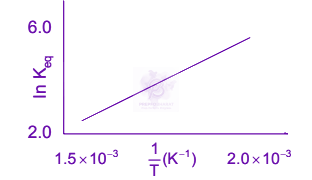 The reaction must be
Aluminium oxide may be electrolysed at $1000^{\circ} \mathrm{C}$ to furnish aluminium metal (Atomic mass $=27$ amu; 1 Faraday $=96,500$ Coulombs). The cathode reaction is $\mathrm{Al}^{3+}+3 \mathrm{e}^{-} \longrightarrow \mathrm{Al}^{\circ}$ To prepare $5.12 \mathrm{~kg}$ of aluminium metal by this method would require
Hydrogen ion concentration in mol / L in a solution of pH = 5.4 will be
If we consider that $\frac{1}{6}$, in place of $\frac{1}{12}$; mass of carbon atom is taken to be the relative atomic mass unit, the mass of one mole of a substance will