Physical Chemistry PYQ — Page 2
JEE Main Chemistry — Physical Chemistry previous year questions with solutions.
All Physical Chemistry Questions (1826)
Consider a weak base ' B ' of $\mathrm{pK}_{\mathrm{b}}=5.699$. ' $x$ ' mL of 0.02 M HCl and ' y ' mL of 0.02 M weak base ' B ' are mixed to make 100 mL of a buffer of pH 9 at $25^{\circ} \mathrm{C}$. The values of ' $x$ ' and ' $y$ ' respectively are: [Given: $\log 2=0.3010, \log 3=0.4771, \log 5=0.699$]
Which of the following is correct set of $4$ quantum numbers of $19^{th}$ electron in Chromium (Atomic number $= 24$) in accordance with Aufbau principle?
Consider the reaction $X \rightleftharpoons Y$ at $300$ K. If $\Delta H^{\theta}$ and $K$ are $28.40$ kJ mol$^{-1}$ and $1.8 \times 10^{-7}$ at the same temperature, then the magnitude of $\Delta S^{\theta}$ for the reaction in J K$^{-1}$ mol$^{-1}$ is _______. (Nearest integer) (Given: $R = 8.3$ J K$^{-1}$ mol$^{-1}$, $\ln 10 = 2.3$, $\log 3 = 0.48$, $\log 2 = 0.30$)
X and Y are the number of electrons involved, respectively during the oxidation of $\mathrm{I}^{-}$to $\mathrm{I}_{2}$ and $\mathrm{S}^{2-}$ to S by acidified $\mathrm{K}_{2} \mathrm{Cr}_{2} \mathrm{O}_{7}$. The value of $\mathrm{X}+\mathrm{Y}$ is $\_\_\_\_$.
If the enthalpy of sublimation of Li is $155 \mathrm{~kJ} \mathrm{~mol}^{-1}$, enthalpy of dissociation of $\mathrm{F}_{2}$ is $150 \mathrm{~kJ} \mathrm{~mol}^{-1}$, ionization enthalpy of Li is $520 \mathrm{~kJ} \mathrm{~mol}^{-1}$, electron gain enthalpy of F is $-313 \mathrm{~kJ} \mathrm{~mol}^{-1}$, standard enthalpy of formation of LiF is $-594 \mathrm{~kJ} \mathrm{~mol}^{-1}$. The magnitude of lattice enthalpy of LiF is $\_\_\_\_$ $\mathrm{kJ} \mathrm{mol}^{-1}$. (Nearest Integer)
Use the following data : \(\begin{array}{|c|c|c|} \hline \text {Substance } & \frac{\Delta_f \mathrm{H}^{\ominus}(500 \mathrm{~K})}{\mathrm{kJmol}^{-1}} & \frac{\mathrm{~S}^{\ominus}(500 \mathrm{~K})}{\mathrm{JK}^{-1} \mathrm{~mol}^{-1}} \\ \hline \mathrm{AB}(\mathrm{~g}) & 32 & 222 \\ \hline \mathrm{~A}_2(\mathrm{g}) & 6 & 146 \\ \hline \mathrm{~B}_2(\mathrm{g}) & x & 280 \\ \hline \end{array}\) One mole each of $\mathrm{A}_{2}(\mathrm{~g})$ and $\mathrm{B}_{2}(\mathrm{~g})$ are taken in a 1 L closed flask and allowed to establish the equilibrium at 500 K. $\mathrm{A}_{2}(\mathrm{~g})+\mathrm{B}_{2}(\mathrm{~g}) \rightleftharpoons 2 \mathrm{AB}(\mathrm{~g})$ The value of $x\left(\mathrm{in} \mathrm{kJ} \mathrm{mol}^{-1}\right)$ is $\_\_\_\_$. (Nearest integer) (Given : $\log \mathrm{K}=2.2 \quad \mathrm{R}=8.3 \mathrm{~J} \mathrm{~K}^{-1} \mathrm{~mol}^{-1}$)
200 cc of $x \times 10^{-3} \mathrm{M}$ potassium dichromate is required to oxidise 750 cc of 0.6 M Mohr's salt solution in acidic medium. Here $x=$ $\_\_\_\_$.
Dissociation of a gas $\mathrm{A}_{2}$ takes place according to the following chemical reaction. At equilibrium, the total pressure is 1 bar at 300 K. $\mathrm{A}_{2}(\mathrm{~g}) \rightleftharpoons 2 \mathrm{~A}(\mathrm{~g})$ The standard Gibbs energy of formation of the involved substances has been provided below: \(\begin{array}{|c|c|} \hline \text { Substance } & \Delta \mathrm{G}_{\mathrm{f}}^{\circ} / \mathrm{kJ} \mathrm{~mol}^{-1} \\ \hline \mathrm{~A}_2 & -100.00 \\ \hline \mathrm{~A} & -50.832 \\ \hline \end{array}\) The degree of dissociation of $\mathrm{A}_{2}(\mathrm{~g})$ is given by $\left(x \times 10^{-2}\right)^{1 / 2}$ where $x=$ $\_\_\_\_$. (Nearest integer). [Given: $\mathrm{R}=8 \mathrm{~J} \mathrm{~mol}^{-1} \mathrm{~K}^{-1}, \log 2=0.3010, \log 3=0.48$ ] Assume degree of dissociation is not negligible.
500 mL of 1.2 M KI solution is mixed with 500 mL of $0.2 \mathrm{M} \mathrm{KMnO}_{4}$ solution in basic medium. The liberated iodine was titrated with standard $0.1 \mathrm{M} \mathrm{Na}_{2} \mathrm{~S}_{2} \mathrm{O}_{3}$ solution in the presence of starch indicator till the blue color disappeared. The volume (in L) of $\mathrm{Na}_{2} \mathrm{~S}_{2} \mathrm{O}_{3}$ consumed is $\_\_\_\_$. (Nearest integer)
Match List-I with List-II.<table class="pyq-table"><tbody><tr><th>List-I Mass of substance</th><th>List-II Number of atoms</th></tr><tr><td>A. $1.8$ mg water</td><td>I. $2\times 10^{-4}\times N_A$</td></tr><tr><td>B. $9.8$ mg sulphuric acid</td><td>II. $1.5\times 10^{-4}\times N_A$</td></tr><tr><td>C. $1.8$ mg carbon</td><td>III. $3\times 10^{-4}\times N_A$</td></tr><tr><td>D. $5.85$ mg salt (NaCl)</td><td>IV. $7\times 10^{-4}\times N_A$</td></tr></tbody></table>Choose the correct answer from the options given below:
Given below are two statements : 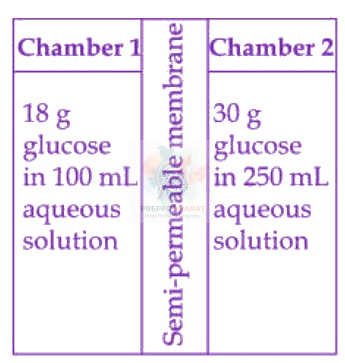 Statement I : H$_2$O molecules move from the chamber $1$ to chamber $2$. Statement II : The osmotic pressure of a solution prepared by dissolving $50$ mg of potassium sulphate (molar mass $= 174$ g/mol) in $2$ L of water (at $27°$C) is $0.0107$ bar. (Given : R $= 0.083$ dm$^3$ bar K$^{-1}$ mol$^{-1}$ and assume complete dissociation of electrolyte) In the light of the above statements, choose the correct answer from the options given below :
The osmotic pressure of a living cell is 12 atm at 300 K. The strength of sodium chloride solution that is isotonic with the living cell at this temperature is $\_\_\_\_$ $\mathrm{g} \mathrm{L}^{-1}$. (Nearest integer) Given : $\mathrm{R}=0.08 \mathrm{~L} \mathrm{~atm} \mathrm{~K}^{-1} \mathrm{~mol}^{-1}$ Assume complete dissociation of NaCl (Given : Molar mass of Na and Cl are 23 and $35.5 \mathrm{~g} \mathrm{~mol}^{-1}$ respectively.)
Consider the reaction $2\text{H}_2\text{S}(g) + 3\text{O}_2(g) \rightarrow 2\text{H}_2\text{O}(l) + 2\text{SO}_2(g)$ The magnitude of enthalpy change for the reaction in kJ mol$^{-1}$ is ________. (Nearest integer) Given: $\Delta_fH^{\ominus}(\text{H}_2\text{S}) = -20.1$ kJ mol$^{-1}$ $\Delta_fH^{\ominus}(\text{H}_2\text{O}) = -286.0$ kJ mol$^{-1}$ $\Delta_fH^{\ominus}(\text{SO}_2) = -297.0$ kJ mol$^{-1}$
Given below are two statements: Statement I: The Henry's law constant $\mathrm{K}_{\mathrm{H}}$ is constant with respect to variations in solution's concentration over the range for which the solution is ideally dilute. Statement II: $\mathrm{K}_{\mathrm{H}}$ does not differ for the same solute in different solvents. In the light of the above statements, choose the correct answer from the options given below
Consider the following spectral lines for atomic hydrogen : A. First line of Paschen series B. Second line of Balmer series C. Third line of Paschen series D. Fourth line of Bracket series. The correct arrangement of the above lines in ascending order of energy is :
For a closed circuit Daniell cell, which of the following plots is the accurate one at a given temperature?
For a reaction $A \rightarrow P$ at $T\text{ K}$, the half life $(t_{1/2})$ is plotted as a function of initial concentration $[A]_0$ of $A$ as given below. 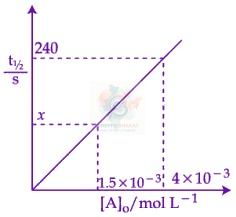 The value of $x$ in the given figure is _______ s (Nearest integer)
Which of the following statement(s) is/are true ? A. If two orbitals have the same value of $(n + l)$, the orbital with lower value of $n$ will have lower energy. B. Energies of the orbitals in the same subshell increase with increase in atomic number. C. The size of $2p_x$ orbital is less than the size of $3p_x$ orbital. D. Among $5f$, $6s$, $4d$, $5p$ and $5d$ orbitals, none of the orbitals have $2$ radial nodes. Choose the correct answer from the options given below :
The reaction $A(g) \rightleftharpoons B(g) + C(g)$ was initiated with the amount '$a$' of $A(g)$. At equilibrium it is found that the amount of $A(g)$ remaining is $(a - x)$ at a total pressure of $p$. The equilibrium constant $K_p$ of the reaction can be calculated from the expression :
Two liquids A and B form an ideal solution at temperature T K. At T K, the vapour pressures of pure A and B are 55 and $15 \mathrm{kN} \mathrm{m}^{-2}$ respectively. What is the mole fraction of $A$ in solution of $A$ and $B$ in equilibrium with a vapour in which the mole fraction of A is 0.8 ?
An electrochemical cell is constructed using half cells in the direction of spontaneous change $Fe(OH)_2(s) + 2e^- \rightarrow Fe(s) + 2OH^-(aq) \quad E^\theta = -0.88$ V and $AgBr(s) + e^- \rightarrow Ag(s) + Br^-(aq) \quad E^\theta = +0.07$ V Which of the following option is correct?
Given below are two statements: $R=8.314$ J K$^{-1}$ mol$^{-1}$ and $1$ cal $=4.2$ J Statement I: When $E_a=12.6$ kcal/mol, the room temperature rate constant is doubled by a $10\,^\circ$C increase in temperature ($298$ K to $308$ K) Statement II: For a first order reactions A $\rightarrow$ B, 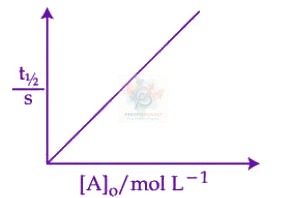 Here $[A]_o$ is the initial concentration of A and $t_{1/2}$ is half life of reaction. In the light of the above statements, choose the correct answer from the options given below:
$\mathrm{A} \rightarrow$ product (First order reaction). Three sets of experiment were performed for a reaction under similar experimental conditions: Run $1 \Rightarrow 100 \mathrm{~mL}$ of 10 M solution of reactant A Run $2 \Rightarrow 200 \mathrm{~mL}$ of 10 M solution of reactant A Run $3 \Rightarrow 100 \mathrm{~mL}$ of 10 M solution of reactant $\mathrm{A}+100 \mathrm{~mL}$ of $\mathrm{H}_{2} \mathrm{O}$ added. The correct variation of rate of reaction is
First order gas phase reaction $A \rightarrow B + C$ $p_i =$ initial pressure of gas A, $p_t =$ total pressure of the reaction mixture at time $t$ Expression of rate constant ($k$) is