JEE Main 2006 — Organic Chemistry
Chemistry Organic Chemistry questions from JEE Main 2006.
Other Years
17 Organic Chemistry Questions from 2006
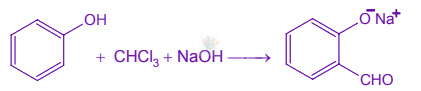 The electrophile involved in the above reaction is
The increasing order of the rate of $\mathrm{HCN}$ addition to compounds $\mathrm{A}-\mathrm{D}$ is (A) $\mathrm{HCHO}$ (B) $\mathrm{CH}_3 \mathrm{COCH}_3$ (C) $\mathrm{PhCOCH}_3$ (D) PhCOPh
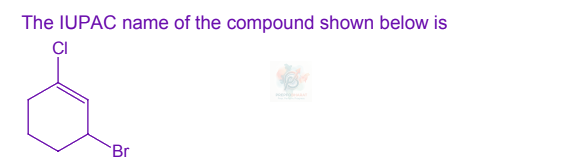
$\mathrm{HBr}$ reacts with $\mathrm{CH}_2=\mathrm{CH}-\mathrm{OCH}_3$ under anhydrous conditions at room temperature to give
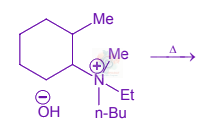 The alkene formed as a major product in the above elimination reaction is
Fluorobenzene $\left(\mathrm{C}_6 \mathrm{H}_5 \mathrm{~F}\right)$ can be synthesized in the laboratory
The term anomers of glucose refers to
Phenyl magnesium bromide reacts with methanol to give
The structure of the compound that gives a tribromo derivative on treatment with bromine water is
Among the following the one that gives positive iodoform test upon reaction with $\mathrm{I}_2$ and $\mathrm{NaOH}$ is
Reaction of trans-2-phenyl-1-bromocyclopentane on reaction with alcoholic KOH produces
The correct order of increasing acid strength of the compounds is (a) $\mathrm{CH}_3 \mathrm{CO}_2 \mathrm{H}$ (b) $\mathrm{MeOCH}_2 \mathrm{CO}_2 \mathrm{H}$ (c) $\mathrm{CF}_3 \mathrm{CO}_2 \mathrm{H}$ (d) 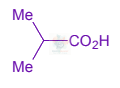
Increasing order of stability among the three main conformations (i.e. Eclipse, Anti, Gauche) of 2-fluoroethanol is
$$ \mathrm{CH}_3 \mathrm{Br}+\mathrm{Nu}^{-} \longrightarrow \mathrm{CH}_3-\mathrm{Nu}+\mathrm{Br}^{-} $$ The decreasing order of the rate of the above reaction with nucleophiles $\left(\mathrm{Nu}^{-}\right) \mathrm{A}$ to $\mathrm{D}$ is $\left[\mathrm{Nu}^{-}=(\mathrm{A}) \mathrm{PhO}^{-}\right.$, (B) $\mathrm{AcO}^{-}$, (C) $\mathrm{HO}^{-}$, (D) $\left.\mathrm{CH}_3 \mathrm{O}^{-}\right]$
The increasing order of stability of the following free radicals is
The structure of the major product formed in the following reaction is 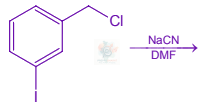
The pyrimidine bases present in DNA are