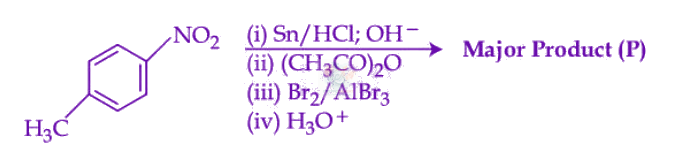
The given reactant is p-nitrotoluene.
Step (i): Reduction with Sn/HCl followed by OH− converts the −NO2 group to an −NH2 group, yielding p-toluidine.
Step (ii): Reaction with acetic anhydride, (CH3CO)2O, protects the amino group by forming N-(4-methylphenyl)acetamide.
Step (iii): Bromination with Br2/AlBr3 directs the incoming bromine to the ortho position relative to the strongly activating −NHCOCH3 group (the para position is blocked by the methyl group). This yields 2-bromo-4-methylacetanilide.
Step (iv): Acid hydrolysis with H3O+ removes the acetyl group, yielding 2-bromo-4-methylaniline as the major product (P).
The molecular formula of product P (2-bromo-4-methylaniline) is C7H8NBr.
Molar mass of P = (7×12)+(8×1)+14+80=186 g mol−1.
In Carius analysis, the bromine in the organic compound is quantitatively converted to silver bromide (AgBr).
Molar mass of AgBr = 108+80=188 g mol−1.
Since one molecule of P contains one bromine atom, 1 mole of P produces 1 mole of AgBr.
Moles of P in 1.0 g=1861.0 mol.
Moles of AgBr produced = 1861.0 mol.
Mass of AgBr produced = 1861.0×188 g≈1.01 g.
Rounding to the nearest integer, the mass of the AgBr precipitate is 1 g.
Answer: 1