JEE Main 2013 — Organic Chemistry
Chemistry Organic Chemistry questions from JEE Main 2013.
Other Years
41 Organic Chemistry Questions from 2013
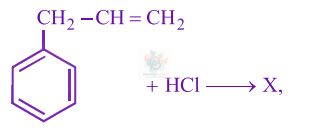 $\mathrm{X} \text { is: }$
A solution of $(-)1-\mathrm{chloro}-1-\mathrm{phenylethane}$ in toluene racemises slowly in the presence of a small amount of SbCl$_{5}$, due to the formation of :
The order of reactivity of the given haloalkanes towards nucleophile is :
In nucleophilic substitution reaction, order of halogens as incoming (attacking) nucleophile is: $\mathrm{I}^{-}>\mathrm{Br}^{-}>\mathrm{Cl}^{-}$ The order of halogens as departing nucleophile should be :
The reaction of phenol with benzoyl chloride to give phenyl benzoate is known as :
Arrange the following compounds in order of decreasing acidity : 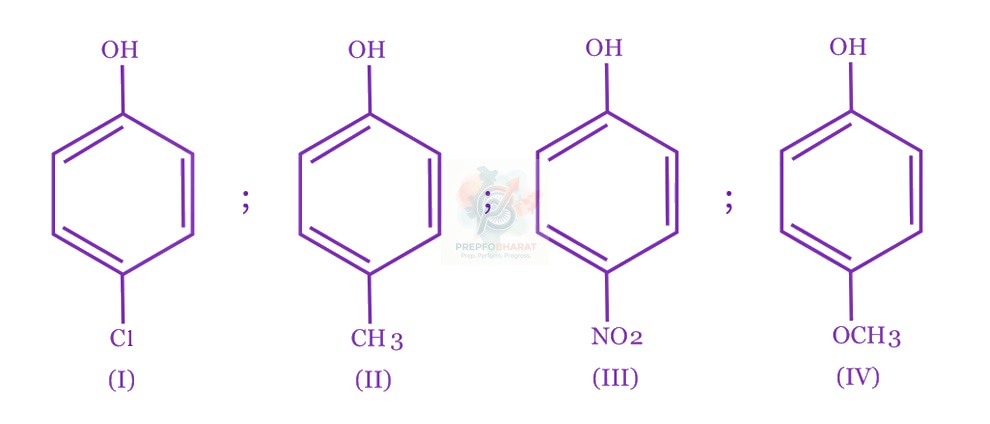
An organic compound A upon reacting with ${\mathrm{NH}}_{3}$$_{ }$gives B. On heating, B gives C. C in presence of KOH reacts with Br$_{2}$ to give CH$_{3}$CH$_{2}$NH$_{2}$. A is :
Which one of the following is most stable ?
An ether (A), $\mathrm{C}_5 \mathrm{H}_{12} \mathrm{O}$, when heated with excess of hot concentrated $\mathrm{HI}$ produced two alkyl halides which when treated with $\mathrm{NaOH}$ yielded compounds (B) and (C). Oxidation of (B) and (C) gave a propanone and an ethanoic acid respectively. The IUPAC name of the ether (A) is :
Amongst the following alcohols which would react fastest with conc. $\mathrm{HCl}$ and $\mathrm{ZnCl}_2$ ?
Which of the following compounds is not expected to show Lassaignes' test for nitrogen ?
The major product in the following reaction 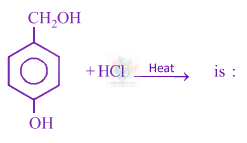
Given 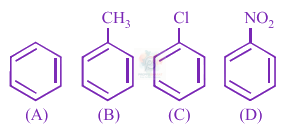 In the above compounds correct order of reactivity in electrophilic substitution reactions will be:
In Williamson synthesis of mixed ether having a primary and a tertiary alkyl group if tertiary halide is used, then :
For which of the following compounds Kjeldahl method can be used to determine the percentage of Nitrogen?
Which of the following is the product of aldol condensation?
What is the structure of the major product when phenol is treated with bromine water?
Compound (A), ${C}_{8}{H}_{9}\mathrm{Cl}$, gives a white precipitate when warmed with alcoholic ${\mathrm{AgNO}}_{3}$$_{.}$ Oxidation of (A) gives an acid (B), ${C}_{8}{H}_{6}{O}_{4}$. (B) easily forms anhydride on heating. Identify the compound (A).
Which of the following structures represents thymine ?
Glycosidic linkage is actually an :
Phenol on heating with $\mathrm{CHCl}_3$ and $\mathrm{NaOH}$ gives salicylaldehyde. The reaction is called:
A compound with molecular mass $180$ is acylated with ${\mathrm{CH}}_{3}\mathrm{COCl}$ to get a compound with molecular mass $390$. The number of amino groups presents per molecule of the former compound is
Cannizaro's reaction is not given by :
The order of basicity of amines in gaseous state is :
An unknown alcohol is treated with the "Lucas reagent" to determine whether the alcohol is primary, secondary or tertiary. Which alcohol reacts fastest and by what mechanism:
Which of the following would not give 2-phenylbutane as the major product in a Friedel-Crafts alkylation reaction ?
Carbylamine forms from aliphatic or aromatic primary amine via which of the following intermediates?
Among the following vitamins the one whose deficiency causes rickets (bone deficiency) is :
Arrange in the correct order of stability (decreasing order) for the following molecules: (I) 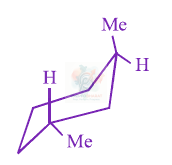 (II)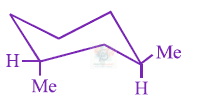 (III)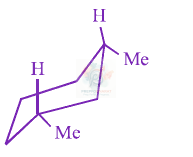 (IV)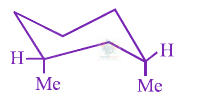
The Wurtz-Fittig reaction involves condensation of:
Formaldehyde can be distinguished from acetaldehyde by the use of :
Synthesis of each molecule of glucose in photosynthesis involves
Natural glucose is termed D-glucose because :
The order of stability of the following carbocations: 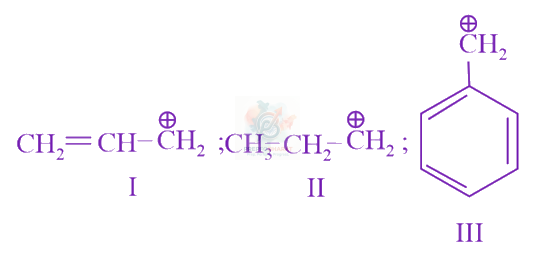
Which of the following reagent(s) used for the conversion? 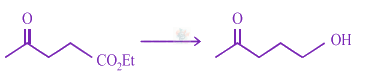
Clemmensen reduction of a ketone is carried out in the presence of :
Monocarboxylic acids are functional isomers of:
A major component of Borsch reagent is obtained by reacting hydrazine hydrate with which of the following ?
Rate of dehydration of alcohols follows the order:
Aryl fluoride may be prepared from arene diazonium chloride using :
The addition of $\mathrm{HI}$ in the presence of peroxide catalyst does not follow anti-Markovnikov's rule because :