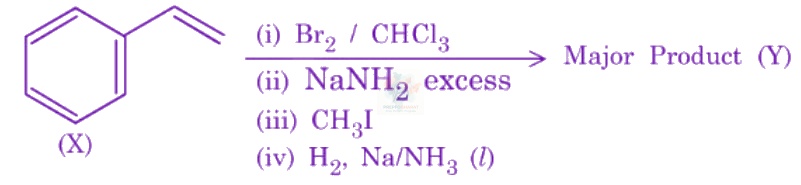
Addition of Br2 to styrene (X) yields 1,2-dibromoethylbenzene.
C6H5−CH=CH2Br2/CHCl3C6H5−CH(Br)−CH2(Br)
Reaction with excess NaNH2 causes double dehydrohalogenation followed by deprotonation of the terminal alkyne, forming sodium phenylacetylide.
C6H5−CH(Br)−CH2(Br)NaNH2 (excess)C6H5−C≡C−Na+
Nucleophilic substitution with CH3I yields 1-phenylpropyne.
C6H5−C≡C−Na+CH3IC6H5−C≡C−CH3
Reduction with Na/NH3(l) reduces the internal alkyne to a trans-alkene without affecting the benzene ring.
C6H5−C≡C−CH3Na/NH3(l)C6H5−CH=CH−CH3
The major product (Y) is trans-1-phenylpropene, which has the molecular formula C9H10.
Molar mass of C9H10=(9×12)+(10×1)=108+10=118 g mol−1.
Answer: 118