Organic Chemistry PYQ — Page 2
JEE Main Chemistry — Organic Chemistry previous year questions with solutions.
All Organic Chemistry Questions (1783)
Given below are two statements: Statement I: On the basis of inductive effect, the order of stability of alkyl carbanions is CH$_3^- >$ CH$_3$-CH$_2^- >$ (CH$_3$)$_2$CH$^- >$ (CH$_3$)$_3$C$^-$. Statement II: Allyl and benzyl carbanions are more stabilised by inductive effect and not by resonance effect. In the light of the above statements, choose the correct answer from the options given below
$2.0$ g of a bromo hydrocarbon $(X)$ was subjected to Carius analysis, gave $3.36$ g of $AgBr$. The percentage of carbon in the compound $(X)$ is $26.7\%$. Total number of carbon atoms in the empirical formula for compound $(X)$ is _____. (Given molar mass in g mol$^{-1}$ H:$1$, C:$12$, Br:$80$, Ag:$108$)
Consider all the structural isomers with molecular formula $\mathrm{C}_{5} \mathrm{H}_{11} \mathrm{Br}$ are separately treated with $\mathrm{KOH}(\mathrm{aq})$ to give respective substitution products, without any rearrangement. The number of products which can exhibit optical isomerism from these is $\_\_\_\_$.
CORRECT order of stability for the following is $\mathrm{CH}_{2}=\mathrm{CH}^{-}, \mathrm{CH}_{3}-\mathrm{CH}_{2}^{-}, \mathrm{CH} \equiv \mathrm{C}^{-}$
Given below are two statements: Statement I: Benzene is nitrated to give nitrobenzene, which on further treatment with $\mathrm{CH}_{3} \mathrm{COCl} / \mathrm{AlCl}_{3}$ will give 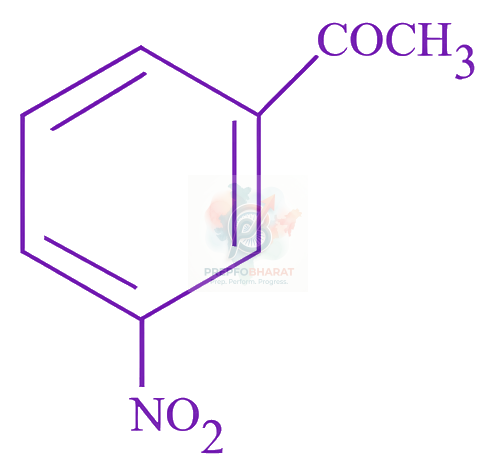 Statement II: $-\mathrm{NO}_{2}$ group is a $m$-directing, and deactivating group. In the light of the above statements, choose the most appropriate answer from the options given below
Given below are two statements: Statement I: $\left(\mathrm{CH}_{3}\right)_{3} \stackrel{\oplus}{\mathrm{C}}$ is more stable than $\stackrel{\oplus}{\mathrm{C}} \mathrm{H}_{3}$ as nine hyperconjugation interactions are possible in $\left(\mathrm{CH}_{3}\right)_{3} \stackrel{\oplus}{\mathrm{C}}$. Statement II: $\stackrel{\oplus}{\mathrm{C}} \mathrm{H}_{3}$ is less stable than $\left(\mathrm{CH}_{3}\right)_{3} \stackrel{\oplus}{\mathrm{C}}$ as only three hyperconjugation interactions are possible in $\stackrel{\oplus}{\mathrm{C}} \mathrm{H}_{3}$. In the light of the above statements, choose the correct answer from the options given below
Sucrose hydrolyses in acidic medium into glucose and fructose by first order rate law with $t_{1/2} = 3$ hour. The percentage of sucrose remaining after $6$ hours is _______. (Nearest integer) (Given: $\log 2 = 0.3010$ and $\log 3 = 0.4771$)
A hydroxy compound $(\mathrm{X})$ with molar mass $122 \mathrm{~g} \mathrm{~mol}^{-1}$ is acetylated with acetic anhydride, using a large excess of the reagent ensuring complete acetylation of all hydroxyl groups. The product obtained has a molar mass of $290 \mathrm{~g} \mathrm{~mol}^{-1}$. The number of hydroxyl groups present in compound (X) is:
Consider the following reaction sequence 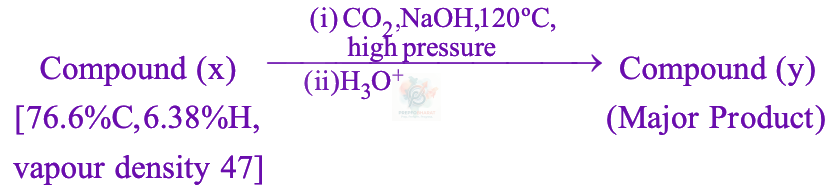 Compound $(\mathrm{y})$ develops characteristic colour with neutral $\mathrm{FeCl}_{3}$ solution. Identify the INCORRECT statement from the following for the above sequence.
Consider the following reaction :  The product Y formed is :
Consider the following sequence of reactions 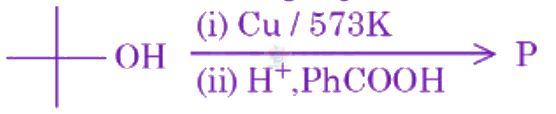 The major product P is:
In the given pentapeptide, find out an essential amino acid $(\mathrm{Y})$ and the sequence present in the pentapeptide:  Choose the correct answer from the options given below:
The incorrect statement from the following with respect to carbohydrates is:
The reactions which produce alcohol as the product are: A. $\mathrm{CH}_{4}+\mathrm{O}_{2} \xrightarrow[\Delta]{\mathrm{Mo}_{2} \mathrm{O}_{3}}$ B. $2 \mathrm{CH}_{3} \mathrm{CH}_{3}+3 \mathrm{O}_{2} \xrightarrow[\Delta]{\left(\mathrm{CH}_{3} \mathrm{COO}\right)_{2} \mathrm{Mn}}$ C. $\left(\mathrm{CH}_{3}\right)_{3} \mathrm{CH} \xrightarrow{\mathrm{KMnO}_{4}}$ D. $2 \mathrm{CH}_{4}+\mathrm{O}_{2} \xrightarrow{\mathrm{Cu} / 523 \mathrm{~K} / 100 \mathrm{~atm}.}$ E. $\mathrm{CH}_{3}-\mathrm{CH}=\mathrm{CH}-\mathrm{CH}_{3} \xrightarrow{\mathrm{KMnO}_{4} / \mathrm{H}^{+}}$ Choose the correct answer from the options given below :
Consider the following organic reaction sequence. Choose the final product $(X)$ from the following (consider the major product in all intermediate reactions) 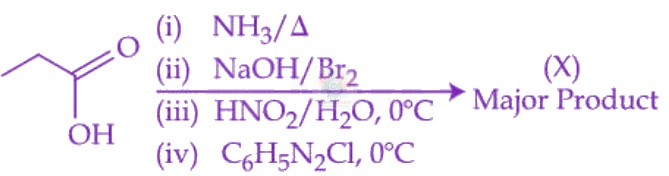
A mixed ether $(\mathrm{P})$, when heated with excess of hot concentrated hydrogen iodide produces two different alkyl iodides which when treated with aq. NaOH give compounds $(\mathrm{Q})$ and $(\mathrm{R})$. Both $(\mathrm{Q})$ and $(\mathrm{R})$ give yellow precipitate with NaOI. Identify the mixed ether $(\mathrm{P})$ :
Consider the following compounds 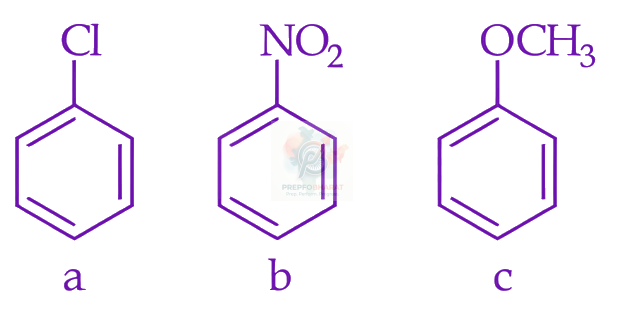 Arrange these compounds in the increasing order of reactivity with nitrating mixture.
Identify compounds A and E in the following reaction sequence. 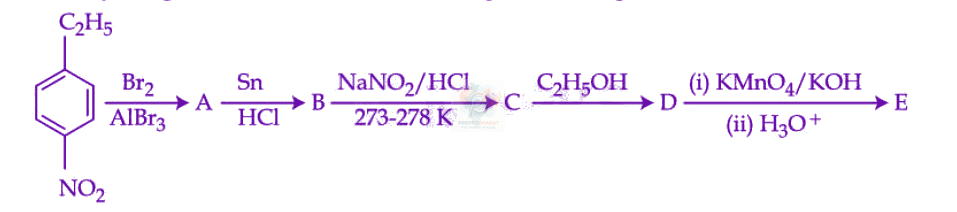
An alkene $(X)$ on ozonolysis followed by reduction gives following products: $H-CHO$ ($2$ moles), $H-CO-CO-CHO$, $CH_3-CO-CO-CH_3$. The alkene $(X)$ is:
Given below are two statements: Statement I: Vapours of the liquid with higher boiling point condense before vapours of the liquid with lower boiling points in fractional distillation. Statement II: The vapours rising up in the fractionating column become richer in high boiling component of the mixture. In the light of the above statements, choose the correct answer from the options given below:
Match List-I with List-II. <table class="pyq-table"><tbody><tr><th>List-I (Purification technique)</th><th>List-II (Used to separate)</th></tr><tr><td>A. Simple distillation</td><td>I. Steam volatile compound</td></tr><tr><td>B. Fractional distillation</td><td>II. Two liquids with large difference in boiling points</td></tr><tr><td>C. Steam distillation</td><td>III. Liquid decomposing at its boiling point</td></tr><tr><td>D. Distillation under reduced pressure</td><td>IV. Two liquids with close boiling points</td></tr></tbody></table> Choose the correct answer from the options given below :
Consider the following sequence of reactions to give the major product $(X)$ 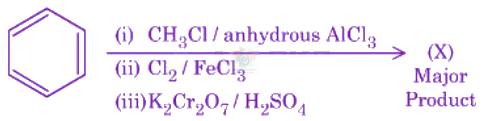 $P$ g of the major product $(X)$ formed is reacted with $NaHCO_3$ solution to liberate a gas which occupied $11.2$ dm$^3$ at STP. $P = $ _____ g. (Given molar mass in g mol$^{-1}$ H:$1$, C:$12$, O:$16$, Cl:$35.5$)
A molecule (X) with following structure under mild acidic condition is hydrolysed to produce (Y) and (Z). Identify the correct statements about (Y) and (Z). 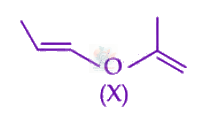 A. Both (Y) and (Z) have same molar mass. B. (Y) and (Z) can be distinguished from each other by $NaHCO_3$. C. (Y) and (Z) react with HCN with same rates. D. (Y) and (Z) undergo addition reaction with $2,4$-DNP. Choose the correct answer from the options given below:
Given below are two statements: Statement I: $2,6$-diethylcyclohexanone and $6$-methyl-$2$-n-propylcyclohexanone are metamers. Statement II: $2,2,6,6$-tetramethylcyclohexanone exhibits keto-enol tautomerism. In the light of the above statements, choose the correct answer from the options given below