Electrophilic aromatic nitration reactivity depends on the electronic effects of substituents.
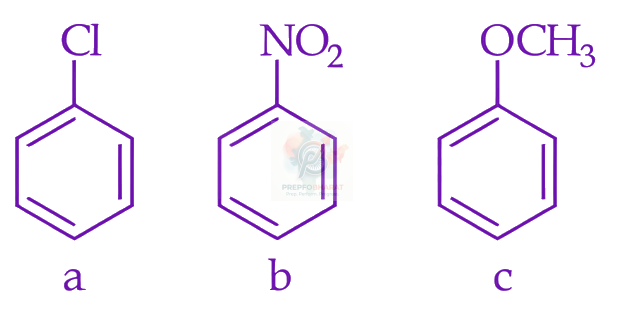
Compound a (chlorobenzene) has a weakly deactivating chlorine group.
Compound b (nitrobenzene) has a strongly electron-withdrawing nitro group, making it significantly deactivated.
Compound c (anisole) has an electron-donating methoxy group, making it highly activated.
In order of increasing reactivity with nitrating mixture: nitrobenzene (b) is least reactive due to strong deactivation, chlorobenzene (a) is moderately reactive, and anisole (c) is most reactive due to activation.
The increasing order is b < a < c.