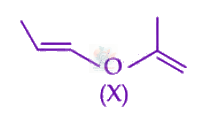
Molecule (X) is an ether with two enol ether functional groups attached to the central oxygen atom. On mild acidic hydrolysis, an enol ether cleaves to give a carbonyl compound and an alcohol.
The 1-propenyl side (CH3−CH=CH−O−) hydrolyses to propanal, CH3CH2CHO.
The isopropenyl side (−O−C(CH3)=CH2) hydrolyses to the enol of acetone, which tautomerises to acetone, CH3COCH3.
Therefore, (Y) and (Z) are propanal and acetone.
Statement A: Both (Y) and (Z) have the same molar mass.
Propanal and acetone are functional isomers with the same molecular formula C3H6O and hence the same molar mass (58 g mol−1).
Statement A is true.
Statement B: (Y) and (Z) can be distinguished by NaHCO3.
NaHCO3 reacts only with carboxylic acids (releasing CO2). Neither an aldehyde nor a ketone reacts with NaHCO3, so it cannot distinguish between them.
Statement B is false.
Statement C: (Y) and (Z) react with HCN at the same rate.
In nucleophilic addition to carbonyls, aldehydes react faster than ketones due to lower steric hindrance and a more electrophilic carbonyl carbon (fewer +I alkyl groups). So propanal reacts faster than acetone.
Statement C is false.
Statement D: (Y) and (Z) undergo addition reaction with 2,4-DNP.
Both aldehydes and ketones react with 2,4-DNP (Brady's reagent) by nucleophilic addition followed by loss of water to give coloured 2,4-dinitrophenylhydrazone precipitates.
Statement D is true.
Hence, the correct statements are A and D only, which corresponds to option (4).