Organic Chemistry PYQ — Page 3
JEE Main Chemistry — Organic Chemistry previous year questions with solutions.
All Organic Chemistry Questions (1783)
0.53 g of an organic compound (x) when heated with excess of nitric acid (concentrated) and then with silver nitrate gave 0.75 g of silver bromide precipitate. 1.0 g of $(\mathrm{x})$ gave 1.32 g of $\mathrm{CO}_{2}$ gas on combustion. The percentage of hydrogen in the compound $(\mathrm{x})$ is $\_\_\_\_$%. [Nearest Integer] [Given: Molar mass in $\mathrm{g} \mathrm{mol}^{-1} \mathrm{H}: 1, \mathrm{C}: 12, \mathrm{Br}: 80, \mathrm{Ag}: 108, \mathrm{O}: 16$; Compound (x) : $\mathrm{C}_{\mathrm{x}} \mathrm{H}_{\mathrm{y}} \mathrm{Br}_{\mathrm{z}}$]
Given below are two statements: Statement I: There are several conformers for n -butane. Out of those conformers, 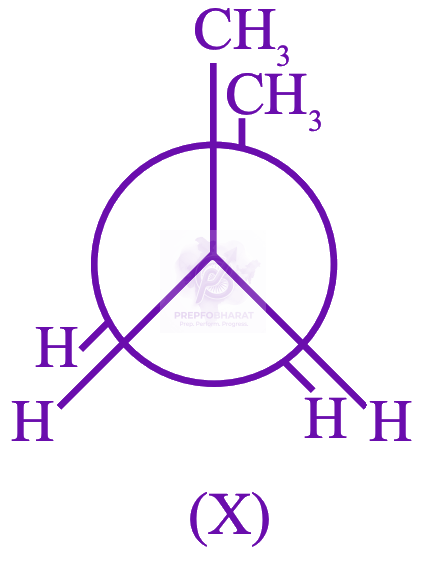 is the least stable and most stable conformer is 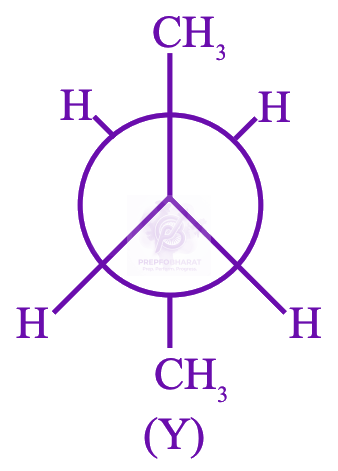 Statement II: As the dihedral angle increases, torsional strain decreases from (X) to $(\mathrm{Y})$. In the light of the above statements, choose the correct answer from the options given below
Consider the following reaction sequence 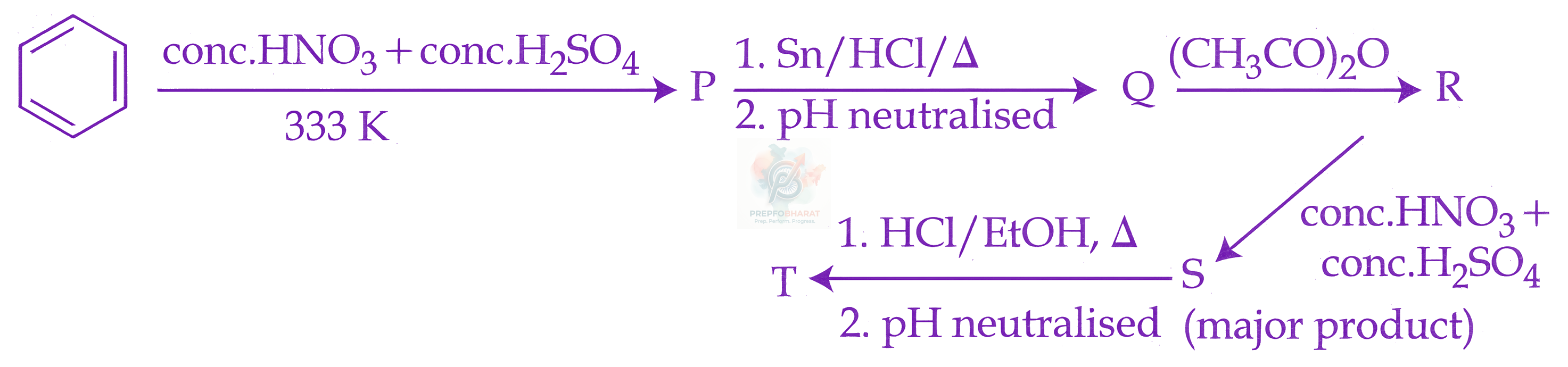 The percentage of nitrogen in product ' T ' formed is $\_\_\_\_$%. (Nearest integer) (Given molar mass in $\mathrm{g} \mathrm{mol}^{-1} \mathrm{H}: 1, \mathrm{C}: 12, \mathrm{~N}: 14, \mathrm{O}: 16$)
But-2-yne and hydrogen (one mole each) are separately treated with (i) $\mathrm{Pd} / \mathrm{C}$ and (ii) $\mathrm{Na} / \mathrm{liq}. \mathrm{NH}_{3}$ to give the products X and Y respectively. 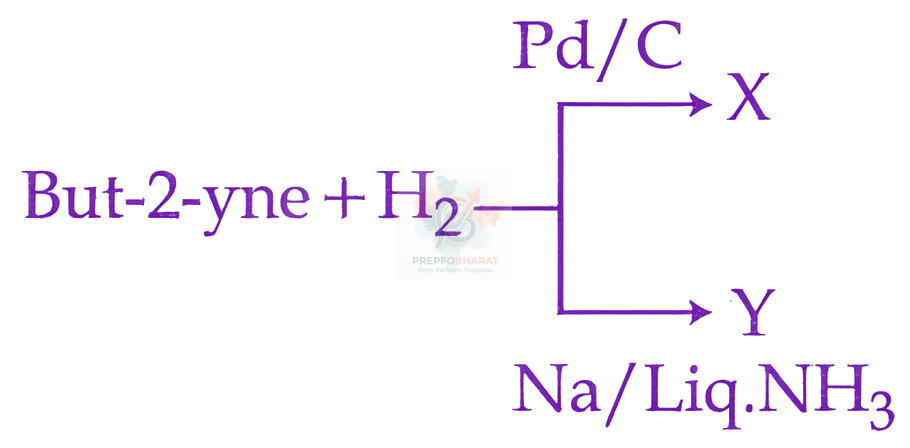 Identify the incorrect statements. A. $X$ and $Y$ are stereoisomers. B. Dipole moment of X is zero. C. Boiling point of $X$ is higher than $Y$. D. X and Y react with $\mathrm{O}_{3} / \mathrm{Zn}+\mathrm{H}_{2} \mathrm{O}$ to give different products. Choose the correct answer from the options given below :
An organic compound "$x$" where molar ratio of C, O and H are equal, on treatment with $50\%$ KOH under reflux followed by acidification produced "$y$". The most likely structure of "$y$" is: [Molar mass of '$x$' is $58$ g mol$^{-1}$]
Given below are two statements: Statement I: In $O_2 N$-$C_6 H_4$-$CH^{\oplus}$-$C_6 H_4$-$OCH_3$, the carbocation is stabilised by $+R$ effect of $-OCH_3$ group. Statement II: In $O_2 N$-$C_6 H_4$-$CH^{\ominus}$-$C_6 H_4$-$OCH_3$, the carbanion is stabilised by $-R$ effect of $-NO_2$ group. In the light of the above statements, choose the correct answer from the options given below:
$R_f$ value for $2$-methylpropene in a solvent system (Ethyl acetate + ether) is $0.42$. $2$-methylpropene is treated with dilute $\text{H}_2\text{SO}_4$ to give major organic product (X). $R_f$ value for (X) in the same solvent system under identical condition will be:
In Carius method, 0.75 g of an organic compound gave 1.2 g of barium sulphate, find percentage of sulphur (molar mass $32 \mathrm{~g} \mathrm{~mol}^{-1}$). Molar mass of barium sulphate is $233 \mathrm{~g} \mathrm{~mol}^{-1}$.
' $x$ ' is the product which is obtained from propanenitrile and stannous chloride in the presence of hydrochloric acid followed by hydrolysis. ' $y$ ' is the product which is obtained from the but-2-ene by the ozonolysis followed by hydrolysis. From the following, which product is not obtained when one mole of ' $x$ ' and one mole of ' $y$ ' react with each other in the presence of alkali followed by heating?
Identify the colour of compound $'X'$ in the sequence of the reaction. 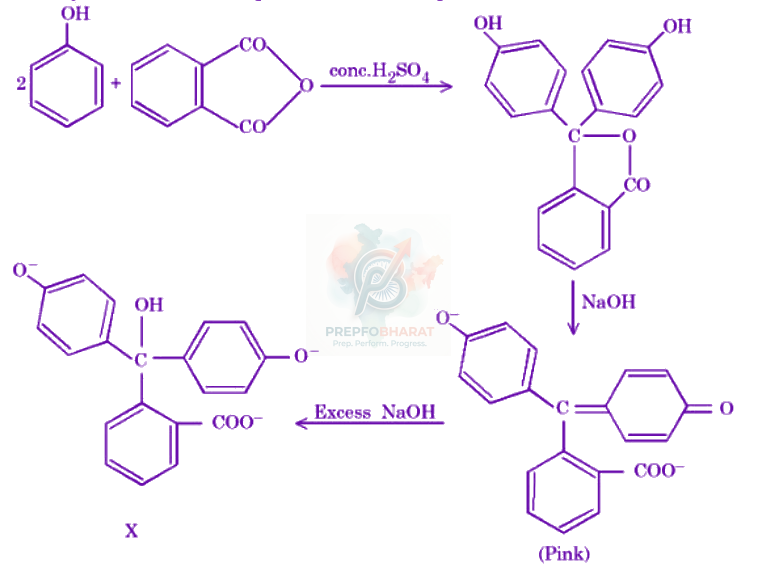
Increasing order of electron withdrawing power of following functional groups is: a. $-CN$ b. $-COOH$ c. $-NO_2$ d. $-I$
Match List - I with List - II. $\begin{array}{l} \text{List - I} & \text{List - II} \\ \text{Reaction of Glucose with} & \text{Product formed} \\ \text{A. Hydroxylamine} & \text{I. Gluconic acid} \\ \text{B. } \mathrm{Br}_{2} \text{ water} & \text{II. Glucose pentacetate} \\ \text{C. Excess acetic anhydride} & \text{III. Saccharic acid} \\ \text{D. Concentrated } \mathrm{HNO}_{3} & \text{IV. Glucoxime} \end{array}$ Choose the correct answer from the options given below :
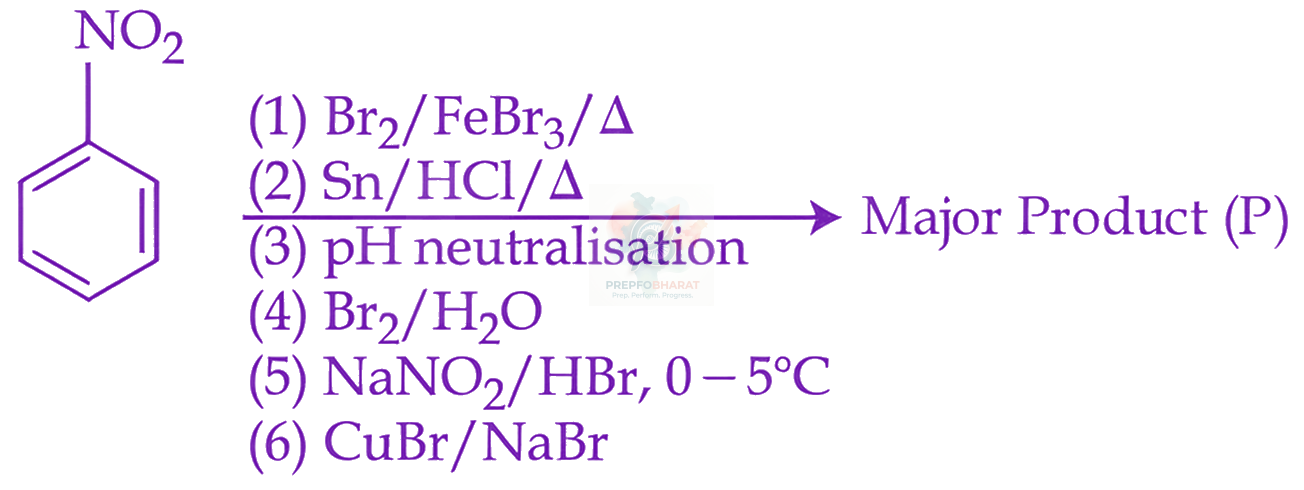 Consider the above sequence of reactions. The number of bromine atom(s) in the final product (P) will be :
Find out the statements which are not true. A. Resonating structures with more number of covalent bonds and lesser charge separation are more stable. B. In electromeric effect, an unsaturated system shows +E effect with nucleophile and -E effect with electrophile. C. Inductive effect is responsible for high melting point, boiling point and dipole moment of polar compounds. D. The greater the number of alkyl groups attached to the doubly bonded carbon atoms, higher is the heat of hydrogenation. E. Stability of carbanion increases with the increase in $\mathrm{s}-$ character of the carbon carrying the negative charge. Choose the correct answer from the options given below:
The number of compounds from the following which can undergo reaction with Br$_2$/KOH (alcoholic) to give respective products and these respective products can also be obtained separately by Gabriel phthalimide reaction is : 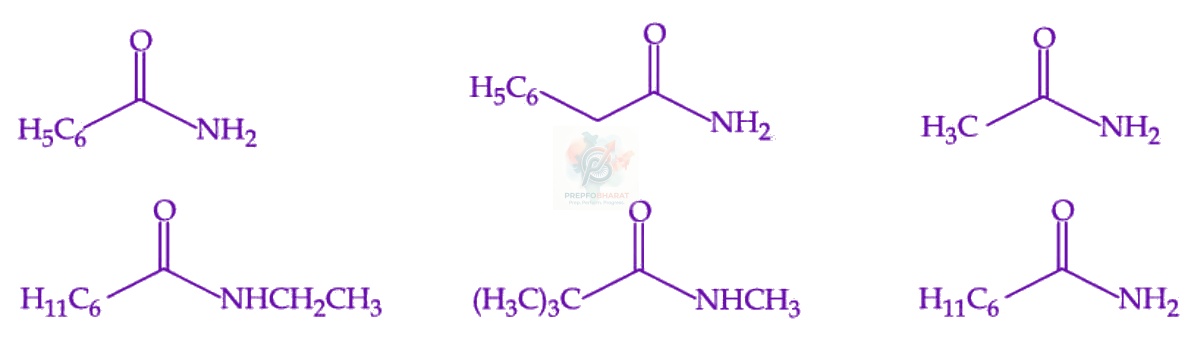
' A ' is a neutral organic compound ($\mathrm{M}. \mathrm{F}: \mathrm{C}_{8} \mathrm{H}_{9} \mathrm{ON}$). On treatment with aqueous $\mathrm{Br}_{2} / \mathrm{HO}^{(-)}$, ' A ' forms a compound ' B ' which is soluble in dilute acid. ' B ' on treatment with aqueous $\mathrm{NaNO}_{2} / \mathrm{HCl}\left(0-5^{\circ} \mathrm{C}\right)$ produces a compound ' C ' which on treatment with $\mathrm{CuCN} / \mathrm{NaCN}$ produces ' D '. Hydrolysis of ' D ' produces ' E ' which is also obtainable from the hydrolysis of ' A '. ' E ' on treatment with acidified $\mathrm{KMnO}_{4}$ produces ' $F$ '. ' $F$ ' contains two different types of hydrogen atoms. The structure of ' A ' is
Given below are two statements: Statement I: 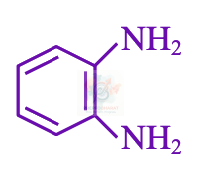 can be synthesized from 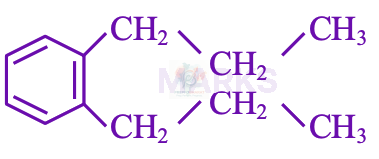 using simpler reagents in the order i) Acidic $\mathrm{KMnO}_{4}$, ii) Ammonia, iii) Bromine and alkali Statement II: 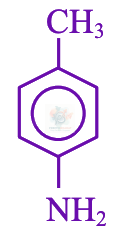 can be converted into 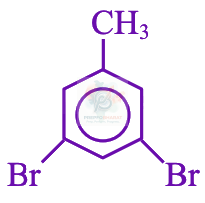 using reagents in the order i) Bromine- $\mathrm{H}_{2} \mathrm{O}$ ii) $\mathrm{NaNO}_{2} / \mathrm{HCl}\left(0-5^{\circ} \mathrm{C}\right)$ (iii) Aq. $\mathrm{H}_{3} \mathrm{PO}_{2}$. In the light of the above statements, choose the correct answer from the options given below
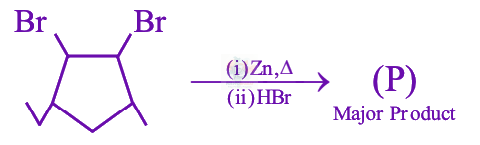 Identify (P)
Given below are two statements: Statement I: Methane can be prepared by decarboxylation of sodium ethanoate, Kolbe's electrolysis of sodium acetate and reaction of $\text{CH}_3\text{MgBr}$ with water. Statement II: Methane cannot be prepared from unsaturated hydrocarbons and by Wurtz reaction. In the light of the above statements, choose the correct answer from the options given below
Match the LIST-I with LIST-II <table class="pyq-table"><tbody><tr><th>List-I Deficiency Disease</th><th>List-II Vitamin</th></tr><tr><td>A. Scurvy</td><td>I. Pyridoxine</td></tr><tr><td>B. Convulsions</td><td>II. Vitamin A</td></tr><tr><td>C. Cheilosis</td><td>III. Ascorbic Acid</td></tr><tr><td>D. Xerophthalmia</td><td>IV. Riboflavin</td></tr></tbody></table> Choose the correct answer from the options given below:
'$x$' is the product which is obtained by the hydrolysis of prop-1-yne in the presence of mercuric sulphate under dilute acidic medium at $333$ K. '$y$' is the product which is obtained by the reaction of ethane nitrile with methyl magnesium bromide in dry ether followed by hydrolysis. IUPAC name of product obtained from '$x$' and '$y$' in the presence of barium hydroxide followed by heating is :
An alkane $(Y)$ requires $8$ moles of oxygen for complete combustion and on chlorination with Cl$_2$/h$\nu$, $(Y)$ gives only one monochlorinated product $(Z)$. The total number of primary carbon atoms in $(Y)$ is __________.
Match List - I with List - II. $\begin{array}{l} \text{List - I} & \text{List - II} \\ \text{Functional group (detection)} & \text{Change observed during detection} \\ \text{A. Unsaturation (Baeyer's test)} & \text{I. Red colour appears} \\ \text{B. Alcoholic group} \\ \text{(Ceric ammonium nitrate test)} & \text{II. Silver mirror appears} \\ \text{C. Aldehyde group (Tollen's reagent)} & \text{III. Violet colour appears} \\ \text{D. Phenolic group } \left(\mathrm{FeCl}_{3}\right. \text{ test)} & \text{IV. Discharge of pink colour} \end{array}$ Choose the correct answer from the options given below :
Identify the correct statements : The presence of $-\mathrm{NO}_{2}$ group in benzene ring A. activates the ring towards electrophilic substitutions. B. deactivates the ring towards electrophilic substitutions. C. activates the ring towards nucleophilic substitutions. D. deactivates the ring towards nucleophilic substitutions. Choose the correct answer from the options given below :