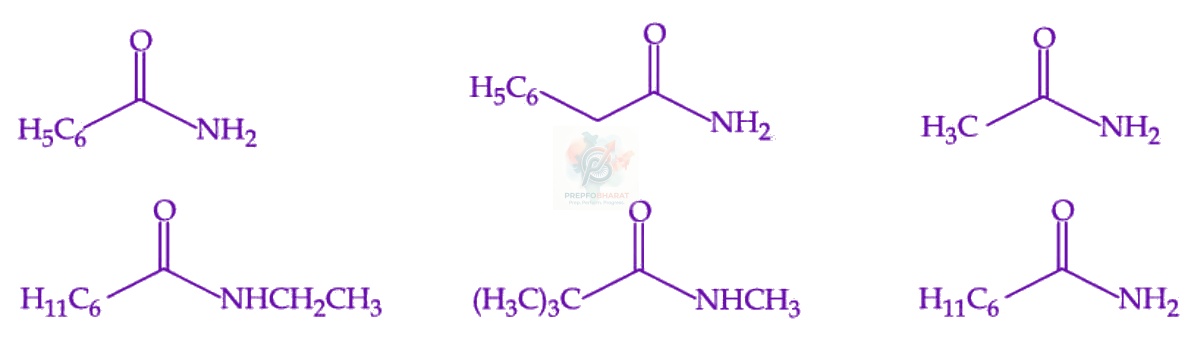
The reaction of an amide with Br2/KOH (alcoholic) is the Hoffmann bromamide degradation reaction. This reaction is specific to primary amides (R−CONH2) and produces primary amines (R−NH2) with one less carbon atom.
Among the given compounds, the primary amides are:
Benzamide (C6H5CONH2)
2-Phenylacetamide (C6H5CH2CONH2)
Acetamide (CH3CONH2)
Cyclohexanecarboxamide (C6H11CONH2)
The other two compounds (N-ethylcyclohexanecarboxamide and N-methylpivalamide) are secondary amides and do not undergo this reaction.
The primary amines formed from the degradation of the four primary amides are:
Aniline (C6H5NH2)
Benzylamine (C6H5CH2NH2)
Methylamine (CH3NH2)
Cyclohexylamine (C6H11NH2)
The Gabriel phthalimide synthesis is used for the preparation of aliphatic primary amines. It cannot be used to prepare aromatic primary amines (like aniline) because aryl halides do not undergo nucleophilic substitution with the phthalimide anion.
Therefore, aniline cannot be prepared by Gabriel phthalimide synthesis. The remaining three amines (benzylamine, methylamine, and cyclohexylamine) are aliphatic primary amines and can be prepared by this method.
Thus, there are 3 compounds that satisfy both conditions.
Answer: 3