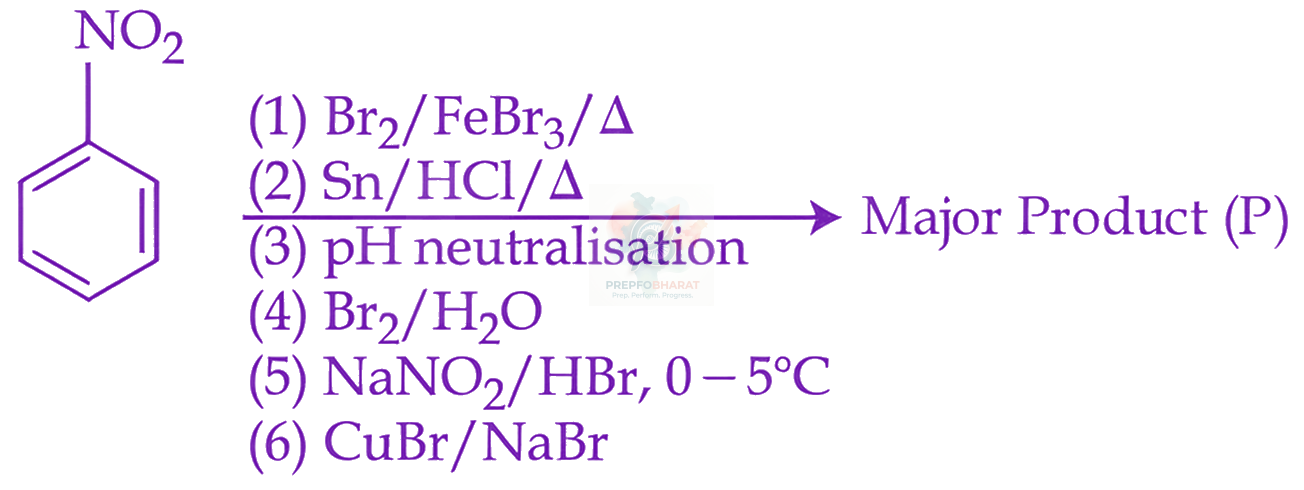
The reaction sequence is as follows:
Bromination of nitrobenzene with Br2/FeBr3 results in meta-bromonitrobenzene because the −NO2 group is meta-directing. (1 Br atom)
Reduction of the nitro group using Sn/HCl followed by pH neutralization converts −NO2 to −NH2. The product is m-bromoaniline.
Reaction with Br2/H2O (bromine water) on m-bromoaniline: The −NH2 group is highly activating and ortho/para directing. In m-bromoaniline, the positions ortho and para to −NH2 are vacant (positions 2, 4, and 6 relative to −NH2). Bromine water causes polybromination at all available ortho and para positions. This adds 3 more bromine atoms. (Total 1 + 3 = 4 Br atoms)
Diazotization with NaNO2/HBr at 0−5∘C converts the −NH2 group into a diazonium salt −N2+Br−.
Sandmeyer reaction with CuBr/NaBr replaces the diazonium group with a bromine atom. (Total 4 + 1 = 5 Br atoms)
The final product (P) is 1,2,3,4,5-pentabromobenzene. Therefore, the number of bromine atoms in the final product is 5.