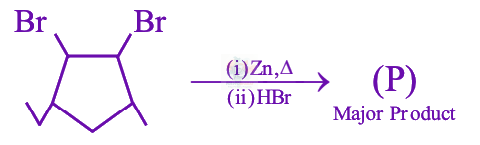
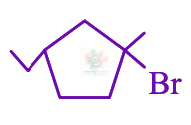
The vicinal dibromide undergoes elimination with Zn/Δ to form cyclohexene.
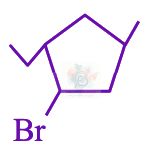
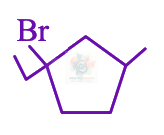
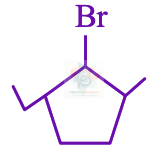
Cyclohexene reacts with HBr. The secondary carbocation formed undergoes a 1,2-hydride shift to give a more stable tertiary carbocation, which then combines with Br− to give 1-bromocyclohexane (with Br at the more substituted position).
The major product (P) is 1-bromo-1-methylcyclohexane (tertiary alkyl bromide).