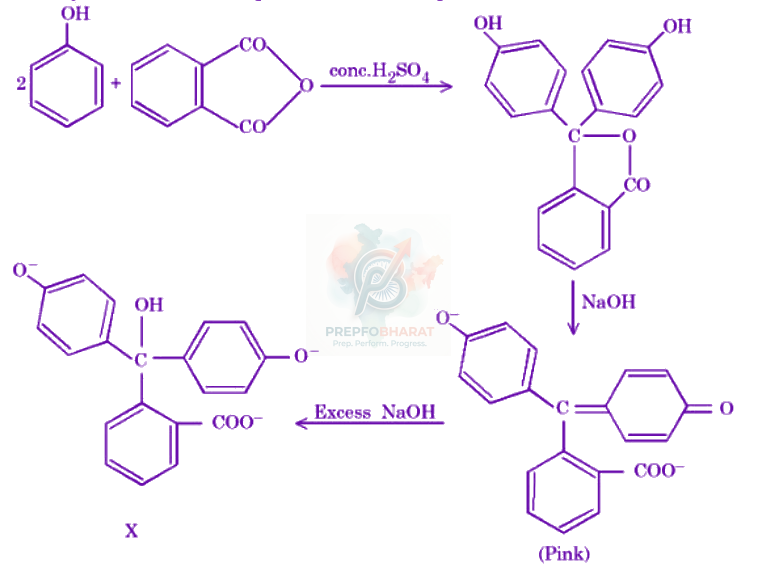
The given reaction sequence represents the synthesis and acid-base behaviour of phenolphthalein.
When phenol reacts with phthalic anhydride in the presence of concentrated H2SO4, phenolphthalein is formed. In acidic or neutral medium, phenolphthalein exists in a lactone form which is colourless.
Upon addition of a moderate amount of alkali (NaOH), the lactone ring opens and a proton is removed, forming a dianion with an extended conjugated quinonoid structure. This extended conjugation is responsible for the characteristic pink colour of phenolphthalein in basic medium.
When excess NaOH is added (strongly alkaline medium), a hydroxide ion attacks the central sp2 hybridized carbon atom of the quinonoid structure. This converts the central carbon to an sp3 hybridized state, forming a carbinol structure (compound X).
Because the central carbon is now sp3 hybridized, the extended conjugation is broken. As a result, the compound loses its colour and becomes colourless.
Therefore, compound X is colourless.
Answer: Colourless