Organic Chemistry PYQ — Page 4
JEE Main Chemistry — Organic Chemistry previous year questions with solutions.
All Organic Chemistry Questions (1783)
Consider the following sequence of reactions. 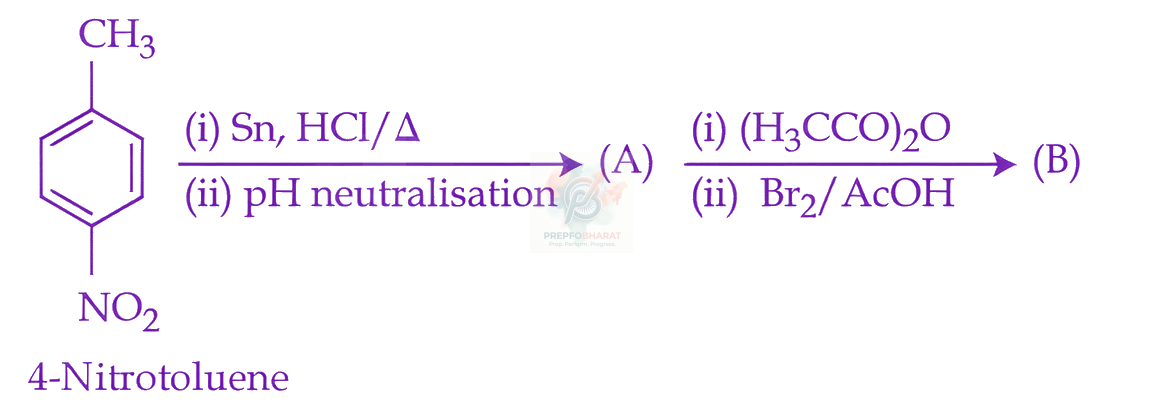 Assuming that the reaction proceeds to completion, then 137 mg of 4 -nitrotoluene will produce $\_\_\_\_$ mg of $B$. (Given molar mass in $\mathrm{g} \mathrm{mol}^{-1} \mathrm{H}: 1, \mathrm{C}: 12, \mathrm{~N}: 14, \mathrm{O}: 16, \mathrm{Br}: 80$)
Consider the three aromatic molecules (P, Q and R) whose structures have been given below : 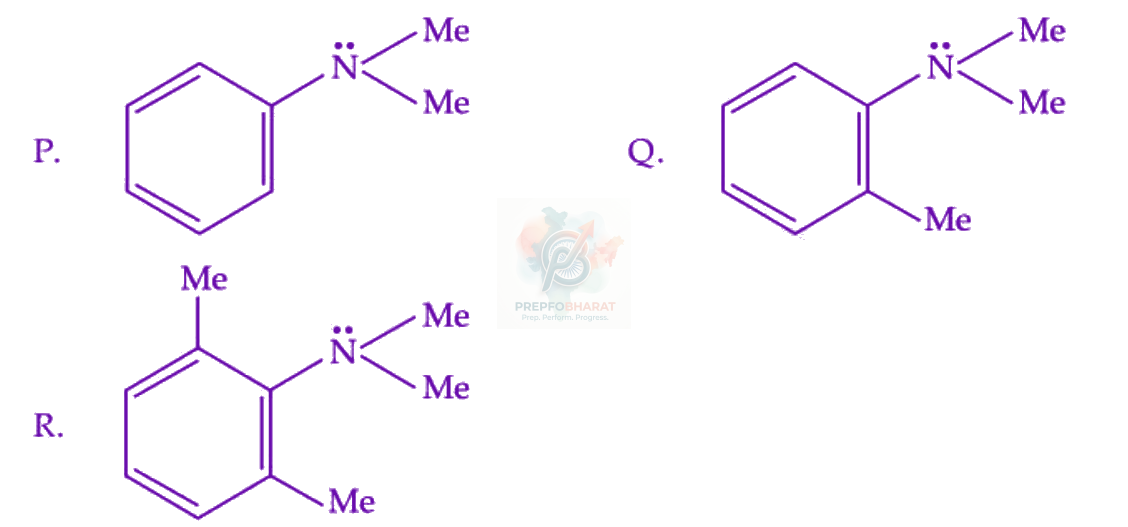 The correct order regarding the reactivity of these compounds with $Ph-N\equiv NCl^{(-)}_{(+)}$ under optimum but slightly acidic medium is :
Complete the following reaction sequence and give the name of major product 'P'. $CH_3-CH_2-C\equiv N \xrightarrow[\text{(ii) } H_3O^+]{\text{(i) } OH^-/H_2O/\Delta} \xrightarrow[\text{(iv) } H_2O]{\text{(iii) } Cl_2/\text{Red P}} P \text{ (Major product)}$
The following structures are 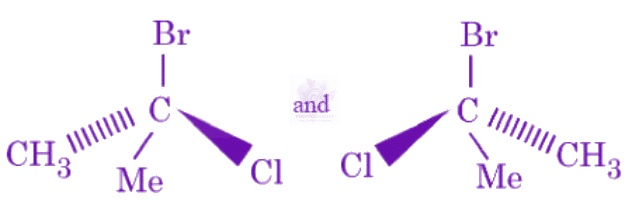
Match the LIST-I with LIST-II \(\begin{array}{|c|l|c|l|} \hline & \textbf{List-I (Reagents)} & & \textbf{List-II (Name of reaction} \\ & & & \textbf{involving carbonyl compounds)} \\ \hline A. & \mathrm{NH_2{-}NH_2,\ KOH} & I. & \text{Tollen's Test} \\ \hline B. & \mathrm{Ag(NH_3)_2OH} & II. & \text{Clemmensen Reduction} \\ \hline C. & \begin{array}{l} \text{Aq. } \mathrm{CuSO_4}, \\ \text{Sodium potassium} \\ \text{tartarate, KOH} \end{array} & III. & \text{Wolff--Kishner Reduction} \\ \hline D. & \mathrm{Zn{-}Hg,\ HCl} & IV. & \text{Fehling's Test} \\ \hline \end{array}\) Choose the correct answer from the options given below:
In Carius method 0.2425 g of an organic compound gave 0.5253 g silver chloride. The percentage of chlorine in the organic compound is
Identify the correct IUPAC name of hydrocarbon ($x$) containing three primary carbon atoms and with molar mass $72\text{ g mol}^{-1}$.
Consider the following reaction. 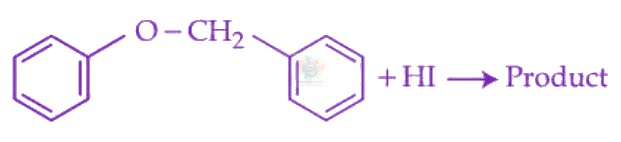 Statement I : In the above reaction, product formed will be a mixture of benzyl alcohol and iodobenzene. Statement II : In the above reaction, the $-\text{O}-\text{CH}_2-$ bond is cleaved to give the product. In the light of the above statements, choose the correct answer from the options given below :
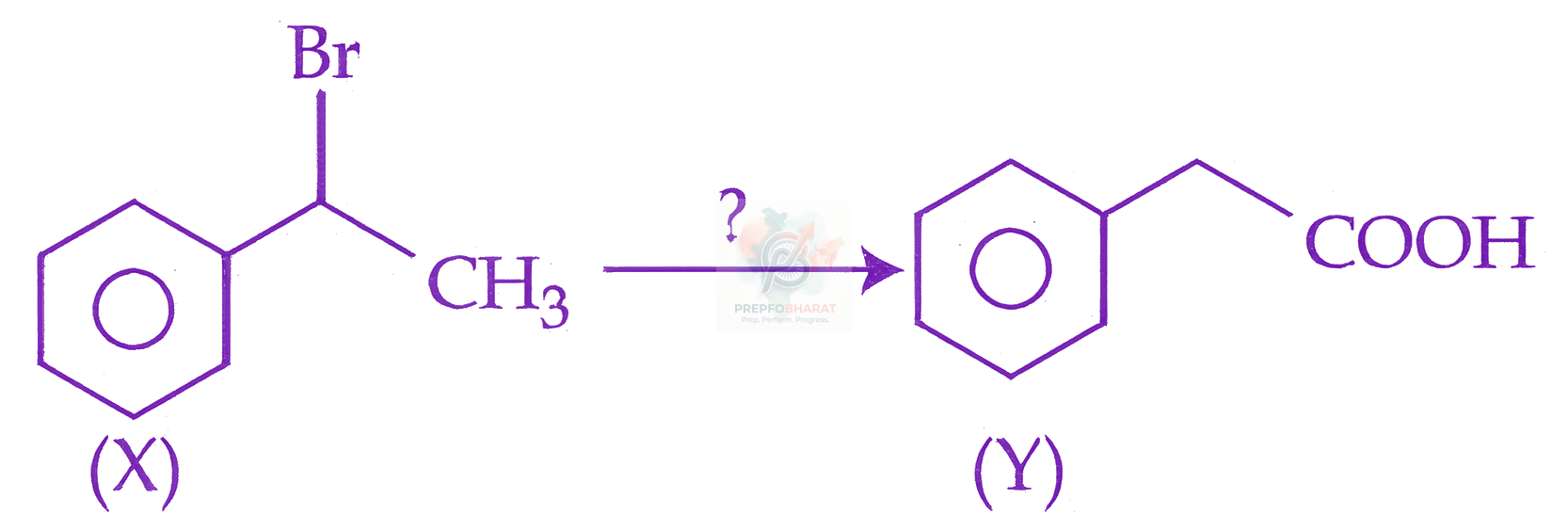 The correct sequence of reagents for the above conversion of X to Y is :
The compound (X) on (i) on heating in the presence of anhydrous $AlCl_3$ and HCl gas gives $2,4$-dimethyl pentane (ii) aromatization gives toluene and (iii) cyclisation gives methyl cyclohexane The correct name of compound (X) is:
When 1 g of compound $(\mathrm{X})$ is subjected to Kjeldahl's method for estimation of nitrogen, 15 mL 1 M $\mathrm{H}_{2} \mathrm{SO}_{4}$ was neutralized by ammonia evolved. The percentage of nitrogen in compound $(\mathrm{X})$ is :
The total number of aromatic compounds/species from the following is 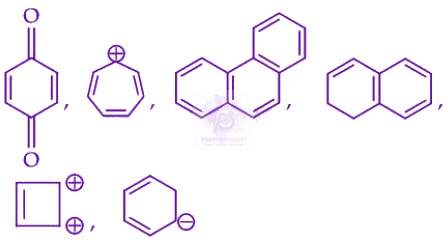
Compound ' P ' undergoes the following sequence of reactions :  ' $\mathrm{P}^{\prime}$ is :
Given below are two statements: Statement I: Cross aldol condensation between two different aldehydes will always produce four different products. Statement II: When semicarbazide reacts with a mixture of benzaldehyde and acetophenone under optimum pH, it forms a condensation product with acetophenone only. In the light of the above statements, choose the correct answer from the options given below
Given below are two statements for the following reaction sequence.  Statement I: Compound ' $Z$ ' will give yellow precipitate with NaOI. Statement II: Compound ' Q ' has two different types of ' H ' atoms (aromatic : aliphatic) in the ratio 1:3. In the light of the above statements, choose the correct answer from the options given below:
Given below are two statements : Statement I: The condensation reaction between $CH_3-CH=O$ and $H_2N-NH-C(=O)-NH_2$ under optimum pH will produce $CH_3-CH=N-N(H)-C(=O)-NH_2$. Statement II: The molecule, $Ph-CH(O-H)(O-CH_3)$ will generate $Ph-CH=O$ in the presence of dilute acid. In the light of the above statements, choose the correct answer from the options given below :
One mole of phenol is treated with dilute HNO$_3$ at $298$ K to give a mixture of products. The mixture is separated by steam distillation. The steam volatile compound (X) is separated. The increase in percentage of oxygen in (X) with respect to phenol is _____ $\times 10^{-1}$ % (Given molar mass in g mol$^{-1}$ H:$1$, C:$12$, N:$14$, O:$16$)
Consider the following reactions giving major product. Identify the correct reaction.
An optically active alkyl bromide C$_4$H$_9$Br, reacts with ethanolic KOH to form major compound [A] which reacts with bromine to give compound [B]. Compound [B] reacts with ethanolic KOH and sodamide to give compound [C]. One molecule of water adds to compound [C] on warming with mercuric sulphate and dilute sulphuric acid at $333$ K to form compound [D]. The functional group in compound D will be confirmed by :
Given below are two statements: Statement I: $3$-phenylpropene reacts with HBr and gives secondary alkyl bromide having a chiral carbon atom as the major product. Statement II: Aryl chlorides and aryl cyanides can be prepared by Sandmeyer reaction as well as Gattermann reaction. In the light of the above statements, choose the correct answer from the options given below
One mole of an alkane (x) requires $8$ mole oxygen for complete combustion. Sum of number of carbon and hydrogen atoms in the alkane (x) is _______.
The compound A, $\mathrm{C}_{8} \mathrm{H}_{8} \mathrm{O}_{2}$ reacts with acetophenone to form a single product via cross-Aldol condensation. The compound A on reaction with conc. NaOH forms a substituted benzyl alcohol as one of the two products. The compound A is :
The number of possible tripeptides formed involving alanine (ala), glycine (gly) and valine (val), where no amino acid has been used more than once is:
A D-aldotetrose on oxidation with concentrated $HNO_3$ resulted in optically inactive dicarboxylic acid. The structure of the D-aldotetrose is: