
The final product is cyclohexyl isocyanide (C6H11NC).
Working backwards from the final product:
The last step involves CHCl3 and KOH (alc), which is the Carbylamine reaction.
This reaction converts a primary amine (R−NH2) into an isocyanide (R−NC). Thus, the intermediate before this step must be cyclohexylamine (C6H11NH2).
The step before cyclohexylamine involves Br2 and KOH, which is the Hoffmann Bromamide Degradation reaction.
This reaction converts an amide (R−CONH2) into a primary amine (R−NH2) with one less carbon atom.
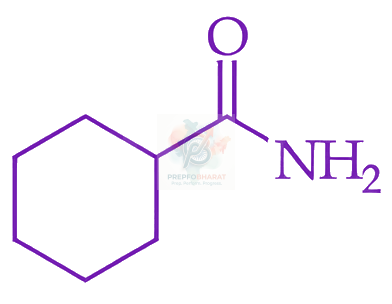
Therefore, the amide 'Q' must be cyclohexanecarboxamide (C6H11CONH2).
The first step converts 'P' into 'Q' using NH3 and heat.
Carboxylic acids react with NH3 followed by heating to form amides.
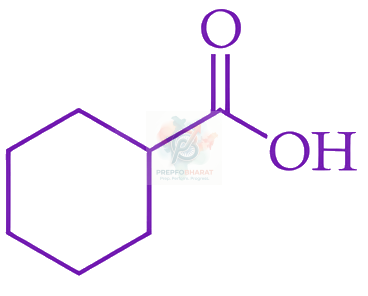
Thus, 'P' must be cyclohexanecarboxylic acid (C6H11COOH).
Reaction sequence:
C6H11COOH (P) NH3,ΔC6H11CONH2 (Q)
C6H11CONH2 (Q) Br2,KOHC6H11NH2 (Cyclohexylamine)
C6H11NH2CHCl3,KOHC6H11NC (Cyclohexyl isocyanide)
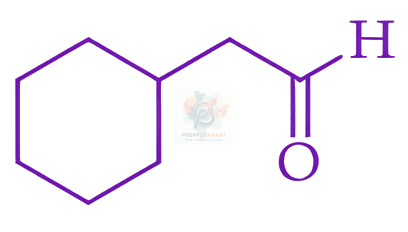
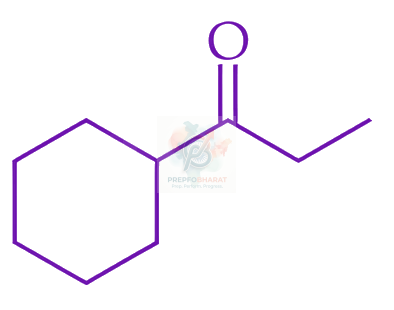
Comparing with the options, 'P' is cyclohexanecarboxylic acid, which corresponds to option (4).