Organic Chemistry PYQ — Page 5
JEE Main Chemistry — Organic Chemistry previous year questions with solutions.
All Organic Chemistry Questions (1783)
Given below are two statements : Statement (I) : Benzyl chloride reacts faster in $S_N1$ mechanism than ethyl chloride. Statement (II) : Ethyl carbocation intermediate is less stabilized by hyperconjugation than benzyl carbocation by resonance. In the light of the above statements, choose the correct answer from the options given below :
The correct order of acidic strength of the major products formed in the given reactions, is : A. 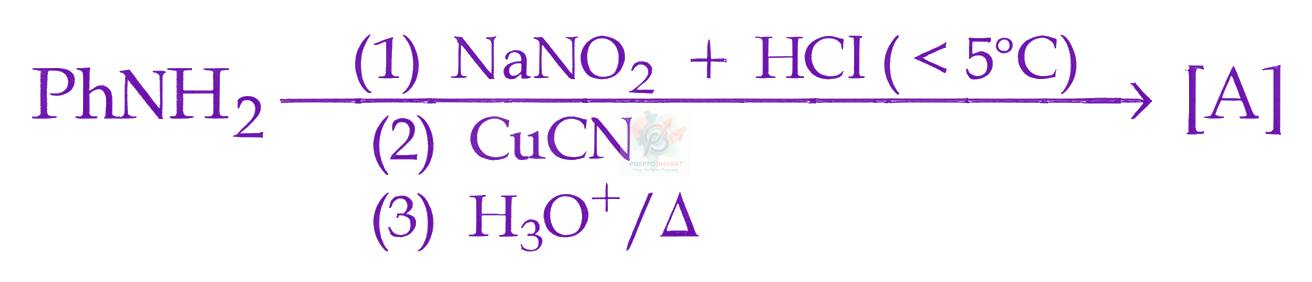 B. $\mathrm{CH}_{3} \mathrm{CH}_{2} \mathrm{CHO} \xrightarrow[\Delta]{\left[\mathrm{Ag}\left(\mathrm{NH}_{3}\right)_{2}\right]^{+}, \mathrm{OH}^{-}}[\mathrm{B}]$ C. $\mathrm{CH}_{4}+\mathrm{O}_{2} \xrightarrow[\text { (ii) } \mathrm{Na}_{2} \mathrm{Cr}_{2} \mathrm{O}_{7} / \mathrm{H}^{+}]{\text {(i) }}[\mathrm{C}]$ D. $\mathrm{PhCH}_{2} \mathrm{MgBr}+\mathrm{CO}_{2} \xrightarrow[\mathrm{H}_{3} \mathrm{O}^{+}]{\text {Dry ether }}[\mathrm{D}]$ Choose the correct answer from the options given below :
Given below are the four isomeric compounds $(\mathrm{P}, \mathrm{Q}, \mathrm{R}, \mathrm{S})$ 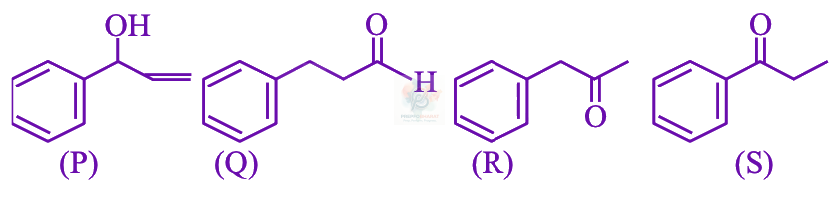 Identify correct statements from below. A. $\mathrm{Q}, \mathrm{R}$ and S will give precipitate with $2,4-\mathrm{DNP}$. B. P and Q will give positive Bayer's test. C. Q and R will give sooty flame. D. R and S will give yellow precipitate with $\mathrm{I}_{2} / \mathrm{NaOH}$. E. Q alone will deposit silver with Tollen's reagent Choose the correct option.
In IUPAC nomenclature, the correct order of decreasing priority of functional group is :
The IUPAC name of the following compound is : 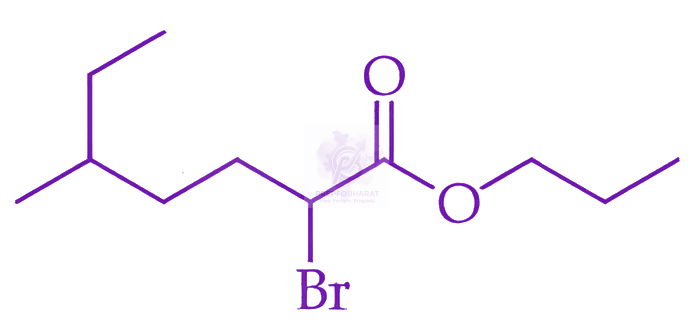
Identify the correct statements. A. Glucose exists in two anomeric forms. B. Anomers of glucose differ in configuration at C$-1$ in cyclic hemiacetal structure. C. Melting point of $\alpha$-anomer of glucose is greater than $\beta$-anomer. D. Specific rotation of $\alpha$-anomer is $+19°$ while for $\beta$-anomer is $+112°$ E. $\alpha$ and $\beta$-anomers of glucose are prepared by crystallization of saturated glucose solution at $303$ K and $371$ K respectively. Choose the correct answer from the options given below:
Iodoform test can differentiate between A. Methanol and Ethanol B. $\mathrm{CH}_{3} \mathrm{COOH}$ and $\mathrm{CH}_{3} \mathrm{CH}_{2} \mathrm{COOH}$ C. Cyclohexene and cyclohexanone D. Diethyl ether and Pentan-3-one E. Anisole and acetone Choose the correct answer from the options given below:
Given below are two statements : Statement I: The two cyclic forms of D-(+)-glucose (α and β anomers differing at C1 hydroxyl orientation) are two anomers of D-(+)-glucose. Statement II: The open chain forms of D-glucose and D-fructose contain three similar chiral carbons at $C_3$, $C_4$ and $C_5$. In the light of the above statements, choose the correct answer from the options given below :
Match List - I with List - II. $\begin{array}{l} \text{List - I} & \text{List - II} \\ \text{Pair of Compounds} & \text{Type of Isomers} \\ \text{A. 2-Methylpropene and but-1-ene} & \text{I. Stereoisomers} \\ \text{B. Cis-but-2-ene and trans-but-2-ene} & \text{II. Position isomers} \\ \text{C. 2-Butanol and diethyl ether} & \text{III. Chain isomers} \\ \text{D. But-1-ene and but-2-ene} & \text{IV. Functional group isomers} \end{array}$ Choose the correct answer from the options given below :
Match List - I with List - II. <table class="pyq-table"><tbody><tr><th>List - I Mixture of Compounds</th><th>List - II Reagent used to distinguish</th></tr><tr><td>A. Diethyl amine + Ethyl amine</td><td>I. Bromine water</td></tr><tr><td>B. Acetaldehyde + Acetone</td><td>II. $CHCl_3 + KOH, \Delta$</td></tr><tr><td>C. Ethanol + Phenol</td><td>III. Neutral $FeCl_3$</td></tr><tr><td>D. Benzoic acid + Cinnamic acid</td><td>IV. Ammonical silver nitrate</td></tr></tbody></table> Choose the correct answer from the options given below :
The dibromo compound $[\mathrm{P}]$ (molecular formula : $\mathrm{C}_{9} \mathrm{H}_{10} \mathrm{Br}_{2}$) when heated with excess sodamide followed by treatment with dilute HCl gives $[\mathrm{Q}]$. On warming $[\mathrm{Q}]$ with mercuric sulphate and dilute sulphuric acid yield $[R]$ which gives positive lodoform test but negative Tollen's test. The compound $[\mathrm{P}]$ is :
Match the LIST-I with LIST-II <table class="pyq-table"><tbody><tr><th>List-I (Chloro derivative)</th><th>List-II (Example)</th></tr><tr><td>A. Vinyl Chloride</td><td>I. $CH_2 = CH - CH_2Cl$</td></tr><tr><td>B. Benzyl chloride</td><td>II. $CH_3 = CH(Cl)CH_3$</td></tr><tr><td>C. Alkyl chloride</td><td>III. $CH_2 = CHCl$</td></tr><tr><td>D. Allyl chloride</td><td>IV. <img src="https://prepforbharat.s3.ap-south-1.amazonaws.com/exam/615f0e999476412f48314daf/Chemistry/images/Haloalkanes_and_Haloarenes/6983c1a28bfdbb243563972d/question_1__q_6983c1a28bfdbb243563972d__cdn-question-pool.getmarks.app__24S1_q_60_1_v2__1278b37ed2_final_ppt_sync.png" alt="JEE Main 2026 Chemistry, Haloalkanes and Haloarenes — question figure"></td></tr></tbody></table> Choose the correct answer from the options given below:
Given below are two statements: Statement I: ' $\mathrm{C}-\mathrm{Cl}^{\prime}$ bond is stronger in $\mathrm{CH}_{2}=\mathrm{CH}-\mathrm{Cl}$ than $\mathrm{CH}_{3}-\mathrm{CH}_{2}-\mathrm{Cl}$ Statement II: The given optically active molecule, 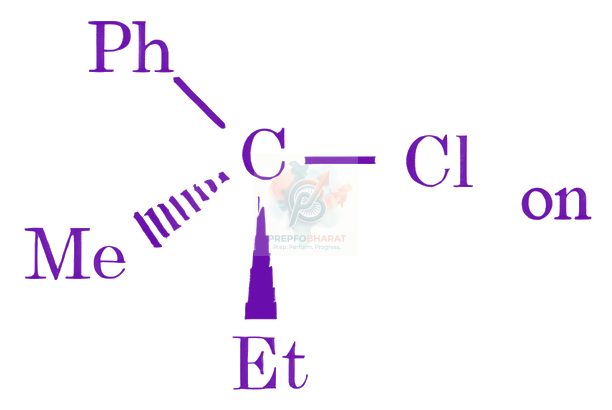 on hydrolysis gives a solution that can rotate the plane polarized light. In the light of the above statements, choose the correct answer from the options given below
The correct order of reactivity of $\mathrm{CH}_{3} \mathrm{Br}$ in methanol with the following nucleophiles is $\mathrm{F}^{-}, \mathrm{I}^{-}, \mathrm{C}_{2} \mathrm{H}_{5} \mathrm{O}^{-}$and $\mathrm{C}_{6} \mathrm{H}_{5} \mathrm{O}^{-}$
The correct order of the rate of the reaction for the following reaction with respect to nucleophiles is : $\mathrm{CH}_{3} \mathrm{Br}+\mathrm{Nu}^{\ominus} \longrightarrow \mathrm{CH}_{3} \mathrm{Nu}+\mathrm{Br}^{\ominus}$
Match the LIST-I with LIST-II <table class="pyq-table"><tbody><tr><th>List-I (Compound)</th><th>List-II (Test)</th></tr><tr><td>A. Cyclohexanol</td><td>I. Hinsberg's reagent test</td></tr><tr><td>B. Cyclohexylamine</td><td>II. Phthalein dye test</td></tr><tr><td>C. Cyclohexanecarbaldehyde</td><td>III. Lucas test</td></tr><tr><td>D. Phenol</td><td>IV. Tollen's test</td></tr></tbody></table> Choose the correct answer from the options given below:
Amongst the following, the total number of compounds soluble in aqueous $NaOH$ at room temperature is: 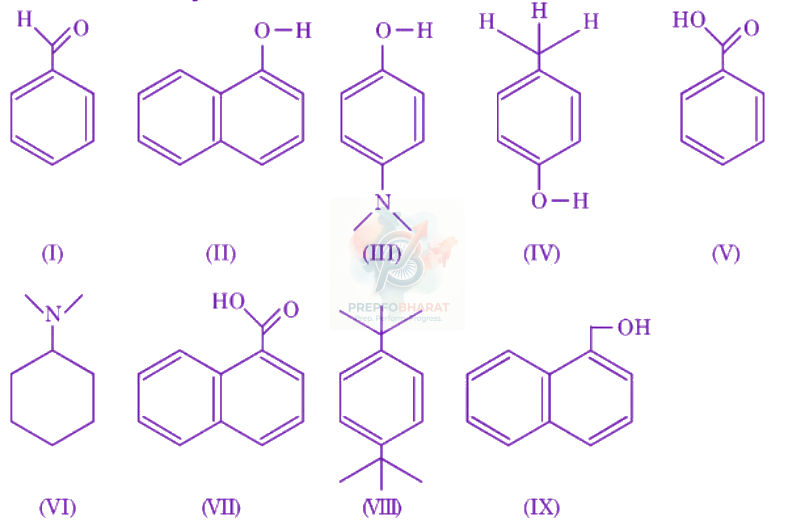
Consider the following two reactions A and B. 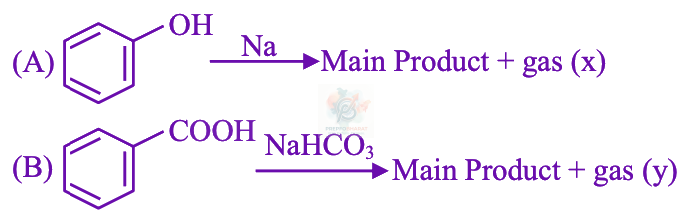 Numerical value of [molar mass of $x+$ molar mass of $y$] is $\_\_\_\_$.
'$x$' is the product which is obtained from benzene by reacting it with carbon monoxide and hydrogen chloride in the presence of cuprous chloride. '$y$' is the major product obtained from the benzene by reacting it with ethanoyl chloride in the presence of anhydrous AlCl$_3$. Product (major) obtained by heating $x$ and $y$ in the presence of alkali is $z$. Total number of $\pi$ (pi) electrons in $z$ is ________.
Consider the following reaction. 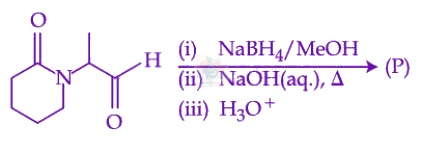 The major product (P) formed is:
A student performed analysis of aliphatic organic compound ' $X$ ' which on analysis gave $C=61.01 \%$, $\mathrm{H}=15.25 \%, \mathrm{~N}=23.74 \%$. This compound, on treatment with $\mathrm{HNO}_{2} / \mathrm{H}_{2} \mathrm{O}$ produced another compound ' Y ' which did not contain any nitrogen atom. However, the compound ' $Y$ ' upon controlled oxidation produced another compound ' $Z$ ' that responded to iodoform test. The structure of ' $X$ ' is :
Given below are two statements : Statement I: Heating benzamide with bromine in an ethanolic solution of sodium hydroxide will give benzylamine. Statement II: Nitration of aniline with $HNO_3/H_2SO_4$ at $288\text{ K}$ produces $m$-nitroaniline in higher amount than $o$-nitroaniline (pH adjusted). In the light of the above statements, choose the correct answer from the options given below :
A student is given one compound among the following compounds that gives positive test with Tollen's reagent. 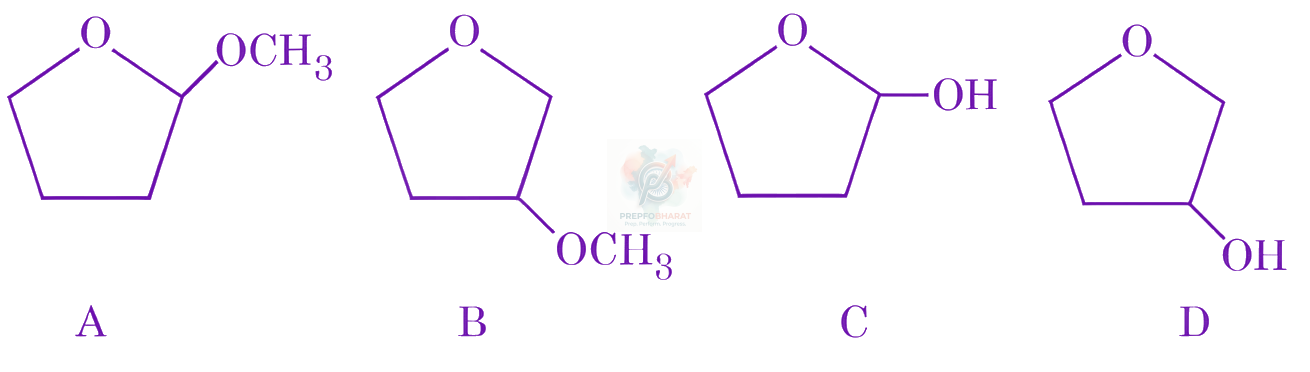 The compound is :
Match the LIST-I with LIST-II <table class="pyq-table"><tbody><tr><th>List-I Amino acid</th><th>List-II Positive reaction/Test for functional group present in side chain of amino acid</th></tr><tr><td>A. Glutamine</td><td>I. Hinsberg's test</td></tr><tr><td>B. Lysine</td><td>II. Neutral $\text{FeCl}_3$ test</td></tr><tr><td>C. Tyrosine</td><td>III. Ceric ammonium nitrate test</td></tr><tr><td>D. Serine</td><td>IV. Hoffman bromamide degradation</td></tr></tbody></table> Choose the correct answer from the options given below: