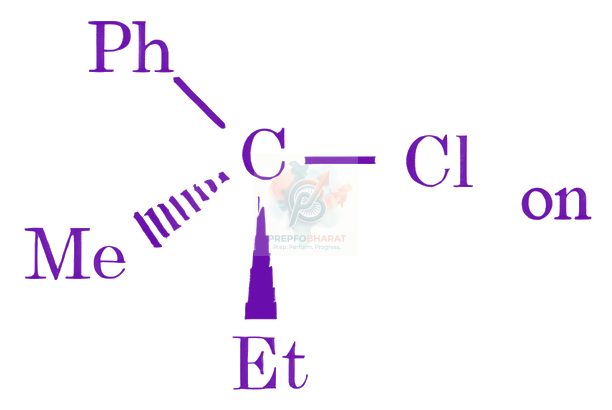
Statement I: In vinyl chloride (CH₂=CH-Cl), the C-Cl bond involves an sp² hybridized carbon, while in ethyl chloride (CH₃-CH₂-Cl), it involves an sp³ carbon. The sp² carbon has greater s-character, forming a shorter and stronger C-Cl bond. Additionally, resonance stabilization from the Cl atom's p-orbital overlapping with the π system further strengthens the vinyl C-Cl bond. Statement I is TRUE.
Statement II: The optically active molecule shown has a stereogenic center bearing Me, Ph, Et, and Cl groups. Upon hydrolysis via nucleophilic substitution (typically SN1 for tertiary or secondary centers), the C-Cl bond breaks to form an alcohol. SN1 mechanism generates a carbocation intermediate, allowing nucleophilic attack from both faces, producing a racemic mixture of the alcohol product. A racemic solution cannot rotate polarized light as the d- and l-enantiomers cancel each other's rotations. Statement II is FALSE.