Organic Chemistry PYQ — Page 6
JEE Main Chemistry — Organic Chemistry previous year questions with solutions.
All Organic Chemistry Questions (1783)
The unsaturated ether on acidic hydrolysis produces carbonyl compounds as shown below:- $\begin{aligned} \mathrm{CH}_{3}-\mathrm{CH}=\mathrm{CH}- & \mathrm{O}-\mathrm{CH}=\mathrm{CH}_{2} \\ & \downarrow \mathrm{H}_{3} \mathrm{O}^{(+)} \\ \mathrm{CH}_{3}-\mathrm{CH}_{2}-\mathrm{CH}= & \mathrm{O} \text { and } \mathrm{O}=\mathrm{CH}-\mathrm{CH}_{3} \end{aligned}$ Based on this, predict the solution/reagent that will help to distinguish " P " and " Q " obtained in the following reaction:- 
Given below are two statements: Statement I: Sucrose is dextrorotatory. However, sucrose upon hydrolysis gives a solution having mixture of products. This solution shows laevorotation. Statement II: Hydrolysis of sucrose gives glucose and fructose. Since the laevorotation of glucose is more than the dextrorotation of fructose, the resulting solution becomes laevorotatory. In the light of the above statements, choose the correct answer from the options given below
From the given following (A to D) cyclic structures, those which will not react with Tollen's reagent are : 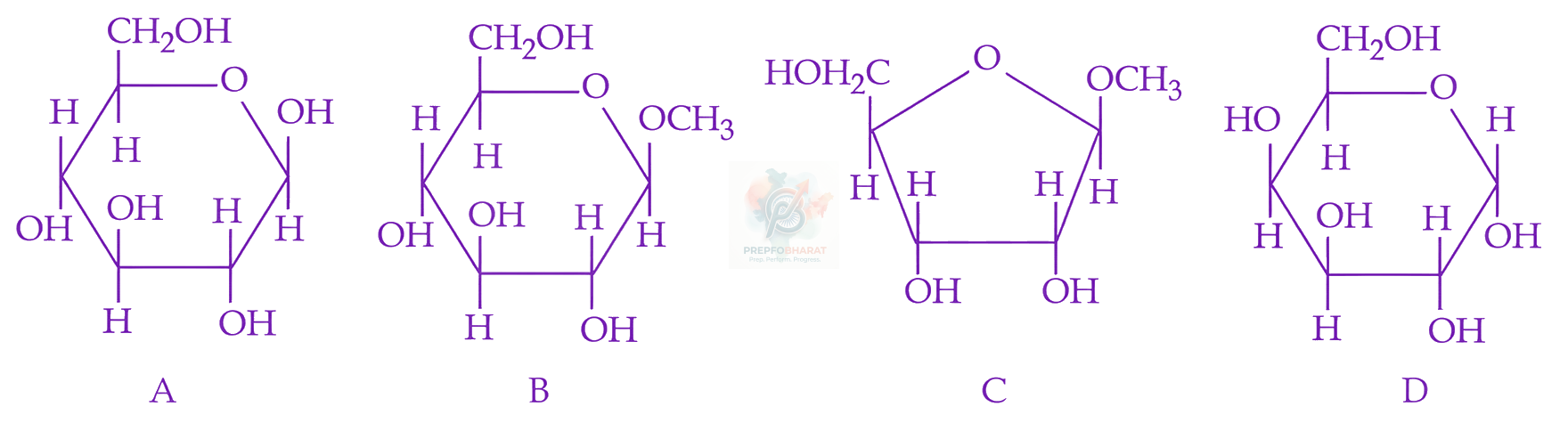
Identify the correct statements. A. Arginine and Tryptophan are essential amino acids. B. Histidine does not contain heterocyclic ring in its structure. C. Proline is a six membered cyclic ring amino acid. D. Glycine does not have chiral centre. E. Cysteine has characteristic feature of side chain as $\mathrm{MeS}-\mathrm{CH}_{2}-\mathrm{CH}_{2}-$. Choose the correct answer from the options given below :
As compared with chlorocyclohexane, which of the following statements correctly apply to chlorobenzene? A. The magnitude of negative charge is more on chlorine atom. B. The $\mathrm{C}-\mathrm{Cl}$ bond has partial double bond character. C. $\mathrm{C}-\mathrm{Cl}$ bond is less polar. D. $\mathrm{C}-\mathrm{Cl}$ bond is longer due to repulsion between delocalised electrons of the aromatic ring and lone pairs of electrons of chlorine. E. The $\mathrm{C}-\mathrm{Cl}$ bond is formed using $\mathrm{sp}^{2}$ hybridised orbital of carbon. Choose the correct answer from the options given below:
Consider compounds A, B and C with following structural formulae $A = $ CH$_3$ - CH$_2$ - CH$_2$ - CH$_2$ - CH$_2$ - OH $B = $ CH$_2 =$ CH - CH$_2$ - CH$_2$ - CH$_3$ $C = $ HO - CH$_2$ - CH$_2$ - CH(OH) - CH$_3$ For the conversion of B from A, reagent (D) required is _________ and structural formula of product (E) obtained when C undergoes same reaction using excess reagent (D) is _________.
Given below are two statements: Statement I: Due to increase in van der Waals forces, the order of boiling points is CH$_3$CH$_2$CH$_2$I > CH$_3$CH$_2$I > CH$_3$I. Statement II: As para-dichlorobenzene is more symmetric, its melting point is higher than ortho-dichlorobenzene, however its boiling point is lower than ortho-dichlorobenzene. In the light of the above statements, choose the correct answer from the options given below:
Match the LIST-I with LIST-II <table class="pyq-table"><tbody><tr><th>List-I Name of amino acid</th><th>List-II One letter symbol/type</th></tr><tr><td>A. Arginine</td><td>I. D/Non-essential</td></tr><tr><td>B. Aspartic acid</td><td>II. R/Essential</td></tr><tr><td>C. Lysine</td><td>III. E/Non-essential</td></tr><tr><td>D. Glutamic acid</td><td>IV. K/Essential</td></tr></tbody></table> Choose the correct answer from the options given below:
0.25 g of an organic compound " A " containing carbon, hydrogen and oxygen was analysed using the combustion method. There was an increase in mass of $\mathrm{CaCl}_{2}$ tube and potash tube at the end of the experiment. The amount was found to be 0.15 g and 0.1837 g, respectively. The percentage of oxygen in compound A is %. (Nearest integer) (Given: molar mass in $\mathrm{g} \mathrm{mol}^{-1} \mathrm{H}: 1, \mathrm{C}: 12, \mathrm{O}: 16$)
Match the LIST-I with LIST-II <table class="pyq-table"><tbody><tr><th>List-I Name of reaction</th><th>List-II Reagent or catalyst used</th></tr><tr><td>A. Finkelstein reaction</td><td>I. $SbF_3$</td></tr><tr><td>B. Swarts reaction</td><td>II. $Na$, dry ether</td></tr><tr><td>C. Sandmeyer's reaction</td><td>III. $NaI$</td></tr><tr><td>D. Fittig reaction</td><td>IV. $Cu_2Cl_2$</td></tr></tbody></table> Choose the correct answer from the options given below:
In Dumas method for estimation of nitrogen, 0.50 g of an organic compound gave 70 mL of nitrogen collected at 300 K and 715 mm pressure. The percentage of nitrogen in the organic compound is $\_\_\_\_$ \%. (Aqueous tension at 300 K is 15 mm).
In an estimation of sulphur by Carius method $0.2$ g of the substance gave $0.6$ g of BaSO$_4$. The percentage of sulphur in the substance is _____ %. (Given molar mass in g mol$^{-1}$ S : $32$, BaSO$_4$ : $233$)
Given below are two statements: Statement I: Griss-Ilosvay test is used for the detection of nitrite ion, which involves the use of sulphanilic acid and $\alpha$-naphthylamine reagent. Statement II: In the above test, sulphanilic acid is diazotized by the acidified nitrite ion, which on further coupling with $\alpha$-naphthylamine forms an azo-dye. In the light of the above statements, choose the correct answer from the options given below
Consider the following molecules/species: 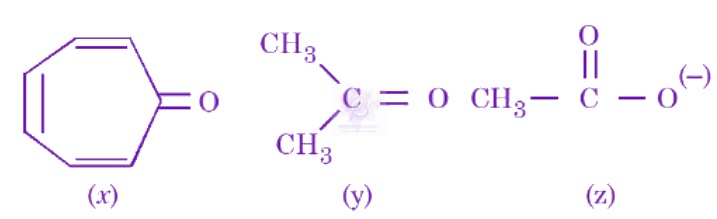 $(x)$ tropone, $(y)$ acetone, $(z)$ acetate ion The correct order of carbon – oxygen double bond length is:
From the following, how many compounds contain at least one secondary alcohol? 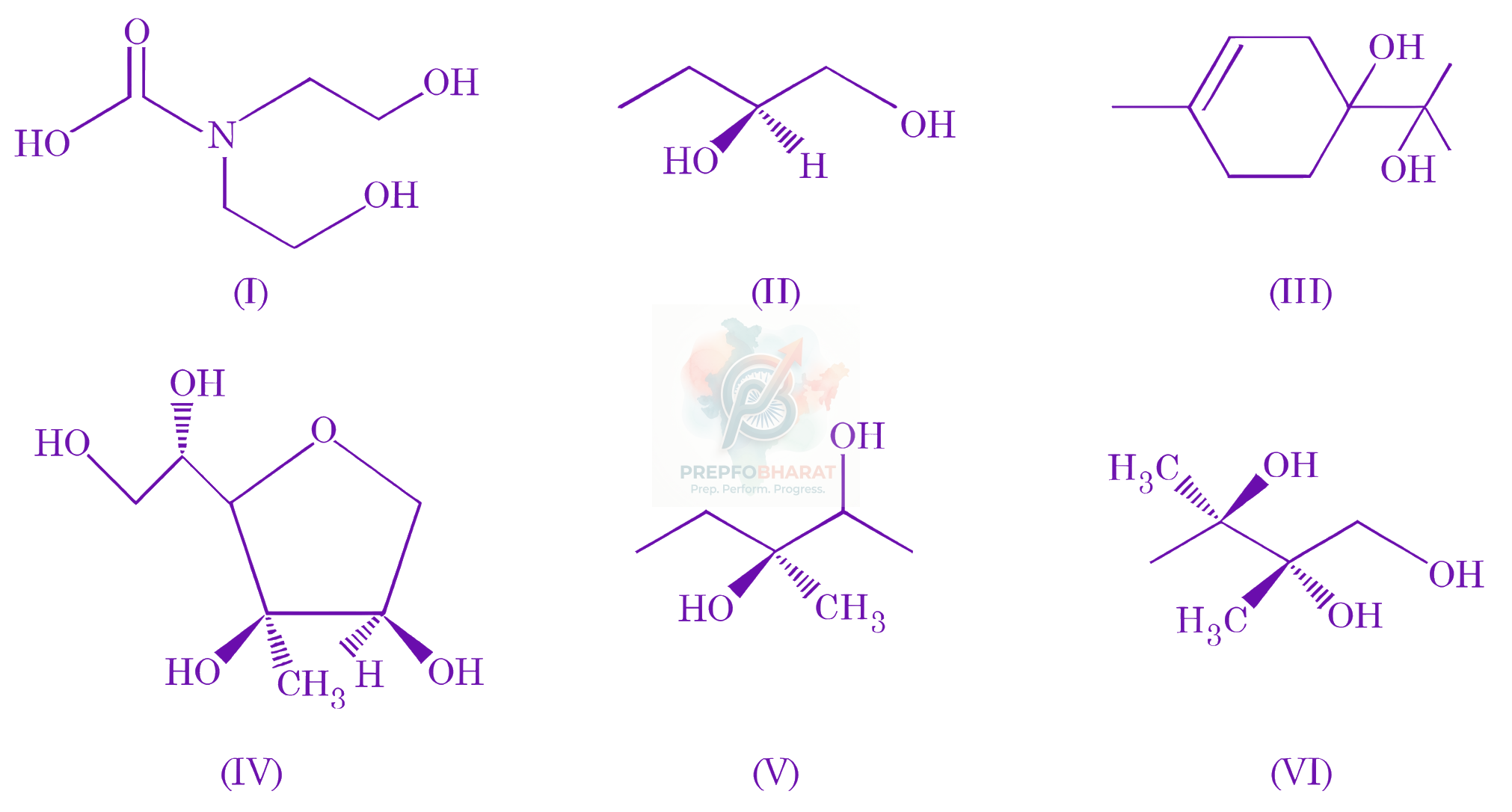 Choose the correct answer from the options given below:
Complete combustion of $X$ g of an organic compound gave $0.25$ g of $CO_2$ and $0.12$ g of $H_2 O$. If the % of carbon is $25\%$ and of hydrogen is $4.89\%$, then $X = $ _____ $\times 10^{-3}$ g. (Nearest integer) (Molar mass of C, H and O are $12, 1$ and $16$ g mol$^{-1}$ respectively.)
3, 3-Dimethyl-2-butanol cannot be prepared by : 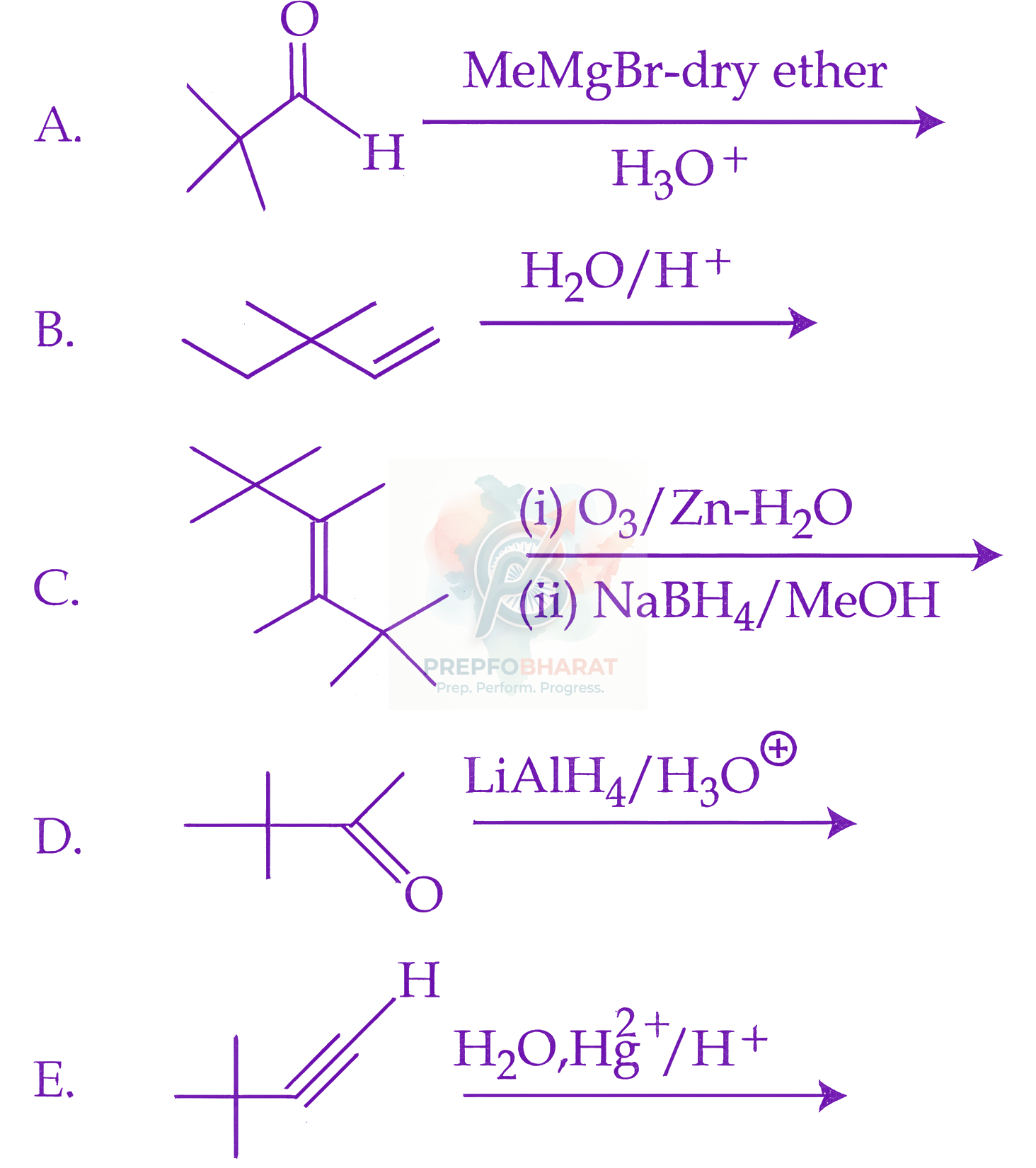 Choose the correct answer from the options given below :
Which of the following statements are TRUE about Haloform reaction?: A. Sodium hypochlorite reacts with KI to give KOI. B. KOI is a reducing agent. C. $\alpha, \beta$-unsaturated methylketone $\left(\mathrm{CH}_{3}-\mathrm{CH}=\mathrm{CH}-\stackrel{\mathrm{O}}{\mathrm{O}}-\mathrm{CH}_{3}\right)$ will give iodoform reaction. D. Isopropyl alcohol will not give iodoform test. E. Methanoic acid will give positive iodoform test. Choose the correct answer from the options given below:
$\mathrm{Ph}-\mathrm{CH}=\mathrm{CH}_{2} \xrightarrow[\mathrm{HBr}]{(\mathrm{PhCOO})_{2}}$ Product Consider the above reaction A. The reaction proceeds through a more stable radical intermediate. B. The role of peroxide is to generate $\mathrm{H}^{\circ}$ (Hydrogen radical). C. During this reaction, benzene is formed as a byproduct. D. 1-Bromo-2-phenylethane is formed as the minor product. E. The same reaction in absence of peroxide proceeds via carbocation intermediate. Identify the correct statements. Choose the correct answer from the options given below:
Sodium fusion extract of an organic compound $(\mathrm{Y})$ with $\mathrm{CHCl}_{3}$ and chlorine water gives violet color to the $\mathrm{CHCl}_{3}$ layer. 0.15 g of $(\mathrm{Y})$ gave 0.12 g of the silver halide precipitate in Carius method. Percentage of halogen in the compound $(\mathrm{Y})$ is $\_\_\_\_$. (Nearest integer) (Given : molar mass $\mathrm{g} \mathrm{mol}^{-1} \mathrm{C}: 12, \mathrm{H}: 1, \mathrm{Cl}: 35.5, \mathrm{Br}: 80, \mathrm{I}: 127$)
Which of the following reaction is NOT correctly represented?
A student has planned to prepare acetanilide from aniline using acetic anhydride. The student has started from 9.3 g of aniline. However, the student has managed to obtain 11 g of dry acetanilide. The % yield of this reaction is :-
Benzyl isocyanide can be obtained from 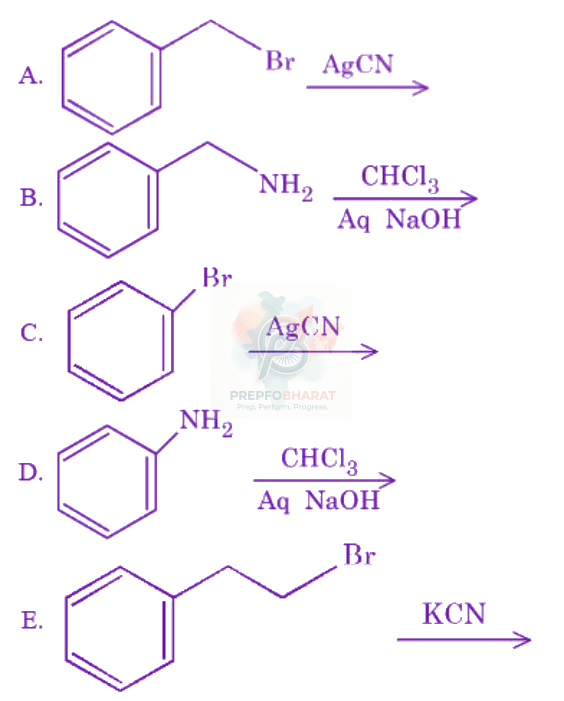 Choose the correct answer from the options given below:
Which of the following amino acid will give violet coloured complex with neutral ferric chloride solution?