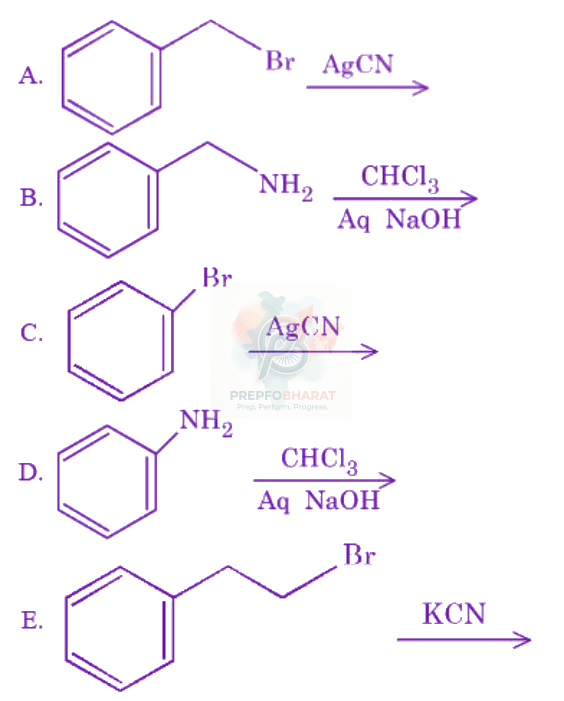
Reaction A: C6H5CH2Br+AgCN→C6H5CH2NC+AgBr
AgCN is predominantly covalent, so the nucleophilic attack occurs through the nitrogen atom, forming benzyl isocyanide.
Reaction B: C6H5CH2NH2+CHCl3+3NaOH→C6H5CH2NC+3NaCl+3H2O
This is the carbylamine reaction. Primary amines react with chloroform and alkali to form isocyanides. Benzyl amine gives benzyl isocyanide.
Reaction C: C6H5Br+AgCN→ No reaction
Aryl halides are generally unreactive towards nucleophilic substitution under normal conditions due to the partial double bond character of the C-Br bond.
Reaction D: C6H5NH2+CHCl3+3NaOH→C6H5NC+3NaCl+3H2O
Aniline undergoes the carbylamine reaction to form phenyl isocyanide, not benzyl isocyanide.
Reaction E: C6H5CH2CH2Br+KCN→C6H5CH2CH2CN+KBr
KCN is predominantly ionic, so the nucleophilic attack occurs through the carbon atom, forming a cyanide (nitrile) rather than an isocyanide.
Thus, benzyl isocyanide is obtained from reactions A and B only.
Answer: A and B Only