Organic Chemistry PYQ — Page 7
JEE Main Chemistry — Organic Chemistry previous year questions with solutions.
All Organic Chemistry Questions (1783)
Given below are two statements: Statement I: The structure of Maltose is given below: 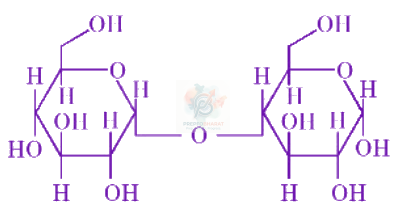 Maltose is a non-reducing sugar. Statement II: The structure of Lactose is given below: 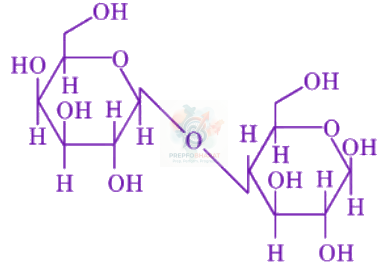 Lactose is a reducing sugar. In the light of the above statements, choose the correct answer from the options given below
An organic compound $(\mathrm{P})$ on treatment with aqueous ammonia under hot condition forms compound (Q) which on heating with $\mathrm{Br}_{2}$ and KOH forms compound (R) having molecular formula $\mathrm{C}_{6} \mathrm{H}_{7} \mathrm{~N}$. Names of P, Q and R respectively are.
Given below are two statements : Statement I : A mixture of C$_{12}$H$_{22}$O$_{11}$ (sugar) and NaCl can be separated by dissolving sugar in alcohol, due to differential solubility. Statement II : Rose essence from rose petals is seperated by steam distillation due to its high volatility and insolubility in H$_2$O. In the light of the above statements, choose the correct answer from the options given below :
IUPAC name of the some alkenes are given below. Find out the correct stability order. A. 2-Methylbut-2-ene B. cis-But-2-ene C. 2,3-Dimethylbut-2-ene D. Prop-1-ene Choose the correct answer from the options given below :
The correct order of reactivity of the following benzyl halides towards reaction with KCN is : 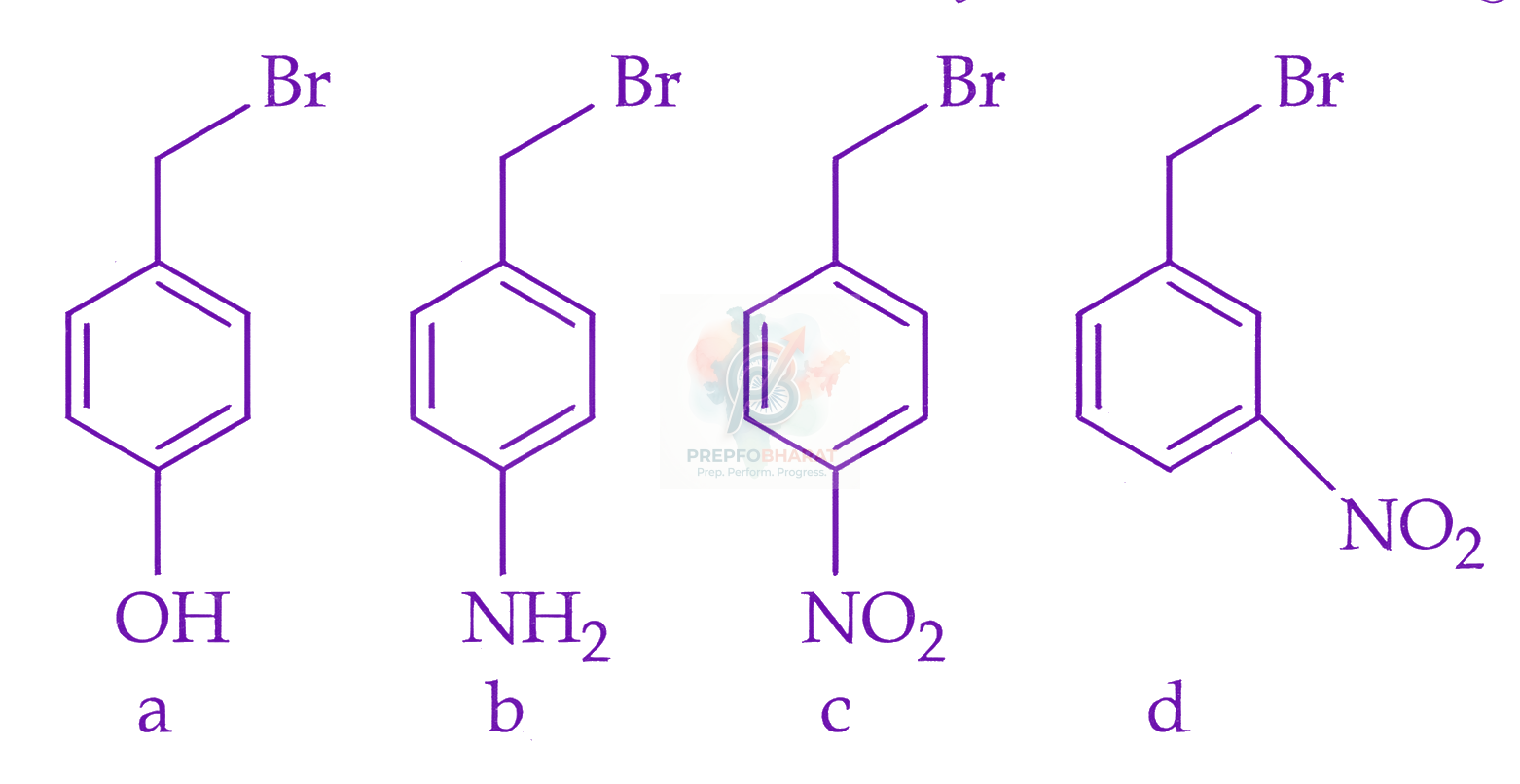
Given below are two statements : Statement I: Sublimation is used for the separation and purification of compounds with low melting point. Statement II: The boiling point of a liquid increases as the external pressure is reduced. In the light of the above statements, choose the correct answer from the options given below :
The major product of which of the following reaction is not obtained by rearrangement reaction?
"P" is a hydrocarbon of molecular formula: C$_8$H$_{14}$. On ozonolysis, "P" forms "Q". "Q" on treatment with alkali under reflux condition produces "R", which on treatment with I$_2$/NaOH gives a yellow precipitate. Acidification of the solution gives "S". The structure of "S" is given below: 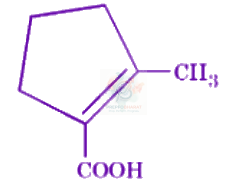 The correct structure of "P" is
Given below are two statements: Statement I: Phenol on treatment with $\mathrm{CHCl}_{3}$ /aq. KOH under refluxing condition, followed by acidification produces $p$-hydroxy benzaldehyde as the major product and $o$-hydroxy benzaldehyde as the minor product. Statement II: The mixture of $p$-hydroxybenzaldehyde and $o$ hydroxybenzaldehyde can be easily separated through steam distillation. In the light of the above statements, choose the correct answer from the options given below
Given below are two statements: Statement I: The dipole moment of R-CN is greater than R-NC and R-NC can undergo hydrolysis under acidic medium to produce 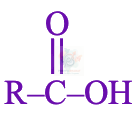. Statement II: R-CN hydrolyses under acidic medium to produce a compound which on treatment with $\mathrm{SOCl}_{2}$, followed by the addition of $\mathrm{NH}_{3}$ gives another compound $(\mathrm{x})$. This compound $(\mathrm{x})$ on treatment with $\mathrm{NaOCl} / \mathrm{NaOH}$ gives a product, that on treatment with $\mathrm{CHCl}_{3} / \mathrm{KOH} / \Delta$ produces R-NC. In the light of the above statements, choose the correct answer from the options given below
The correct stability order of the following diazonium salts is 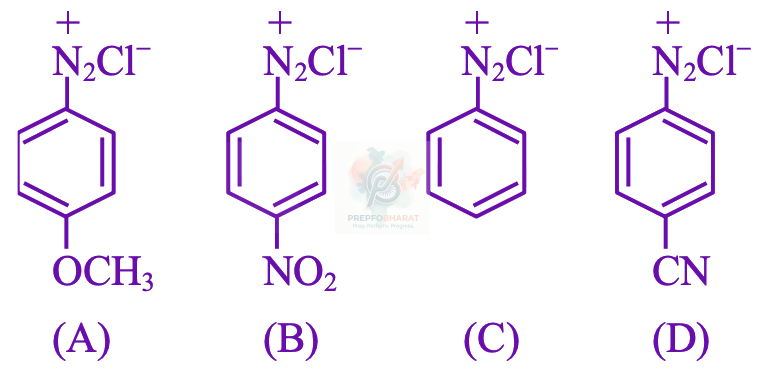
Grignard reagent $\mathrm{RMgBr}(\mathrm{P})$ reacts with water and forms a gas (Q). One gram of Q occupies $1.4 \mathrm{dm}^{3}$ at STP. (P) on reaction with dry ice in dry ether followed by $\mathrm{H}_{3} \mathrm{O}^{+}$forms a compound (Z). 0.1 mole of (Z) will weigh $\_\_\_\_$ g. (Nearest integer)
Identify the incorrect statement about tertiary structure of proteins.
Which statements are True? A. In Hoffmann bromamide degradation, $4$ moles of NaOH and $2$ moles of Br$_2$ are consumed per mole of an amide B. Hoffmann bromamide reaction is not given by alkyl amides. C. Primary amines can be synthesized by Hoffmann bromamide degradation. D. Secondary amide on reaction with Br$_2$ and NaOH will give secondary amine. E. The by-products of Hoffmann degradation are Na$_2$CO$_3$, NaBr and H$_2$O. Choose the correct answer from the options given below:
Consider the following reaction of benzene. 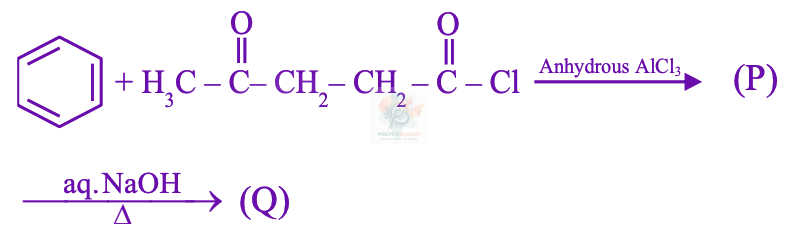 In compound (Q), the percentage of oxygen is $\_\_\_\_$ %. (Nearest integer)
Match List - I with List - II. $\begin{array}{l} \text{List - I} & \text{List - II} \\ \text{Reagents} & \text{Reaction Name (Involving aldehydes)} \\ \text{A. } \mathrm{H}_{2}, \mathrm{Pd}-\mathrm{BaSO}_{4} & \text{I. Etard Reaction} \\ \text{B. } \mathrm{SnCl}_{2}, \mathrm{HCl} & \text{II. Rosenmund Reduction} \\ \text{C. } \mathrm{CrO}_{2} \mathrm{Cl}_{2}, \mathrm{CS}_{2} & \text{III. Gatterman - Koch Reaction} \\ \text{D. } \mathrm{CO}, \mathrm{HCl}, \text{ Anhyd. } \mathrm{AlCl}_{3} & \text{IV. Stephen Reaction} \end{array}$ Choose the correct answer from the options given below :
Correct statements regarding alkyl halides $(R - X)$ among the following are: A. Alcohol being less polar solvent as compared to water, alcoholic KOH favours elimination reaction with $R - X$. B. Order of reactivity towards $S_N^1$ mechanism is $C_6 H_5 - CH_2 - Cl > C_6 H_5 - CHCl - C_6 H_5$. C. Non substituted aryl halides exhibit properties similar to alkyl halides. D. Vinyl chloride is an example of haloalkene and allyl chloride is an example of haloalkyne. E. $R - Cl$ can be prepared by reacting $R - OH$ with $SOCl_2$ but $Ar - Cl$ cannot be prepared by reacting $Ar - OH$ with $SOCl_2$. Choose the correct answer from the options given below:
Consider the isomers of hydrocarbon with molecular formula $C_5H_{10}$. These isomers do not decolourise $KMnO_4$ solution. These isomers are subjected to chlorination with chlorine in presence of light to give monochloro compounds. The total number of monochloro compounds (structural isomers only) formed is _______.
n-Butane on monochlorination under photochemical condition gives an optically active compound "P". "P" on further chlorination gives dichloro compounds. The number of dichloro compounds obtained (ignore stereoisomers) is:
The cyclic cations having the same number of hyperconjugation are : 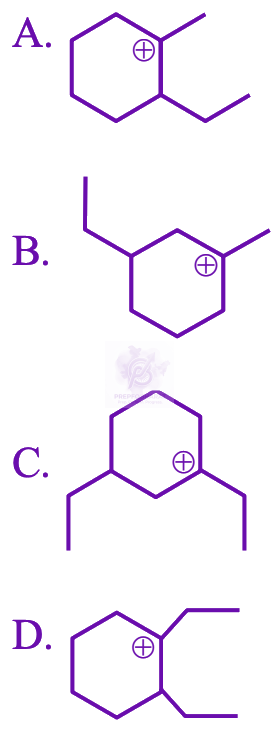 Choose the correct answer from the options given below :
Arrange the following compounds according to increasing order of boiling points. $n\text{-}\text{C}_4\text{H}_9\text{OH}$ (A), $n\text{-}\text{C}_4\text{H}_9\text{NH}_2$ (B), $n\text{-}\text{C}_4\text{H}_{10}$ (C) and $\text{C}_2\text{H}_5\text{NHC}_2\text{H}_5$ (D).
Given below are four compounds : (a) n-propyl chloride (b) iso-propyl chloride (c) sec-butyl chloride (d) neo-pentyl chloride Percentage of carbon in the one which exhibits optical isomerism is :
Method used for separation of mixture of products (B and C) obtained in the following reaction is 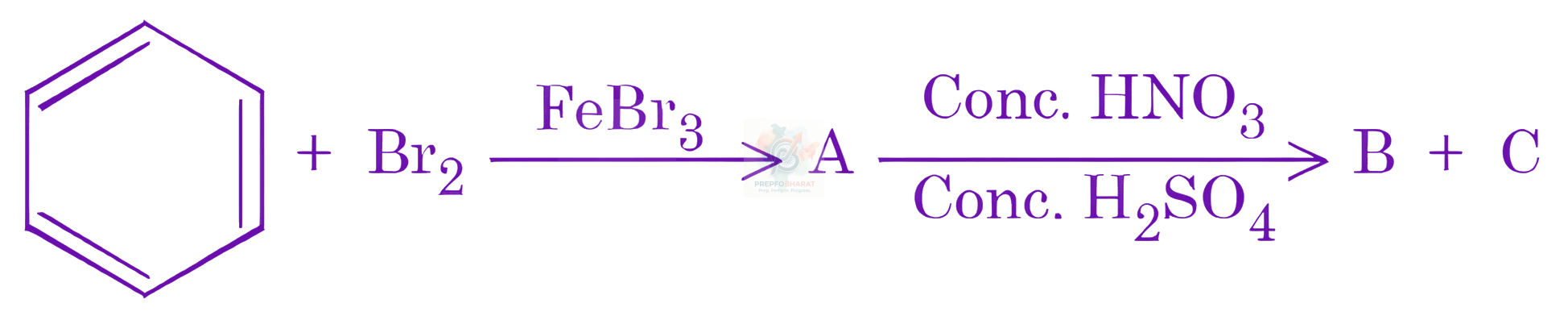
Structures of four disaccharides are given below. Among the given disaccharides, the non-reducing sugar is :