Organic Chemistry PYQ — Page 8
JEE Main Chemistry — Organic Chemistry previous year questions with solutions.
All Organic Chemistry Questions (1783)
The strongest conjugate acid will result from:
Arrange the following carbanions in the decreasing order of stability. 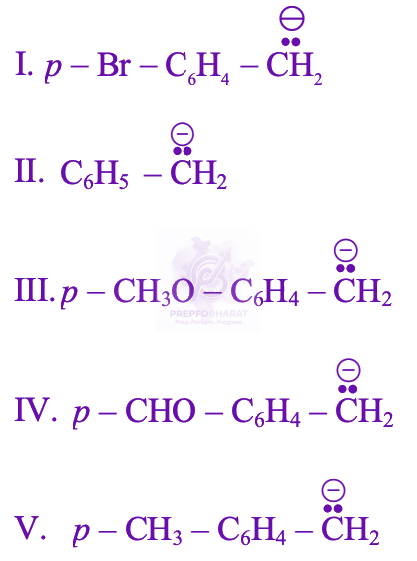 Choose the correct answer from the options given below:
Shown below is the structure of methyl acetate with three different $\alpha$, $\beta$ and $\gamma$ carbon - oxygen bonds. 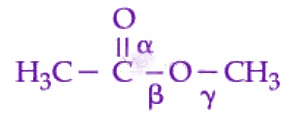 The correct order of bond lengths of these bonds is :
From the following, the least stable structure is:
Identify correct statements from the following : A. Propanal and propanone are functional isomers. B. Ethoxyethane and methoxypropane are metamers. C. But-2-ene shows optical isomerism. D. But-1-ene and but-2-ene are functional isomers. E. Pentane and 2, 2-dimethyl propane are chain isomers. Choose the correct answer from the options given below :
For the given molecule, "$x$", the preferred site for the attack of the electrophile is : 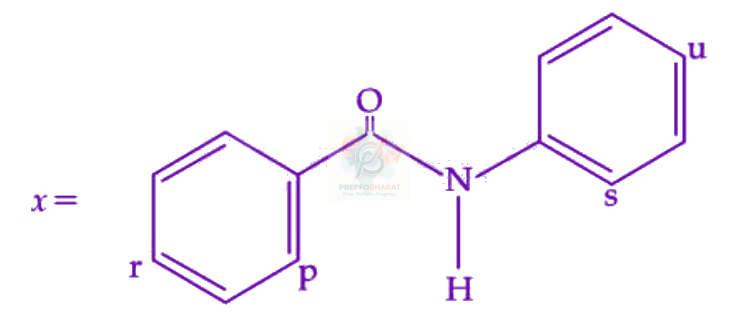
Consider the following reactions. Total number of electrons in the $\pi$ bonds and lone pair of electrons in the product $(X)$ is : 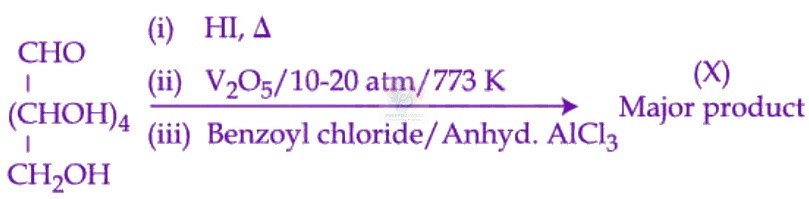
Total number of alkali insoluble solid sulphonamides obtained by reaction of given amines with Hinsberg's reagent is $\_\_\_\_$. Aniline, N-Methylaniline, Methanamine, N, N-Dimethylmethanamine, N-Methyl methanamine, Phenylmethanamine, N-propylaniline, N-phenylaniline, N, N-Dimethylaniline, Allyl amine, Isopropyl amine
A hydrocarbon ' $\mathrm{P}^{\prime}\left(\mathrm{C}_{4} \mathrm{H}_{8}\right)$ on reaction with HCl gives an optically active compound ' Q ' $\left(\mathrm{C}_{4} \mathrm{H}_{9} \mathrm{Cl}\right)$ which on reaction with one mole of ammonia gives compound ' $\mathrm{R}^{\prime}\left(\mathrm{C}_{4} \mathrm{H}_{11} \mathrm{~N}\right)$. ' $\mathrm{R}^{\prime}$ on diazotization followed by hydrolysis gives ' S '. Identify $\mathrm{P}, \mathrm{Q}, \mathrm{R}$ and S.
 The final product $[\mathrm{B}]$ is :
Which among the following react with Hinsberg's reagent? 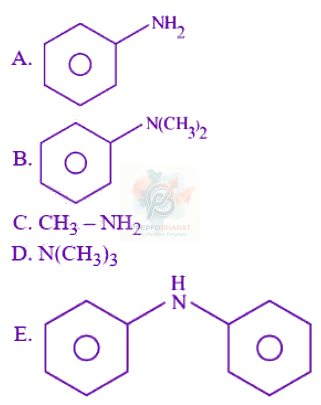 Choose the correct answer from the options given below:
In Dumas' method for estimation of nitrogen 0.4 g of an organic compound gave 60 mL of nitrogen collected at 300 K temperature and 715 mm Hg pressure. The percentage composition of nitrogen in the compound is (Given : Aqueous tension at $300 \mathrm{~K}=15 \mathrm{~mm} \mathrm{Hg}$)
Given below are two statements: Statement I: Fructose does not contain an aldehydic group but still reduces Tollen's reagent Statement II: In the presence of base, fructose undergoes rearrangement to give glucose. In the light of the above statements, choose the correct answer from the options given below
The ascending order of relative rate of solvolysis of following compounds is : 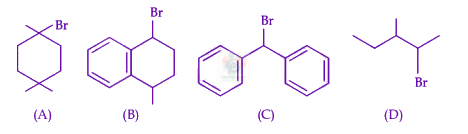
Given below are two statements : Statement I : Dimethyl ether is completely soluble in water. However, diethyl ether is soluble in water to a very small extent.Statement II : Sodium metal can be used to dry diethyl ether and not ethyl alcohol. In the light of given statements, choose the correct answer from the options given below
Which of the following amine (s) show (s) positive carbylamines test? (A) 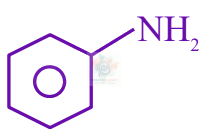 (B) $\left(\mathrm{CH}_3\right)_2 \mathrm{NH}$ (C) $\mathrm{CH}_3 \mathrm{NH}_2$ (D) $\left(\mathrm{CH}_3\right)_3 \mathrm{~N}$ (E)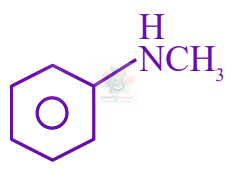
The most stable carbocation from the following is :
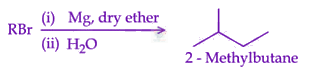 The maximum number of RBr producing 2-methylbutane by above sequence of reactions is ________ - (Consider the structural isomers only)
Given below are two statements : 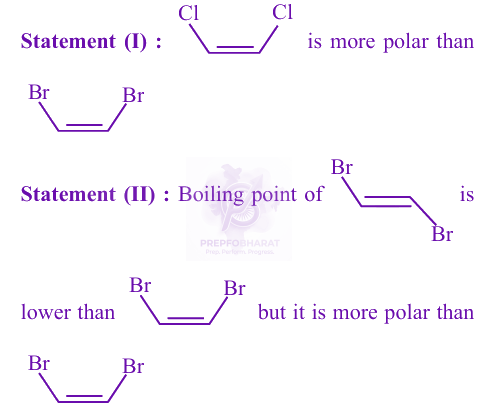 In the light of the above statements, choose the most appropriate answer from the options given below :
An optically active alkyl halide \(\mathrm{C}_4 \mathrm{H}_9 \mathrm{Br}\) [A] reacts with hot KOH dissolved in ethanol and forms alkene [B] as major product which reacts with bromine to give dibromide [C]. The compound [C] is converted into a gas [D] upon reacting with alcoholic \(\mathrm{NaNH}_2\). During hydration 18 gram of water is added to 1 mole of gas [D] on warming with mercuric sulphate and dilute acid at 333 K to form compound [E]. The IUPAC name of compound \([\mathrm{E}]\) is :
Which one of the following reaction sequences will give an azo dye?
During " S " estimation, 160 mg of an organic compound gives 466 mg of barium sulphate. The percentage of Sulphur in the given compound is _______ %. (Given molar mass in $\mathrm{g} \mathrm{mol}^{-1}$ of $\mathrm{Ba}: 137, \mathrm{~S}: 32, \overline{\mathrm{O}: 16}$ )
Identify $[\mathrm{A}],[\mathrm{B}]$, and $[\mathrm{C}]$, respectively in the following reaction sequence : 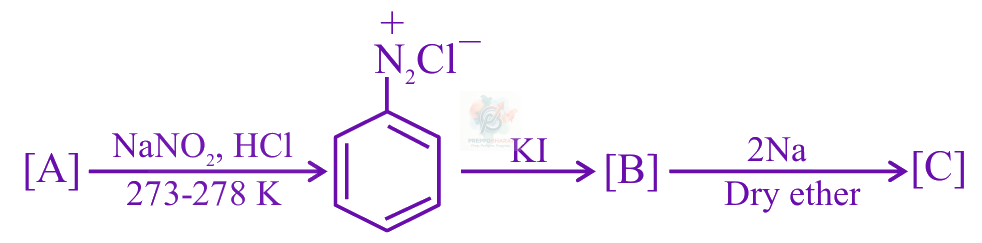
X g of nitrobenzene on nitration gave 4.2 g of m-dinitrobenzene. $\mathrm{X}=$______ g. (nearest integer) [Given : molar mass (in $\mathrm{g} \mathrm{mol}^{-1}$) $\mathrm{C}: 12, \mathrm{H}: 1$, $\mathrm{O}: 16, \mathrm{~N}: 14]$