Organic Chemistry PYQ — Page 9
JEE Main Chemistry — Organic Chemistry previous year questions with solutions.
All Organic Chemistry Questions (1783)
Identify the number of structure/s from the following which can be correlated to D-glyceraldehyde. 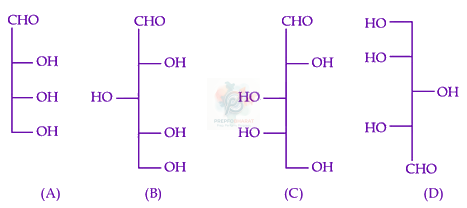
Which one of the following, with HBr will give a phenol?
How many different stereoisomers are possible for the given molecule? 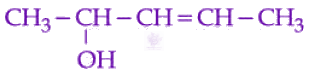
Given below are two statements: Statement I: The conversion proceeds well in the less polar medium. $\mathrm{CH}_3-\mathrm{CH}_2-\mathrm{CH}_2-\mathrm{CH}_2-\mathrm{Cl} \xrightarrow{\mathrm{HO}^{-}} \mathrm{CH}_3-\mathrm{CH}_2-\mathrm{CH}_2-\mathrm{CH}_2-\mathrm{OH}+\mathrm{Cl}^{(-)}$ Statement II: The conversion proceeds well in the more polar medium.  In the light of the above statements, choose the correct answer from the options given below
In Dumas' method for estimation of nitrogen 1 g of an organic compound gave 150 mL of nitrogen collected at 300 K temperature and 900 mm Hg pressure. The percentage composition of nitrogen in the compound is _____ $\%$ (nearest integer). (Aqueous tension at $300 \mathrm{~K}=15 \mathrm{~mm} \mathrm{Hg}$)
Consider the following compound (X)  The most stable and least stable carbon radicals, respectively, produced by homolytic cleavage of corresponding \(\mathrm{C}-\mathrm{H}\) bond are :
In the following substitution reaction: 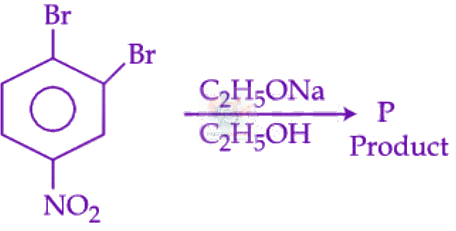 product \({ }^{\prime} \mathrm{P}^{\prime}\) formed is :
Given below are two statements : Statement I : One mole of propyne reacts with excess of sodium to liberate half a mole of $\mathrm{H}_2$ gas. Statement II : Four g of propyne reacts with $\mathrm{NaNH}_2$ to liberate $\mathrm{NH}_3$ gas which occupies 224 mL at STP. In the light of the above statements, choose the most appropriate answer from the options given below:
The total number of structural isomers possible for the substituted benzene derivatives with the molecular formula $\mathrm{C}_9 \mathrm{H}_{12}$ is ______.
Identify correct statement/s : (A) $-\mathrm{OCH}_3$ and $-\mathrm{NHCOCH}_3$ are activating group. (B) -CN and -OH are meta directing group. (C) -CN and $-\mathrm{SO}_3 \mathrm{H}$ are meta directing group. (D) Activating groups act as ortho - and para directing groups. (E) Halides are activating groups. Choose the correct answer from the options given below :
Predict the major product of the following reaction sequence :- 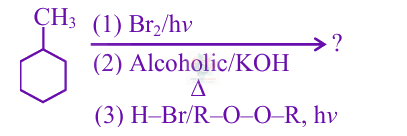
The sequence from the following that would result in giving predominantly $3,4,5$-Tribromoaniline is :
"P" is an optically active compound with molecular formula $\mathrm{C}_6 \mathrm{H}_{12} \mathrm{O}$. When " P " is treated with 2,4-dinitrophenylhydrazine, it gives a positive test. However, in presence of Tollens reagent, "P" gives a negative test. Predict the structure of "P".
Given below are two statements : Consider the following reaction 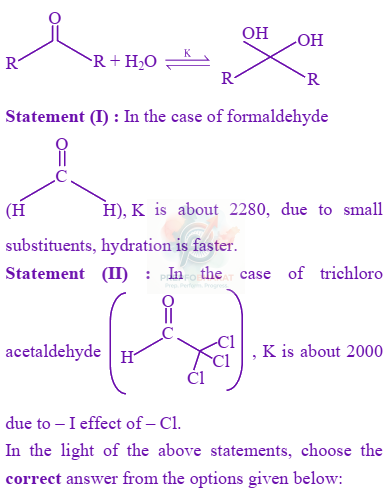
When a concentrated solution of sulphanilic acid and 1-naphthylamine is treated with nitrous acid ( 273 K) and acidified with acetic acid, the mass ( g) of 0.1 mole of product formed is : (Given molar mass in $\mathrm{g} \mathrm{mol}^{-1} \mathrm{H}: 1, \mathrm{C}: 12, \mathrm{~N}: 14$, $\mathrm{O}: 16, \mathrm{~S}: 32)$
Which among the following compounds give yellow solid when reacted with $\mathrm{NaOI} / \mathrm{NaOH}$ ? 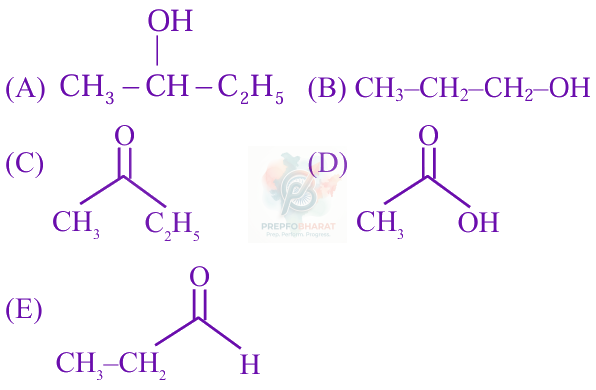 Choose the correct answer from the options given below :
Given below are two statements : Statement (I): In partition chromatography, stationary phase is thin film of liquid present in the inert support. Statement (II) : In paper chromatography, the material of paper acts as a stationary phase. In the light of the above statements, choose the correct answer from the options given below :
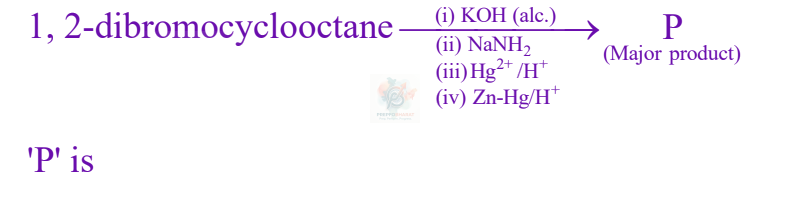
The steam volatile compounds among the following are : (A) 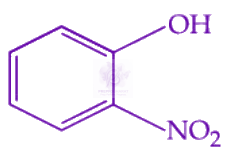 (B)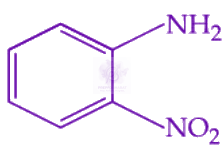 (C)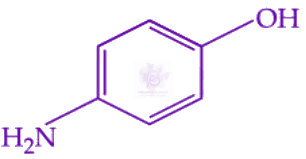 (D)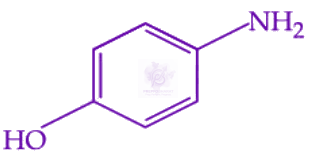 Choose the correct answer from the options given below :
Match List - I with List - II. \(\begin{array}{ll|ll} & \begin{array}{l} \text { List - I } \\ \text { (Carbohydrate) } \end{array} & \begin{array}{l} \text { List - II } \\ \text { (Linkage Source) } \end{array} \\ \hline \text { (A) } & \text { Amylose } & \text { (I) } \beta-C_1-C_4 \text {, plant } \\ \text { (B) } & \text { Cellulose } & \text { (II) } \alpha-C_1-C_4, \text { animal } \\ \text { (C) } & \text { Glycogen } & \text { (III) } \alpha-C_1-C_4, \alpha-C_1-C_6, \text { plant } \\ \text { (D) } & \text{ Amylopectin } & \text { (IV) } \alpha-C_1-C_4, \text { plant } \end{array}\) Choose the correct answer from the options given below :
Match the LIST-I with LIST-II $\begin{array}{|l|l|l|l|}\hline & \text{LIST-I} & & \text{LIST-II} \\ \hline \text{A.} & \text{Carbocation} & \text{I.} & \begin{array}{l} \text{Species that can} \\ \text{supply a pair of} \\ \text{electrons.} \end{array} \\ \hline \text{B.} & \begin{array}{l} \text{C-Free} \\ \text{radical} \end{array} & \text{II.} & \begin{array}{l} \text{Species that can} \\ \text{receive a pair of} \\ \text{electrons.} \end{array} \\ \hline \text{C.} & \text{Nucleophile} & \text{III.} & \begin{array}{l} sp ^2 \text{ hybridized} \\ \text{carbon with empty} \\ \text{p-orbital.} \end{array} \\ \hline \text{D.} & \text{Electrophile} & \text{IV.} & \begin{array}{l} sp ^2 / sp ^3 \text{ hybridized} \\ \text{carbon with one} \\ \text{unpaired electron.} \end{array} \\ \hline \end{array}$ Choose the correct answer from the options given below :
Which among the following halides will generate the most stable carbocation in the nucleophilic substitution reaction?
Which of the following acids is a vitamin?