Organic Chemistry PYQ — Page 10
JEE Main Chemistry — Organic Chemistry previous year questions with solutions.
All Organic Chemistry Questions (1783)
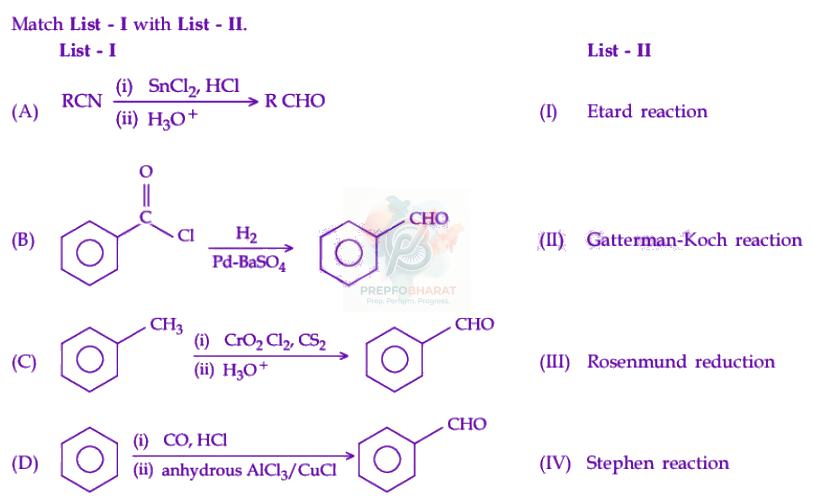
Match List-I with List-II 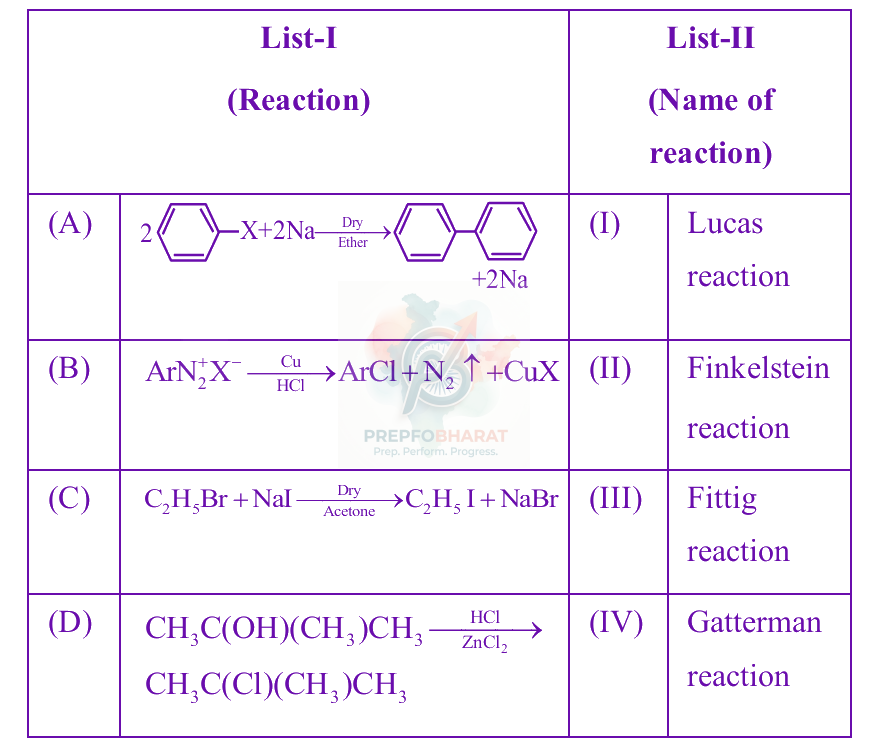 Choose the correct answer from the options given below :
When sec-butylcyclohexane reacts with bromine in the presence of sunlight, the major product is :
The compound with molecular formula $\mathrm{C}_6 \mathrm{H}_6$, which gives only one monobromo derivative and takes up four moles of hydrogen per mole for complete hydrogenation has ________ $=$ electrons.
Given below are two statements : Statement (I) : On hydrolysis, oligo peptides give rise to fewer number of $\alpha$-amino acids while proteins give rise to a large number of $\beta$-amino acids. Statement (II) : Natural proteins are denatured by acids which convert the water soluble form of fibrous proteins to their water insoluble form. In the light of the above statements, choose the most appropriate answer from the options given below :
Match the LIST-I with LIST-II $\begin{array}{|l|l|l|l|} \hline & \begin{array}{l} \text{LIST-I} \\ \text{(Reagent)} \end{array} & & \begin{array}{c} \text{LIST-II} \\ \text{(Functional Group} \\ \text{detected)} \end{array} \\ \hline \text{A.} & \begin{array}{l} \text{Sodium} \\ \text{bicarbonate} \\ \text{solution} \end{array} & \text{I.} & \begin{array}{l} \text{double} \\ \text{bond/unsaturation} \end{array} \\ \hline \text{B.} & \begin{array}{l} \text{Neutral ferric} \\ \text{chloride} \end{array} & \text{II.} & \text{carboxylic acid} \\ \hline \text{C.} & \begin{array}{l} \text{ceric} \\ \text{ammonium} \\ \text{nitrate} \end{array} & \text{III.} & \text{phenolic - OH} \\ \hline \text{D.} & \begin{array}{l} \text{alkaline} \\ \text{KMnO} \end{array} & \text{IV.} & \text{alcoholic - OH} \\ \hline \end{array}$ Choose the correct answer from the options given below :
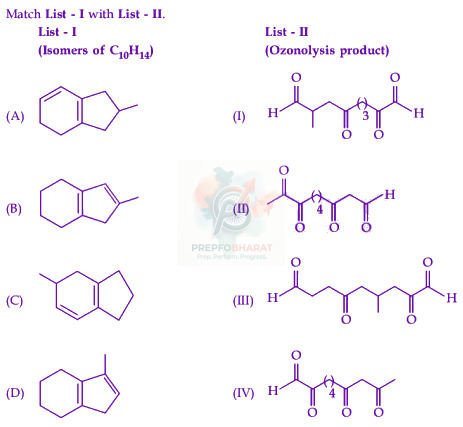 Choose the correct answer from the options given below :
The $\alpha$-Helix and $\beta$ - Pleated sheet structures of protein are associated with its :
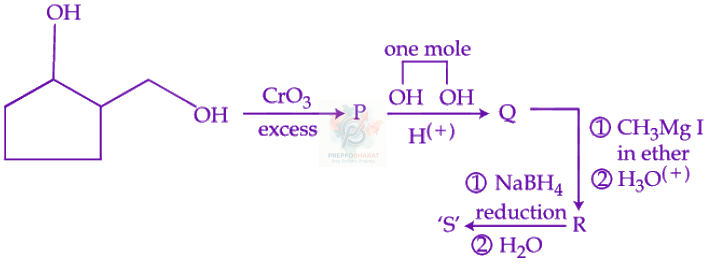 0.1 mole of compound ' S ' will weigh _______ g. (Given molar mass in \(\mathrm{g} \mathrm{mol}^{-1} \mathrm{C}: 12, \mathrm{H}: 1, \mathrm{O}: 16\))
Both acetaldehyde and acetone (individually) undergo which of the following reactions? A. Iodoform Reaction B. Cannizaro Reaction C. Aldol Condensation D. Tollen's Test E. Clemmensen Reduction Choose the correct answer from the options given below:
The major product of the following reaction is: $\mathrm{CH}_3 \mathrm{CH}_2 \mathrm{CH}=\mathrm{O} \xrightarrow[\text { reflux }]{\substack{\text { excess } \mathrm{HCHO} \\ \text { alkali }}}$ ?
Consider the following molecule (X). The structure of X is 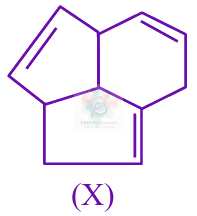
Given below are two statements : Statement (I) : Nitrogen, sulphur, halogen and phosphorus present in an organic compound are detected by Lassaigne's Test. Statement (II) : The elements present in the compound are converted from covalent form into ionic form by fusing the compound with Magnesium in Lassaigne's test. In the light of the above statements, choose the correct anower from the options given below :
Given below are two statements : Statement (I) : The boiling points of alcohols and phenols increase with increase in the number of C-atoms. Statement (II) : The boiling points of alcohols and phenols are higher in comparison to other class of compounds such as ethers, haloalkanes. In the light of the above statements, choose the correct answer from the options given below :
In the following reactions, which one is NOT correct?
The compounds which give positive Fehling's test are : (A)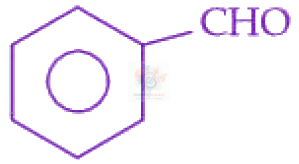 (B)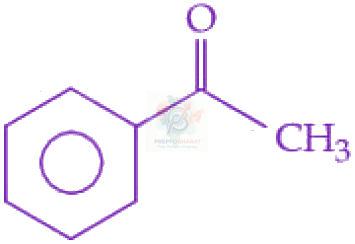 (C)$\mathrm{HOCH}_2-\mathrm{CO}-(\mathrm{CHOH})_3-\mathrm{CH}_2-\mathrm{OH}$ (D)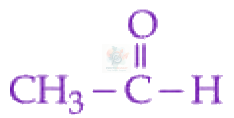 (E)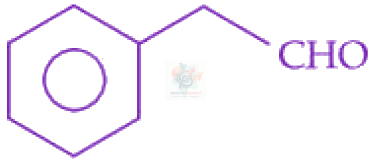 Choose the correct answer from the options given below :
Identify the structure of the final product (D) in the following sequence of the reactions : 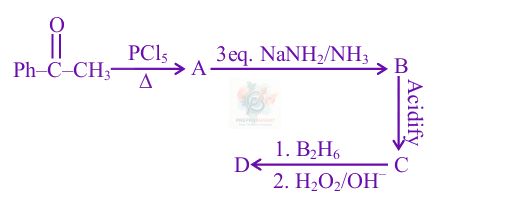 Total number of $\mathrm{sp}^2$ hybridised carbon atoms in product D is.
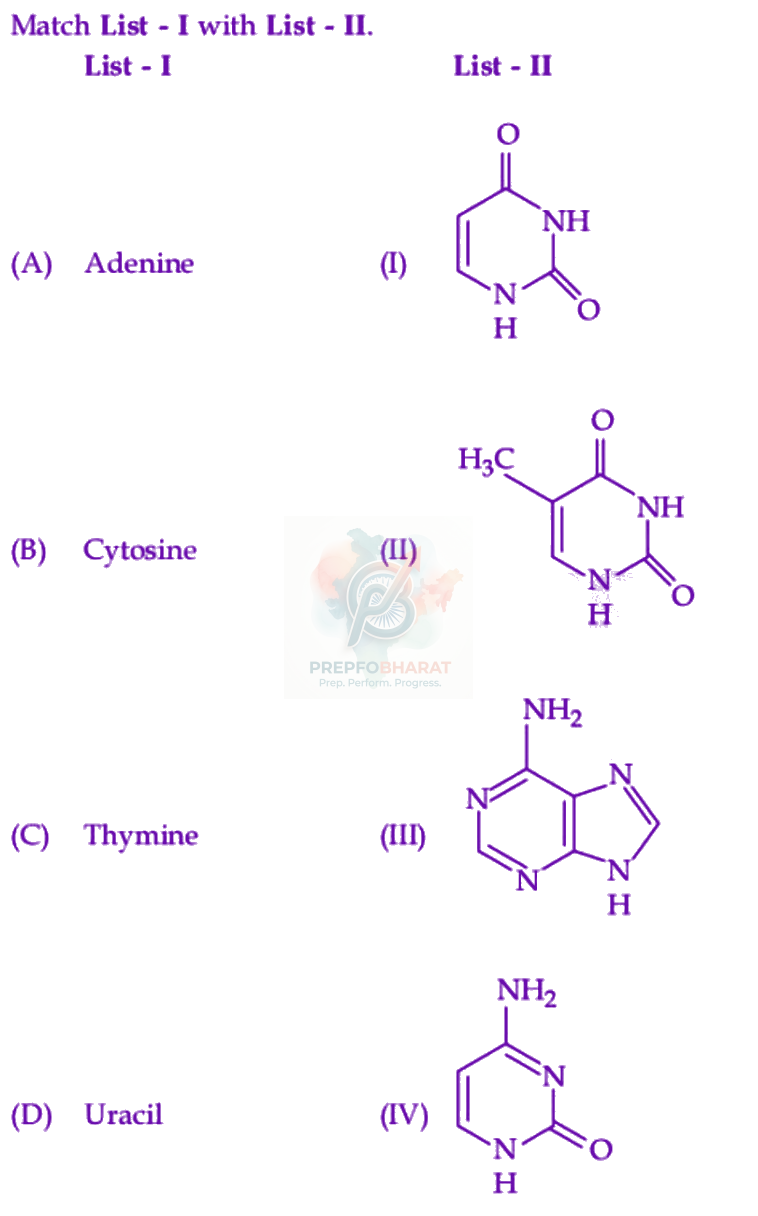 Choose the correct answer from the options given below :
The product $B$ formed in the following reaction sequence is : 
Match List-I with List-II 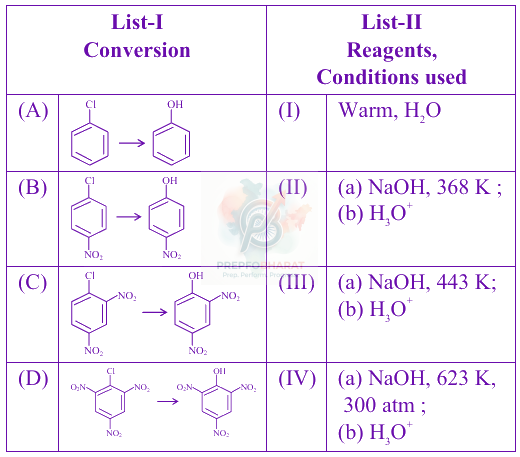 Choose the correct answer from the options given below :
Propane molecule on chlorination under photochemical condition gives two di-chloro products, " x " and " y ". Amongst " x " and " y ", " x " is an optically active molecule. How many tri-chloro products (consider only structural isomers) will be obtained from " x " when it is further treated with chlorine under the photochemical condition?
The possible number of stereoisomers for 5-phenylpent-4-en-2-ol is $\ldots\ldots$
 Choose the correct answer from the options given below :
The least acidic compund, among the following is : 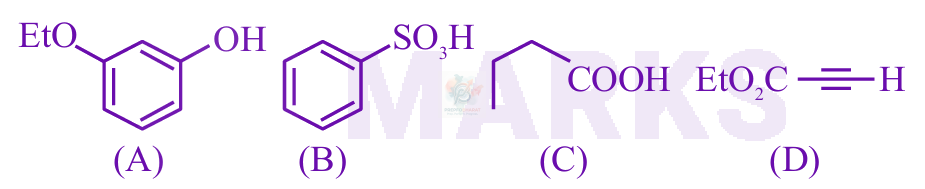
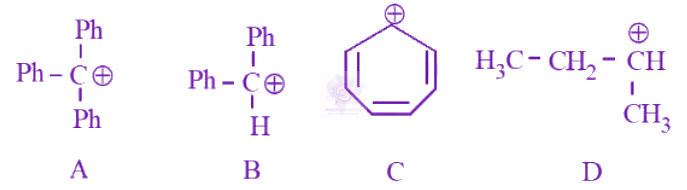
The correct order of stability of following carbocations is :