Organic Chemistry PYQ — Page 11
JEE Main Chemistry — Organic Chemistry previous year questions with solutions.
All Organic Chemistry Questions (1783)
Given below are two statements : Statement (I) :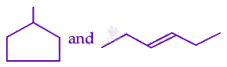 are isomeric compounds.Statement (II) : are functional group isomers.
Consider the following sequence of reactions: 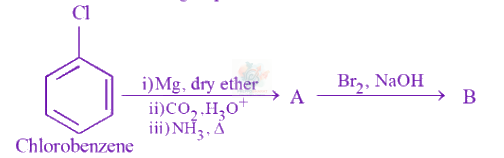 11.25 mg of chlorobenzene will produce __________ $\times 10^{-1} \mathrm{mg}$ of product B . (Consider the reactions result in complete conversion.) [Given molar mass of $\mathrm{C}, \mathrm{H}, \mathrm{O}, \mathrm{N}$ and Cl as $12,1,16,14$ and $35.5 \mathrm{~g} \mathrm{~mol}^{-1}$ respectively]
The correct order of basic nature on aqueous solution for the bases \(\mathrm{NH}_3, \mathrm{H}_2 \mathrm{~N}-\mathrm{NH}_2, \mathrm{CH}_3 \mathrm{CH}_2 \mathrm{NH}_2\), \(\left(\mathrm{CH}_3 \mathrm{CH}_2\right)_2 \mathrm{NH}\) and \(\left(\mathrm{CH}_3 \mathrm{CH}_2\right)_3 \mathrm{~N}\) is :
Match List-I with List-II 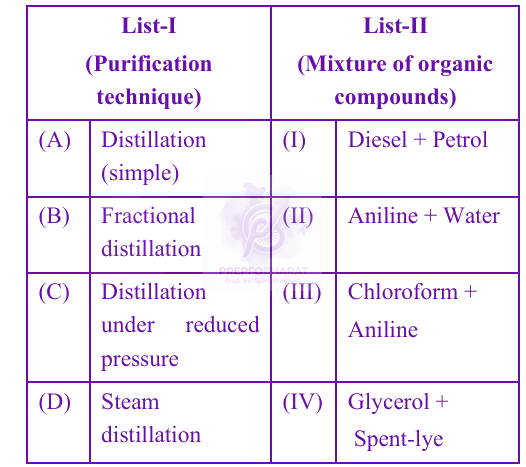 Choose the correct answer from the options given below :
In Carius method for estimation of halogens, 180 mg of an organic compound produced 143.5 mg of AgCl . The percentage composition of chlorine in the compound is _______ \%. (Given : molar mass in $\mathrm{g} \mathrm{mol}^{-1}$ of $\mathrm{Ag}: 108, \mathrm{Cl}: 35.5$ )
Identify correct statements : (A) Primary amines do not give diazonium salts when treated with $\mathrm{NaNO}_2$ in acidic condition. (B) Aliphatic and aromatic primary amines on heating with $\mathrm{CHCl}_3$ and ethanolic KOH form carbylamines. (C) Secondary and tertiary amines also give carbylamine test. (D) Benzenesulfonyl chloride is known as Hinsberg's reagent. (E) Tertiary amines reacts with benzenesulfonyl chloride very easily. Choose the correct answer from the options given below :
Which of the following compounds is least likely to give effervescence of $\mathrm{CO}_2$ in presence of aq. $\mathrm{NaHCO}_3$ ?
Match the LIST-I with LIST-II 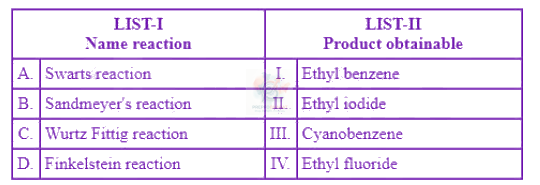 Choose the correct answer from the options given below:
Consider the following reactions. From these reactions which reaction will give carboxylic acid as a major product ? (A) $\mathrm{R}-\mathrm{C} \equiv \mathrm{N} \xrightarrow[\text { mild condition }]{\text { (i) } \mathrm{H}^{+} / \mathrm{H}_2 \mathrm{O}}$ (B) $\mathrm{R}-\mathrm{MgX} \xrightarrow[\text { (ii) } \mathrm{H}_3 \mathrm{O}^{+}]{\text {(i) } \mathrm{CO}_2}$ (C) $\mathrm{R}-\mathrm{C} \equiv \mathrm{N} \xrightarrow[\text { (ii) } \mathrm{H}_3 \mathrm{O}^{+}]{\text {(i) } \mathrm{SnCl}_2 / \mathrm{HCl}}$ (D) $\mathrm{R} \cdot \mathrm{CH}_2 \cdot \mathrm{OH} \xrightarrow{\mathrm{PCC}}$ (E)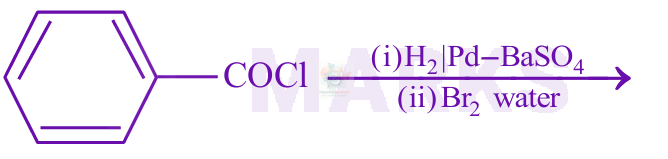 Choose the correct answer from the options given below:
Given below are two statements : Statement (I) : Alcohols are formed when alkyl chlorides are treated with aqueous potassium hydroxide by elimination reaction. Statement (II) : In alcoholic potassium hydroxide, alkyl chlorides form alkenes by abstracting the hydrogen from the $\beta$-carbon. In the light of the above statements, choose the most appropriate answer from the options given below :
Given below are two statements: 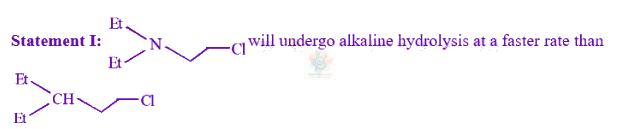  involving lone pair of electrons on nitrogen. In the light of the above statements, choose the most appropriate answer from the options given below
Given below are two statements: Statement I : D-(+)-glucose $+\mathrm{D}-(+)$ fructose $\xrightarrow{-\mathrm{H}_2 \mathrm{O}}$ sucrose Statement II : Invert sugar is formed during sucrose hydrolysis. In the light of the above statements, choose the correct answer from the options given below -
Given below are some nitrogen containing compounds 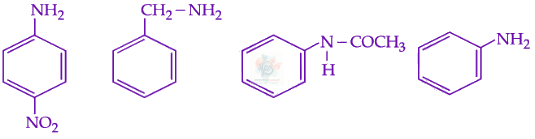 Each of them is treated with HCl separately. 1.0 g of the most basic compound will consume _______ mg of HCl. (Given molar mass in \(\mathrm{g} \mathrm{mol}^{-1} \mathrm{C}: 12, \mathrm{H}: 1, \mathrm{O}: 16, \mathrm{Cl}: 35.5\))
What amount of bromine will be required to convert 2 g of phenol into 2,4,6-tribromophenol? (Given molar mass in $\mathrm{g} \mathrm{mol}^{-1}$ of $\mathrm{C}, \mathrm{H}, \mathrm{O}, \mathrm{Br}$ are $12,1,16,80$ respectively )
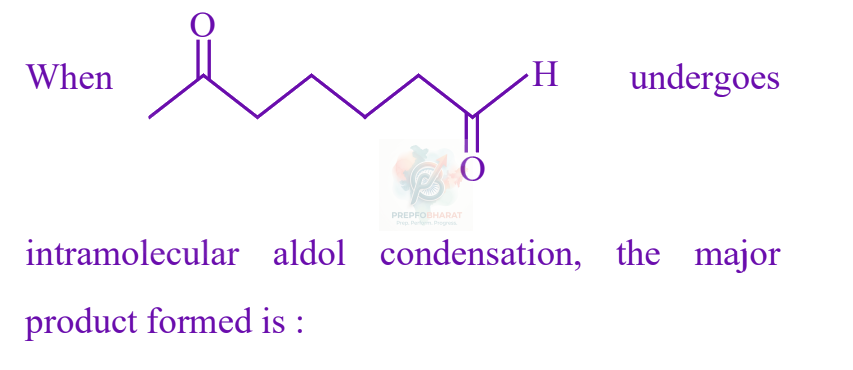
The compounds that produce $\mathrm{CO}_2$ with aqueous $\mathrm{NaHCO}_3$ solution are: A. 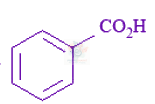 B.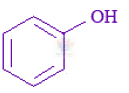 C.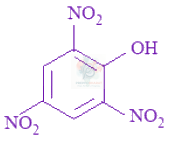 D.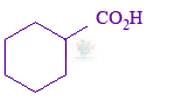 E.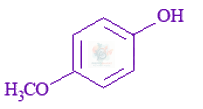 Choose the correct answer from the options given below:
Consider the following molecules : 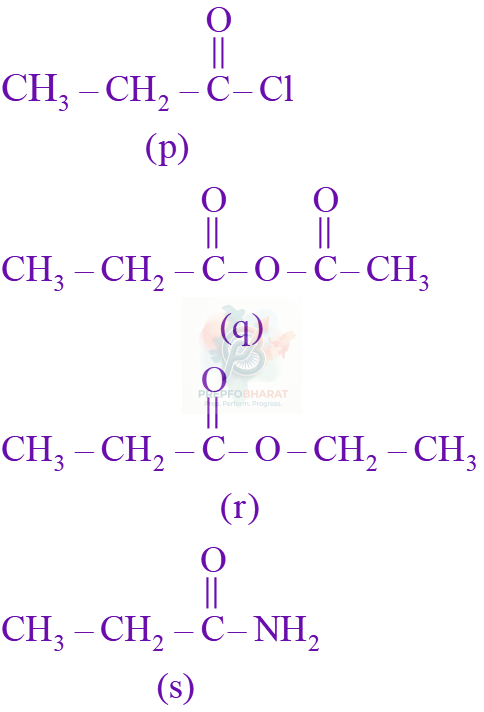 The correct order of rate of hydrolysis is :
Consider the following sequence of reactions. 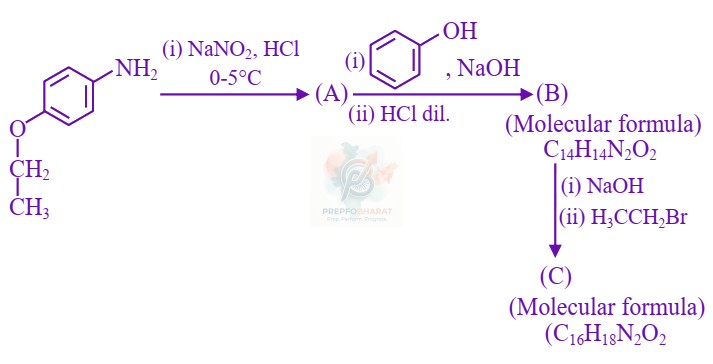 Total number of $\mathrm{sp}^3$ hybridised carbon atoms in the major product C formed is________
$\mathrm{A} \xrightarrow[\text { (ii) } \mathrm{H}_3 \mathrm{O}^{+}]{\text {(i) } \mathrm{NaOH}} \mathrm{B} \xrightarrow[\text { (ii) } \mathrm{H}_2 \mathrm{SO}_4, \Delta]{\text { (i) } \mathrm{EtOH}} \mathrm{C}$ ' A ' shows positive Lassaign's test for N and its molar mass is 121. ' B ' gives effervescence with aq. $\mathrm{NaHCO}_3$. 'C' gives fruity smell. Identify $\mathrm{A}, \mathrm{B}$ and C from the following.
A dipeptide, " $x$ " on complete hydrolysis gives " $y$ " and " $z$ ". " $y$ " on treatment with aq. $\mathrm{HNO}_2$ produces lactic acid. On the other hand " $z$ " on heating gives the following cyclic molecule. 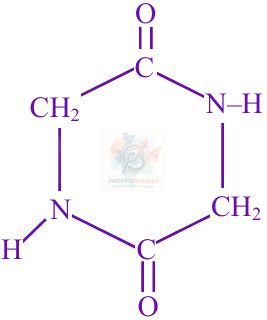 Based on the information given, the dipeptide X is:
Identify the correct statement among the following:
Given below are two statements: Statement I : D-glucose pentaacetate reacts with 2, 4-dinitrophenylhydrazine Statement II : Starch, on heating with concentrated sulfuric acid at $100^{\circ} \mathrm{C}$ and 2-3 atmosphere pressure produces glucose. In the light of the above statements, choose the correct answer from the options given below
Given below are two statements. Statement I : The dipole moment of $\stackrel{4}{\mathrm{CH}_3}-\stackrel{3~~~~}{\mathrm{CH}}=\stackrel{3~~~~}{\mathrm{CH}}-\stackrel{1~~~~}{\mathrm{CH}}=\mathrm{O}$ is greater than $\stackrel{4}{\mathrm{CH}_3}-\stackrel{3}{\mathrm{CH}_2}-\stackrel{2}{\mathrm{CH}_2}-\stackrel{1}{\mathrm{CH}}=\mathrm{O}$ Statement II : $\mathbf{C}_1-\mathbf{C}_2$ bond length of $\underset{4}{\mathrm{CH}_3-\mathrm{}} \underset{3}{\mathrm{CH=}} \underset{2}{\mathrm{CH}}-\mathrm{CH}=\mathrm{O}$ is greater than $\mathrm{C}_1-\mathrm{C}_2$ bond length of 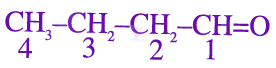 In the light of the above statements, choose the correct answer from the options given below:
Thyroxine, the hormone has given below structure 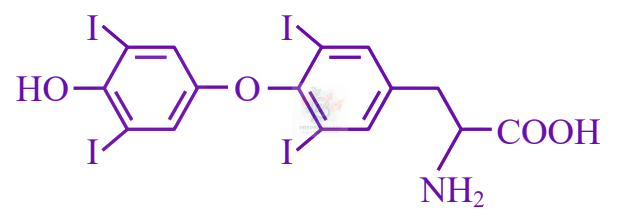 The percentage of iodine in thyroxine is ____ $\%$. (nearest integer) (Given molar mass in $\mathrm{g} \mathrm{mol}^{-1} \mathrm{C}: 12. \mathrm{H}: 1, \mathrm{O}: 16$, $\mathrm{N}: 14, \mathrm{I}: 127)$